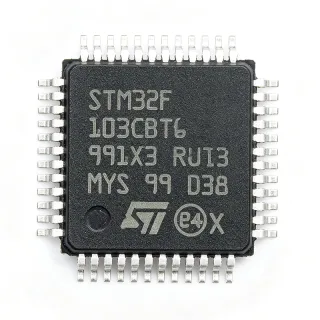
PIC16F15243-I/REB - 8-bit 32MHz MCU, 3.5KB Flash, 20-VQFN | Microchip
MPN: PIC16F15243-I/REB ✓ Active| Qty | Unit Price | Extended |
|---|---|---|
| 1 | $1.05 | $1.05 |
| 10 | $0.95 | $9.50 |
| 100 | $0.88 | $88.00 |
| 500 | $0.82 | $410.00 |
| 1,000 | $0.76 | $760.00 |
PIC16F15243-I/REB Overview
What is a PIC16 8-bit microcontroller? A PIC16F microcontroller is a low-power, mid-performance 8-bit RISC MCU family from Microchip built on a Harvard architecture with separate program and data buses. The PIC16F152xx sub-family adds Core Independent Peripherals (CIPs) - hardware state machines that run without CPU intervention - and Intelligent Analog on-chip peripherals, sitting in the power-management and embedded control hierarchy between simple 8-bit MCUs and 32-bit Cortex-M parts.
Key features include 32MHz internal oscillator operation, 3.5KB Flash self-programmable memory, hardware PPS (Peripheral Pin Select), Hardware Limit Timer (HLT), Windowed Watchdog Timer (WDT), and the XLP sleep mode with nanoWatt leakage. The 20-VQFN package has an exposed thermal pad and a compact 3x3 mm footprint suitable for space-constrained PCB designs. Peripherals include a 10-bit ADC with Computation (ADC2) for automated averaging and threshold comparison.
Typical applications include sensor nodes, IoT edge devices, battery-powered instruments, appliance controls, lighting ballasts, and safety-capable embedded subsystems. The Functional Safety documentation and FMEDA support enable integration into IEC 61508 SIL 2 designs when paired with a safety manual and proper diagnostic coverage at the system level.
When designing with this device, allocate pins carefully because PPS lets most digital peripherals be remapped to multiple I/O pins. Ensure decoupling capacitors are placed within 3mm of VDD and VSS. Use the ADC2 Computation mode for oversampling to reduce software overhead in sensor acquisition loops.
This page synthesizes distributor pricing, drop-in same-family alternatives, and practical design notes not found in the standalone Microchip datasheet. Pin-compatible variants in PDIP, SOIC, SSOP, and TSSOP packages are listed in the alternatives section for PCB layout reuse.
Drop-in alternatives for PIC16F15243-I/REB — same package, pin-to-pin compatible. Different-package parts requiring PCB rework are excluded.
Variants in this series
Same-series models that are drop-in compatible with PIC16F15243-I/REB (same form factor and footprint) — differing in Core Architecture, Package, Program Memory (Flash), ADC, CCP Modules.
Quick Comparison Tool — Select alternative parts for side-by-side comparison:
PIC16F15244-I/REB
✅ Drop-In ⚠️ 参数待验证✓ In Stock
$0.71 / Unit
View Datasheet →PIC16F15245-I/REB
✅ Drop-In ⚠️ 参数待验证✓ In Stock
$0.52 / Unit
View Datasheet →PIC16F15243-I/SS
✅ Drop-In✓ In Stock
$0.55 / Unit
View Datasheet →PIC16F15244-I/SO
✅ Drop-In ⚠️ 参数待验证📋 Reference alternative (not in catalog)
PIC16F1509-I/P
✅ Drop-In ⚠️ 参数待验证✓ In Stock
$1.43 / Unit
View Datasheet →PIC16F15243-E/REB
✅ Drop-In📋 Reference alternative (not in catalog)
PIC16F15243-I/REB Maximum Ratings & Electrical Characteristics
| Core Architecture | PIC 8-bit RISC (Harvard) |
| CPU Maximum Frequency | 32 MHz |
| Program Memory (Flash) | 3.5 KB (2K x 14 words) |
| Data SRAM | 256 bytes |
| Data EEPROM | 0 bytes (no on-chip EEPROM) |
| ADC | 10-bit, multi-channel (ADC2 with Computation) |
| PWM Channels | 2 (10-bit) |
| CCP Modules | 2 (Capture/Compare/PWM) |
| Communication Interfaces | 1x EUSART, 1x SPI, 1x I2C |
| I/O Pins | Up to 17 GPIO |
| Operating Voltage (VDD) | 1.8V to 5.5V |
| XLP Sleep Current | nanoWatt XLP sleep mode |
| Package | 20-pin VQFN (3x3 mm) with exposed pad |
| Mounting Type | Surface Mount |
| Temperature Range | -40C to +85C (Industrial, -I suffix) |
| Functional Safety | FuSa-capable (FMEDA documentation available) |
| Hardware Limit Timer (HLT) | Yes |
| Watchdog Timer | Windowed WDT |
| Peripheral Pin Select (PPS) | Yes |
| RoHS Status | Compliant |
PIC16F15243-I/REB Pin Configuration
| Pin 1 | VDD — Positive supply voltage |
| Pin 2 | RA5 — GPIO RA5 / digital I/O |
| Pin 3 | RA4 — GPIO RA4 / digital I/O |
| Pin 4 | RA3/MCLR — GPIO RA3 / Master Clear (reset) input |
| Pin 5 | RA2 — GPIO RA2 / analog input |
| Pin 6 | RA1 — GPIO RA1 / ICSPCLK / analog input |
| Pin 7 | RA0 — GPIO RA0 / ICSPDAT / analog input |
| Pin 8 | VSS — Ground reference |
| Pin 9 | RA7 — GPIO RA7 / digital I/O |
| Pin 10 | RA6 — GPIO RA6 / digital I/O |
| Pin 11 | RC5 — GPIO RC5 / digital I/O |
| Pin 12 | RC4 — GPIO RC4 / digital I/O |
| Pin 13 | RC3 — GPIO RC3 / digital I/O |
| Pin 14 | RC2 — GPIO RC2 / digital I/O |
| Pin 15 | RC1 — GPIO RC1 / digital I/O |
| Pin 16 | RC0 — GPIO RC0 / digital I/O |
| Pin 17 | RB7 — GPIO RB7 / ICSPDAT / digital I/O |
| Pin 18 | RB6 — GPIO RB6 / ICSPCLK / digital I/O |
| Pin 19 | RB5 — GPIO RB5 / analog input |
| Pin 20 | RB4 — GPIO RB4 / analog input |
Typical Applications
PIC16F15243-I/REB is suitable for 6 applications: IoT Edge Sensor Node, Functional Safety Appliance Control, LED Lighting Ballast Controller, Battery-Powered Handheld Instrument, Automotive Body Electronics (Sub-System), Home Appliance Sensor Hub.
IoT Edge Sensor Node
The PIC16F15243-I/REB is an ideal MCU for IoT edge sensor nodes where code density, low power, and small package footprint matter. Its 32MHz CPU and 3.5KB Flash handle sensor acquisition, local thresholding, and transmit/receive state machines, while the nanoWatt XLP sleep mode drops current to sub-microamp levels between measurements. The 10-bit ADC2 with Computation performs hardware averaging and threshold comparison without waking the CPU, and PPS remaps peripherals to free GPIO for multiple sensors. Typical deployments: BLE/Zigbee sensor endpoints, LoRaWAN environmental loggers, smart agriculture soil/light probes, and battery-powered HVAC transducers. Pair with an MCP9808 temperature sensor and an RN4871 BLE module for a coin-cell sensor tag lasting 3+ years on a CR2032.
Recommended
Functional Safety Appliance Control
The PIC16F15243-I/REB's Functional Safety (FuSa) qualification, including FMEDA and Safety Manual documentation, makes it suitable for IEC 61508 SIL 2 capable subsystems in white goods and small industrial appliances. The Hardware Limit Timer (HLT) provides a hardware-only safety stop independent of firmware, the Windowed Watchdog Timer detects code lockups, and the ADC2 with Computation validates analog inputs against safety thresholds. Typical deployments: washing machine motor control boards, dishwasher pump controllers, refrigerator sensor managers, and small industrial relay drivers. Designers should follow the Microchip Safety Manual's diagnostic coverage checklist and implement dual-channel sensing or cross-checks at the system level for SIL 2 compliance.
Recommended
LED Lighting Ballast Controller
The PIC16F15243-I/REB drives LED lighting ballasts with its two 10-bit PWM channels and 2 CCP modules providing high-resolution dimming down to 0.1% duty cycle steps. The wide 1.8V-5.5V VDD range accepts both 3.3V and 5V LED driver supply rails, and the ADC2 monitors LED current/voltage feedback for closed-loop brightness regulation. The 20-VQFN (3x3 mm) package fits inside small MR16/MR11 LED bulb form factors. Typical deployments: tunable-white architectural downlights, RGB color-mixing fixtures, horticultural LED panels, and emergency-driver backup circuits. The Windowed WDT prevents firmware lockup from causing lighting flicker or stuck-on conditions in safety-critical installations.
Recommended
Battery-Powered Handheld Instrument
The PIC16F15243-I/REB suits battery-powered handheld instruments where size, weight, and runtime are critical. The XLP sleep mode draws nanoamps in standby, and the PIC's fast 8 MIPS throughput from the 32MHz oscillator processes measurement data quickly before returning to sleep. The peripheral pin select (PPS) flexibility lets the designer route EUSART to the data port, SPI to an LCD driver, and I2C to a sensor all on the same chip. Typical deployments: digital multimeters, handheld environmental meters, barcode scanners, portable medical spot-check devices, and remote controls with OLED displays. Two AA cells (3V nominal) operating at 1.8V-5.5V VDD extend runtime, and PPS lets the design scale across multiple handheld form factors without firmware changes.
Recommended
Automotive Body Electronics (Sub-System)
While the industrial -I grade PIC16F15243 supports non-critical body electronics, the underlying silicon family extends to AEC-Q100 automotive qualified parts. The same PIC16F15243 peripheral set - ADC2, PWM, CCP, EUSART, SPI/I2C - handles body controllers, lighting modules, and small motor drivers at automotive temperatures. Typical sub-system deployments include seat position sensors, mirror controllers, ambient lighting strips, and HVAC blend-door actuators. For AEC-Q100 grade 0/1 requirements, designers select the automotive temperature grade variant from the same PIC16F152xx family. The 20-VQFN footprint supports the small PCB areas typical of distributed body modules, and PPS lets one firmware image serve multiple body sub-system variants.
Recommended
Home Appliance Sensor Hub
The PIC16F15243-I/REB serves as a low-cost sensor hub for home appliances that aggregate temperature, humidity, water level, and door-switch status. The 10-bit ADC2 with Computation handles multi-channel sensor scans without CPU intervention, while the two PWM outputs drive indicator LEDs or small buzzers. The 20-pin VQFN fits inside compact appliance control boards, and the wide 1.8V-5.5V VDD range accepts both 3.3V and 5V sensor rails. Typical deployments: refrigerator fresh-food compartment sensors, washing machine water-level monitors, dishwasher turbidity sensors, and HVAC indoor air quality (IAQ) hubs. With EUSART and SPI/I2C all available, designers can bridge between legacy UART-based sensors and modern I2C peripherals on the same board.
Recommended
Recommended Products Summary
Engineering reference data for PIC16F15243-I/REB — comparison, design guidance, and compliance information.
Selection Guide
Comparison with Alternatives
| Parameter | This Product | PIC16F15244-I/REB | PIC16F15245-I/REB | PIC16F15243-I/SS | PIC16F15244-I/SO | PIC16F1509-I/P |
|---|---|---|---|---|---|---|
| Package | 20-VQFN (3x3 mm) | 20-VQFN (3x3 mm) - same | 20-VQFN (3x3 mm) - same | 20-SSOP - same pin count, different footprint | 20-SOIC - same pin count, different footprint | 20-PDIP - same pin count, through-hole |
| Brand | Microchip Technology | Microchip Technology | Microchip Technology | Microchip Technology | Microchip Technology | Microchip Technology |
| Flash Memory | 3.5 KB (2K x 14) | 7 KB (4K x 14) - 2x | 14 KB (8K x 14) - 4x | 3.5 KB - identical | 7 KB - 2x | 8 KB - 2.3x |
| SRAM | 256 B | 512 B - 2x | 1024 B - 4x | 256 B - identical | 512 B - 2x | 512 B - 2x |
| Max CPU Frequency | 32 MHz | 32 MHz - identical | 32 MHz - identical | 32 MHz - identical | 32 MHz - identical | 20 MHz |
| ADC | 10-bit ADC2 with Computation | 10-bit ADC2 - identical | 10-bit ADC2 - identical | 10-bit ADC2 - identical | 10-bit ADC2 - identical | 10-bit ADC (no Computation) |
| Operating Voltage | 1.8V to 5.5V | 1.8V to 5.5V - identical | 1.8V to 5.5V - identical | 1.8V to 5.5V - identical | 1.8V to 5.5V - identical | 2.0V to 5.5V |
| Temperature Range | -40C to +85C (Industrial) | -40C to +85C - identical | -40C to +85C - identical | -40C to +85C - identical | -40C to +85C - identical | -40C to +85C - identical |
Key Differentiators
- Functional Safety (FuSa) documentation at this memory tier (vs PIC16F1509-I/P)
- ADC2 with Computation hardware averaging (vs PIC16F1509-I/P)
- Higher CPU frequency with same code density (vs PIC16F15244-I/REB (memory upgrade))
Design Notes
Estimated: at 32MHz CPU active drawing ~5mA plus peripherals, the PIC16F15243-I/REB draws roughly 5-8 mA from VDD. In XLP sleep mode current drops below 1uA. Place a 100nF decoupling capacitor within 3mm of each VDD/VSS pair, plus a bulk 10uF tantalum or ceramic on the main supply rail. For battery applications verify worst-case active current at your VDD before sizing the battery; PIC16 XLP nanoWatt sleep is the lowest-power mode but does not preserve RAM content if voltage drops below 1.7V BOR threshold.
The 20-VQFN (3x3 mm) package has an exposed thermal pad (EP) under the chip that MUST be soldered to the PCB ground plane for both thermal dissipation and electrical grounding. Without the EP soldered, junction-to-ambient thermal resistance degrades and the chip can overheat at high ambient temperatures. Use a 3x3 array of thermal vias (0.3mm drill, 0.5mm pitch) under the EP connecting to the L2 ground plane. Keep high-speed traces (SPI, EUSART clock) away from the ADC analog pins (RA0/RA1/RA2/RB4/RB5) and use a ground guard ring around analog traces for best ADC2 accuracy.
Do not leave the MCLR pin floating - tie RA3/MCLR to VDD through a 10kohm pull-up resistor to prevent spurious resets from noise. When using PPS (Peripheral Pin Select), remap functions at startup before enabling peripherals; mid-flight PPS changes can cause glitches on output compare modules. The 10-bit ADC2 requires the FVR (Fixed Voltage Reference) to be stable before conversions; allow at least 20us after enabling FVR. For FuSa applications, implement dual-channel sensing at the system level since the PIC16F15243 alone is not a certified safety device.
Compliance Information
RoHS compliant and lead-free per Microchip product page and DigiKey/Mouser listings. Industrial -I temperature grade -40C to +85C (not AEC-Q100; for automotive AEC-Q100 grade 0/1 select from the PIC16F152xx automotive family). REACH compliance and conflict mineral reporting available on Microchip corporate compliance portal.