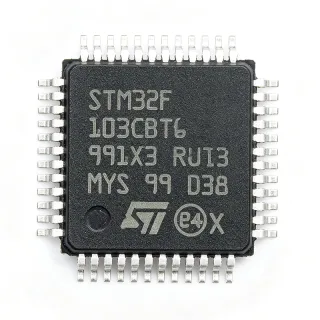
PIC16F15274-I/MP - 8-Bit 32MHz 7KB Flash MCU | Microchip | QFN-40
MPN: PIC16F15274-I/MP ✓ Active| Qty | Unit Price | Extended |
|---|---|---|
| 1 | $1.31 | $1.31 |
| 10 | $1.18 | $11.80 |
| 100 | $1.02 | $102.00 |
| 500 | $0.86 | $430.00 |
| 1,000 | $0.74 | $740.00 |
PIC16F15274-I/MP Overview
A microcontroller (MCU) is a single-chip computer integrating a CPU core, non-volatile program memory, working RAM, and programmable peripherals. The PIC16F15274 belongs to the 8-bit PIC16 family - within the broader taxonomy, this places it as: PIC16F15274 -> PIC16F152xx family -> PIC16F1xxx series -> PIC16 family -> 8-bit PIC microcontrollers -> microcontrollers -> embedded processors -> semiconductors. The 8-bit PIC architecture uses a Harvard design with separate program and data buses and a RISC-style instruction set optimized for deterministic interrupt response and low power operation.
Key features of the PIC16F15274 include 7KB (7K x 14 word) self-programmable Flash, 512 bytes SRAM, 10-bit analog-to-digital converter with multiple channels, dual PWM outputs for motor or lighting control, complementary core independent peripherals (CIPs) such as the configurable logic cell and signal measurement timer, and the Intelligent Analog peripheral set. Operating voltage spans 1.8V to 5.5V, making the part suitable for both 3.3V and 5V system rails.
Architecturally the device combines a 32MHz internal oscillator, instruction-cycle throughput up to 8 MIPS, and peripheral pin select (PPS) for flexible remapping of digital functions to physical pins. The XLP feature delivers nanoWatt sleep currents, allowing battery-powered nodes to remain dormant for years on a single cell. The integrated core-independent peripherals offload timing, waveform generation, and signal-conditioning tasks from the CPU.
Typical applications include consumer appliances, sensor interface modules, low-cost motor control, LED lighting controllers, battery-powered IoT edge nodes, and general-purpose embedded control. The wide 1.8V-5.5V operating range and tiny QFN-40 footprint also suit space-constrained designs in industrial and home automation segments.
Designers should note that the QFN-40 (5x5 mm) package requires a thermal pad soldered to a sufficient copper pour to meet the rated thermal performance. Programming is supported through Microchip's MPLAB X IDE ecosystem with XC8 compilers and PICkit programmers, and code examples are published for common tasks.
This page consolidates distributor pricing, drop-in alternatives, design considerations, and application guidance drawn from the manufacturer datasheet and authorized distributors.
Drop-in alternatives for PIC16F15274-I/MP — same package, pin-to-pin compatible. Different-package parts requiring PCB rework are excluded.
Variants in this series
Same-series models that are drop-in compatible with PIC16F15274-I/MP (same form factor and footprint) — differing in Operating Temperature, Package, Program Memory (Flash), ADC, Communication.
Quick Comparison Tool — Select alternative parts for side-by-side comparison:
PIC16F15274-E/MP
✅ Drop-In📋 Reference alternative (not in catalog)
PIC16F15275-I/MP
✅ Drop-In✓ In Stock
$1.32 / Unit
View Datasheet →PIC16F15276-I/MV
✅ Drop-In📋 Reference alternative (not in catalog)
PIC16F18076-E/MP
✅ Drop-In📋 Reference alternative (not in catalog)
PIC16F15244-I/SS
✅ Drop-In ⚠️ 参数待验证✓ In Stock
$0.85 / Unit
View Datasheet →PIC16F15274-I/MP Maximum Ratings & Electrical Characteristics
| Core Architecture | 8-bit PIC16 |
| Program Memory (Flash) | 7 KB (7K x 14) |
| RAM | 512 B |
| CPU Speed (Max) | 32 MHz |
| Instruction Throughput | 8 MIPS |
| ADC | 10-bit |
| PWM Channels | 2 |
| CCP Modules | 2 |
| Communication | EUSART, SPI, I2C |
| Operating Voltage | 1.8 V to 5.5 V |
| Operating Temperature | -40C to +85C (Industrial) |
| Package | 40-QFN (5x5 mm) |
| Mounting Type | Surface Mount |
| Low-Power Feature | eXtreme Low-Power (XLP) |
| Hardware Limit Timer | Yes (HLT) |
| Peripheral Pin Select | Yes (PPS) |
| Watchdog Timer | Yes |
| RoHS Status | Compliant |
PIC16F15274-I/MP Pin Configuration
| Pin 1 | RA0 — Port A bit 0 / analog input |
| Pin 2 | RA1 — Port A bit 1 / analog input |
| Pin 3 | RA2 — Port A bit 2 / analog input |
| Pin 4 | RA3 — Port A bit 3 / analog input / VREF+ |
| Pin 5 | RA4 — Port A bit 4 |
| Pin 6 | RA5 — Port A bit 5 |
| Pin 7 | RA6 — Port A bit 6 |
| Pin 8 | RA7 — Port A bit 7 |
| Pin 9 | VSS — Ground |
| Pin 10 | VDD — Positive supply voltage |
| Pin 11 | RB0 — Port B bit 0 |
| Pin 12 | RB1 — Port B bit 1 |
| Pin 13 | RB2 — Port B bit 2 |
| Pin 14 | RB3 — Port B bit 3 |
| Pin 15 | RB4 — Port B bit 4 |
| Pin 16 | RB5 — Port B bit 5 |
| Pin 17 | RB6 — Port B bit 6 / ICSPCLK |
| Pin 18 | RB7 — Port B bit 7 / ICSPDAT |
| Pin 19 | RC0 — Port C bit 0 |
| Pin 20 | RC1 — Port C bit 1 |
| Pin 21 | RC2 — Port C bit 2 |
| Pin 22 | RC3 — Port C bit 3 / SCL |
| Pin 23 | RC4 — Port C bit 4 / SDA |
| Pin 24 | RC5 — Port C bit 5 |
| Pin 25 | RC6 — Port C bit 6 / TX |
| Pin 26 | RC7 — Port C bit 7 / RX |
| Pin 27 | RD0 — Port D bit 0 |
| Pin 28 | RD1 — Port D bit 1 |
| Pin 29 | RD2 — Port D bit 2 |
| Pin 30 | RD3 — Port D bit 3 |
| Pin 31 | RD4 — Port D bit 4 |
| Pin 32 | RD5 — Port D bit 5 |
| Pin 33 | RD6 — Port D bit 6 |
| Pin 34 | RD7 — Port D bit 7 |
| Pin 35 | RE0 — Port E bit 0 |
| Pin 36 | RE1 — Port E bit 1 |
| Pin 37 | RE2 — Port E bit 2 |
| Pin 38 | RE3 — Port E bit 3 / MCLR |
| Pin 39 | VSS — Ground |
| Pin 40 | VDD — Positive supply voltage |
Typical Applications
PIC16F15274-I/MP is suitable for 6 applications: Sensor Interface Module, Low-Cost Motor Control, LED Lighting Controller, Battery-Powered IoT Edge Node, Home Appliance Control, Industrial Sensor Hub.
Sensor Interface Module
The PIC16F15274-I/MP fits sensor interface modules by combining its 10-bit ADC, eXtreme Low-Power (XLP) nanoWatt sleep modes, and 32 MHz core in a compact 40-QFN (5x5 mm) footprint. Engineers can sample multiple analog sensors, perform local conditioning in hardware, and duty-cycle the CPU to extend battery life to multi-year levels. The 7 KB Flash provides ample code space for linearization, calibration, and digital filtering routines. Placing the MCU between the sensor bridge and an I2C or SPI bus lets it aggregate readings and wake a host only when thresholds are crossed.
Recommended
Low-Cost Motor Control
The PIC16F15274-I/MP is suitable for low-cost brushed DC and small BLDC motor control thanks to its two PWM channels, two CCP modules, hardware limit timer (HLT), and 1.8-5.5 V operating range. The 32 MHz core executes 8 MIPS, sufficient for trapezoidal commutation loops at several kHz. The QFN-40 footprint fits compact motor driver boards, while PPS lets designers route PWM outputs to any available pin to simplify PCB layout. Designers should pair this MCU with a discrete H-bridge driver such as the MCP8026 for 12 V to 24 V brushed motors.
Recommended
LED Lighting Controller
The PIC16F15274-I/MP drives LED lighting controllers using its dual PWM outputs for color mixing or dimming, complemented by the 10-bit ADC for ambient-light feedback. The XLP feature enables standby currents suitable for always-on wall-switch or smart-bulb designs that must pass energy-star standby budgets. Operating from 1.8-5.5 V lets the part run from a 3.3 V or 5 V supply derived directly from the AC-DC driver. The QFN-40 (5x5 mm) footprint fits inside compact lamp-base PCBs.
Recommended
Battery-Powered IoT Edge Node
The PIC16F15274-I/MP anchors battery-powered IoT edge nodes by leveraging nanoWatt XLP sleep currents below 100 nA, a wide 1.8-5.5 V supply range compatible with Li-ion or 2xAA cells, and integrated EUSART/SPI/I2C for connecting sub-GHz radios or sensors. With 7 KB Flash and 512 B RAM, the part supports small MQTT-SN or LoRaWAN application stacks. The 32 MHz CPU bursts awake to process events and returns to sleep quickly, maximizing battery life in duty-cycled deployments. Use it with a Microchip RN2483 LoRa module for a complete long-range IoT node.
Recommended
Home Appliance Control
The PIC16F15274-I/MP serves home appliance control boards for white goods, small kitchen appliances, and HVAC accessories by providing a robust 8-bit MCU with a wide 1.8-5.5 V supply range tolerant of rectified mains-derived rails. Two PWM channels drive triac phase control or relay PWM, while the 10-bit ADC reads temperature, humidity, and current sensors. Industrial-grade -40C to +85C operation supports unheated appliance environments. Designers pair this MCU with an MCP1700 LDO and an opto-isolated TRIAC driver for full mains-voltage switching.
Recommended
Industrial Sensor Hub
The PIC16F15274-I/MP acts as an industrial sensor hub aggregating multiple analog and digital sensors and exposing them over RS-485, I2C, or SPI. The 10-bit ADC handles 4-20 mA loop inputs with appropriate scaling, while EUSART supports RS-485 with an external transceiver. The 32 MHz core can run Modbus RTU slave firmware within 7 KB Flash, and PPS simplifies PCB routing in dense enclosures. The -40C to +85C industrial temperature range supports factory-floor operation without additional thermal management.
Recommended
Recommended Products Summary
Engineering reference data for PIC16F15274-I/MP — comparison, design guidance, and compliance information.
Selection Guide
Comparison with Alternatives
| Parameter | This Product | PIC16F15274-E/MP | PIC16F15275-I/MP | PIC16F15276-I/MV | PIC16F18076-E/MP | PIC16F15244-I/SS |
|---|---|---|---|---|---|---|
| Package | 40-QFN (5x5 mm) | 40-QFN (5x5 mm) - same | 40-QFN (5x5 mm) - same | 40-QFN (5x5 mm) - same | 40-QFN (5x5 mm) - same | SSOP-20 - different |
| Brand | Microchip Technology | Microchip Technology | Microchip Technology | Microchip Technology | Microchip Technology | Microchip Technology |
| Flash Memory | 7 KB | 7 KB | 14 KB | 28 KB | 28 KB | 7 KB |
| RAM | 512 B | 512 B | 1024 B | 2048 B | 2048 B | 512 B |
| CPU Speed | 32 MHz | 32 MHz | 32 MHz | 32 MHz | 32 MHz | 32 MHz |
| Operating Voltage | 1.8 V to 5.5 V | 1.8 V to 5.5 V | 1.8 V to 5.5 V | 1.8 V to 5.5 V | 1.8 V to 5.5 V | 1.8 V to 5.5 V |
| Operating Temperature | -40C to +85C | -40C to +125C | -40C to +85C | -40C to +85C | -40C to +125C | -40C to +85C |
| Pin Count | 40 | 40 | 40 | 40 | 40 | 20 |
Key Differentiators
- QFN-40 (5x5 mm) package with 7 KB Flash and 32 MHz core (vs PIC16F15244-I/SS)
- Industrial temperature grade with XLP low-power feature (vs PIC16F15275-I/MP)
- Hardware limit timer (HLT) and dual CCP for robust motor control (vs PIC16F18076-E/MP)
Design Notes
The PIC16F15274-I/MP 40-QFN (5x5 mm) package has an exposed thermal pad (EP) on the underside that MUST be soldered to a sufficiently large copper pour on the PCB to meet the rated thermal performance. Without the EP soldered, junction temperature can rise well above ambient under sustained CPU load at 32 MHz. Recommended: minimum 1 sq. inch of 2 oz copper connected to the EP and the ground plane, with multiple thermal vias to the inner ground plane.
Place a 100 nF decoupling capacitor as close as possible to each VDD pin (pins 10 and 40) and a bulk 1-10 uF tantalum or ceramic capacitor on the supply rail. For analog ADC accuracy, add a small ferrite bead or 10 ohm resistor between VDD and AVDD if the device has separate analog supply pins, and keep analog traces short and away from digital switching signals. Use PPS to route peripheral functions to convenient PCB locations.
Do not exceed 5.5 V on VDD - the part is rated 1.8 V to 5.5 V. Configure the MCLR pin (RE3) properly: as a reset input with the internal pull-up enabled or as a digital input, but never leave it floating. When programming via ICSP, ensure the PGC/PGD pins (RB6/RB7) are not loaded with strong external pull-ups or capacitance that would prevent in-circuit programming. Use the Microchip MPLAB X IDE with XC8 compiler for code development and PICkit 4 or Snap programmer for in-circuit debugging.
Compliance Information
RoHS and REACH compliant per Microchip product page. Industrial temperature grade -40C to +85C. For automotive AEC-Q100 qualified variants, refer to Microchip's automotive-grade PIC portfolio.