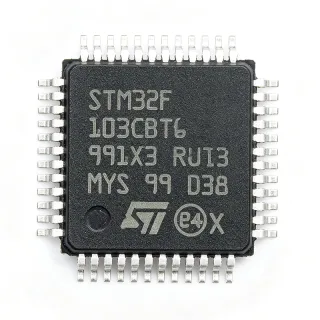
PIC16F15324T-I/7NVAO - 7KB Flash 8-bit MCU AEC-Q100 | Microchip
MPN: PIC16F15324T-I/7NVAO ✓ Active| Qty | Unit Price | Extended |
|---|---|---|
| 1 | $1.42 | $1.42 |
| 10 | $1.27 | $12.70 |
| 100 | $1.08 | $108.00 |
| 500 | $0.92 | $460.00 |
| 1,000 | $0.78 | $780.00 |
PIC16F15324T-I/7NVAO Overview
An 8-bit microcontroller (MCU) is a small, low-power computer-on-a-chip that integrates a CPU, non-volatile program memory (typically Flash), working RAM, and a set of peripherals (timers, ADC, communication ports, GPIO) onto a single silicon die. 8-bit MCUs sit in a hierarchy: microcontroller -> embedded processor -> integrated circuit -> semiconductor. The PIC16F153xx family specifically targets low-power, mixed-signal applications using Core Independent Peripherals (CIPs) and eXtreme Low-Power (XLP) technology, and the "F" suffix indicates Flash memory and In-Circuit Serial Programming (ICSP).
Key features include 12 I/O pins, 256 B EEPROM data memory, an 8-bit ADC with multiple channel options, a 5-bit DAC, and intelligent analog peripherals. The PIC16F15324T-I/7NVAO supports the automotive AEC-Q100 qualification standard via the /VAO suffix, making it suitable for vehicle applications. The device also integrates two EUSART modules that handle RS-232/RS-485 plus LIN bus protocols in hardware, which reduces firmware overhead compared to bit-banged UART.
The architecture is built around a 14-bit instruction word with a hardware multiplier and a single-cycle ALU. The CWG, combined with the 4 PWM channels, generates complementary waveforms with programmable dead-band for motor-drive or power-conversion control loops. The CIP (Core Independent Peripheral) blocks - including the CWG, NCO, and configurable logic cells - run independently of the CPU, allowing the core to remain in sleep and reducing average power consumption for battery-powered or always-on designs.
Typical applications include automotive body electronics, sensor conditioning nodes, low-end motor control (small fans, pumps, valves), LED lighting controllers, and home-appliance user-interface panels. The AEC-Q100 qualification makes it a fit for under-hood and cabin electronics where temperature and reliability are scrutinized. The 16-pin VQFN package suits space-constrained PCBs in sensor modules and small actuator drivers.
When designing with the PIC16F15324T-I/7NVAO, ensure that the ICSPDAT/ICSPCLK pins are accessible for in-circuit programming, that the exposed thermal pad (EP) is soldered to a sufficient copper pour for thermal dissipation, and that Vdd decoupling is placed within 3 mm of the supply pin. Use the MPLAB X IDE and the MPLAB Code Configurator (MCC) to generate peripheral-setup code from the CIP blocks.
This page synthesizes distributor pricing, drop-in same-package alternatives, and practical design notes drawn from Microchip's PIC16(L)F15324/44 datasheet and CIP application briefs, complementing the manufacturer documentation with decision support not found in the datasheet alone.
Drop-in alternatives for PIC16F15324T-I/7NVAO — same package, pin-to-pin compatible. Different-package parts requiring PCB rework are excluded.
Quick Comparison Tool — Select alternative parts for side-by-side comparison:
PIC16F15324T-E/7NVAO
✅ Drop-In📋 Reference alternative (not in catalog)
PIC16F15324-I/7NVAO
✅ Drop-In📋 Reference alternative (not in catalog)
PIC16F15324T-I/JQ
✅ Drop-In✓ In Stock
$0.86 / Unit
View Datasheet →PIC16F15323T-I/7NVAO
✅ Drop-In📋 Reference alternative (not in catalog)
PIC16F15324T-I/7NVAO Maximum Ratings & Electrical Characteristics
| Core Processor | PIC |
| Core Size | 8-bit |
| CPU Speed | 32 MHz |
| Program Memory (Flash) | 7 KB (4K x 14) |
| RAM | 512 B |
| EEPROM | 256 B |
| Supply Voltage | 3 V |
| Number of I/O Pins | 12 |
| PWM Channels | 4 |
| ADC | Yes (10-bit, multi-channel) |
| DAC | 5-bit |
| Comparator | Yes |
| CWG (Complementary Waveform Generator) | Yes |
| Communication Interfaces | 2x EUSART, SPI, I2C |
| Package | 16-VQFN (4x4) with Exposed Pad |
| AEC-Q100 Qualification | Yes (Automotive grade) |
| Mounting Type | Surface Mount |
| Operating Temperature | -40C to +85C (Industrial, "I") |
| Series | PIC® 16F |
| RoHS Status | Compliant |
PIC16F15324T-I/7NVAO Pin Configuration
| Pin 1 | RA2 — Bidirectional I/O / reference clock |
| Pin 2 | RA3 — Bidirectional I/O |
| Pin 3 | RA4 — Bidirectional I/O |
| Pin 4 | RA5 — Bidirectional I/O |
| Pin 5 | VSS — Ground reference |
| Pin 6 | RA1 — Bidirectional I/O |
| Pin 7 | RA0 — Bidirectional I/O / ICDDAT |
| Pin 8 | RA7 — Bidirectional I/O / ICSPCLK |
| Pin 9 | RC5 — Bidirectional I/O |
| Pin 10 | RC4 — Bidirectional I/O |
| Pin 11 | RC3 — Bidirectional I/O |
| Pin 12 | RC2 — Bidirectional I/O |
| Pin 13 | RC1 — Bidirectional I/O |
| Pin 14 | RC0 — Bidirectional I/O |
| Pin 15 | VDD — Positive supply (3V) |
| Pin 16 | RC6 — Bidirectional I/O |
| Pin EP | EP — Exposed thermal pad - connect to VSS |
Typical Applications
PIC16F15324T-I/7NVAO is suitable for 6 applications: Automotive Body Electronics, Sensor Conditioning Nodes, Small Motor Control, LED Lighting Controllers, Home Appliance User-Interface Panels, Battery-Powered IoT Edge Nodes.
Automotive Body Electronics
The PIC16F15324T-I/7NVAO is AEC-Q100 qualified via the /VAO suffix, with 7 KB Flash and 512 B RAM handling seat-control, mirror-adjustment, or lighting-node firmware. Two EUSART channels support LIN-bus slaves to the body controller, while the 32 MHz core services 10 ms task loops. Its 4 PWMs and CWG drive LED dimming or small DC-motor loads; the 16-VQFN footprint fits behind the instrument cluster or inside door-module PCBs where board area is tight.
Recommended
Sensor Conditioning Nodes
The PIC16F15324T-I/7NVAO's integrated 10-bit ADC and 5-bit DAC combined with 256 B EEPROM let the device store calibration constants while digitizing sensor signals at low quiescent current thanks to eXtreme Low-Power (XLP) sleep modes. Its 4 PWM outputs can drive excitation sources for resistive bridges, and the 12 GPIOs handle interrupt-driven wake from multiple sensor lines. The 16-VQFN exposed pad enables compact sensor-module PCBs for industrial IoT gateways.
Recommended
Small Motor Control
The PIC16F15324T-I/7NVAO drives small BLDC or brushed DC motors using the CWG with complementary outputs and programmable dead-band plus 4 PWM channels for speed and current control. The 32 MHz CPU executes field-oriented control loops at the millisecond scale for small fans, pumps, and appliance valves. Hardware fault handling via the on-chip comparator and ADC shuts down PWMs without software latency. The VQFN-16 exposed pad handles the modest dissipation of sub-50 W motor control.
Recommended
LED Lighting Controllers
The PIC16F15324T-I/7NVAO delivers 4 PWMs for multi-channel LED dimming, with the 5-bit DAC and DACREF tied to analog current-set references for tunable-white or RGBW strips. Its 32 MHz core drives 16-bit PWM resolution at frequencies above 1 kHz, eliminating visible flicker in architectural lighting. The 7 KB Flash accommodates proprietary dimming curves, and the /VAO AEC-Q100 grade suits automotive interior-ambient lighting. The 16-VQFN footprint fits inside lamp-driver PCBs.
Recommended
Home Appliance User-Interface Panels
The PIC16F15324T-I/7NVAO's 12 GPIOs handle capacitive touch buttons, rotary encoders, and 7-segment display multiplexing on a washing-machine or microwave front panel. Its 512 B SRAM buffers display updates, while the 7 KB Flash stores multi-language UI strings. EUSART ports connect to the main appliance controller, and the 5-bit DAC drives an audible buzzer for end-of-cycle alerts.
Recommended
Battery-Powered IoT Edge Nodes
The PIC16F15324T-I/7NVAO uses Core Independent Peripherals (CIPs) such as the CWG and NCO to perform timing-critical functions while the CPU stays in XLP sleep, dropping current to the microamp range for battery-powered IoT sensors. Its SPI/I2C ports interface with low-power radios or environmental sensors, and the 256 B EEPROM logs non-volatile state across battery swaps. The 16-VQFN (4x4) keeps the PCB small enough for wearable or tag-form-factor designs.
Recommended
Recommended Products Summary
Engineering reference data for PIC16F15324T-I/7NVAO — comparison, design guidance, and compliance information.
Selection Guide
Comparison with Alternatives
| Parameter | This Product | PIC16F15324T-E/7NVAO | PIC16F15324-I/7NVAO | PIC16F15324T-I/JQ | PIC16F15323T-I/7NVAO |
|---|---|---|---|---|---|
| Package | 16-VQFN (4x4) | 16-VQFN (4x4) - same | 16-VQFN (4x4) - same | 16-UQFN (4x4) - same footprint | 16-VQFN (4x4) - same |
| Brand | Microchip Technology | Microchip Technology | Microchip Technology | Microchip Technology | Microchip Technology |
| Program Memory (Flash) | 7 KB | 7 KB | 7 KB | 7 KB | 3.5 KB |
| RAM | 512 B | 512 B | 512 B | 512 B | 256 B |
| Operating Temperature | -40C to +85C (I grade) | -40C to +125C (E grade) | -40C to +85C (I grade) | -40C to +85C (I grade) | -40C to +85C (I grade) |
| AEC-Q100 Automotive Grade | Yes (/VAO) | Yes (/VAO) | No | Yes (/VAO) | Yes (/VAO) |
| CPU Speed | 32 MHz | 32 MHz | 32 MHz | 32 MHz | 32 MHz |
| PWM Channels | 4 | 4 | 4 | 4 | 4 |
Key Differentiators
- AEC-Q100 automotive qualification with /VAO suffix (vs PIC16F15324-I/7NVAO)
- Higher Flash density in the same VQFN-16 footprint (vs PIC16F15323T-I/7NVAO)
- Industrial-grade screening rather than extended-temperature (vs PIC16F15324T-E/7NVAO)
Design Notes
Solder the VQFN-16 exposed thermal pad (EP) to a continuous ground pour on the top or bottom layer, with at least 8 thermal vias (0.3 mm drill, 0.5 mm pitch) stitching to the inner ground plane. This keeps the junction temperature within the -40C to +85C (or +125C for E grade) operating envelope at full 32 MHz CPU load and supports the CIP blocks running concurrently.
Place a 100 nF ceramic decoupling capacitor within 3 mm of the VDD pin (pin 15) and a bulk 1 uF to 10 uF capacitor on the same node. For noise-sensitive analog applications using the ADC and DAC, add a ferrite bead or 10 ohm resistor between VDD and the MCU supply pin to isolate digital switching noise from analog rails.
Do not use the ICSPDAT/ICSPCLK pins (RA0/RA7) as general-purpose outputs during in-circuit programming; either dedicate them to programming or reserve firmware routines that tri-state them at reset. Failure to do so prevents the MPLAB ICD or PICkit programmer from acquiring the device. The /MCLR pin (if exposed in your variant) must have a pull-up to VDD for normal operation.
Compliance Information
AEC-Q100 qualified per /VAO suffix. RoHS and REACH compliance per Microchip product page. Lead-free packaging. Halogen-free status not explicitly stated in provided data.