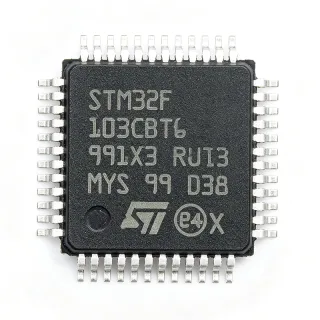
PIC16F15345-E/GZVAO - 8-bit 32MHz 14KB Flash MCU | Microchip
MPN: PIC16F15345-E/GZVAO ✓ Active| Qty | Unit Price | Extended |
|---|---|---|
| 1 | $2.85 | $2.85 |
| 10 | $2.56 | $25.60 |
| 100 | $2.27 | $227.00 |
| 500 | $1.95 | $975.00 |
| 1,000 | $1.74 | $1,740.00 |
| 3,000 | $1.55 | $4,650.00 |
PIC16F15345-E/GZVAO Overview
An 8-bit microcontroller (MCU) is a single-chip computer that integrates a CPU, memory, and peripherals on one die. PIC16F-series MCUs use Microchip's enhanced mid-range 8-bit core with a 14-bit instruction word and RISC architecture. They typically sit below 16-bit PIC24/dsPIC and 32-bit PIC32MX parts in Microchip's portfolio, but above legacy 14-bit PIC16 baseline cores. They are widely used where low cost, deterministic interrupt response, and ultra-low sleep current are more important than raw compute throughput.
Key differentiating features of the PIC16F15345 include four 10-bit PWM channels, a 10-bit ADC, two 5-bit DACs, comparators, a Complementary Waveform Generator (CWG), two EUSART peripherals plus SPI/I2C, and the eXtreme Low-Power (XLP) sleep mode that draws nanoamp-range currents. The 20-UQFN (GZ) package with exposed thermal pad reduces PCB footprint for space-constrained designs.
Architecturally, the device uses Microchip's enhanced mid-range core with a hardware multiplier, 49 instruction set, and vectored interrupts. The CIPs (CLC, NCO, CWG, DSM, Configurable Logic Cell, Numerically Controlled Oscillator) allow hardware-state-machine functions to offload the CPU, enabling deterministic low-power response without firmware polling.
Typical applications include automotive body and sensor node ECUs, IoT edge sensor nodes, industrial controls and instrumentation, low-power consumer appliances, LED lighting control, and small motor/solenoid drivers where CIPs handle timing in hardware. The wide 2.3V-5.5V operating range and nanoWatt XLP sleep modes also suit battery-powered designs such as remote controls and wearable health patches.
When designing with the GZVAO suffix, note that AEC-Q100 qualification, the -E extended temperature grade (-40C to +125C), and the UQFN exposed pad require careful PCB thermal land and reflow profile matching. The VAO suffix indicates automotive-grade packaging and traceability per Microchip's part-numbering convention.
Drop-in alternatives for PIC16F15345-E/GZVAO — same package, pin-to-pin compatible. Different-package parts requiring PCB rework are excluded.
Variants in this series
Same-series models that are drop-in compatible with PIC16F15345-E/GZVAO (same form factor and footprint) — differing in ADC, DAC, Package, Comparators, Mounting Type.
Quick Comparison Tool — Select alternative parts for side-by-side comparison:
PIC16F15344-I/SS
✅ Drop-In✓ In Stock
$0.79 / Unit
View Datasheet →PIC16F15344-I/P
✅ Drop-In✓ In Stock
$1.32 / Unit
View Datasheet →PIC16F15344-E/P
✅ Drop-In✓ In Stock
$0.96 / Unit
View Datasheet →PIC16F15325T-E/SLVAO
⚠️ 参数待验证✓ In Stock
$0.77 / Unit
View Datasheet →PIC16F15345-E/GZVAO Maximum Ratings & Electrical Characteristics
| Core Architecture | PIC16 Enhanced Mid-Range 8-bit |
| Program Memory (Flash) | 14 KB (8K x 14 words) |
| Data SRAM | 1 KB |
| EEPROM | 256 bytes |
| Maximum CPU Frequency | 32 MHz |
| Operating Voltage Range | 2.3 V to 5.5 V |
| I/O Pins | 18 |
| PWM Channels | 4 (10-bit) |
| ADC | 10-bit |
| DAC | 2 x 5-bit |
| Comparators | Yes |
| EUSART | 2 |
| SPI / I2C | Yes (peripheral) |
| Complementary Waveform Generator (CWG) | Yes |
| eXtreme Low-Power (XLP) | Yes |
| Operating Temperature | -40C to +125C (E = extended) |
| Package | 20-pin UQFN-EP (4x4 mm) - GZ |
| Mounting Type | Surface Mount |
| Automotive Qualification | AEC-Q100 (VAO suffix) |
| RoHS Status | Compliant |
PIC16F15345-E/GZVAO Pin Configuration
| Pin 1 | RA5 — Bidirectional I/O / ADC input |
| Pin 2 | RA0 — Bidirectional I/O / ADC input |
| Pin 3 | RA1 — Bidirectional I/O / ADC input |
| Pin 4 | RA2 — Bidirectional I/O / ADC input |
| Pin 5 | RA3/MCLR — I/O or Master Clear (reset) input |
| Pin 6 | RA4 — Bidirectional I/O / ADC input |
| Pin 7 | VSS — Ground reference |
| Pin 8 | RA7 — Bidirectional I/O |
| Pin 9 | RA6 — Bidirectional I/O / oscillator |
| Pin 10 | RC0 — Bidirectional I/O |
| Pin 11 | RC1 — Bidirectional I/O |
| Pin 12 | RC2 — Bidirectional I/O |
| Pin 13 | RC3 — Bidirectional I/O / SPI SCK |
| Pin 14 | RC4/SDA — I/O or I2C data |
| Pin 15 | RC5/SCL — I/O or I2C clock |
| Pin 16 | VDD — Positive supply (2.3V-5.5V) |
| Pin 17 | RC6 — Bidirectional I/O / EUSART TX |
| Pin 18 | RC7 — Bidirectional I/O / EUSART RX |
| Pin 19 | RB7 — Bidirectional I/O / ICSP data |
| Pin 20 | RB6 — Bidirectional I/O / ICSP clock |
Typical Applications
PIC16F15345-E/GZVAO is suitable for 6 applications: Automotive Body and Sensor ECUs, IoT Edge Sensor Nodes, Industrial Controls and Instrumentation, Low-Power Consumer Appliances, LED Lighting and Driver Control, Small Motor and Solenoid Drivers.
Automotive Body and Sensor ECUs
The PIC16F15345-E/GZVAO's AEC-Q100 qualification and -40C to +125C extended temperature range make it well-suited for automotive body controllers, BCM sub-modules, and sensor ECUs. Its 18 I/O lines easily support multi-channel sensor inputs (via the 10-bit ADC and 2 comparators) plus PWM-controlled actuators such as lighting drivers. The XLP nanoWatt sleep mode enables <100 nA quiescent draw for always-on body networks that wake on CAN or LIN traffic, and the 14 KB Flash holds both the application firmware and the small UDS/KWP2000 diagnostic stack. Its compact 20-UQFN 4x4 mm footprint allows placement inside space-constrained sensor housings, and the VAO suffix provides the automotive PPAP traceability required by Tier-1 OEM programs.
Recommended
IoT Edge Sensor Nodes
For battery-powered IoT sensor nodes, the PIC16F15345-E/GZVAO combines an XLP sleep mode that drops current into the nanoamp range with a fast 32 MHz wake-up, enabling multi-year coin-cell lifetimes. The 10-bit ADC and 5-bit DACs interface directly with environmental sensors (temperature, humidity, gas), while SPI/I2C peripherals connect to wireless modules like LoRa or BLE transceivers. Its 14 KB Flash holds small over-the-air (OTA) update images, and the Core Independent Peripherals (CLC, NCO) perform sensor pre-conditioning in hardware without CPU wake-up, dramatically lowering average power. The 20-UQFN package fits inside sub-1 cubic-inch sensor enclosures.
Recommended
Industrial Controls and Instrumentation
Industrial control loops and instrumentation benefit from the PIC16F15345-E/GZVAO's deterministic 8-bit core, hardware CWG for H-bridge/PWM timing, and two EUSART peripherals for RS-232/RS-485 half-duplex or full-duplex industrial buses. The 10-bit ADC and comparator enable precise signal conditioning for 4-20 mA loop interfaces or analog sensor readouts, and the four 10-bit PWM channels drive proportional valves or motor speed controllers. The -40C to +125C operating range tolerates cabinet-internal or outdoor enclosure temperatures, while the 20-UQFN small footprint simplifies mounting on densely populated controller PCBs alongside other analog signal-chain ICs.
Recommended
Low-Power Consumer Appliances
Consumer appliances such as coffee machines, robotic vacuums, and small kitchen devices use the PIC16F15345-E/GZVAO to consolidate motor control, user interface, and sensor reading on a single 8-bit MCU. The Complementary Waveform Generator (CWG) produces complementary PWM outputs for half-bridge motor drivers, while the four 10-bit PWMs support multiple brushed DC or stepper axes. XLP sleep modes allow standby power well below 100 uA to meet ENERGY STAR idle budgets, and the 14 KB Flash easily accommodates user-interface state charts plus remote-control protocol stacks (NEC RC5, BLE HIDs).
Recommended
LED Lighting and Driver Control
For LED lighting fixtures, the PIC16F15345-E/GZVAO provides 4 channels of 10-bit PWM to drive RGBW or tunable-white LED strings, while the CWG and comparator modules support hysteretic constant-current control and high-frequency dimming. The two EUSART peripherals enable DALI-2 or DMX512 lighting-protocol bridging over UART, and the small 20-UQFN footprint tucks easily into bulb-form-factor PCBs. XLP sleep mode allows standby currents under 1 uA between wireless control events, helping connected lighting products meet strict EU standby regulations while preserving instant-on responsiveness.
Recommended
Small Motor and Solenoid Drivers
The PIC16F15345-E/GZVAO is an excellent fit for small brushed DC motors, stepper indexers, and solenoid drivers where the 4 PWMs and CWG deliver complementary outputs up to 32 MHz instruction clock. Hardware-based dead-band control via the CWG prevents shoot-through in half-bridge FET drivers, while the 18 I/O pins handle end-stop, encoder, and current-sense feedback. The 14 KB Flash holds small motion-control state machines and the 1 KB SRAM retains live trajectory data, and the automotive temperature grade lets the same firmware be reused across consumer and light-industrial products without recertification.
Recommended
Recommended Products Summary
Engineering reference data for PIC16F15345-E/GZVAO — comparison, design guidance, and compliance information.
Selection Guide
Comparison with Alternatives
| Parameter | This Product | PIC16F15344-I/SS | PIC16F15344-I/P | PIC16F15344-E/P |
|---|---|---|---|---|
| Package | 20-UQFN (4x4 mm) | 20-SSOP - same pin count | 20-PDIP - same pin count | 20-PDIP - same pin count |
| Brand | Microchip Technology | Microchip Technology | Microchip Technology | Microchip Technology |
| Flash Memory | 14 KB | 14 KB - same | 14 KB - same | 14 KB - same |
| SRAM | 1 KB | 1 KB - same | 1 KB - same | 1 KB - same |
| CPU Frequency | 32 MHz | 32 MHz - same | 32 MHz - same | 32 MHz - same |
| I/O Pins | 18 | 18 - same | 18 - same | 18 - same |
| Automotive Grade (AEC-Q100) | Yes (VAO suffix) | No (industrial) | No (industrial) | No (industrial, extended temp) |
| Operating Temperature | -40C to +125C | -40C to +85C (industrial) | -40C to +85C (industrial) | -40C to +125C (extended) |
Key Differentiators
- AEC-Q100 automotive grade with VAO traceability (vs PIC16F15344-I/P)
- 20-UQFN (4x4 mm) ultra-small footprint with exposed pad (vs PIC16F15344-I/P)
- Extended temperature grade (-40C to +125C) labeled on part number (vs PIC16F15344-I/SS)
Design Notes
The 20-UQFN package has an exposed thermal pad (EP) that must be soldered to a copper land on the PCB for rated thermal performance. Use at least 4 thermal vias under the EP to an internal ground plane to keep the junction temperature within the -40C to +125C automotive limit. For high-toggle I/O or fast SPI/EUSART clocks, expect modest self-heating around 50-100 mW worst case.
Place the decoupling capacitor (100 nF ceramic plus optionally 1 uF bulk) as close as possible to the VDD pin (pin 16) and VSS pin (pin 7). For the 20-UQFN 4x4 mm package, route the EUSART/SPI traces with 50 ohm controlled impedance and length-match the SCK/SDO pair for clean SPI communication above 8 MHz. Avoid routing noisy PWM traces across the analog ADC inputs to preserve 10-bit ADC accuracy.
Do not connect any signal to the EP (it must be soldered to the thermal land but electrically isolated from signals). When migrating from the /GZ industrial grade to the /GZVAO automotive grade, confirm that firmware does not depend on undocumented silicon behavior since automotive PPAP screens across wider process variation. Always enable the MCLR pull-up or external reset supervisor for automotive safety integrity (ASIL) targets.
Estimated: with XLP sleep mode active and peripherals disabled, the PIC16F15345 typically draws under 100 nA at 3V, enabling multi-year coin-cell operation. Wake-up time from XLP sleep is ~1 us, so duty-cycle the firmware to maximize sleep ratio for best battery life. For automotive quiescent budgets, design for less than 1 mA sleep current including external ICs.
Compliance Information
AEC-Q100 qualified per VAO suffix and Hotenda listing. RoHS and REACH compliant per Microchip product page. Lead-free and halogen-free per Microchip environmental documentation.