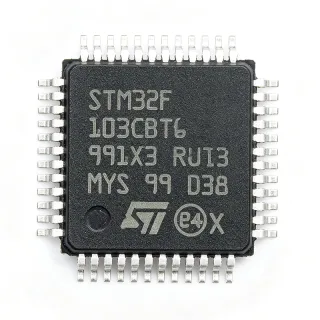
PIC16F15354-E/5NVAO - 8-Bit 32MHz 7KB Flash MCU | Microchip | 28-VQFN
MPN: PIC16F15354-E/5NVAO ✓ Active| Qty | Unit Price | Extended |
|---|---|---|
| 1 | $1.85 | $1.85 |
| 10 | $1.66 | $16.60 |
| 100 | $1.47 | $147.00 |
| 500 | $1.32 | $660.00 |
| 1,000 | $1.18 | $1,180.00 |
PIC16F15354-E/5NVAO Overview
A microcontroller (MCU) is a single-chip computer that integrates a CPU core, program memory (Flash/ROM), data memory (RAM), and configurable peripherals. The PIC16 family belongs to the broader 8-bit microcontroller category, which sits below 16-bit (MSP430) and 32-bit (ARM Cortex-M) architectures in the embedded hierarchy. Within the power-management and mixed-signal landscape, 8-bit MCUs remain popular for cost- and power-sensitive applications such as sensor interfaces, LED control, and simple user-input handling.
Key features include 10-bit ADC, 5-bit DAC, comparators, Core Independent Peripherals (CIPs), PWM modules, Peripheral Module Disable (PMD), and an integrated temperature sensor. The device operates from 2.3V to 5.5V supply, supports eXtreme Low-Power (XLP) modes with nanoWatt technology, and integrates multiple communication peripherals (I2C, SPI, EUSART). The 28-VQFN package with exposed thermal pad delivers a compact 6x6 mm footprint suitable for space-constrained designs.
Architecturally, the PIC16F15354 uses Microchip's enhanced mid-range core with a 14-bit instruction word and 16-level hardware stack. The CIP blocks (CLC, COG, NCO, PWM, DSM) execute deterministic functions without CPU intervention, reducing latency and code complexity. The XLP Sleep mode can reduce current consumption to under 100 nA, making this part suitable for battery-powered and energy-harvesting applications.
Typical applications include automotive body electronics, IoT sensor nodes, consumer white goods, LED lighting control, low-power remote controls, and battery management subsystems. The combination of integrated analog peripherals (10-bit ADC, comparators, 5-bit DAC, temperature sensor) makes it well suited for sensor signal conditioning and closed-loop control loops.
When designing with this MCU, note that the /5NVAO suffix indicates an automotive-grade ordering code; verify AEC-Q100 qualification status with the manufacturer. For production programming, the device supports in-circuit serial programming (ICSP) via PGED/PGEC pins. The 28-VQFN exposed pad must be soldered to the PCB ground plane for thermal dissipation and electrical performance.
This page synthesizes distributor pricing, drop-in alternatives drawn from the same PIC16F153xx family, and practical design notes for automotive and low-power applications, providing information gain beyond what is in the manufacturer datasheet alone.
Drop-in alternatives for PIC16F15354-E/5NVAO — same package, pin-to-pin compatible. Different-package parts requiring PCB rework are excluded.
Variants in this series
Same-series models that are drop-in compatible with PIC16F15354-E/5NVAO (same form factor and footprint) — differing in Package, ADC, Operating Temperature, Program Memory (Flash), Comparators.
Quick Comparison Tool — Select alternative parts for side-by-side comparison:
PIC16F15344-E/5NVAO
✅ Drop-In📋 Reference alternative (not in catalog)
PIC16F15355-E/5NVAO
✅ Drop-In📋 Reference alternative (not in catalog)
PIC16F15345-E/SS
✅ Drop-In✓ In Stock
$1.05 / Unit
View Datasheet →PIC16F15276-I/PT
✅ Drop-In✓ In Stock
$1.2 / Unit
View Datasheet →PIC16F15324-I/P
✅ Drop-In✓ In Stock
$0.58 / Unit
View Datasheet →PIC16F15354-E/5NVAO Maximum Ratings & Electrical Characteristics
| Core Architecture | 8-bit PIC enhanced mid-range |
| CPU Speed | 32 MHz (max) |
| Program Memory (Flash) | 7 KB (4K x 14 words) |
| Data RAM | 512 bytes |
| Data EEPROM | 256 bytes |
| Package | 28-VQFN (6x6 mm) with exposed pad |
| Pin Count | 28 |
| Operating Voltage | 2.3 V to 5.5 V |
| ADC | 10-bit, multiple channels |
| DAC | 5-bit |
| Comparators | Yes |
| PWM Modules | Yes (multiple) |
| Core Independent Peripherals (CIPs) | Yes (CLC, COG, NCO, DSM) |
| Temperature Sensor | Integrated |
| Communication Interfaces | I2C, SPI, EUSART (configurable) |
| Low-Power Technology | eXtreme Low-Power (XLP) with nanoWatt |
| Operating Temperature | -40C to +125C (extended, /5NVAO suffix) |
| Mounting Type | Surface Mount |
| RoHS Status | Compliant |
PIC16F15354-E/5NVAO 28-vqfn (6x6 mm) with exposed pad Pin Configuration Guide
Pin configuration for PIC16F15354-E/5NVAO (28-vqfn (6x6 mm) with exposed pad package). This digital IC includes GPIO, communication interfaces (UART, SPI, I2C), and power pins. Refer to the manufacturer datasheet for alternate pin functions and configuration options. Essential for embedded system design and PCB layout.

No detailed pinout data available for PIC16F15354-E/5NVAO.
Refer to the datasheet for full pin configuration.
Typical Applications
PIC16F15354-E/5NVAO is suitable for 6 applications: Automotive Body Electronics, Low-Power IoT Sensor Nodes, LED Lighting Control, Consumer White Goods, Battery Management Systems, Remote Controls and HMI.
Automotive Body Electronics
The PIC16F15354-E/5NVAO is well-suited for automotive body electronics modules such as interior lighting controllers, seat adjustment switches, mirror controllers, and HVAC damper actuators. Its 32 MHz core and 10-bit ADC enable fast sensor readout (less than 1 us conversion), while the 5-bit DAC supports PWM-driven LED dimming with smooth brightness transitions. The integrated temperature sensor eliminates external components for thermal monitoring in cabin modules. The /5NVAO automotive ordering code indicates AEC-Q100 qualification, and the -E temperature grade (-40C to +125C) handles under-hood and cabin environments. The 28-VQFN 6x6 mm package with exposed pad allows compact PCB layouts in space-constrained modules. Pair with a CAN transceiver (e.g., MCP2515) for body-network connectivity; the EUSART peripheral on the PIC16F15354 supports standard automotive bus rates up to 1 Mbps.
Recommended
Low-Power IoT Sensor Nodes
The PIC16F15354-E/5NVAO excels in battery-powered wireless sensor nodes for home automation, building management, and agricultural monitoring. Its eXtreme Low-Power (XLP) Sleep mode draws less than 100 nA with full RAM retention, allowing multi-year operation from a single CR2032 coin cell. The 10-bit ADC and integrated temperature sensor support periodic environmental sampling; the core wakes from Sleep via the Watchdog Timer or external interrupt, takes a measurement in approximately 25 us, transmits via EUSART to a sub-GHz radio module, and returns to Sleep. CIPs such as the NCO can generate precise timing pulses without CPU intervention, further reducing average current. The 7 KB Flash accommodates application firmware plus simple sensor calibration libraries. Pair with a low-power RF module such as the MRF89XA or LoRa transceiver for long-range connectivity.
Recommended
LED Lighting Control
The PIC16F15354-E/5NVAO drives multi-channel LED lighting fixtures with smooth dimming and color-mixing capabilities. Its multiple PWM modules (with up to 16-bit resolution) generate precise duty cycles for RGB and tunable-white LED strings, achieving flicker-free dimming down to 0.1% without perceivable artifacts. The 5-bit DAC and comparators enable closed-loop current regulation, maintaining constant LED brightness across temperature variations. Core Independent Peripherals (CIPs) such as the Complementary Output Generator (COG) and Data Signal Modulator (DSM) generate high-frequency switching waveforms for synchronous buck or boost LED drivers without CPU load. The 32 MHz core and 7 KB Flash support DMX512 or DALI receive stacks for professional lighting control. Pair with a constant-current LED driver such as the CL88030 or AL8860 to complete the lighting subsystem.
Recommended
Consumer White Goods
The PIC16F15354-E/5NVAO controls user-interface panels and motor subsystems in consumer white goods such as washing machines, dishwashers, refrigerators, and microwave ovens. Its 10-bit ADC reads multiple sensor inputs (temperature, humidity, water level, door state) within microseconds, while the comparators detect threshold events for over-temperature or overflow protection. The PWM modules drive brushless DC (BLDC) or universal motors through external gate drivers, and the Core Independent Peripherals generate commutation timing with microsecond accuracy. The 28-VQFN package withstands the thermal cycling of appliance environments, and the -40C to +125C operating range covers both indoor and outdoor appliance deployments. Pair with a motor driver such as the DRV8870 or MTD6501 for variable-speed control.
Recommended
Battery Management Systems
The PIC16F15354-E/5NVAO serves as the supervisory controller in single-cell lithium-ion or multi-cell NiMH battery packs for portable electronics and power tools. Its 10-bit ADC monitors cell voltage (typically 2.5-4.2 V for Li-ion) and charge current through external sense resistors, while the integrated temperature sensor detects pack overheating. The 5-bit DAC and PWM modules control external charging FETs to implement constant-current/constant-voltage (CC-CV) charging profiles without dedicated charger ICs. Core Independent Peripherals (CIPs) such as the Numerically Controlled Oscillator (NCO) and Configurable Logic Cells (CLC) provide hardware-level over-current and over-voltage protection that triggers within 100 ns, independent of firmware execution. The XLP Sleep mode preserves battery life during storage, drawing less than 100 nA. Pair with a fuel gauge IC such as the MCP3421 for coulomb counting.
Recommended
Remote Controls and HMI
The PIC16F15354-E/5NVAO forms the core of low-cost infrared and radio-frequency remote controls for TVs, set-top boxes, smart speakers, and industrial HMI panels. Its 32 MHz core executes consumer IR protocols (RC-5, NEC, SIRC) and RF protocols (BLE, proprietary) within tight timing margins, and the 7 KB Flash accommodates multiple protocol stacks. The PWM modules drive IR LEDs at 38-56 kHz carrier frequencies with programmable duty cycles, while the EUSART interfaces with RF modules. The integrated temperature sensor provides ambient compensation for touch-button capacitance measurements via the comparators. XLP Sleep modes extend battery life to multi-year operation on coin cells. Pair with a sub-GHz transmitter (e.g., MICRF112) or IR LED driver for complete remote-control subsystems.
Recommended
Recommended Products Summary
Engineering reference data for PIC16F15354-E/5NVAO — comparison, design guidance, and compliance information.
Selection Guide
Comparison with Alternatives
| Parameter | This Product | PIC16F15344-E/5NVAO | PIC16F15355-E/5NVAO | PIC16F15345-E/SS | PIC16F15276-I/PT | PIC16F15324-I/P |
|---|---|---|---|---|---|---|
| Brand | Microchip Technology | Microchip Technology | Microchip Technology | Microchip Technology | Microchip Technology | Microchip Technology |
| Package | 28-VQFN (6x6 mm) | 28-VQFN (6x6 mm) - same | 28-VQFN (6x6 mm) - same | 28-SSOP (different footprint, NOT VQFN) | 28-VQFN (6x6 mm) - same | 28-VQFN (6x6 mm) - same |
| CPU Speed | 32 MHz | 32 MHz | 32 MHz | 32 MHz | 20 MHz | 32 MHz |
| Flash Memory | 7 KB | 3.5 KB | 14 KB | 14 KB | 14 KB | 7 KB |
| RAM | 512 B | 256 B | 1 KB | 1 KB | 1 KB | 256 B |
| ADC Resolution | 10-bit | 10-bit | 10-bit | 10-bit | 10-bit | 10-bit |
| DAC | 5-bit | 5-bit | 5-bit | 5-bit | No DAC | 5-bit |
| AEC-Q100 Automotive | Yes (/5NVAO) | Yes (/5NVAO) | Yes (/5NVAO) | No (industrial grade) | No (industrial grade) | No (industrial grade) |
| Operating Voltage | 2.3 V to 5.5 V | 2.3 V to 5.5 V | 2.3 V to 5.5 V | 2.3 V to 5.5 V | 1.8 V to 5.5 V | 2.3 V to 5.5 V |
| Core Independent Peripherals | CLC, COG, NCO, DSM (full set) | CLC, COG, NCO, DSM (full set) | CLC, COG, NCO, DSM (full set) | CLC, COG, NCO, DSM (full set) | Reduced (no CLC/COG/NCO) | Limited set |
Key Differentiators
- Full CIP peripheral set with CLC, COG, NCO, DSM (vs PIC16F15276-I/PT)
- Automotive AEC-Q100 grade with -40C to +125C operation (vs PIC16F15345-E/SS)
- 32 MHz CPU vs 20 MHz in PIC16F15276 family (vs PIC16F15276-I/PT)
Design Notes
Estimated: At VDD = 5 V and 32 MHz active CPU clock, the PIC16F15354-E/5NVAO consumes approximately 7 mA (typical per Microchip datasheet DS40002395). In Sleep mode with XLP enabled, current drops below 100 nA, enabling multi-year battery life from a CR2032 coin cell (235 mAh). For sensor-node duty cycling, activate the Watchdog Timer at 16 ms intervals and wake for sub-millisecond ADC conversions before returning to Sleep; this pattern typically achieves average current under 10 uA. Use the Peripheral Module Disable (PMD) registers to gate unused peripherals such as PWM or EUSART to further reduce active current. Decoupling should include a 100 nF ceramic capacitor placed within 5 mm of the VDD pin, plus a bulk 4.7 uF tantalum or ceramic cap on the main rail.
The 28-VQFN (6x6 mm) package requires careful PCB layout due to its bottom-side exposed thermal pad. The exposed pad MUST be soldered to a ground plane with at least 8 thermal vias (0.3 mm drill, 0.6 mm pad) connecting to inner ground layers for heat dissipation and electrical grounding. According to Microchip's package specification, a missing or poorly soldered exposed pad can increase junction-to-ambient thermal resistance (theta_JA) by 50% or more, leading to thermal issues at high CPU loading. Use NSMD (Non-Solder Mask Defined) pads for the perimeter pins with 0.25 mm pitch tolerance, and route high-speed signals (PGED/PGEC for ICSP, EUSART) as 50-ohm impedance-controlled traces. Place the ICSP header at the board edge for production programming access.
Common pitfalls with the PIC16F15354-E/5NVAO include: (1) Forgetting to set the CONFIG words for clock source and oscillator selection - the device ships with internal oscillator disabled by default, causing apparent 'dead' units; always program CONFIG1 with the FOSC field set to appropriate oscillator mode before first use. (2) Mixing up RA5 and RA4 on the 28-VQFN pinout - Pin 1 is RA5, not RA0, which differs from some competing 28-pin QFN packages. (3) Exceeding the 5.5 V absolute maximum on any I/O pin, which can latch up the device. (4) Not enabling the brown-out reset (BOR) module, leading to undefined behavior during slow power-up. (5) Using the /5NVAO automotive variant without proper PCB-level ESD protection on external connector pins.
For designs using the EUSART peripheral at high baud rates (above 500 kbps), keep trace lengths below 50 mm and route EUSART signals away from PWM outputs and switching power converter nodes. The PIC16F15354's I/O pins have edge rates of approximately 5 ns, which can introduce crosstalk on adjacent signal traces; maintain at least 3x dielectric spacing between high-speed digital signals and analog sensor inputs (ADC channels). When using the ADC, place a 10 nF ceramic bypass capacitor at the AVDD pin (or share VDD with adequate filtering if AVDD is bonded internally). Reference Microchip application note AN234 for ADC layout best practices on PIC microcontrollers.
Compliance Information
RoHS and REACH compliant per Microchip product page. AEC-Q100 qualified for automotive applications based on the /5NVAO ordering code suffix.