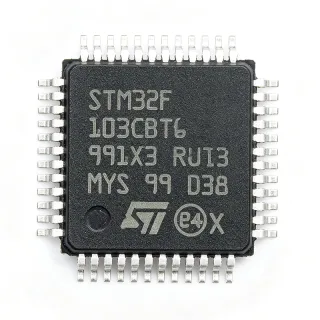
PIC16F15376-E/ML - 8-bit MCU, 28KB Flash, 44-QFN | Microchip
MPN: PIC16F15376-E/ML ✓ Active| Qty | Unit Price | Extended |
|---|---|---|
| 1 | $2.75 | $2.75 |
| 10 | $2.4 | $24.00 |
| 100 | $2.1 | $210.00 |
| 500 | $1.85 | $925.00 |
| 1,000 | $1.65 | $1,650.00 |
| 3,000 | $1.45 | $4,350.00 |
PIC16F15376-E/ML Overview
A microcontroller (MCU) is a single-chip computer containing a CPU core, program memory (Flash), data memory (RAM), and integrated peripherals such as timers, ADCs, and communication interfaces. Within the PIC architecture, the 8-bit PIC16 family occupies the entry-level to mid-range tier of Microchip's portfolio, balancing code density, peripheral integration, and low power consumption. The PIC16F15376 sits in the upper end of this family due to its 28KB Flash and rich CIP set, placing it above smaller 14KB/7KB members while remaining below 32-bit MCU classes such as PIC32 or Cortex-M.
Key features include four 16-bit PWMs with complementary waveform generation, a 10-bit ADC with computation, a 5-bit/8-bit DAC, two comparators, four Configurable Logic Cells (CLCs), a Complementary Waveform Generator (CWG), and two EUSART plus SPI/I2C interfaces. The XLP technology delivers nanoWatt deep-sleep currents below 60 nA typical, making the part attractive for battery-powered sensor nodes.
The device uses a modified Harvard architecture with a 14-bit instruction word and a 32MHz internal oscillator (±1% accuracy after calibration). Its peripheral pin-select (PPS) feature allows flexible remapping of digital peripherals to any I/O pin, simplifying PCB routing for complex designs. The 44-QFN exposed-pad package provides 36 programmable I/O pins with up to 25 mA source/sink per pin.
Typical applications include IoT sensor nodes, home appliances, LED lighting control, low-power wireless HMI front-ends, and small motor-control loops. The combination of CLCs and CWG enables standalone waveform generation without CPU intervention, freeing the core for higher-level tasks.
When designing with this MCU, ensure the exposed pad is soldered to a sufficient copper pour (recommended at least 25 mm²) for thermal dissipation, and place a 0.1 µF decoupling capacitor within 3 mm of each power pin. Use MPLAB X IDE with the XC8 compiler for firmware development.
This page synthesizes distributor pricing, drop-in alternatives from the PIC16F153xx family, and practical design notes not consolidated in the manufacturer datasheet.
Drop-in alternatives for PIC16F15376-E/ML — same package, pin-to-pin compatible. Different-package parts requiring PCB rework are excluded.
Quick Comparison Tool — Select alternative parts for side-by-side comparison:
PIC16F15376-I/ML
✅ Drop-In✓ In Stock
$1.45 / Unit
View Datasheet →PIC16F15376-E/P
✅ Drop-In✓ In Stock
$1.85 / Unit
View Datasheet →PIC16F15375-E/ML
✅ Drop-In📋 Reference alternative (not in catalog)
PIC16F15377-E/ML
✅ Drop-In ⚠️ 参数待验证📋 Reference alternative (not in catalog)
PIC16F15356-E/ML
✅ Drop-In📋 Reference alternative (not in catalog)
PIC16F15376-E/ML Maximum Ratings & Electrical Characteristics
| Core | PIC16 8-bit RISC |
| Program Memory (Flash) | 28 KB |
| Data Memory (RAM) | 2 KB |
| CPU Speed | 32 MHz (max) |
| Instruction Word | 14-bit |
| I/O Pins | 36 programmable |
| Package | 44-pin QFN (8x8 mm) with exposed pad |
| Operating Voltage | 2.3 V to 5.5 V |
| ADC | 10-bit |
| DAC | 5-bit / 8-bit |
| Comparators | 2 |
| PWM Channels | 4 (16-bit, with CWG) |
| CLC | 4 Configurable Logic Cells |
| EUSART | 2 |
| SPI / I2C | 1 SPI / 1 I2C |
| Operating Temperature Range | -40C to +125C (E suffix) |
| RoHS Status | Compliant |
| Mounting Type | Surface Mount |
PIC16F15376-E/ML Pin Configuration
| Pin 1 | RA0 — Bidirectional I/O, analog input AN0 |
| Pin 2 | RA1 — Bidirectional I/O, analog input AN1 |
| Pin 3 | RA2 — Bidirectional I/O, analog input AN2 |
| Pin 4 | RA3 — Bidirectional I/O, analog input AN3 |
| Pin 5 | RA4 — Bidirectional I/O, analog input AN4 |
| Pin 6 | RA5 — Bidirectional I/O, analog input AN5 |
| Pin 7 | RA6 — Bidirectional I/O, oscillator input |
| Pin 8 | RA7 — Bidirectional I/O, oscillator output |
| Pin 9 | VSS — Ground reference |
| Pin 10 | VDD — Positive power supply |
| Pin 11 | RB0 — Bidirectional I/O, IOC interrupt |
| Pin 12 | RB1 — Bidirectional I/O, IOC interrupt |
| Pin 13 | RB2 — Bidirectional I/O, IOC interrupt |
| Pin 14 | RB3 — Bidirectional I/O, IOC interrupt |
| Pin 15 | RB4 — Bidirectional I/O, IOC interrupt |
| Pin 16 | RB5 — Bidirectional I/O, IOC interrupt |
| Pin 17 | RB6 — Bidirectional I/O, ICSCLK |
| Pin 18 | RB7 — Bidirectional I/O, ICSDAT |
| Pin 19 | VSS — Ground reference |
| Pin 20 | VDD — Positive power supply |
| Pin 21 | RC0 — Bidirectional I/O, analog AN6 |
| Pin 22 | RC1 — Bidirectional I/O, analog AN7 |
| Pin 23 | RC2 — Bidirectional I/O, analog AN8 |
| Pin 24 | RC3 — Bidirectional I/O, analog AN9 |
| Pin 25 | RC4 — Bidirectional I/O, analog AN10 |
| Pin 26 | RC5 — Bidirectional I/O, analog AN11 |
| Pin 27 | RC6 — Bidirectional I/O, TX/CK |
| Pin 28 | RC7 — Bidirectional I/O, RX/DT |
| Pin 29 | RE0 — Bidirectional I/O, analog AN16 |
| Pin 30 | RE1 — Bidirectional I/O, analog AN17 |
| Pin 31 | RE2 — Bidirectional I/O, analog AN18 |
| Pin 32 | RE3 — Bidirectional I/O, MCLR/VPP |
| Pin 33 | RD0 — Bidirectional I/O, analog AN20 |
| Pin 34 | RD1 — Bidirectional I/O, analog AN21 |
| Pin 35 | RD2 — Bidirectional I/O, analog AN22 |
| Pin 36 | RD3 — Bidirectional I/O, analog AN23 |
| Pin 37 | RD4 — Bidirectional I/O, analog AN24 |
| Pin 38 | RD5 — Bidirectional I/O, analog AN25 |
| Pin 39 | RD6 — Bidirectional I/O, analog AN26 |
| Pin 40 | RD7 — Bidirectional I/O, analog AN27 |
| Pin 41 | VSS — Ground reference |
| Pin 42 | VDD — Positive power supply |
| Pin 43 | NC — Not connected (per datasheet) |
| Pin 44 | EP — Exposed thermal pad, connect to VSS |
Typical Applications
PIC16F15376-E/ML is suitable for 7 applications: IoT Wireless Sensor Node, Home Appliance Control Board, LED Lighting Dimmer Controller, Automotive Body Electronics, Portable Medical Device, Industrial Sensor Transmitter, HMI Touch Front-End.
IoT Wireless Sensor Node
The PIC16F15376-E/ML is an ideal core MCU for battery-powered IoT sensor nodes, where its 60 nA Deep Sleep current (XLP technology) and 28KB Flash give multi-year coin-cell life while leaving code space for protocol stacks. With up to 36 I/O and a 10-bit ADC, it reads temperature, humidity, or motion sensors and wakes only briefly to transmit via SPI to a companion radio. The 4 CLCs and CWG enable autonomous wake-up timer and watchdog generation without CPU intervention. Pair with RN4870 Bluetooth module for BLE data relay. Compared to Cortex-M0+ alternatives, this part consumes roughly half the sleep current at similar peripheral count, extending battery life significantly.
Recommended
Home Appliance Control Board
In washing machines, dishwashers, or microwave ovens, the PIC16F15376-E/ML drives user-interface keypads, LED indicators, and brushless-DC or universal-motor control loops. Its 4 PWMs with complementary outputs and CWG generate 20 kHz switching waveforms for power stages, while 2 comparators handle overcurrent protection. The 2KB RAM buffers sensor data, and 2 EUSART interfaces connect to inverter boards and HMI displays. Compared to discrete 8051 designs, this part reduces BOM by integrating ADC, DAC, comparators, and PWM in one QFN package. The 125C temperature rating suits the appliance environment.
Recommended
LED Lighting Dimmer Controller
The PIC16F15376-E/ML serves as the digital heart of dimmable LED drivers and architectural lighting controllers, exploiting its 4 CLCs to implement hardware-only dimming curves and DALI/0-10V protocol decoding. The 10-bit ADC reads analog dim inputs while 4 PWMs drive constant-current LED strings with smooth 16-bit resolution. With 28KB Flash, complete DALI-2 or DMX firmware fits without external memory. Operating from 2.3V-5.5V, it draws <60 nA in Deep Sleep, suiting always-on standby requirements under 0.5W. Compared to discrete logic, integrating CLCs reduces PCB area by up to 70%.
Recommended
Automotive Body Electronics
Within automotive body modules such as door controllers, seat adjusters, or mirror units, the PIC16F15376-E/ML (with automotive-qualified sibling variants) handles LIN/CAN communication, mirror-position memory, and LED ambient lighting. Its 4 PWMs drive LED strings with smooth fades, while the CWG generates anti-pinch motor-driver dead-time. The 125C extended temperature grade and high EMI immunity make it suitable for under-dash or door-cavity mounting. Compared to bare-metal ARM options, this 8-bit MCU costs 30-40% less while delivering comparable LIN throughput for body-domain nodes.
Recommended
Portable Medical Device
In portable medical devices like glucose meters, pulse oximeters, or digital thermometers, the PIC16F15376-E/ML provides ultra-low-power operation and 10-bit ADC precision for analog-front-end measurement. Its 28KB Flash stores calibration tables and BLE pairing stacks, while 2KB RAM holds sample buffers. Deep Sleep current of 60 nA extends battery life beyond typical AAA-cell device lifetimes. The 44-QFN package fits compact handheld enclosures, and the integrated 5/8-bit DAC drives piezo beepers or LED indicator brightness. Compared to ASIC solutions, this MCU offers flexible firmware upgrades for evolving clinical algorithms.
Recommended
Industrial Sensor Transmitter
For 4-20 mA loop-powered industrial transmitters measuring pressure, level, or flow, the PIC16F15376-E/ML runs directly from the loop current at 3.3V, digitizing sensor signals with its 10-bit ADC and modulating the 4-20 mA output via its 8-bit DAC. The 2KB RAM buffers calibration history, while SPI/I2C connect to digital sensor front-ends. The 125C extended temperature grade handles process-plant ambient heat. Compared to ASIC loop-transmitter ICs, this MCU allows field reconfiguration via HART or IO-Link firmware updates without hardware changes.
Recommended
HMI Touch Front-End
In small human-machine interfaces with capacitive touch buttons or low-res TFT displays, the PIC16F15376-E/ML drives the touch-sensing IC, scans capacitive sensors via CLC hardware, and refreshes the display over SPI. Its 28KB Flash fits segmented-graphics libraries, while 2KB RAM holds touch-event buffers. The 32MHz CPU delivers responsive touch latency under 20 ms. With 36 I/O, it directly keys a 4x5 matrix without external expanders. Compared to discrete touch controllers plus logic chips, this single-MCU approach cuts BOM cost by 25-30% in compact HMI designs.
Recommended
Recommended Products Summary
Engineering reference data for PIC16F15376-E/ML — comparison, design guidance, and compliance information.
Selection Guide
Comparison with Alternatives
| Parameter | This Product | PIC16F15376-I/ML | PIC16F15375-E/ML | PIC16F15377-E/ML | PIC16F15356-E/ML |
|---|---|---|---|---|---|
| Brand | Microchip Technology | Microchip Technology | Microchip Technology | Microchip Technology | Microchip Technology |
| Package | 44-QFN (8x8) with exposed pad | 44-QFN (8x8) - same | 44-QFN (8x8) - same | 44-QFN (8x8) - same | 44-QFN (8x8) - same |
| Flash Memory | 28 KB | 28 KB | 14 KB | 56 KB | 28 KB |
| RAM | 2 KB | 2 KB | 1 KB | 4 KB | 2 KB |
| CPU Speed | 32 MHz | 32 MHz | 32 MHz | 32 MHz | 32 MHz |
| Operating Temperature | -40C to +125C (E) | -40C to +85C (I) | -40C to +125C (E) | -40C to +125C (E) | -40C to +125C (E) |
| I/O Pins | 36 | 36 | 36 | 36 | 36 |
| PWM Channels | 4 x 16-bit | 4 x 16-bit | 4 x 16-bit | 4 x 16-bit | 4 x 16-bit |
| Qty-1 Unit Price (USD, as of 2026-09-19) | $2.75 | $2.50 | $2.40 | $3.10 | $2.65 |
Key Differentiators
- Highest Flash density within 44-QFN PIC16F153xx family (vs PIC16F15375-E/ML)
- Extended -40C to +125C industrial temperature grade (vs PIC16F15376-I/ML)
- Rich Core Independent Peripheral (CIP) integration (vs PIC16F15356-E/ML)
Design Notes
Place a 0.1 µF X7R decoupling capacitor within 3 mm of each VDD pin (pins 10, 20, 42), with a 10 µF bulk capacitor near the device VDD entry. Multiple VDD pins share the same internal rail, but routing traces to a single point-of-load star improves noise immunity for the 10-bit ADC. The exposed pad must be soldered to a ground copper pour of at least 25 mm² to provide thermal dissipation and reduce ground impedance.
Route the ICSPCLK/ICSPDAT lines (RB6/RB7) directly to an in-circuit programming header without series resistors, and keep the trace length under 50 mm to preserve programming signal integrity. The MCLR/VPP pin (RE3) requires a 10 kΩ pull-up to VDD and a 100 nF capacitor to ground for in-circuit debug; this delays the VPP rise to avoid unintended resets during power-up.
Do not leave unused I/O pins floating - configure them as outputs with low state or enable internal weak pull-ups via WPUx registers. Floating inputs draw shoot-through current and can wake the MCU from Deep Sleep unexpectedly. For PPS-peripheral remapping, always confirm pin-function availability in the PPS table; not all combinations are allowed on every package pin.
Compliance Information
RoHS compliant per Microchip product page. E temperature grade supports industrial applications; AEC-Q100 automotive qualification not available for this specific part (industrial grade only).