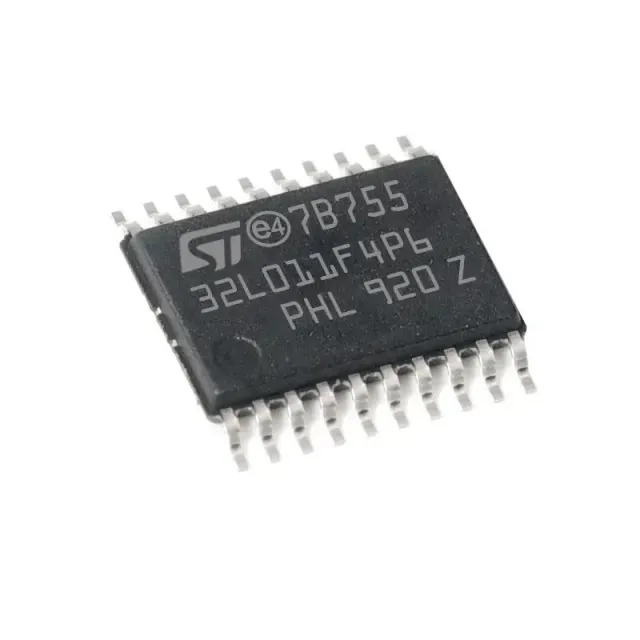
STM32L011F4P6 - Ultra-Low-Power ARM Cortex-M0+ MCU | STMicroelectronics
MPN: STM32L011F4P6 ✓ Active| Qty | Unit Price | Extended |
|---|---|---|
| 1 | $1.3636 | $1.36 |
| 10 | $0.9848 | $9.85 |
| 100 | $0.8712 | $87.12 |
| 500 | $0.8333 | $416.65 |
| 1,000 | $0.7955 | $795.50 |
Drop-in alternatives for STM32L011F4P6 — same package, pin-to-pin compatible. Different-package parts requiring PCB rework are excluded.
Quick Comparison Tool — Select alternative parts for side-by-side comparison:
STM32L011F3P6
📋 Reference alternative (not in catalog)
STM32L011F4P6TR
📋 Reference alternative (not in catalog)
STM32L011G4U6
📋 Reference alternative (not in catalog)
LPC812M101JDH16
📋 Reference alternative (not in catalog)
EFM8BB10F8G-A-QFN20
📋 Reference alternative (not in catalog)
STM32L011F4P6 Maximum Ratings & Electrical Characteristics
| Core | ARM Cortex-M0+ |
| Maximum Clock Frequency | 32 MHz |
| Flash Memory | 16 KB |
| SRAM | 2 KB |
| Supply Voltage Range | 1.8 V to 3.6 V |
| Operating Temperature Range | -40°C to +85°C |
| Package | TSSOP-20 (P) |
| Mounting Type | Surface Mount |
| ADC Resolution | 12-bit |
| ADC Sampling Rate | 1 Msps |
| Communication Interfaces | I2C, SPI, USART |
| Timers | Multiple (including basic, general-purpose, and low-power timers) |
| Real-Time Clock (RTC) | Yes |
| Low-Power UART | Yes |
| Unique Device ID | Yes |
| Stop Mode Current (with RTC) | 0.23 µA (typical) |
| RoHS Status | Compliant |
STM32L011F4P6 Pin Configuration
| Pin 1 | VBAT — Backup power supply for RTC and backup registers |
| Pin 2 | PC14 — I/O or OSC32_IN (32.768 kHz crystal input) |
| Pin 3 | PC15 — I/O or OSC32_OUT (32.768 kHz crystal output) |
| Pin 4 | NRST — Reset (active low) |
| Pin 5 | VSS — Ground |
| Pin 6 | VDDA — Analog power supply |
| Pin 7 | PA0 — I/O or ADC_IN0 |
| Pin 8 | PA1 — I/O or ADC_IN1 |
| Pin 9 | PA2 — I/O or USART2_TX |
| Pin 10 | PA3 — I/O or USART2_RX |
| Pin 11 | PA4 — I/O or SPI1_NSS |
| Pin 12 | PA5 — I/O or SPI1_SCK |
| Pin 13 | PA6 — I/O or SPI1_MISO |
| Pin 14 | PA7 — I/O or SPI1_MOSI |
| Pin 15 | PB0 — I/O or ADC_IN8 |
| Pin 16 | PB1 — I/O or ADC_IN9 |
| Pin 17 | VDD — Power supply |
| Pin 18 | PB3 — I/O or SPI1_SCK (alternate) |
| Pin 19 | PB4 — I/O or SPI1_MISO (alternate) |
| Pin 20 | PB5 — I/O or I2C1_SMBA |
Safe Operating Area (SOA) & Thermal Characteristics
No official SOA curve available for this digital IC. Always operate within absolute maximum ratings specified in the datasheet. Ensure adequate cooling and derate as needed.
Typical Applications
STM32L011F4P6 is suitable for 6 applications: Portable Medical Devices, Smart Sensors, IoT Nodes, Industrial Monitoring, Wearable Devices, Energy Harvesting Systems.
Portable Medical Devices
The STM32L011F4P6 is ideal for portable medical devices such as glucose meters, pulse oximeters, and wearable health monitors. Its ultra-low power consumption (0.23 µA in Stop mode) extends battery life, while the 12-bit ADC enables accurate sensor readings. The small TSSOP-20 package fits compact designs, and the wide supply voltage range (1.8V-3.6V) allows direct battery operation. In a typical glucose meter, the MCU reads the sensor via the ADC, processes the data, and displays results on an LCD, all while maintaining minimal power draw to preserve battery life.
Recommended
Smart Sensors
The STM32L011F4P6 is well-suited for smart sensors in industrial and building automation. Its multiple low-power modes and fast wake-up time enable energy-efficient operation, while the I2C, SPI, and USART interfaces allow connection to various sensors and actuators. The 12-bit ADC can digitize analog sensor outputs, and the RTC provides time-stamping for data logging. In a smart thermostat, the MCU reads temperature and humidity sensors, processes the data, and communicates with a central hub via UART, all while consuming minimal power to meet energy efficiency standards.
Recommended
IoT Nodes
The STM32L011F4P6 is an excellent choice for IoT nodes that require long battery life and reliable connectivity. Its ultra-low-power Stop mode (0.23 µA) allows devices to sleep for extended periods, waking only to transmit data. The device supports multiple communication interfaces, enabling connection to Wi-Fi, Bluetooth, or LoRa modules. The unique device ID can be used for secure authentication. In a typical IoT sensor node, the MCU periodically wakes, reads sensors, and sends data via a radio module, then returns to sleep, achieving years of operation on a single coin cell battery.
Recommended
Industrial Monitoring
The STM32L011F4P6 is suitable for industrial monitoring systems that require robust operation in harsh environments. Its operating temperature range of -40°C to +85°C ensures reliability in extreme conditions. The device's multiple timers and ADC enable precise measurement of analog signals, while the USART interface allows connection to industrial networks. In a motor vibration monitoring system, the MCU samples accelerometer data via the ADC, performs basic signal processing, and communicates alerts over a Modbus network, all while maintaining low power consumption for remote installations.
Recommended
Wearable Devices
The STM32L011F4P6 is perfect for wearable devices like fitness trackers and smartwatches. Its small TSSOP-20 package and low power consumption make it ideal for space-constrained, battery-powered designs. The device supports various sensors via I2C/SPI, and its low-power modes allow continuous operation for days or weeks. In a fitness tracker, the MCU reads an accelerometer and heart rate sensor, processes the data, and displays steps and heart rate on an OLED display, all while minimizing power draw to maximize battery life.
Recommended
Energy Harvesting Systems
The STM32L011F4P6 is designed for energy harvesting applications where power is scarce. Its ultra-low-power modes and wide supply voltage range (1.8V-3.6V) allow it to operate directly from solar cells or thermoelectric generators. The device can wake up periodically to take measurements and transmit data, consuming minimal energy. In a wireless sensor node powered by a small solar panel, the MCU manages power, reads sensors, and sends data via a low-power radio, ensuring sustainable operation without batteries.
Recommended
Recommended Products Summary
Engineering reference data for STM32L011F4P6 — comparison, design guidance, and compliance information.
Selection Guide
Comparison with Alternatives
| Parameter | This Product | STM32L011F3P6 | STM32L011F4P6TR | LPC812M101JDH16 |
|---|---|---|---|---|
| Package | TSSOP-20 | TSSOP-20 | TSSOP-20 | TSSOP-20 |
| Brand | STMicroelectronics | STMicroelectronics | STMicroelectronics | NXP Semiconductors |
| Core | ARM Cortex-M0+ | ARM Cortex-M0+ | ARM Cortex-M0+ | ARM Cortex-M0+ |
| Maximum Clock Frequency | 32 MHz | 32 MHz | 32 MHz | 30 MHz |
| Flash Memory | 16 KB | 8 KB | 16 KB | 16 KB |
| SRAM | 2 KB | 2 KB | 2 KB | 4 KB |
| Supply Voltage Range | 1.8V to 3.6V | 1.8V to 3.6V | 1.8V to 3.6V | 1.8V to 3.6V |
| ADC Resolution | 12-bit | 12-bit | 12-bit | 12-bit |
Key Differentiators
- Ultra-low power consumption in Stop mode (0.23 µA) (vs LPC812M101JDH16)
- Wide supply voltage range (1.8V to 3.6V) (vs EFM8BB10F8G-A-QFN20)
- Integrated RTC with dedicated backup domain (vs LPC812M101JDH16)
Design Notes
For ultra-low-power operation, use the Stop mode with RTC enabled, which draws only 0.23 µA. Ensure the power supply is stable and decoupled with a 100 nF capacitor close to the VDD pin. Use the internal low-speed oscillator (LSI) for RTC to avoid external crystal power consumption.
Place decoupling capacitors (100 nF and 4.7 µF) as close as possible to the VDD and VDDA pins. For analog applications, connect VDDA to a clean analog supply and use a ferrite bead to isolate from digital noise. Ensure the ground plane is continuous under the MCU to minimize noise.
Do not exceed the absolute maximum ratings, especially the supply voltage (3.6V). When using the ADC, ensure the sampling time is sufficient for the source impedance. Also, configure the clock system correctly to avoid unexpected behavior; use the internal HSI oscillator for quick startup if external crystal is not needed.
Compliance Information
RoHS compliant per STMicroelectronics product page. Not AEC-Q100 qualified. Halogen-free status not specified in provided data.