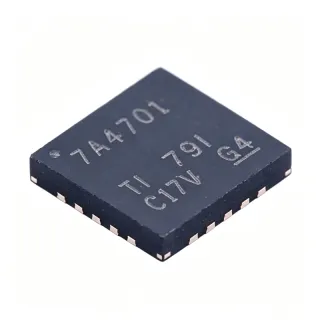
TCAN1051DRBRQ1 - Automotive CAN FD Transceiver | TI
MPN: TCAN1051DRBRQ1 ✓ Active| Qty | Unit Price | Extended |
|---|---|---|
| 1 | $2.1 | $2.10 |
| 10 | $1.89 | $18.90 |
| 100 | $1.62 | $162.00 |
| 500 | $1.38 | $690.00 |
| 1,000 | $1.18 | $1,180.00 |
Drop-in alternatives for TCAN1051DRBRQ1 — same package, pin-to-pin compatible. Different-package parts requiring PCB rework are excluded.
Quick Comparison Tool — Select alternative parts for side-by-side comparison:
TCAN1051VDRBRQ1
✅ Drop-In📋 Reference alternative (not in catalog)
TCAN1051HVDRBRQ1
✅ Drop-In📋 Reference alternative (not in catalog)
TCAN1051GVDRBRQ1
✅ Drop-In ⚠️ 参数待验证📋 Reference alternative (not in catalog)
TCAN1051AVDRBRQ1
✅ Drop-In ⚠️ 参数待验证📋 Reference alternative (not in catalog)
TCAN1051ADRBRQ1
✅ Drop-In ⚠️ 参数待验证📋 Reference alternative (not in catalog)
TCAN1051DRBRQ1 Maximum Ratings & Electrical Characteristics
| Function | CAN transceiver, half duplex |
| Protocol | CAN / CAN FD (flexible data-rate) |
| Data Rate | 2 Mbps |
| Supply Voltage | 5 V |
| Operating Temperature Range | -55C to +125C |
| Package | VSON (DRB), 8 pins, 3x3 mm |
| Mounting Type | Surface Mount |
| Number of Drivers/Receivers | 1 / 1 |
| Automotive Qualification | AEC-Q100 (Q1) |
| Fault Protection | Automotive fault-protected CAN bus pins |
| Sleep Mode | Yes |
| Duplex | Half |
| Package Height | 1.00 mm |
| Package Code | HVSON |
| Receiver Type | Half |
TCAN1051DRBRQ1 Pin Configuration
| Pin 1 | TXD — Transmit data input from CAN controller |
| Pin 2 | GND — Ground reference |
| Pin 3 | VCC — 5 V supply voltage |
| Pin 4 | RXD — Receive data output to CAN controller |
| Pin 5 | S — Sleep/standby mode control input |
| Pin 6 | CANL — CAN low differential bus line (fault protected) |
| Pin 7 | CANH — CAN high differential bus line (fault protected) |
| Pin 8 | NC — Not connected (per datasheet) |
Safe Operating Area (SOA) & Thermal Characteristics
No official SOA curve available for this digital IC. Always operate within absolute maximum ratings specified in the datasheet. Ensure adequate cooling and derate as needed.
Typical Applications
TCAN1051DRBRQ1 is suitable for 6 applications: Body Control Modules, Automotive Gateways, Battery Management Systems, Industrial CAN Networks, ADAS Sensor Modules, Agricultural and Off-Highway Vehicles.
Body Control Modules
Body control modules (BCMs) aggregate dozens of loads and switches over a CAN network that stays partially powered with the ignition off, making the TCAN1051DRBRQ1 an excellent fit. Its integrated sleep mode minimizes standby current, while AEC-Q100 qualification and the -55C to +125C range cover under-dash thermal conditions. The fault-protected CANH/CANL pins survive wiring-harness short circuits to battery or ground - a common real-world event in door and lighting harnesses - reducing field failure rates. In the signal chain, the transceiver connects the MCU CAN controller (TXD/RXD) to the twisted-pair bus at up to 2 Mbps for CAN FD frames used in newer BCM platforms. The 3x3 mm VSON DRB package conserves PCB area in space-constrained BCM boards.
Recommended
Automotive Gateways
Vehicle gateways bridge multiple CAN and CAN FD domains at data rates up to 2 Mbps, and the TCAN1051DRBRQ1 provides the physical layer for one or more of those channels. Its flexible data-rate support keeps the node forward-compatible with CAN FD frames while remaining backward-compatible with classic CAN traffic. Fault protection on the bus pins is essential at the gateway, where a single failed ECU or chafed harness can impose DC fault conditions on a shared bus segment; the TCAN1051-Q1 family tolerates these events without latching damage. Sleep mode supports the gateway's role in network power management, biasing and releasing bus segments on demand. The -55C to +125C rating and HVSON 8-pin 3x3 mm package suit the dense, thermally loaded gateway PCB.
Recommended
Battery Management Systems
In EV and hybrid battery management systems, CAN is the primary communication backbone between the BMS master, cell supervisors, and the vehicle controller. The TCAN1051DRBRQ1 fits this role because its 5 V CAN FD physical layer sustains 2 Mbps traffic for fast state-of-health reporting, and its fault-protected bus pins tolerate the high-voltage creepage and isolation fault events characteristic of high-voltage battery environments. Sleep mode aligns with the BMS's ultra-low quiescent current budget during parking and transport modes, where every milliamp drains the 12 V battery over weeks. The AEC-Q100 qualified -55C to +125C range accommodates battery-pack thermal excursions. Companion devices such as the BQ76952 battery monitor and ADS131M08 ADC form the sensing front end around this transceiver.
Recommended
Industrial CAN Networks
Industrial machinery, elevators, and agricultural equipment use CAN or CAN FD buses for distributed control, and the TCAN1051DRBRQ1 serves these nodes despite its automotive suffix, since its -55C to +125C range and robust fault protection exceed industrial requirements. In such networks, cable runs pass near motor drives and contactors, so the transceiver's fault tolerance and differential signaling maintain communication integrity amid transients. Sleep mode is valuable in battery-powered or duty-cycled equipment such as portable diagnostics tools and autonomous guided vehicles. The 2 Mbps CAN FD data rate shortens cycle times for motion and safety-related messages. Designers should verify bus biasing and termination against the TI datasheet typical application section when adapting automotive parts to 24 V industrial buses.
Recommended
ADAS Sensor Modules
Radar, camera, and lidar sensor modules stream high-volume data over CAN FD and automotive Ethernet backbones, with CAN FD up to 2 Mbps used for control, configuration, and diagnostic traffic. The TCAN1051DRBRQ1 fits this control-plane role: its flexible data-rate support matches CAN FD frame timing, the fault-protected bus pins protect against harness faults near moving vehicle components, and the compact 3x3 mm VSON DRB package fits the dense sensor PCB. AEC-Q100 qualification and the -55C to +125C range cover windshield-mounted and bumper-mounted thermal extremes, where solar loading can push package temperatures beyond 105C. Sleep mode permits the sensor module to be de-powered between drive cycles, supporting the vehicle's overall standby current budget defined by OEM electrical systems teams.
Recommended
Agricultural and Off-Highway Vehicles
Tractors, harvesters, and construction equipment implement ISOBUS (ISO 11783) over CAN, and the TCAN1051DRBRQ1 provides a rugged transceiver for implement ECUs and cab controllers. Off-highway harnesses suffer severe mechanical stress, moisture ingress, and short-circuit events; the fault-protected CANH/CANL pins of the TCAN1051-Q1 family are engineered for exactly these conditions, surviving DC faults without permanent damage. The -55C to +125C operating range spans cold-soaked winter startups to engine-bay heat, and sleep mode supports master-ECU-initiated power management across the implement bus. The 2 Mbps CAN FD capability future-proofs designs migrating from 250 kbps classic CAN toward higher-rate diagnostic and precision-agriculture traffic, all within a compact 8-pin VSON DRB footprint.
Recommended
Recommended Products Summary
Engineering reference data for TCAN1051DRBRQ1 — comparison, design guidance, and compliance information.
Selection Guide
Comparison with Alternatives
| Parameter | This Product | TCAN1051VDRBRQ1 | TCAN1051HVDRBRQ1 | TCAN1051ADRBRQ1 |
|---|---|---|---|---|
| Package | VSON-8 (DRB) 3x3 mm | VSON-8 (DRB) - same | VSON-8 (DRB) - same | VSON-8 (DRB) - same |
| Brand | Texas Instruments | Texas Instruments | Texas Instruments | Texas Instruments |
| Data Rate | 2 Mbps (CAN FD) | 2 Mbps (CAN FD) | 2 Mbps (CAN FD) | 2 Mbps (CAN FD) |
| Operating Temperature | -55C to +125C | -55C to +125C | -55C to +125C | -55C to +125C |
| I/O Supply (VIO) | No (5 V I/O) | Yes (VIO pin for 3.3 V logic) | No | No |
| Bus Fault Tolerance | Automotive fault protection | Automotive fault protection | Extended (high-voltage HV variant) | Automotive fault protection |
| Sleep Mode | Yes | Yes | Yes | Yes |
| Automotive Qualification | AEC-Q100 (Q1) | AEC-Q100 (Q1) | AEC-Q100 (Q1) | AEC-Q100 (Q1) |
Key Differentiators
- Fault-protected bus pins reduce external protection components (vs TCAN1051ADRBRQ1)
- True VSON-8 (DRB) drop-in ecosystem within one family (vs TCAN1145DMTRQ1)
- Extended -55C to +125C range (vs Commercial-grade CAN transceivers)
Design Notes
Solder the VSON (DRB) die-attach pad to a solid ground plane with a thermal via array (4-6 vias, 0.3 mm drill) beneath the pad. The 3x3 mm HVSON body dissipates heat and clamps bus transients through this pad; a floating or minimally soldered pad degrades both transient immunity and EMI performance. Place a 100 nF ceramic decoupling capacitor within 2 mm of the VCC pin, plus a 4.7-10 uF bulk capacitor on the 5 V rail per the TI datasheet typical application.
Route CANH and CANL as a tightly coupled 120-ohm differential pair; place the split or single 120-ohm termination at the physical bus ends, not at every node. Do not confuse the DRB (VSON-8) footprint with SOIC-8 family members such as TCAN1145DMTRQ1 - although functionally similar, the packages are NOT footprint-compatible and a substitution requires PCB respin. Verify the sleep-mode control logic polarity before routing the S pin, since an incorrect level holds the transceiver out of or locked in sleep.
For CAN FD nodes at 2 Mbps, keep the TXD/RXD traces short and away from switching regulators to avoid ringing-induced bit errors during the faster arbitration-free data phase. Optionally add common-mode chokes (rated around 100 uH at 100 kHz) and bus protection capacitors close to the connector. Estimated: keeping stub lengths under 10 mm on a 2 Mbps FD data phase minimizes reflections given typical 5 ns/m cable propagation in vehicle harnesses.
Compliance Information
AEC-Q100 qualification indicated by the Q1 suffix per TI product page. RoHS/REACH/lead-free status should be confirmed via the TI quality summary page for the exact orderable part.