TLE42662GSV33HTMA2 - 3.3V 150mA LDO Regulator | Infineon OPTIREG
MPN: TLE42662GSV33HTMA2 ✓ Active| Qty | Unit Price | Extended |
|---|---|---|
| 1 | $2.43 | $2.43 |
| 10 | $2.18 | $21.80 |
| 100 | $1.65 | $165.00 |
| 500 | $1.32 | $660.00 |
| 1,000 | $1.05 | $1,050.00 |
TLE42662GSV33HTMA2 Overview
An LDO (Low-Dropout) linear regulator is a member of the linear voltage regulator family that maintains a tightly regulated output even when the input voltage is only marginally higher than the desired output. Within the broader taxonomy, an LDO sits below standard NPN regulators and above simple Zener shunts; it shares the linear regulator category with high-PSRR audio LDOs and low-Iq nanopower parts, and is itself part of the power management IC hierarchy that also includes DC-DC converters, supervisors, and battery management ICs. LDOs differ from switching regulators in that they dissipate the VIN - VOUT difference as heat, but in exchange they introduce no switching ripple and require only input/output capacitors.
Key features of the TLE42662GSV33HTMA2 include a fixed 3.3 V output with ±2 % accuracy, 150 mA continuous load capability, sub-1 µA quiescent current in OFF mode, and approximately 40 µA quiescent current in ON mode, plus integrated overtemperature shutdown and reverse-polarity robustness. The wide 45 V input margin tolerates 24 V automotive jump-start and load-dump transients without additional front-end protection, simplifying ECU and sensor harness designs.
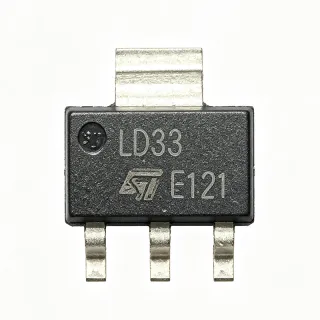
Technically, the regulator uses a monolithic bipolar architecture with an integrated pass transistor sized for the 150 mA load. The INH pin implements logic-level shutdown that drops Iq below 1 µA, supporting battery-save strategies when the ECU is parked. The exposed thermal tab on the SOT-223 package provides a low thermal resistance path (~70 C/W on a standard 2-layer 1 oz PCB) so that full-load dissipation can be handled without an external heatsink in typical automotive ambient temperatures.
Typical applications include automotive body and chassis ECUs, sensor supplies (Hall, pressure, position), infotainment keep-alive rails, CAN/LIN transceiver power, and any 12 V/24 V always-on node that needs a quiet 3.3 V rail with very low standby drain. When designing with this part, observe the SOA at high VIN (45 V) where full-load dissipation can exceed 6 W, and follow Infineon's recommended 100 nF + 10 µF input/output capacitor combination for stability.
Drop-in alternatives for TLE42662GSV33HTMA2 — same package, pin-to-pin compatible. Different-package parts requiring PCB rework are excluded.
Variants in this series
Same-series models that are drop-in compatible with TLE42662GSV33HTMA2 (same form factor and footprint) — differing in Input Voltage Range, Maximum Output Current, Operating Temperature Range, Package, Dropout Voltage.
Quick Comparison Tool — Select alternative parts for side-by-side comparison:
TLE42662GSV33
✅ Drop-In ⚠️ 参数待验证📋 Reference alternative (not in catalog)
TLE4299GV33
✅ Drop-In ⚠️ 参数待验证📋 Reference alternative (not in catalog)
TLE4266-2GSV33
✅ Drop-In ⚠️ 参数待验证📋 Reference alternative (not in catalog)
TLE42662GSV18
✅ Drop-In ⚠️ 参数待验证📋 Reference alternative (not in catalog)
TLE42662GSV33HTMA2 Maximum Ratings & Electrical Characteristics
| Manufacturer | Infineon Technologies |
| Product Family | OPTIREG LINEAR |
| Regulator Type | LDO (Low-Dropout) Linear Regulator, Fixed Output |
| Output Voltage | 3.3 V (fixed) |
| Output Voltage Accuracy | ±2 % |
| Maximum Output Current | 150 mA |
| Input Voltage Range | 4.4 V to 45 V |
| Dropout Voltage | 1 V (typical at 150 mA) |
| Quiescent Current (ON) | 40 µA (typical) |
| Quiescent Current (OFF / INH) | < 1 µA |
| Inhibit (INH) Pin | Yes (active-high, low-Iq shutdown) |
| Operating Temperature Range | -40 °C to +150 °C junction |
| Package | PG-SOT223-4 (TO-261-4, 3 leads + tab) |
| Mounting Type | Surface Mount |
| Automotive Qualification | AEC-Q100 qualified |
| Protection Features | Overtemperature shutdown, reverse-polarity robust |
| Output Capacitor Requirement | 10 µF ceramic / tantalum, ESR-stable |
TLE42662GSV33HTMA2 Pin Configuration
| Pin 1 | IN — Input voltage (4.4 V to 45 V) |
| Pin 2 | GND — Ground reference |
| Pin 3 | INH — Inhibit input (active-high enable, tie high for normal operation) |
| Pin 4 | OUT — Regulated 3.3 V output, up to 150 mA |
Typical Applications
TLE42662GSV33HTMA2 is suitable for 6 applications: Automotive Body & Chassis ECU Power, Automotive Sensor Power Supply (Hall, Pressure, Position), Infotainment Keep-Alive Rail, 24V Commercial Vehicle Always-On Rail, Industrial 24V Sensor / PLC Power, Battery-Backed IoT / Smart Sensor Node.
Automotive Body & Chassis ECU Power
The TLE42662GSV33HTMA2's 4.4 V to 45 V input range, AEC-Q100 qualification, and 3.3 V fixed output make it ideal for powering body and chassis ECUs that draw always-on current from the 12 V battery rail. With 150 mA capacity it can supply microcontroller + CAN transceiver + sensors from a single rail, and the < 1 µA INH-mode quiescent current preserves battery life during vehicle parking (months-long standby). The 45 V transient margin absorbs load-dump events per ISO 7637-2 without external TVS protection, reducing BOM cost and PCB area in ECU designs.
Recommended
Automotive Sensor Power Supply (Hall, Pressure, Position)
Hall-effect, pressure, and position sensors in automotive systems require a clean, low-noise 3.3 V supply with very low standby current. The TLE42662GSV33HTMA2 provides 150 mA of well-regulated output with a linear (non-switching) topology that introduces zero switching ripple into sensitive analog signal-conditioning circuits. The INH pin allows the sensor module to be put into microamp-range standby when the vehicle is parked, while the AEC-Q100 qualification covers the -40 °C to +125 °C ambient and the 150 °C junction temperature seen in engine-bay-mounted sensors.
Recommended
Infotainment Keep-Alive Rail
Infotainment head units require a permanent keep-alive supply that preserves user settings, clock, and telematics state even when the ignition is off. The TLE42662GSV33HTMA2's < 1 µA INH quiescent current and 3.3 V fixed output are well-matched to the standby power budget for these always-on domains, while the 150 mA capacity easily handles RTC, EEPROM, and the microcontroller's low-power core. Its 45 V input transient tolerance is essential for tolerating double-battery jump-start conditions in commercial-vehicle infotainment deployments.
Recommended
24V Commercial Vehicle Always-On Rail
Commercial trucks, buses, and off-road vehicles operate on 24 V battery systems where load-dump transients can reach 50 V or higher. The TLE42662GSV33HTMA2's 45 V absolute-maximum input rating gives ample margin against these transients, allowing direct connection to the 24 V bus without a pre-regulator. The 150 mA output comfortably powers telematics control units (TCUs), GPS trackers, and fleet-management modules, while the INH pin enables remote wake-up/sleep from the vehicle's body controller.
Recommended
Industrial 24V Sensor / PLC Power
In factory automation, PLCs and remote I/O modules are powered from a 24 V industrial bus that can carry large transients when inductive loads switch. The TLE42662GSV33HTMA2's 45 V input tolerance and ±2 % load regulation ensure stable 3.3 V to microcontrollers, ADCs, and isolated communication transceivers even when bus voltage sags to 18 V or spikes to 40 V. The exposed thermal tab provides the heat-spreading surface needed for sustained 150 mA operation in DIN-rail enclosures with limited airflow.
Recommended
Battery-Backed IoT / Smart Sensor Node
Battery-powered IoT sensor nodes that operate from a 12-24 V external rail with a battery backup need an LDO that can sip current when the main rail is off. The TLE42662GSV33HTMA2's 40 µA ON-mode Iq and < 1 µA INH-mode Iq are well-suited to remote telemetry nodes that spend most of their life in deep sleep. Its fixed 3.3 V output directly powers BLE/Zigbee/LoRa SoCs and their associated sensors, while the wide input margin tolerates the voltage swings of photovoltaic or thermoelectric energy-harvesting front-ends common in remote installations.
Recommended
Recommended Products Summary
Engineering reference data for TLE42662GSV33HTMA2 — comparison, design guidance, and compliance information.
Selection Guide
Comparison with Alternatives
| Parameter | This Product | TLE42662GSV33 | TLE4299GV33 | TLE4266-2GSV33 |
|---|---|---|---|---|
| Brand | Infineon | Infineon | Infineon | Infineon |
| Package | PG-SOT223-4 | PG-SOT223-4 - same | PG-SOT223-4 - same | PG-SOT223-4 - same |
| Output Voltage | 3.3 V fixed | 3.3 V fixed | 3.3 V fixed | 3.3 V fixed |
| Output Current | 150 mA | 150 mA | 150 mA | 150 mA |
| Input Voltage Range | 4.4 V to 45 V | 4.4 V to 45 V | 4.4 V to 45 V | 4.4 V to 45 V |
| Quiescent Current (ON) | 40 µA | 40 µA | 40 µA | 40 µA |
| Quiescent Current (OFF) | < 1 µA | < 1 µA | < 1 µA | < 1 µA |
| AEC-Q100 Qualified | Yes | No (industrial) | Yes | No (industrial) |
| Dropout at Full Load | 1 V | 1 V | 1 V | 1 V |
| Inhibit (INH) Pin | Yes | Yes | Yes | Yes |
Key Differentiators
- 45 V absolute-maximum input rating (vs TLE42754DATMA1)
- Sub-1 µA INH-mode quiescent current (vs TLE42662GSV18)
- Compact PG-SOT223-4 footprint at full 150 mA (vs TLE42662GSV33 (industrial grade))
Design Notes
At maximum VIN of 45 V and full 150 mA load, the worst-case continuous power dissipation is approximately (45 V - 3.3 V) × 0.15 A = 6.25 W. With a PG-SOT223-4 thermal resistance of ~70 C/W on a standard 1 oz 2-layer PCB, this would push the junction 437 °C above ambient - clearly exceeding the 150 °C maximum. Practical designs should limit VIN to ≤ 35 V at full load OR expand the copper-pour area under the thermal tab to 1 cm² minimum, OR derate the load to 80-100 mA at 45 V. The Infineon datasheet provides thermal derating curves for the PG-SOT223-4 footprint that should be consulted for production designs.
Place a 100 nF ceramic capacitor as close as possible to the IN pin (within 3 mm) to filter high-frequency noise from the upstream wiring harness. The OUT pin requires a minimum 10 µF ceramic or tantalum output capacitor with ESR below the datasheet stability curve (typically < 1 Ω). For automotive environments with long input cable harnesses, add a series ferrite bead or input inductor to attenuate conducted EMI from the 12 V bus. The exposed thermal tab must be soldered to a copper pad of at least 50 mm² to achieve the rated thermal performance.
Do not leave the INH pin floating - it must be actively driven high (logic 1, ≥ 2 V) for normal operation, or tied to IN via a 100 kΩ pull-up if shutdown is not used. Floating INH can result in unstable output or unintended shutdown. Also note that the tab is internally connected to GND; do not connect it to a copper pour that carries switching currents or noisy grounds. Finally, verify that downstream 3.3 V logic draws no more than 150 mA peak - the device has foldback current limiting but continuous operation near the limit will trigger thermal shutdown at elevated VIN.
Compliance Information
AEC-Q100 qualified automotive grade per HTMA2 suffix. RoHS and REACH compliant per Infineon product page. Lead-free (Pb-free) reflow-compatible per JEDEC J-STD-020.