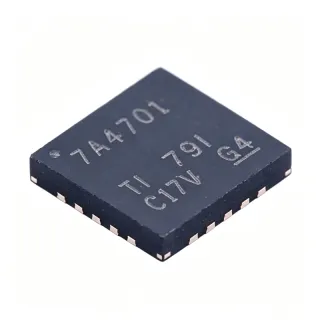
TLV2371QDBVRQ1 - 3MHz RRIO Automotive Op Amp | TI
MPN: TLV2371QDBVRQ1 ✓ Active| Qty | Unit Price | Extended |
|---|---|---|
| 1 | $0.55 | $0.55 |
| 10 | $0.48 | $4.80 |
| 100 | $0.4466 | $44.66 |
| 500 | $0.4 | $200.00 |
| 1,000 | $0.36 | $360.00 |
Drop-in alternatives for TLV2371QDBVRQ1 — same package, pin-to-pin compatible. Different-package parts requiring PCB rework are excluded.
Quick Comparison Tool — Select alternative parts for side-by-side comparison:
TLV2371IDBVR
✅ Drop-In📋 Reference alternative (not in catalog)
TLV9151IDBVR
✅ Drop-In📋 Reference alternative (not in catalog)
TLV271QDBVRQ1
✅ Drop-In📋 Reference alternative (not in catalog)
TLV2370IDBVR
✅ Drop-In📋 Reference alternative (not in catalog)
OPA314QDBVRQ1
✅ Drop-In ⚠️ 参数待验证📋 Reference alternative (not in catalog)
TLV2371QDBVRQ1 Maximum Ratings & Electrical Characteristics
| Amplifier Type | General Purpose Operational Amplifier |
| Number of Channels | 1 |
| Rail-to-Rail | Input and Output (RRIO) |
| Gain Bandwidth Product | 3 MHz |
| Slew Rate | 2.1 V/us |
| Quiescent Current | 550 uA per channel |
| Supply Voltage Range | 2.7 V to 16 V (single), +/-1.35 V to +/-8 V (dual) |
| Operating Temperature | -40C to +125C |
| Package | SOT-23-5 (DBV, SC-74A, SOT-753) |
| Mounting Type | Surface Mount |
| Automotive Qualification | AEC-Q100 qualified |
| Packaging | Tape & Reel |
| Unity-Gain Stability | Yes (internally compensated) |
| Input Stage | CMOS rail-to-rail input |
| RoHS Status | Compliant |
TLV2371QDBVRQ1 Pin Configuration
| Pin 1 | OUT — Amplifier output |
| Pin 2 | V- / GND — Negative supply or ground (single-supply) |
| Pin 3 | IN+ — Non-inverting input |
| Pin 4 | IN- — Inverting input |
| Pin 5 | V+ — Positive supply, 2.7V to 16V |
Safe Operating Area (SOA) & Thermal Characteristics
No official SOA curve available for this component. Always operate within absolute maximum ratings specified in the datasheet. Ensure adequate cooling and derate as needed.
Typical Applications
TLV2371QDBVRQ1 is suitable for 6 applications: Automotive Sensor Signal Conditioning, Battery Monitoring and Management, Motor Control Current Sensing, Active Filters in Engine Control Units, ADC Interface Buffering, Portable and IoT Battery-Powered Devices.
Automotive Sensor Signal Conditioning
The TLV2371QDBVRQ1's AEC-Q100 qualification, -40C to +125C rating, and 2.7V-16V supply tolerance make it ideal for conditioning signals from automotive pressure, position, and temperature sensors. Its rail-to-rail input accepts signals near the ground rail common in resistor-bridge sensors, while the rail-to-rail output maximizes the input span of downstream 3.3V/5V ADCs. The 3MHz bandwidth and 2.1V/us slew rate accommodate kHz-range sensor signals with anti-alias filtering, and the 550uA quiescent current suits always-on modules powered from battery-cranked rails.
Recommended
Battery Monitoring and Management
In 12V automotive battery monitoring, the TLV2371QDBVRQ1's 16V absolute supply rating covers normal charging voltages, and its CMOS inputs draw picoamp bias currents that prevent draining the sense node or corrupting high-impedance dividers. The rail-to-rail output swings to within millivolts of the rails, preserving measurement range across the full battery state-of-charge. At only 550uA per channel, it suits always-on current-shunt amplification ahead of ADCs such as the ADS131M08, while RRIO operation maintains accuracy at both low-cell and full-charge operating points.
Recommended
Motor Control Current Sensing
The TLV2371QDBVRQ1 amplifies shunt-resistor voltages in motor-drive feedback loops for MCUs such as the TMS320F280041C-Q1. Its 3MHz gain bandwidth supports closed-loop current sensing with adequate phase margin, and the 2.1V/us slew rate tracks PWM-induced ripple at the shunt. The 16V supply survives gate-driver domain rails, while rail-to-rail output resolves near-zero current at low duty cycles. Pairing with isolated or precision current-sense amplifiers gives complete phase-current chains in automotive traction and auxiliary motor controllers.
Recommended
Active Filters in Engine Control Units
ECU analog front ends use the TLV2371QDBVRQ1 as Sallen-Key or multiple-feedback active filters to reject alternator ripple and switching noise before ADC sampling. The 3MHz bandwidth supports corner frequencies up to tens of kHz with good Q accuracy, and RRIO behavior preserves headroom on battery-derived 5V rails. The 550uA/channel consumption keeps total ECU analog budget low across multiple filter stages, and AEC-Q100 qualification with -40C to +125C operation ensures stable filter characteristics across under-hood temperature extremes.
Recommended
ADC Interface Buffering
SAR and delta-sigma ADCs need low-impedance drive; the TLV2371QDBVRQ1 buffers sensor or divider outputs before the ADC input. Its rail-to-rail output maximizes effective resolution on 3.3V supplies, while the 3MHz bandwidth settles signals within typical SAR acquisition windows at moderate sample rates. The CMOS input's picoamp bias current preserves accuracy with high-value divider networks, and unity-gain stability ensures no oscillation in the direct-buffer configuration common with devices like the ADS1115 or ADS1220.
Recommended
Portable and IoT Battery-Powered Devices
With 550uA quiescent current per channel and operation down to 2.7V, the TLV2371QDBVRQ1 extends battery life in portable sensor nodes and IoT endpoints. The rail-to-rail input accepts signals near ground from photodiodes and microphones, and the rail-to-rail output drives comparators or ADCs directly without headroom loss. Its low-power 3MHz performance class fits kHz-bandwidth signal conditioning, and the tiny SOT-23-5 package conserves board area in space-constrained wearables, smart-home sensors, and battery-backed telemetry modules.
Recommended
Recommended Products Summary
Engineering reference data for TLV2371QDBVRQ1 — comparison, design guidance, and compliance information.
Selection Guide
Comparison with Alternatives
| Parameter | This Product | TLV2371IDBVR | TLV9151IDBVR | TLV271QDBVRQ1 | OPA314QDBVRQ1 |
|---|---|---|---|---|---|
| Package | SOT-23-5 (DBV) | SOT-23-5 (DBV) - same | SOT-23-5 (DBV) - same | SOT-23-5 (DBV) - same | SOT-23-5 (DBV) - same |
| Brand | Texas Instruments | Texas Instruments | Texas Instruments | Texas Instruments | Texas Instruments |
| Gain Bandwidth Product | 3 MHz | 3 MHz | 4.5 MHz | [DATA_NEEDED] | 3 MHz |
| Slew Rate | 2.1 V/us | 2.1 V/us | [DATA_NEEDED] | [DATA_NEEDED] | [DATA_NEEDED] |
| Quiescent Current per Channel | 550 uA | 550 uA | Low power | Lower than TLV2371 | 150 uA |
| Supply Voltage Range | 2.7 V to 16 V | 2.7 V to 16 V | 1.8 V to 5.5 V | [DATA_NEEDED] | 2.5 V to 5.5 V |
| Automotive Qualification | AEC-Q100 qualified (-40 to +125C) | No (industrial) | No (industrial) | Yes (AEC-Q100) | Yes (AEC-Q100) |
| Rail-to-Rail | Input and Output (RRIO) | RRIO | RRIO | RRIO | RRIO |
| Price (1pc approx) | $0.55 | [DATA_NEEDED] | [DATA_NEEDED] | [DATA_NEEDED] | [DATA_NEEDED] |
Key Differentiators
- Automotive AEC-Q100 qualification with wide 16V supply tolerance (vs TLV9151IDBVR)
- Proven 3MHz/2.1V/us performance in same SOT-23-5 footprint (vs TLV271QDBVRQ1)
- Lower quiescent current than TLV9151 (vs TLV9151IDBVR)
Design Notes
Decouple the V+ pin with a 0.1uF ceramic capacitor placed within 2-3mm of pin 5, plus a 1uF bulk capacitor per supply domain. In automotive environments add a series ferrite and TVS on upstream rails to survive load-dump transients - the TLV2371QDBVRQ1's 16V rating covers normal operation but not unclamped load dump.
The 3MHz bandwidth makes the output sensitive to capacitive loads above roughly 100pF; add a small series isolation resistor (10-50 ohm) when driving long cables or ADC input capacitance to preserve phase margin. Keep feedback traces short and route them away from CAN transceiver or clock lines to prevent coupled glitches.
Do not exceed the 16V absolute maximum supply even during automotive transients. For single-supply designs, remember the output cannot fully reach the negative rail beyond datasheet swing limits under load - verify headroom at minimum load current for zero-crossing sensor signals. Substitute only with same-pinout SOT-23-5 parts; verify temperature grade requirement before using industrial variants.
Compliance Information
AEC-Q100 qualified for automotive applications per TI product page. RoHS compliant per TI listing; other compliance details [DATA_NEEDED].