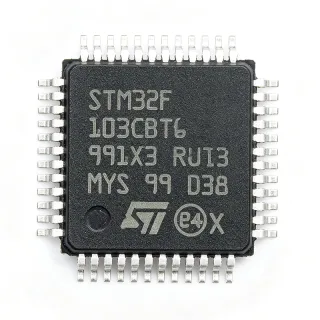
ATMEGA164P-A15AZ - 8-bit AVR MCU 16KB Flash, Automotive | Atmel
MPN: ATMEGA164P-A15AZ ✓ Active| Qty | Unit Price | Extended |
|---|---|---|
| 1 | $4.12 | $4.12 |
| 10 | $3.71 | $37.10 |
| 100 | $3.3 | $330.00 |
| 500 | $2.97 | $1,485.00 |
| 1,000 | $2.68 | $2,680.00 |
ATMEGA164P-A15AZ Overview
An 8-bit AVR microcontroller is a Harvard-architecture processor that executes most of its 133 powerful instructions in a single clock cycle. In the embedded-systems hierarchy, the MCU sits above discrete logic and below application processors, integrating CPU, program memory, data memory, timers, UART, SPI, TWI (I2C) and analog peripherals on a single die. The AVR family is widely used for cost-sensitive control tasks where a full ARM device would be over-specified.
Key features of this part include the picoPower AVR core for low active and sleep current, read-while-write Flash for self-programming and bootloaders, 32 general purpose I/O lines, 32 general purpose working registers, and an advanced RISC architecture with single-cycle execution. The -A15AZ suffix denotes the automotive temperature grade, making it suitable for harsh environments beyond commercial ratings.
Technically, the device pairs the enhanced AVR core with two 8-bit timers, one 16-bit timer, a 10-bit ADC, USART, SPI, and TWI interfaces. In-circuit debugging and In-Circuit Serial Programming (ICSP) are supported through the SPI pins using tools such as the MPLAB SNAP, per the Microchip product page, enabling field firmware updates without socketed parts.
Typical applications include automotive body modules and sensor nodes, industrial control panels, motor control auxiliary logic, and battery-powered instrumentation where the 2.7 V to 5.5 V rail tolerance simplifies power design across 3.3 V and 5 V systems.
When designing with the ATMEGA164P-A15AZ, decouple both VCC pin pairs and program fuse bits carefully - wrong fuse settings on an AVR can lock out ISP access. Verify the 8 MHz clock speed grade against your timing budget before pin-migrating from 16 MHz parts.
This page synthesizes distributor pricing, pin-compatible drop-in alternatives, and practical AVR design notes not consolidated in the manufacturer datasheet.
Drop-in alternatives for ATMEGA164P-A15AZ — same package, pin-to-pin compatible. Different-package parts requiring PCB rework are excluded.
Variants in this series
Same-series models that are drop-in compatible with ATMEGA164P-A15AZ (same form factor and footprint) — differing in Core Architecture, EEPROM, Communication Interfaces, Maximum Clock Speed, RAM Size.
Quick Comparison Tool — Select alternative parts for side-by-side comparison:
ATMEGA164P-15AT1
✅ Drop-In✓ In Stock
$3.6 / Unit
View Datasheet →ATMEGA164P-15AT
✅ Drop-In✓ In Stock
$2.35 / Unit
View Datasheet →ATMEGA164P-15AZ
✅ Drop-In📋 Reference alternative (not in catalog)
ATMEGA16A-AU
✅ Drop-In✓ In Stock
$2.05 / Unit
View Datasheet →ATMEGA8535L-8MI
✅ Drop-In📋 Reference alternative (not in catalog)
ATMEGA164P-A15AZ Maximum Ratings & Electrical Characteristics
| Core Architecture | 8-bit AVR RISC |
| Data Bus Width | 8 bit |
| Flash Memory | 16 KB in-system programmable (read-while-write) |
| EEPROM | 512 B |
| SRAM | 1 KB |
| Maximum Clock Speed | 8 MHz |
| Supply Voltage Range | 2.7 V to 5.5 V |
| General Purpose I/O | 32 I/O lines (Microchip product page) |
| Working Registers | 32 general purpose registers |
| Instruction Set | 133 instructions, most single-cycle |
| Package Type | TQFP, 14 x 14 mm, 1 mm height, 44 terminals |
| Terminal Form | Gull wing |
| Temperature Grade | Automotive |
| Mounting Style | Surface Mount |
| Life Cycle Stage | ACTIVE |
| Debug/Programming | ICSP and in-circuit debugging via SPI (e.g., MPLAB SNAP) |
ATMEGA164P-A15AZ Pin Configuration
| Pin 1 | PB5 (SCK) — Port B bit 5 / SPI serial clock |
| Pin 2 | PB6 (MISO) — Port B bit 6 / SPI master-in slave-out |
| Pin 3 | PB7 (MOSI) — Port B bit 7 / SPI master-out slave-in |
| Pin 4 | RESET — Active-low reset input |
| Pin 5 | VCC — Digital supply voltage |
| Pin 6 | GND — Ground |
| Pin 7 | XTAL2 — Crystal oscillator output |
| Pin 8 | XTAL1 — Crystal oscillator input / external clock |
| Pin 9 | PD0 (RXD0) — Port D bit 0 / USART0 receive |
| Pin 10 | PD1 (TXD0) — Port D bit 1 / USART0 transmit |
| Pin 11 | PD2 (INT0) — Port D bit 2 / external interrupt 0 |
| Pin 12 | PD3 (INT1) — Port D bit 3 / external interrupt 1 |
| Pin 13 | PD4 (XCK/T0) — Port D bit 4 / USART clock or timer 0 input |
| Pin 14 | VCC — Digital supply voltage |
| Pin 15 | GND — Ground |
| Pin 16 | PD5 (T1/OC0B) — Port D bit 5 / timer 1 input or output compare |
| Pin 17 | PD6 (ICP1) — Port D bit 6 / timer 1 input capture |
| Pin 18 | PD7 (OC2A/OC0A) — Port D bit 7 / output compare PWM |
| Pin 19 | PA0 (ADC0) — Port A bit 0 / ADC channel 0 |
| Pin 20 | PA1 (ADC1) — Port A bit 1 / ADC channel 1 |
| Pin 21 | PA2 (ADC2) — Port A bit 2 / ADC channel 2 |
| Pin 22 | PA3 (ADC3) — Port A bit 3 / ADC channel 3 |
| Pin 23 | PA4 (ADC4) — Port A bit 4 / ADC channel 4 |
| Pin 24 | PA5 (ADC5) — Port A bit 5 / ADC channel 5 |
| Pin 25 | PA6 (ADC6) — Port A bit 6 / ADC channel 6 |
| Pin 26 | PA7 (ADC7) — Port A bit 7 / ADC channel 7 |
| Pin 27 | AVCC — Analog supply voltage for ADC |
| Pin 28 | AREF — Analog reference voltage |
| Pin 29 | GND — Ground |
| Pin 30 | PC0 (SCL/PCINT16) — Port C bit 0 / TWI clock |
| Pin 31 | PC1 (SDA/PCINT17) — Port C bit 1 / TWI data |
| Pin 32 | PC2 (TCK/PCINT18) — Port C bit 2 / JTAG test clock |
| Pin 33 | PC3 (TMS/PCINT19) — Port C bit 3 / JTAG test mode select |
| Pin 34 | PC4 (TDO/PCINT20) — Port C bit 4 / JTAG test data out |
| Pin 35 | PC5 (TDI/PCINT21) — Port C bit 5 / JTAG test data in |
| Pin 36 | PC6 (TOSC1/PCINT22) — Port C bit 6 / timer oscillator input |
| Pin 37 | PC7 (TOSC2/PCINT23) — Port C bit 7 / timer oscillator output |
| Pin 38 | VCC — Digital supply voltage |
| Pin 39 | GND — Ground |
| Pin 40 | PB0 (XCK0/T0/PCINT8) — Port B bit 0 / pin change interrupt |
| Pin 41 | PB1 (T1/OC1A/PCINT9) — Port B bit 1 / timer 1 or output compare |
| Pin 42 | PB2 (OC1B/PCINT10) — Port B bit 2 / output compare PWM |
| Pin 43 | PB3 (OC2A/MOSI/PCINT11) — Port B bit 3 / PWM or SPI MOSI |
| Pin 44 | PB4 (OC0A/MISO/PCINT12) — Port B bit 4 / PWM or SPI MISO |
Typical Applications
ATMEGA164P-A15AZ is suitable for 6 applications: Automotive Body and Sensor Modules, Industrial Control Panels, Battery-Powered Instrumentation, Embedded Communication Nodes, Motor Control Auxiliary Logic, Security and IoT Sensor Devices.
Automotive Body and Sensor Modules
The ATMEGA164P-A15AZ targets automotive body electronics, sensor nodes, and actuator control, where the -AZ automotive temperature grade and 2.7 V to 5.5 V supply tolerance cover cold-crank and load-dump-adjacent rail conditions after upstream regulation. Its 16 KB ISP Flash with read-while-write supports field firmware updates over the vehicle's service interface, while 512 B EEPROM retains calibration data across power cycles. The 8-bit AVR core executing 133 mostly single-cycle instructions handles switch debouncing, LIN-style UART messaging, and PWM lamp or motor control with deterministic latency. Designers should verify the exact AEC-Q100 grade in the qualification report and derate clock frequency at low supply voltage per the datasheet's frequency-versus-voltage curve.
Recommended
Industrial Control Panels
In industrial control panels, the ATMEGA164P-A15AZ provides 32 GPIO lines plus USART, SPI, and TWI interfaces for driving relays, reading discrete sensors, and communicating with HMIs. The 5 V-tolerant 2.7-5.5 V rail matches legacy 24 V-panel logic translated to 5 V, and the 10-bit ADC family peripherals digitize potentiometer and current-sense inputs. Read-while-write Flash enables on-panel bootloader updates without removing the TQFP from the board. Compared with a 3.3 V-only MCU, operating at 5 V improves noise margin in electrically noisy cabinet environments. Designers should add TVS protection on field-wired GPIO and validate the 8 MHz clock grade for deterministic scan times.
Recommended
Battery-Powered Instrumentation
The picoPower technology in the ATMEGA164P-A15AZ makes it suitable for battery-powered meters, dataloggers, and handheld instruments. The AVR core supports multiple sleep modes that cut average current dramatically between measurements, while the wide 2.7 V to 5.5 V supply range allows direct operation from three alkaline cells or a single lithium cell via an LDO. The 512 B EEPROM stores calibration constants without external memory, and the ADC conditions sensor signals such as thermistors and strain gauges. A typical trade-off: the 1 KB SRAM limits complex signal processing, so keep buffering modest and stream data over USART or SPI rather than accumulating large arrays in RAM.
Recommended
Embedded Communication Nodes
For RS-485/CAN-gateway auxiliary nodes and RF-module host controllers, the ATMEGA164P-A15AZ offers a hardware USART plus SPI and TWI, letting one MCU bridge a field bus to a radio module or display. The 8 MHz AVR core with single-cycle execution services UART framing at high baud rates with CPU headroom left for protocol logic. The 16 KB read-while-write Flash accommodates protocol stacks plus a bootloader, and 1 KB SRAM handles packet buffering for moderate message sizes. Surface-mount the 44-pin TQFP on a 4-layer board with solid ground plane for EMI performance, and route the crystal traces short and guarded to maintain clock stability in noisy RF environments.
Recommended
Motor Control Auxiliary Logic
In motor-driven products such as fans, pumps, and small appliances, the ATMEGA164P-A15AZ supervises drive electronics: it generates PWM on timer outputs, reads back tachometer and current signals through the ADC, and implements fault shutdown in firmware. The 2.7-5.5 V range pairs with 5 V gate-driver or gate-pull-up circuits common in low-voltage BLDC and brushed-DC designs. The automotive grade extends reliability margins for products with harsh duty cycles. Keep PWM ISR execution short at the 8 MHz clock to preserve ADC sampling, and use the input-capture/pin-change interrupt features for precise tach edges. Validate thermal performance of the TQFP layout with generous copper pours on the power rails.
Recommended
Security and IoT Sensor Devices
The ATMEGA164P-A15AZ fits security sensors, access-control readers, and IoT edge nodes that need 5 V I/O compatibility and modest compute. Thirty-two GPIO drive keypads, LEDs, and relays, while the TWI interface reads MEMS sensors or RTCs and the USART reports events upstream. Read-while-write Flash allows credential or configuration updates in the field, and EEPROM keeps keys and counters through power loss. The picoPower sleep modes support battery-backed or energy-harvesting installations. Note the 1 KB SRAM constraint: cryptographic buffering must stay lightweight, and designers requiring TLS-class security should treat this part as a front-end controller paired with a dedicated secure element.
Recommended
Recommended Products Summary
Engineering reference data for ATMEGA164P-A15AZ — comparison, design guidance, and compliance information.
Selection Guide
Comparison with Alternatives
| Parameter | This Product | ATMEGA164P-15AT1 | ATMEGA164P-15AT | ATMEGA164P-15AZ | ATMEGA16A-AU | ATMEGA8535L-8MI |
|---|---|---|---|---|---|---|
| Brand | Atmel (Microchip Technology) | Atmel (Microchip Technology) | Atmel (Microchip Technology) | Atmel (Microchip Technology) | Atmel (Microchip Technology) | Atmel (Microchip Technology) |
| Package | TQFP-44 (14x14 mm) | TQFP-44 - same footprint | TQFP-44 - same footprint | TQFP-44 - same footprint | TQFP-44 - same footprint | TQFP-44 - same footprint |
| Flash Memory | 16 KB | 16 KB | 16 KB | 16 KB | 16 KB | 8 KB |
| SRAM | 1 KB | 1 KB | 1 KB | 1 KB | 1 KB | 512 B |
| EEPROM | 512 B | 512 B | 512 B | 512 B | 512 B | 512 B |
| Core / Low-Power Technology | AVR picoPower | AVR picoPower | AVR picoPower | AVR picoPower | AVR (non-picoPower) | AVR (older generation) |
Key Differentiators
- picoPower low-power core (vs ATMEGA16A-AU)
- Double the program memory of legacy generation (vs ATMEGA8535L-8MI)
- Automotive qualification suffix (vs ATMEGA16A-AU)
Design Notes
The TQFP-44 provides two VCC pins (5, 14, 38) and three GND pins (6, 15, 29) plus a separate AVCC (pin 27). Decouple each VCC pin with a 100 nF ceramic capacitor placed within 2-3 mm of the pin, and add a 10 uF bulk capacitor per supply domain. Connect AVCC to VCC through an LC filter (ferrite bead plus 100 nF) when ADC accuracy matters, and keep the AREF trace short with its own 100 nF capacitor to ground. Route the crystal (XTAL1/XTAL2) traces as short as possible with a guard ground.
AVR fuse misconfiguration is the most common field failure. Never clear the SPIEN fuse or disable the RESET pin function unless a high-voltage parallel programmer is available - doing so locks out ICSP permanently on assembled boards. When migrating firmware from ATmega16A or ATmega8535 parts, re-verify fuse defaults, interrupt vector tables, and peripheral register names, since even same-footprint AVR dies differ. For bootloader designs, confirm the read-while-write Flash page size in the datasheet before writing the erase/program loop.
The 2.7 V to 5.5 V supply range allows both 3.3 V and 5 V operation, but clock frequency must be derated at low supply per the AVR frequency-versus-voltage safe operating curve in the datasheet. This automotive suffix carries an 8 MHz clock grade in the verified data - do not clock it at 16 MHz ratings used by standard-grade 164P variants. Estimated: at 5 V/8 MHz, active current per the ATmega164P family datasheet is in the low mA range; budget regulator headroom accordingly and use power-down sleep modes between tasks in battery designs.
In automotive and industrial environments, protect field-connected GPIO with series resistors (100-470 ohm) and TVS diodes, and use the internal pin-change interrupt features instead of polling to reduce EMI-sensitive bus activity. For SPI and TWI buses longer than 10 cm on the PCB, slow the edge rate via appropriate pull-up sizing on TWI (typically 4.7 kohm at 5 V) and keep SPI clock under 8 MHz with proper ground return paths beneath the traces.
Compliance Information
FindIC's product overview labels the part 'Automotive, AEC-Q100, AVR ATmega'. Specific RoHS/REACH/lead-free status not stated in the verified web data - confirm on the Microchip product page.