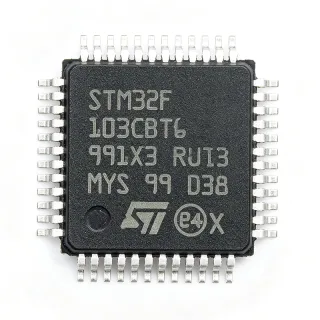
ATMEGA165A-MU - AVR 8-Bit MCU 16KB Flash 16MHz QFN-64 | Microchip
MPN: ATMEGA165A-MU ✓ Active| Qty | Unit Price | Extended |
|---|---|---|
| 1 | $3.42 | $3.42 |
| 10 | $3.08 | $30.80 |
| 100 | $2.72 | $272.00 |
| 500 | $2.45 | $1,225.00 |
| 1,000 | $2.18 | $2,180.00 |
ATMEGA165A-MU Overview
An 8-bit microcontroller is an integrated circuit that combines a processor core, memory, and peripherals on a single chip to execute a dedicated embedded control program. Within the power management hierarchy of embedded systems, the ATmega family sits in the 8-bit MCU category under microcontrollers under semiconductors, bridging small PIC-class devices and 32-bit ARM MCUs for cost-sensitive control tasks.
Key features include the AVR Advanced RISC architecture executing 133 powerful instructions with mostly single-cycle execution, 32 general-purpose working registers, an on-chip JTAG interface for boundary scan and on-chip debugging, and read-while-write Flash for in-system self-programming. The device also integrates SPI and UART/USART serial connectivity plus a 10-bit ADC for analog sensing.
Technically, the AVR core is a Harvard-architecture RISC machine with separate program and data buses, enabling one instruction per clock cycle for most operations. The 16 KB Flash supports 10,000 write cycles and code executes at 16 MIPS at 16 MHz, while the JTAG port enables production boundary-scan testing of assembled PCBs.
Typical applications include industrial control panels, HVAC and building automation nodes, consumer appliance control, battery-powered instrumentation, and sensor-based embedded systems that need moderate Flash, rich GPIO, and 5 V tolerance.
Design-wise, the 2.7 V to 5.5 V supply range permits direct 5 V industrial operation, but decouple the VCC/AVCC pins individually and remember the datasheet clock rating differences between the A (16 MHz) and V (8 MHz) speed grades.
This page adds value beyond the datasheet by synthesizing distributor pricing, verified drop-in alternatives such as ATMEGA169P-16MCH and ATMEGA165P-16MU, and practical design notes for QFN-64 layouts.
Drop-in alternatives for ATMEGA165A-MU — same package, pin-to-pin compatible. Different-package parts requiring PCB rework are excluded.
Variants in this series
Same-series models that are drop-in compatible with ATMEGA165A-MU (same form factor and footprint) — differing in Package, ADC, Flash Memory, I/O Count, Instructions.
Quick Comparison Tool — Select alternative parts for side-by-side comparison:
ATMEGA165P-16MU
✅ Drop-In✓ In Stock
$2.19 / Unit
View Datasheet →ATMEGA165PA-MU
✅ Drop-In ⚠️ 参数待验证✓ In Stock
$2.08 / Unit
View Datasheet →ATMEGA165A-MCH
✅ Drop-In📋 Reference alternative (not in catalog)
ATMEGA169A-MU
✅ Drop-In📋 Reference alternative (not in catalog)
ATMEGA169P-16MCH
✅ Drop-In✓ In Stock
Contact for price
View Datasheet →ATMEGA325A-MU
✅ Drop-In ⚠️ 参数待验证📋 Reference alternative (not in catalog)
ATMEGA165A-MU Maximum Ratings & Electrical Characteristics
| Core Processor | AVR |
| Core Size | 8-Bit |
| Max Clock Speed | 16 MHz |
| Flash Memory | 16 KB (8K x 16), In-System Programmable |
| EEPROM | 512 B |
| SRAM | 1 KB |
| Supply Voltage Range | 2.7 V to 5.5 V |
| General Purpose I/O | 54 |
| Instructions | 133 (mostly single-cycle execution) |
| Working Registers | 32 x 8-bit general purpose |
| Connectivity | SPI, UART/USART |
| Debug / Test Interface | JTAG (on-chip debug and boundary scan) |
| ADC | Yes, 10-bit |
| Package | 64-QFN (9x9 mm) MLF, surface mount |
| Mounting Type | Surface Mount |
ATMEGA165A-MU 64-qfn (9x9 mm) mlf, surface mount Pin Configuration Guide
Pin configuration for ATMEGA165A-MU (64-qfn (9x9 mm) mlf, surface mount package). This digital IC includes GPIO, communication interfaces (UART, SPI, I2C), and power pins. Refer to the manufacturer datasheet for alternate pin functions and configuration options. Essential for embedded system design and PCB layout.

No detailed pinout data available for ATMEGA165A-MU.
Refer to the datasheet for full pin configuration.
Typical Applications
ATMEGA165A-MU is suitable for 6 applications: Industrial Control Panels, Building Automation and HVAC Nodes, Consumer Appliance Control, Battery-Powered Instrumentation, Sensor Acquisition Systems, Embedded Test and Debug Systems.
Industrial Control Panels
Industrial control panels need a rugged, 5 V-capable MCU with abundant GPIO and production-test support. The ATMEGA165A-MU fits this role with 54 general-purpose I/O lines for driving relays, indicators, and keypads, a 2.7 V to 5.5 V supply range that accepts standard industrial 5 V rails directly, and a JTAG boundary-scan interface for automated board-level test of the 64-QFN assembly where pad inspection is impossible. The 16 KB ISP Flash with read-while-write supports field firmware updates over the on-chip UART/USART bootloader. Placed at the center of a panel board with SPI-connected peripherals and a 10-bit ADC for potentiometer or sensor feedback, it executes deterministic single-cycle AVR instructions at up to 16 MHz, delivering 16 MIPS of control bandwidth without an RTOS.
Recommended
Building Automation and HVAC Nodes
HVAC controllers and building automation nodes benefit from the ATMEGA165A-MU's balance of analog input, serial connectivity, and low-cost memory sizing. The 10-bit ADC samples temperature, humidity, and pressure sensors, while the UART/USART links to RS-485 transceivers for Modbus-style networks and SPI connects EEPROMs or displays. Its 16 KB Flash and 1 KB SRAM comfortably hold protocol stacks for small node counts, and the 512 B EEPROM stores calibration and setpoint data through power cycles. Operating from a 2.7 V to 5.5 V supply simplifies 5 V backplane designs, and hardware JTAG debugging shortens commissioning time. Because the same footprint family includes picoPower ATmega165P derivatives, designers can reduce standby current in battery-backed nodes without changing the PCB.
Recommended
Consumer Appliance Control
White goods and small appliance controllers demand cost-optimized MCUs with reliable in-system programming and low EMI layout options. The ATMEGA165A-MU provides 16 KB self-programmable Flash so the same PCB can ship with regional firmware variants programmed at end-of-line via UART. Its 54 GPIO lines drive seven-segment displays, relays, and touch or mechanical keypads without port expanders, reducing BOM cost. The 10-bit ADC reads NTC thermistors and user trimmers directly. The AVR core's mostly single-cycle 133-instruction set executes at up to 16 MHz for responsive user interfaces, and the on-chip JTAG port supports boundary-scan production test. The 9x9 mm QFN-64 keeps board area compact inside appliance housings while remaining reworkable with hot-air tools.
Recommended
Battery-Powered Instrumentation
Portable measurement instruments require an MCU that can sleep between readings yet wake quickly to process data. The ATMEGA165A-MU's 10-bit ADC handles sensor channels such as load cells and thermocouple front-ends, and the 512 B EEPROM preserves calibration constants without external memory. The 2.7 V floor allows operation from three alkaline cells or a single lithium cell with a simple regulator, and SPI support enables low-power external ADCs or RF modules when higher resolution or wireless telemetry is required. Designers needing longer battery life can adopt the pin-compatible picoPower ATMEGA165P or 165PA variants on the identical QFN-64 footprint, cutting sleep current dramatically while retaining identical firmware architecture and pin mapping.
Recommended
Sensor Acquisition Systems
Multi-sensor acquisition nodes use the ATMEGA165A-MU as the aggregation controller: the 10-bit ADC and internal multiplexer sample several analog channels, while the SPI bus interfaces external precision converters or digital sensors and the UART/USART forwards packets upstream. With 54 GPIO lines, the MCU can also bit-bang custom protocols for legacy sensors and control channel-select multiplexers. The AVR Harvard architecture with 32 working registers processes filtering and scaling math efficiently at up to 16 MIPS, and 1 KB SRAM accommodates small sample buffers. Firmware stored in 16 KB read-while-write Flash can be updated in the field over UART. For boards standardized on this footprint, ATmega325 derivatives offer double the Flash without changing the PCB layout.
Recommended
Embedded Test and Debug Systems
The ATMEGA165A-MU is well suited to embedded test fixtures and production-programming stations. Its JTAG interface provides both on-chip debugging of the target code and boundary-scan testing of the fixture's own board assembly - a rare combination at this price point that reduces dependence on bed-of-nails test points. Multiple UART/USART and SPI ports allow simultaneous communication with several devices under test, and 54 GPIO lines drive relays, LEDs, and connector sense lines. The 2.7 V to 5.5 V supply range lets one fixture design test both 3.3 V and 5 V products. The 16 KB ISP Flash stores test scripts resident on the MCU, while read-while-write support allows parameter updates during execution without halting measurements.
Recommended
Recommended Products Summary
Engineering reference data for ATMEGA165A-MU — comparison, design guidance, and compliance information.
Selection Guide
Comparison with Alternatives
| Parameter | This Product | ATMEGA165P-16MU | ATMEGA165PA-MU | ATMEGA165A-MCH | ATMEGA169A-MU | ATMEGA169P-16MCH |
|---|---|---|---|---|---|---|
| Package | 64-QFN (9x9 mm) | 64-QFN (9x9 mm) - same | 64-QFN (9x9 mm) - same | 64-QFN (9x9 mm) - same | 64-QFN (9x9 mm) - same | 64-QFN (9x9 mm) - same |
| Brand | Microchip Technology (Atmel) | Microchip Technology | Microchip Technology | Microchip Technology | Microchip Technology | Microchip Technology |
| Flash Memory | 16 KB | 16 KB | 16 KB | 16 KB | 16 KB | 16 KB |
| Max Clock Speed | 16 MHz | 16 MHz | 20 MHz | 16 MHz | 16 MHz | 16 MHz |
| Supply Voltage | 2.7 V to 5.5 V | 2.7 V to 5.5 V | 1.8 V to 5.5 V | 2.7 V to 5.5 V | 2.7 V to 5.5 V | 2.7 V to 5.5 V |
| Low-Power Feature | Standard power | picoPower | picoPower (enhanced) | Standard power | Standard power | picoPower |
| LCD Controller | No | No | No | No | Yes (segment LCD) | Yes (segment LCD) |
| Pin Compatibility | Reference (QFN-64) | Pin-to-pin compatible | Pin-to-pin compatible | Pin-to-pin compatible | Same footprint, verify multiplexing | Same footprint, verify multiplexing |
Key Differentiators
- Lowest-cost standard-power grade in the QFN-64 mega165 family (vs ATMEGA165P-16MU)
- Wider supply range than picoPower successor (vs ATMEGA165PA-MU)
- General-purpose I/O focus without LCD overhead (vs ATMEGA169A-MU)
- Memory upgrade path on identical footprint (vs ATMEGA325A-MU)
Design Notes
The 64-QFN (9x9 mm) MLF package has a large central exposed pad that must be soldered to a grounded copper pour for reliable operation and heat dissipation - it is also the primary ground return. Use an 8x8 windowed via array under the pad for reflow outgassing and via-in-pad thermal relief. Minimum 0.5 mm pitch requires solder-mask-defined or NSMD pads per IPC-7351 QFN land-pattern guidelines; verify paste aperture segmentation to avoid bridging. Estimated: stencil thickness of 0.127 mm with ~50% pad coverage on the thermal pad is a common starting point.
Decouple each VCC and AVCC pin with 100 nF ceramic capacitors placed within 2 mm of the pin, plus one 10 uF bulk capacitor near the supply entry. Connect AVCC to VCC through an LC filter (ferrite bead plus 100 nF) when using the 10-bit ADC to reduce digital noise coupling into conversions. The 2.7 V to 5.5 V range tolerates 5 V rails, but respect the datasheet speed-versus-voltage curve: do not run 16 MHz below the minimum voltage stated for that frequency grade.
Do not confuse package suffixes: ATMEGA165A-MU is QFN-64 while ATMEGA165A-AU is TQFP-64 - they are not footprint interchangeable. If migrating to the ATMEGA169A/169P for its LCD controller, re-verify pin multiplexing on shared pins because LCD segment functions alter default GPIO mapping. When using JTAG for boundary scan, remember JTAG-enabled fuse settings consume PC pins 2-5 (TCK/TMS/TDO/TDI), removing four GPIO lines from application use unless JTAG is disabled after programming.
For UART/USART links longer than a few centimeters, buffer TX/RX through an RS-485/RS-232 transceiver rather than driving cables directly. Keep the SPI bus traces short and route clock away from ADC inputs; series 22-33 ohm resistors on SCK reduce ringing and EMI. Estimated: a 22 ohm series resistor with typical trace capacitance of 20 pF gives an edge-time constant around 0.44 ns, enough to damp reflections on short PCB runs without slowing the 16 MHz bus.
Compliance Information
RoHS and lead-free status per standard Microchip/Atmel green packaging for active ATmega165A parts; detailed REACH and halogen declarations require Microchip's official compliance documents.