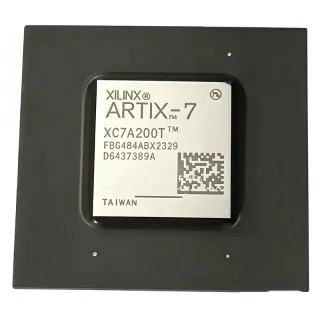
EP20K200RC240-3 - APEX-20K FPGA, 200K Gates, 240-BFQFP | Intel / Altera
MPN: EP20K200RC240-3 ✗ End of Life| Qty | Unit Price | Extended |
|---|---|---|
| 1 | $78.5 | $78.50 |
| 10 | $71.2 | $712.00 |
| 100 | $62.4 | $6,240.00 |
| 500 | $55.1 | $27,550.00 |
| 1,000 | $49.85 | $49,850.00 |
EP20K200RC240-3 Overview
An FPGA (Field-Programmable Gate Array) is a semiconductor integrated circuit composed of configurable logic blocks (CLBs), programmable interconnects, and I/O cells that the designer can program after manufacturing. FPGAs sit at the top of the programmable logic hierarchy: programmable logic device (PLD) -> complex programmable logic device (CPLD) -> FPGA. They are used to implement arbitrary digital logic, glue logic, signal processing pipelines, and full processor subsystems without fabricating a custom ASIC. The APEX-20K family was Altera's first SOPC (system-on-a-programmable-chip) platform, integrating look-up tables for register-intensive functions and product-term logic for arithmetic paths into a single fabric.
Key features of the EP20K200RC240-3 include 174 maximum user I/O, 4 Embedded System Blocks (ESBs) supporting True Dual-Port RAM at up to 311 MHz in -3 speed grade, an internal MultiTrack interconnect for high-speed routing, and IEEE 1149.1 JTAG boundary-scan support. The 1.8V core (VCCINT) with 2.375V to 2.625V supply tolerance and 3.3V tolerant I/O make it well suited for mixed-voltage board designs.
Typical applications span telecommunications line cards, industrial control, high-speed data processing, DSP co-processing, and legacy ASIC replacement. The wide I/O count and embedded RAM make it effective for bus-bridging, custom peripheral controllers, and parallel DSP pipelines. Designers should configure the device with Quartus II (legacy) or Max+Plus II to generate the configuration bitstream loaded into the on-chip SRAM cells.
This page synthesizes distributor pricing, drop-in pin-compatible alternatives, and practical design notes not found in the manufacturer datasheet alone. Engineers comparing this part against modern Cyclone or Lattice alternatives should weigh the 1.8V core supply, BFQFP-240 footprint, and active Altera/Intel legacy support window.
Drop-in alternatives for EP20K200RC240-3 — same package, pin-to-pin compatible. Different-package parts requiring PCB rework are excluded.
Variants in this series
Same-series models that are drop-in compatible with EP20K200RC240-3 (same form factor and footprint) — differing in Package, Speed Grade, Maximum Internal Frequency, Core Supply Voltage, Process Technology.
Quick Comparison Tool — Select alternative parts for side-by-side comparison:
EP20K200RC240-2X
✅ Drop-In ⚠️ 参数待验证✓ In Stock
$240.36 / Unit
View Datasheet →EP20K200RC240-1
✅ Drop-In ⚠️ 参数待验证✓ In Stock
$65 / Unit
View Datasheet →EP20K200EQC240-3N
✅ Drop-In ⚠️ 参数待验证✓ In Stock
$45.25 / Unit
View Datasheet →EP20K200EQC240-2
✅ Drop-In ⚠️ 参数待验证✓ In Stock
$14 / Unit
View Datasheet →EP20K200EQC240-1
✅ Drop-In ⚠️ 参数待验证✓ In Stock
Contact for price
View Datasheet →EP20K200RC240-2X
✅ Drop-In✓ In Stock
$240.36 / Unit
View Datasheet →EP20K200RC240-3 Maximum Ratings & Electrical Characteristics
| Series | APEX-20K |
| Device Family | Apex 20KE |
| Logic Elements / Cells | 8320 |
| System Gates | 106496 |
| Number of Logic Array Blocks (LABs) | 832 |
| Maximum User I/O | 174 |
| Embedded Memory Blocks (ESBs) | 4 |
| Total Embedded RAM Bits | 53248 bits |
| Number of I/O Banks | 8 |
| Core Supply Voltage (VCCINT) | 1.8 V (typ) |
| I/O Supply Voltage Range | 2.375 V to 2.625 V |
| Speed Grade | -3 (commercial, low-power) |
| Operating Temperature | 0C to +85C |
| Package | 240-BFQFP Exposed Pad (Plastic Quad Flat Pack) |
| Mounting Type | Surface Mount |
| Configuration Mode | SRAM-based, JTAG / Passive Serial / Passive Parallel |
| JTAG Support | IEEE 1149.1 Boundary-Scan |
EP20K200RC240-3 240-bfqfp exposed pad (plastic quad flat pack) Pin Configuration Guide
Pin configuration for EP20K200RC240-3 (240-bfqfp exposed pad (plastic quad flat pack) package). This digital IC includes GPIO, communication interfaces (UART, SPI, I2C), and power pins. Refer to the manufacturer datasheet for alternate pin functions and configuration options. Essential for embedded system design and PCB layout.

No detailed pinout data available for EP20K200RC240-3.
Refer to the datasheet for full pin configuration.
Typical Applications
EP20K200RC240-3 is suitable for 7 applications: Telecommunications Line Card Interface, Industrial Motor Control and Drive, High-Speed Data Acquisition Front-End, ASIC Replacement and Glue Logic Consolidation, Custom DSP Co-Processor Pipeline, Embedded Industrial Networking Bridge, Legacy Test and Measurement Backplane.
Telecommunications Line Card Interface
The EP20K200RC240-3 fits telecom line cards as a glue-logic and bus-aggregation controller, leveraging its 174 user I/O and 106,496 system gates to interface between TDM backplanes and parallel data paths. Its 1.8V core and 3.3V-tolerant I/O simplify mixed-voltage board designs common in legacy telecom racks. Placed between an upstream PHY and a downstream processor, the device can run custom framing, error correction, and rate-adaptation logic in hardware. Designers should pair it with a 53,248-bit embedded RAM block to buffer packet fragments, and use Quartus II SOPC Builder to instantiate the Avalon bus. Trade-off: the APEX-20K fabric is older than modern Cyclone IV/V and consumes more power per logic element.
Recommended
Industrial Motor Control and Drive
The EP20K200RC240-3 suits industrial motor drive controllers where deterministic logic and abundant I/O outweigh absolute clock speed. With 174 user I/O it can drive PWM channels, encoder feedback, and Hall-sensor inputs simultaneously while running state machines for commutation and current-loop control. Speed grade -3 (slower, low-power) is acceptable in motor control where PWM frequencies stay below 100 kHz. The 240-BFQFP exposed-pad package offers excellent thermal dissipation for hot control cabinets. Compared to a microcontroller, this FPGA offers deterministic latency and parallel I/O handling at the cost of higher BOM and configuration overhead. Recommended for legacy industrial designs or retrofits where the existing APEX-20K firmware is reused.
Recommended
High-Speed Data Acquisition Front-End
The EP20K200RC240-3 is well-matched to high-speed data acquisition front-ends that require parallel ADC interfacing, FIFO buffering, and custom DSP pipelines. Its 4 embedded system blocks (ESBs) provide up to 53,248 bits of true dual-port RAM ideal for sample-rate buffers between ADCs and a downstream DSP. The 174 I/O can directly sample 16-bit parallel ADCs running at 80-100 MSPS and perform real-time filtering or decimation. Speed grade -3 supports internal fabric clocks around 150-180 MHz. Pair with the Apex 20KE SignalTap II logic analyzer in Quartus II to verify timing closure during board bring-up. Trade-off: APEX-20K lacks hard DSP blocks, so designers must implement MAC units in LUTs, increasing logic element usage.
Recommended
ASIC Replacement and Glue Logic Consolidation
The EP20K200RC240-3 is commonly used to replace obsolete ASICs in legacy designs where redesigning the silicon is cost-prohibitive. Its 106,496 system gates can absorb the typical density of a mid-1990s gate-array ASIC, while its reprogrammability enables late-stage bug fixes. The 240-BFQFP package and 1.8V core are pin-compatible with many existing boards, making it a mechanical drop-in upgrade. Designers migrating from a discontinued ASIC benefit from Quartus II SOPC integration to add Nios soft-processors for system control. The NRND status is acceptable for legacy support windows where the design must simply function. Trade-off: not recommended for new high-volume designs given APEX-20K NRND classification.
Recommended
Custom DSP Co-Processor Pipeline
The EP20K200RC240-3 serves as a co-processor in DSP pipelines where parallel arithmetic and I/O parallelism outperform microcontrollers. Designers can implement custom FIR/IIR filters, FFTs, or codec blocks in LUTs and ESBs while a host processor streams data via the parallel I/O. With 8,320 logic elements and 53,248 bits of embedded RAM, the device can handle a 64-tap FIR filter running at audio bandwidth or a small image-processing pipeline. Speed grade -3 sets internal fabric clocks at roughly 150-180 MHz, sufficient for video-rate processing of moderate complexity. Pair with external SDRAM to extend sample buffers beyond the ESB capacity. Trade-off: APEX-20K uses more power per MAC than modern FPGAs with hard DSP blocks.
Recommended
Embedded Industrial Networking Bridge
The EP20K200RC240-3 fits embedded industrial networking bridges where it must translate between Ethernet, Profibus, RS-485, and CAN, while presenting a unified register map to a host PLC. The 174 I/O can directly drive multiple isolated transceivers and the 106,496 system gates can host custom frame-formatters for each protocol. The 1.8V core and 3.3V I/O simplify mixed-voltage designs where some PHY chips run at 2.5V. Speed grade -3 keeps power consumption acceptable for always-on industrial installations. Quartus II SOPC Builder can instantiate a Nios II soft-processor to run network management protocols without an external MCU. Trade-off: APEX-20K NRND status makes it suitable only for legacy support of fielded industrial equipment.
Recommended
Legacy Test and Measurement Backplane
The EP20K200RC240-3 is used in legacy test-and-measurement backplanes where the FPGA performs pattern generation, scan-chain control, and custom stimulus routing. With 174 user I/O and 4 ESBs, it can drive a 16-channel mixed-signal test platform while buffering captured waveforms in embedded RAM. Speed grade -3 supports stimulus patterns at up to 100 MHz which matches most legacy ATE timing requirements. The 240-BFQFP exposed-pad package delivers thermal headroom for continuous full-power operation in test head environments. Designers use SignalTap II for on-chip debugging and Quartus II LogicLock regions to isolate test IP blocks. Trade-off: APEX-20K is supported only by legacy Quartus II 13.0 and earlier, not by modern Intel Quartus Prime Pro.
Recommended
Recommended Products Summary
Engineering reference data for EP20K200RC240-3 — comparison, design guidance, and compliance information.
Selection Guide
Comparison with Alternatives
| Parameter | This Product | EP20K200RC240-2 | EP20K200RC240-1 | EP20K200EQC240-3 | EP20K200EQC240-2 | EP20K200EQC240-1 | EP20K200RC240-2X |
|---|---|---|---|---|---|---|---|
| Package | 240-BFQFP Exposed Pad | 240-BFQFP Exposed Pad (same) | 240-BFQFP Exposed Pad (same) | 240-BFQFP Exposed Pad (same) | 240-BFQFP Exposed Pad (same) | 240-BFQFP Exposed Pad (same) | 240-BFQFP Exposed Pad (same) |
| Brand | Intel (formerly Altera) | Intel | Intel | Intel | Intel | Intel | Intel |
| Speed Grade | -3 (commercial, low-power) | -2 (faster) | -1 (fastest) | -3 (enhanced, low-power) | -2 (enhanced, faster) | -1 (enhanced, fastest) | -2 RoHS (faster, lead-free) |
| System Gates | 106,496 | 106,496 | 106,496 | 106,496 | 106,496 | 106,496 | 106,496 |
| Logic Elements | 8,320 | 8,320 | 8,320 | 8,320 | 8,320 | 8,320 | 8,320 |
| Maximum User I/O | 174 | 174 | 174 | 174 | 174 | 174 | 174 |
| Embedded RAM (bits) | 53,248 | 53,248 | 53,248 | 53,248 | 53,248 | 53,248 | 53,248 |
| Core Supply (VCCINT) | 1.8 V (2.375-2.625 V I/O) | 1.8 V (same) | 1.8 V (same) | 1.8 V (same) | 1.8 V (same) | 1.8 V (same) | 1.8 V (same) |
| Device Family | APEX-20KE (Standard) | APEX-20KE (Standard) | APEX-20KE (Standard) | APEX-20KE (Enhanced) | APEX-20KE (Enhanced) | APEX-20KE (Enhanced) | APEX-20KE (Standard, lead-free) |
| Lifecycle Status | NRND | NRND | NRND | NRND | NRND | NRND | NRND |
Key Differentiators
- Lowest-power speed grade in APEX-20KE 200K family (vs EP20K200RC240-2)
- Standard fabric vs Enhanced interconnect (vs EP20K200EQC240-3)
- Lead-free / RoHS compliance variant available (vs EP20K200RC240-2X)
Design Notes
Estimated: at 1.8V core, with 8320 logic elements running at 50% utilization and 174 I/O at 25 MHz LVCMOS33, the EP20K200RC240-3 typically draws 250-400 mA on VCCINT. Provide a 1.8V rail via an LT1764A-1.8 or equivalent low-noise LDO rated for at least 800 mA, with a 10uF tantalum plus 0.1uF ceramic decoupling network placed within 5 mm of each VCCINT pin. The exposed pad on the 240-BFQFP package must be soldered to a copper pour connected to GND for thermal dissipation. Insufficient decoupling will cause logic glitches and I/O timing violations during high-ESB read/write activity.
The 240-BFQFP exposed-pad package has 0.5 mm pitch leads, which is challenging for hand-soldering and demands reflow assembly. Use a 4-layer PCB stackup with continuous GND planes on layer 2 to minimize ground bounce. Length-match clock traces (CLK0, CLK1) to within 1 mm to avoid duty-cycle distortion; route configuration PROM data lines (DCLK, DATA, nCONFIG, nSTATUS, CONF_DONE) in a single bus with matched lengths to prevent configuration errors. Provide JTAG test points on TCK, TMS, TDI, TDO for in-system programming and boundary-scan diagnostics.
The EP20K200RC240-3 is SRAM-based and loses its configuration on every power-down. You must pair it with an EPC2 or EPC16 configuration PROM or use a microcontroller to load the bitstream via JTAG. Forgetting the configuration PROM is a common engineering error that leaves the device non-functional at first prototype. Additionally, this device is supported only by Quartus II versions up to 13.0 (legacy Intel/Altera tools); modern Quartus Prime does not support APEX-20K. Verify your toolchain compatibility before committing to this FPGA for new development.
Estimated: at 1A VCCINT current and 1.8V supply, the device dissipates ~1.8W internally. The 240-BFQFP exposed-pad package has theta_JA of approximately 18 C/W with a 4-layer 4x4 inch board and a properly soldered exposed pad, giving a junction temperature rise of ~32C above ambient. At the upper commercial limit of 85C ambient, junction temperature reaches ~117C - well within the 125C silicon limit but leaves minimal headroom. For industrial temperature (85C) operation in enclosed cabinets, add forced-air cooling or reduce fabric utilization to maintain margin.
Compliance Information
RoHS status not confirmed in verified data; the original EP20K200RC240-3 likely contains lead (standard Altera BFQFP), choose EP20K200RC240-2X for the RoHS-compliant variant. AEC-Q100 not applicable - APEX-20K FPGAs are not automotive-qualified.