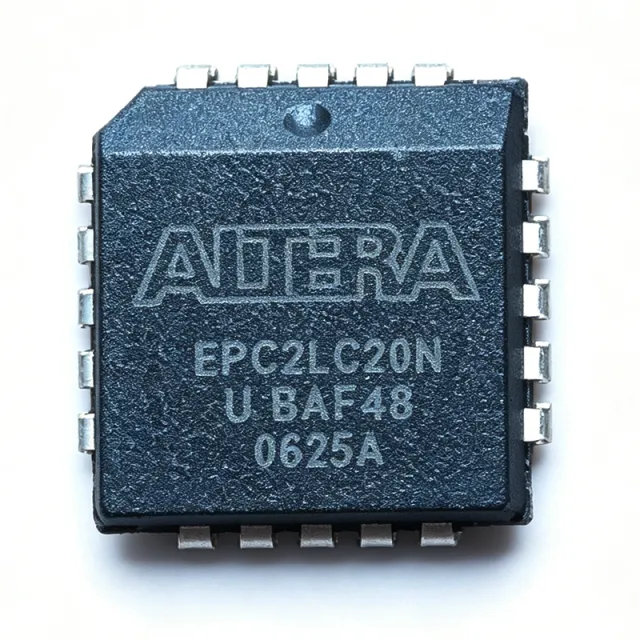
EPC2LC20 - 1.6Mb In-System Prog Config PROM 20-PLCC | Altera
MPN: EPC2LC20 ✗ End of Life| Qty | Unit Price | Extended |
|---|---|---|
| 1 | $14.5 | $14.50 |
| 10 | $12.85 | $128.50 |
| 100 | $10.4 | $1,040.00 |
| 500 | $8.75 | $4,375.00 |
| 1,000 | $7.2 | $7,200.00 |
EPC2LC20 Overview
A configuration PROM is a non-volatile memory device that stores the FPGA's configuration bitstream and delivers it serially or in parallel to the target SRAM-based FPGA every time the system powers up or when new configuration data is needed. Because SRAM-based LUT devices are volatile, the EPC2LC20 eliminates the need for a separate boot ROM and reduces BOM cost, PCB area, and design complexity. The EPC2 family sits in the broader hierarchy of FPGA configuration memory: configuration PROM -> non-volatile boot memory -> FPGA companion IC -> programmable logic support silicon.
Key features of the EPC2LC20 include 1.6 Mbits of storage capacity, cascadable JTAG-chain support so multiple EPC2 devices can be chained together to configure larger FPGAs, and dedicated open-drain CONF_DONE and nSTATUS pins for handshaking with the target FPGA. The device supports 8-bit or 16-bit JTAG boundary-scan, plus built-in data decompression compatible with Altera Quartus II programming files. Programming is performed via the Altera Programming Unit (APU) or any IEEE 1149.1-compliant JTAG controller.
In terms of architecture, the EPC2LC20 is built around a CMOS non-volatile memory array with on-chip charge pumps for ISP operation. It exposes standard JTAG pins (TCK, TMS, TDI, TDO) plus dedicated nCONFIG, nSTATUS, CONF_DONE and DCLK interface pins to the FPGA, so no glue logic is required between the PROM and the FPGA. The JTAG-based ISP allows field upgrades and factory-floor programming using only a 4-wire JTAG cable.
Typical applications include boot configuration for Cyclone and Cyclone II FPGA designs, APEX 20K family prototyping cards, multi-FPGA systems that daisy-chain several EPC2 devices in JTAG order, industrial controllers using FLEX 10K/6000 logic, and legacy designs that require a simple non-volatile companion to Altera SRAM-based FPGAs. When selecting between EPC2 variants, choose the EPC2LC20 for low-density designs and cascade additional EPC2s for larger FPGA bitstreams.
Drop-in alternatives for EPC2LC20 — same package, pin-to-pin compatible. Different-package parts requiring PCB rework are excluded.
Variants in this series
Same-series models that are drop-in compatible with EPC2LC20 (same form factor and footprint) — differing in Memory Type, Mounting Type, Package, Compatible FPGA Families, Interface.
Quick Comparison Tool — Select alternative parts for side-by-side comparison:
EPC2LC20N
✓ In Stock
$7.4 / Unit
View Datasheet →EPC2LI20
✓ In Stock
$5.95 / Unit
View Datasheet →EPC2LI20N
✓ In Stock
$5.1 / Unit
View Datasheet →EPC2LC120
✓ In Stock
$9.95 / Unit
View Datasheet →EPC1LC20
✓ In Stock
$7.95 / Unit
View Datasheet →EPC2LC20 Maximum Ratings & Electrical Characteristics
| Memory Type | Non-volatile configuration PROM |
| Memory Size | 1.6 Mbit |
| Configuration Interface | Serial (x1) to FPGA via DCLK/nCONFIG/nSTATUS/CONF_DONE |
| Programming Interface | IEEE 1149.1 (JTAG) ISP, 5.0-V and 3.3-V tolerant |
| Supply Voltage VCC | 3.0 V to 3.6 V (3.3-V operation) |
| ISP Voltage Range | 5.0 V or 3.3 V |
| Supported FPGA Families | ACEX 1K, APEX 20K/20KC/20KE, APEX II, Arria GX, Cyclone, Cyclone II, FLEX 10K, FLEX 6000, MAX 9000 |
| Cascade Support | Yes - daisy-chain multiple EPC2 devices via JTAG for larger bitstreams |
| Package | 20-pin PLCC (J-lead, 9x9 mm) |
| Mounting Type | Surface Mount |
| RoHS Status | Non-Compliant (original Altera Pb-containing part) |
| Lead-Free Version | EPC2LC20N available as lead-free equivalent |
| Programming Support | Altera Programming Unit (APU), Quartus II, JTAG programmer |
| Boundary-Scan | IEEE 1149.1 compliant, 8-bit or 16-bit JTAG |
EPC2LC20 Pin Configuration
| Pin 1 | TCK — JTAG Test Clock |
| Pin 2 | TMS — JTAG Test Mode Select |
| Pin 3 | nCONFIG — Configuration control (from FPGA, input to PROM) |
| Pin 4 | nSTATUS — Configuration status (open-drain, to FPGA) |
| Pin 5 | DCLK — Configuration clock (to FPGA) |
| Pin 6 | DATA — Configuration data serial output to FPGA |
| Pin 7 | nCS — Chip select (cascade use) |
| Pin 8 | nCE — Chip enable (cascade use) |
| Pin 9 | VCC — Power supply (+3.3 V) |
| Pin 10 | VCC — Power supply (+3.3 V) |
| Pin 11 | GND — Ground |
| Pin 12 | GND — Ground |
| Pin 13 | OE — Output enable |
| Pin 14 | nRESET — Reset input |
| Pin 15 | TDI — JTAG Test Data In |
| Pin 16 | TDO — JTAG Test Data Out |
| Pin 17 | A0 — Address input / cascade select |
| Pin 18 | A1 — Address input / cascade select |
| Pin 19 | A2 — Address input / cascade select |
| Pin 20 | CONF_DONE — Configuration done flag (open-drain, to FPGA) |
Typical Applications
EPC2LC20 is suitable for 6 applications: Cyclone / Cyclone II FPGA Boot Configuration, APEX 20K Family Configuration, Multi-FPGA JTAG Daisy-Chain Systems, Industrial Controller FLEX 10K / FLEX 6000 Designs, Prototype & Development Boards, Legacy MAX 9000 / ACEX 1K Designs.
Cyclone / Cyclone II FPGA Boot Configuration
The EPC2LC20's 1.6-Mbit density and JTAG ISP interface align with Cyclone and Cyclone II configuration bitstreams up to ~200 Kbytes (compressed). It connects directly to the FPGA's nCONFIG/nSTATUS/CONF_DONE/DCLK pins, eliminating an external boot ROM and reducing BOM cost and PCB area. The 3.3-V VCC matches Cyclone's VCCIO domain, and the dedicated JTAG TAP enables field firmware updates without removing the board. For designs that exceed 1.6 Mb the EPC2LC120 in the same PLCC-20 footprint provides a higher-density upgrade path.
Recommended
APEX 20K Family Configuration
The EPC2LC20 supports Altera's APEX 20K, APEX 20KC, and APEX 20KE multi-million-gate FPGAs in serial configuration mode. With 1.6 Mb of storage it fits smaller APEX 20K bitstreams; larger APEX designs cascade multiple EPC2 devices via JTAG. The PLCC-20 footprint is the same as APEX 20K EDA board designs, allowing drop-in placement in industrial automation and telecom hardware that still uses APEX 20K logic. The dedicated open-drain nSTATUS/CONF_DONE handshaking matches APEX 20K's PS mode timing.
Recommended
Multi-FPGA JTAG Daisy-Chain Systems
When a single EPC2LC20 is insufficient, multiple EPC2 devices can be cascaded via JTAG to deliver larger configuration bitstreams to high-density FPGAs such as APEX II and Arria GX. The EPC2LC20 acts as one node in the JTAG chain, sharing TCK/TMS/TDI and passing TDO. The daisy-chain topology is supported natively in Quartus II programmer, so engineers do not need external mux logic. Industrial-grade parts (EPC2LI20N) are preferred in 24V factory-floor systems with elevated ambient temperature.
Recommended
Industrial Controller FLEX 10K / FLEX 6000 Designs
Legacy industrial controllers built on Altera FLEX 10K and FLEX 6000 series logic continue to use EPC2LC20 as their boot configuration PROM. The 1.6-Mbit density is more than adequate for these older FPGA families, and the PLCC-20 socket allows easy field replacement. Designers maintaining FLEX-based equipment can substitute the EPC2LC20N (Pb-free) or EPC2LI20N (industrial Pb-free) as drop-in replacements. The JTAG ISP allows in-system firmware upgrades without opening the enclosure.
Recommended
Prototype & Development Boards
Altera / Intel FPGA development kits for Cyclone, Cyclone II, APEX 20K, and ACEX 1K frequently reference EPC2LC20 as the on-board configuration PROM because it supports every supported FPGA family in a single package. The 20-pin PLCC socket simplifies rework during board bring-up. JTAG ISP via the APU or Quartus Programmer means designers can iterate bitstreams in-circuit. For RoHS-compliant builds the EPC2LC20N retains the same PLCC-20 footprint.
Recommended
Legacy MAX 9000 / ACEX 1K Designs
Older MAX 9000 CPLDs and ACEX 1K FPGAs rely on EPC2LC20 for non-volatile boot. The 1.6 Mb of storage far exceeds ACEX 1K's typical 100 Kbit bitstream, leaving margin for design growth. The PLCC-20 pinout is identical to EPC2LI20 and EPC2LC20N, so existing boards can accept the lead-free conversion part with zero PCB rework. Maintenance and spare-parts inventories continue to stock EPC2LC20 because of its long service history in telecom and industrial automation.
Recommended
Recommended Products Summary
Engineering reference data for EPC2LC20 — comparison, design guidance, and compliance information.
Selection Guide
Comparison with Alternatives
| Parameter | This Product | EPC2LC20N | EPC2LI20 | EPC2LI20N | EPC2LC120 | EPC1LC20 |
|---|---|---|---|---|---|---|
| Package | 20-pin PLCC (9x9 mm) | 20-pin PLCC (9x9 mm) - same | 20-pin PLCC (9x9 mm) - same | 20-pin PLCC (9x9 mm) - same | 20-pin PLCC (9x9 mm) - same | 20-pin PLCC (9x9 mm) - same |
| Brand | Altera | Altera | Altera | Altera | Altera | Altera |
| Memory Density | 1.6 Mbit | 1.6 Mbit | 1.6 Mbit | 1.6 Mbit | 4 Mbit (larger) | 1 Mbit (smaller) |
| Programming Interface | IEEE 1149.1 JTAG ISP (5V/3.3V) | IEEE 1149.1 JTAG ISP | IEEE 1149.1 JTAG ISP | IEEE 1149.1 JTAG ISP | IEEE 1149.1 JTAG ISP | IEEE 1149.1 JTAG ISP |
| Cascade Support | Yes (JTAG chain) | Yes | Yes | Yes | Yes | Yes |
| Supported FPGA Families | ACEX 1K, APEX 20K, Cyclone, Cyclone II, FLEX 10K/6000, MAX 9000 | Same families | Same families | Same families | Same + larger bitstreams | Same families (smaller designs) |
Key Differentiators
- Direct Altera-original configuration PROM with native JTAG ISP (vs Generic third-party SPI flash + soft-controller solutions)
- Pin-compatible Pb-free upgrade path (vs EPC2LC20 (this part))
- 1.6 Mbit density matches the most common Cyclone II bitstreams (vs EPC1LC20 (1 Mbit))
Design Notes
Place the EPC2LC20 within 50 mm of the target FPGA to keep the DCLK and DATA traces short and matched; long traces degrade signal integrity at higher DCLK rates. Provide a solid ground plane under the device and route JTAG signals (TCK, TMS, TDI, TDO) away from switching power and clock lines. Keep VCC and GND pin pairs (9/10 and 11/12) on a low-impedance 3.3-V plane.
The EPC2LC20 requires a stable 3.3-V supply; add a 0.1 uF ceramic decoupling capacitor close to each VCC pin (9 and 10) and a 10 uF bulk capacitor near the device. The 5.0-V ISP mode is supported on VCC at 3.3 V; do not exceed the absolute maximum VCC rating. If the host JTAG programmer drives 5-V logic on TDI/TMS, ensure the FPGA's JTAG VCCIO matches.
Do not confuse the EPC2LC20 (lead-containing) with the EPC2LC20N (Pb-free RoHS) when ordering for RoHS-compliant builds. In daisy-chained configurations, ensure nCS/nCE cascade logic is correct; a single mis-wired nCS line will prevent all downstream FPGAs from configuring. Confirmed FPGA nCONFIG must be held low at power-up before the EPC2LC20 releases CONF_DONE, otherwise the FPGA may start up in an undefined state.
Compliance Information
EPC2LC20 is the original lead-containing Altera part; EPC2LC20N is the Pb-free / RoHS-compliant conversion variant in the same PLCC-20 footprint. AEC-Q100 is not applicable because this is a memory/configuration device, not an automotive-grade IC.