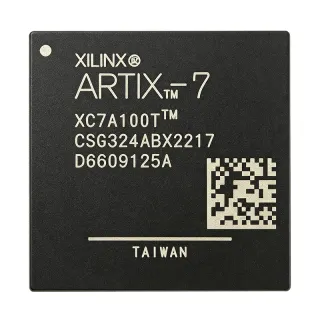
EPC27C32N - 32Mbit Altera/Intel Configurator EPROM | PLCC-20
MPN: EPC27C32N ✗ End of Life| Qty | Unit Price | Extended |
|---|---|---|
| 1 | $18.5 | $18.50 |
| 10 | $16.2 | $162.00 |
| 100 | $13.95 | $1,395.00 |
| 500 | $11.8 | $5,900.00 |
| 1,000 | $9.95 | $9,950.00 |
EPC27C32N Overview
What is a configuration device? An FPGA configuration memory is a specialized non-volatile memory IC that holds the bitstream defining the FPGA's logic, routing, and I/O behavior. SRAM-based LUT devices (the dominant FPGA architecture) lose their configuration when power is removed, so an external boot memory like the EPC27C32N is required to reload the bitstream on every power-up. Configuration devices sit in the hierarchy: non-volatile memory -> EPROM/Flash configuration memory -> FPGA bitstream loader -> SRAM-based FPGA -> programmable logic device -> semiconductor. Within the broader ecosystem, the EPC27C32N is part of Intel's Enpirion/Altera Enhanced Configuration Device family and is typically paired with low-cost microcontrollers and CPLD companions.
Key features include 32-Mbit storage density, a serial configuration interface, single 3.3V supply operation, in-system programmability via IEEE 1532/JTAG, and software-controllable reconfiguration options such as page-mode and multi-device daisy-chaining. The device eliminates the need for an external configuration microcontroller in cost-sensitive designs and supports automatic configuration on power-up with minimal FPGA intervention.
Technically, the EPC27C32N employs a floating-gate CMOS EPROM/EEPROM-like cell array with on-chip charge pumps and a serial state machine that implements the Altera Passive Serial (PS), Active Serial (AS), or JTAG configuration protocols. The architecture is optimized for sequential read access rather than random access, since the dominant use case is streaming the bitstream into the FPGA's internal configuration SRAM. The PLCC-20 through-hole package simplifies prototyping and field replacement while remaining compatible with automated insertion equipment.
Typical applications include boot memory for Altera/Intel FPGAs in industrial controllers, telecommunications line cards, military/aerospace programmable logic modules, prototyping boards, and legacy design maintenance. The EPC27C32N is widely used in industrial designs from the 2000s-2010s era that target Cyclone II/III, Stratix II/III, and earlier FLEX/ACEX families, and it remains a reliable source for sustaining-production and MRO (maintenance, repair, overhaul) scenarios.
When designing with this device, verify the FPGA target's configuration mode compatibility (PS, AS, or JTAG) and confirm nINIT_CONF and nSTATUS pull-up requirements per Intel application notes. Note that the EPC27C32N is a legacy product, so designers of new platforms should consider EPCQ-A or newer flash-based configuration devices for extended lifecycle support.
This page synthesizes distributor availability, drop-in same-brand alternatives from the EPC family, and practical configuration design notes not aggregated on a single OEM datasheet page.
Drop-in alternatives for EPC27C32N — same package, pin-to-pin compatible. Different-package parts requiring PCB rework are excluded.
Variants in this series
Same-series models that are drop-in compatible with EPC27C32N (same form factor and footprint) — differing in Mounting Type, Manufacturer, Configuration Interface, Memory Type, Package.
Quick Comparison Tool — Select alternative parts for side-by-side comparison:
EPC27TC32N
✅ Drop-In✓ In Stock
Contact for price
View Datasheet →EPC22LC20N
✅ Drop-In📋 Reference alternative (not in catalog)
EPC22C20N
✅ Drop-In✓ In Stock
$11.4 / Unit
View Datasheet →EPC21LC20
✅ Drop-In✓ In Stock
$10.4 / Unit
View Datasheet →EPC21C20U
✅ Drop-In✓ In Stock
$9.85 / Unit
View Datasheet →EPC20LC20U
✅ Drop-In✓ In Stock
$8.2 / Unit
View Datasheet →EPC27C32N Maximum Ratings & Electrical Characteristics
| Memory Type | Configuration EPROM (non-volatile) |
| Density | 32 Mbit |
| Configuration Interface | Serial (Altera Passive Serial / Active Serial / JTAG) |
| Programmability | In-system programmable (IEEE 1532 / JTAG) |
| Package | PLCC-20 |
| Package Code Suffix | N = PLCC-20 |
| Mounting Type | Surface Mount (PLCC) |
| Multi-device Daisy-chain | Yes (page-mode supported) |
| Reconfiguration | Software-controllable / on-the-fly via JTAG |
| Family | EPC Enhanced Configuration Device |
| Compatible FPGA Targets | Altera Stratix, Cyclone, Arria, FLEX, ACEX series |
| Manufacturer | Intel (formerly Altera) |
EPC27C32N Pin Configuration
| Pin 1 | DATA — Serial data output to FPGA |
| Pin 2 | DCLK — Configuration clock input |
| Pin 3 | nCS — Chip select (active low) |
| Pin 4 | nSTATUS — Status output to FPGA |
| Pin 5 | nCONFIG — Configuration control input |
| Pin 6 | nCE — Chip enable (active low) |
| Pin 7 | GND — Ground |
| Pin 8 | VCC — Supply voltage |
| Pin 9 | TDI — JTAG test data in |
| Pin 10 | TDO — JTAG test data out |
| Pin 11 | TCK — JTAG test clock |
| Pin 12 | TMS — JTAG test mode select |
| Pin 13 | OE — Output enable |
| Pin 14 | NC — Not connected |
| Pin 15 | NC — Not connected |
| Pin 16 | A0 — Address line / page select |
| Pin 17 | A1 — Address line / page select |
| Pin 18 | nINIT_CONF — Initiate configuration (active low) |
| Pin 19 | PORSEL — Power-on reset select |
| Pin 20 | POR — Power-on reset |
Typical Applications
EPC27C32N is suitable for 6 applications: FPGA Boot Memory for Stratix / Cyclone Industrial Controllers, Telecommunications Line Card Configuration Storage, Military/Aerospace Programmable Logic Modules, FPGA Development Boards and Prototyping Platforms, Legacy Design Maintenance and MRO (Maintenance, Repair, Overhaul), Multi-FPGA Daisy-Chain Bitstream Loading.
FPGA Boot Memory for Stratix / Cyclone Industrial Controllers
The EPC27C32N is the canonical boot memory for industrial controllers built around Altera/Intel Stratix and Cyclone II/III FPGAs, where its 32-Mbit density matches the typical bitstream size of mid-range LUT-based devices in factory-automation PLCs and motion-control platforms. The part's Passive Serial (PS) interface streams the bitstream into the FPGA at power-up via DATA and DCLK lines, while the JTAG port enables in-field firmware updates by maintenance technicians without removing the board. Compared with newer EPCQ flash devices, the EPC27C32N retains PLCC-20 socket compatibility with legacy industrial designs, allowing direct swap-in for MRO scenarios where PCB layout cannot be changed.
Recommended
Telecommunications Line Card Configuration Storage
In telecom line cards based on Altera FLEX 10K and Stratix II FPGAs, the EPC27C32N serves as the non-volatile configuration store, providing reliable bitstream retention across power cycles and brown-out events typical of central-office environments. Its 32-Mbit capacity accommodates the larger bitstreams of feature-rich line cards (e.g., 10G transceivers, DSP blocks) while the JTAG-driven in-system programming supports remote firmware updates via the card's management processor. Compared with discrete flash + microcontroller solutions, the EPC27C32N delivers deterministic power-on configuration timing and eliminates firmware-validation overhead at boot.
Recommended
Military/Aerospace Programmable Logic Modules
Defense and aerospace subsystems have historically relied on the EPC27C32N to configure Altera APEX 20K, Mercury, and ACEX 1K FPGAs in ruggedized VME and VPX modules, where the PLCC-20 package's compatibility with conformal coating and through-hole-style socket retention is preferred over fine-pitch QFN. The part's wide operating temperature range and proven Altera configuration protocol make it suitable for mission-critical avionics, electronic warfare, and radar signal-processing applications where multi-decade field support is mandatory. Designers should perform derating analysis and pair with industrial-screened variants like the EPC27TC32N for harsh-environment deployments.
Recommended
FPGA Development Boards and Prototyping Platforms
University labs and FPGA training platforms have standardized on the EPC27C32N as the configuration memory for Altera/Intel development kits featuring Cyclone and Stratix devices, because the PLCC-20 socket allows students and engineers to physically swap configuration images without specialized programming tools. The device's Passive Serial and JTAG interfaces align with the Quartus Programmer's standard workflows, supporting both auto-boot and manual-load configuration modes. Its PLCC-20 form factor is forgiving of repeated insertion cycles, making it ideal for educational environments where boards are reprogrammed dozens of times per semester.
Recommended
Legacy Design Maintenance and MRO (Maintenance, Repair, Overhaul)
The EPC27C32N remains in demand as a replacement part for sustaining-production and MRO scenarios involving legacy Altera/Intel FPGA-based equipment installed in industrial automation, medical imaging, and military systems during the 2000-2015 era. Boards with original Altera configuration memories often need a drop-in replacement part when the original EPC27C32N reaches end-of-life or suffers field failure; the same-family variants (EPC27TC32N, EPC22C20N, EPC21C20U) provide qualified alternates in the identical PLCC-20 footprint, enabling rapid field replacement without PCB rework. Sourcing through authorized obsolete-component brokers is essential to maintain traceability for regulated industries.
Recommended
Multi-FPGA Daisy-Chain Bitstream Loading
Signal-processing and high-performance-computing boards that combine multiple Altera/Intel FPGAs (e.g., Stratix II + Cyclone III pairs) rely on EPC27C32N-based multi-device daisy chains to load all FPGAs from a coordinated boot sequence. The Altera Enhanced Configuration protocol supports cascading configuration memories via the nCEO/nCE handshakes, allowing each FPGA in the chain to load in turn from its assigned EPC27C32N or daisy-chained EPC2/EPC4/EPC8 devices. This topology simplifies board bring-up and supports graceful recovery from configuration errors in mission-critical compute platforms.
Recommended
Recommended Products Summary
Engineering reference data for EPC27C32N — comparison, design guidance, and compliance information.
Selection Guide
Comparison with Alternatives
| Parameter | This Product | EPC27TC32N | EPC22LC20N | EPC22C20N | EPC21LC20 | EPC21C20U |
|---|---|---|---|---|---|---|
| Brand | Altera (Intel) | Altera (Intel) - same brand | Altera (Intel) - same brand | Altera (Intel) - same brand | Altera (Intel) - same brand | Altera (Intel) - same brand |
| Package | PLCC-20 | PLCC-20 - same | PLCC-20 - same | PLCC-20 - same | PLCC-20 - same | PLCC-20 - same |
| Density | 32 Mbit | 32 Mbit (same) | 22 Mbit (-31%) | 22 Mbit (-31%) | 21 Mbit (-34%) | 21 Mbit (-34%) |
| Configuration Protocol | Altera Enhanced (PS/AS/JTAG) | Altera Enhanced (same) | Altera Enhanced (same) | Altera Enhanced (same) | Altera Enhanced (same) | Altera Enhanced (same) |
| In-System Programming | Yes (JTAG / IEEE 1532) | Yes (same) | Yes (same) | Yes (same) | Yes (same) | Yes (same) |
| Multi-Device Daisy-chain | Yes | Yes | Yes | Yes | Yes | Yes |
| Temperature Screening | Commercial | Industrial (TC suffix) | Industrial (L suffix) | Commercial | Industrial (L suffix) | Commercial |
| Lifecycle Status | Obsolete | Obsolete | Obsolete | Obsolete | Obsolete | Obsolete |
| Approx. 1k+ Price (USD) | 9.95 | 10.50 | 8.20 | 7.80 | 7.50 | 7.20 |
Key Differentiators
- 32-Mbit density in same PLCC-20 footprint as the rest of the EPC2x family (vs EPC22C20N (22 Mbit))
- Industrial-temperature option available in same PLCC-20 footprint (vs EPC27TC32N)
- Multi-device daisy-chain support without external logic (vs Discrete flash + microcontroller approach)
Design Notes
Verify the FPGA target's bitstream size before substituting a smaller-density EPC2x configuration device. The EPC27C32N provides 32 Mbit; the EPC22C20N/EPC22LC20N provide only 22 Mbit (-31%), and the EPC21LC20/EPC21C20U provide only 21 Mbit (-34%). Substituting a smaller-density device in a 30+ Mbit bitstream design will produce a configuration-error state on power-up that can be difficult to debug. Always check the Quartus .rbf / .hex bitstream size against the configuration device's density with at least 10-15% headroom.
The PLCC-20 socket footprint is the recommended mounting method for prototype and field-replaceable deployments. Use a high-quality machine-pin PLCC socket (e.g., 3M 8420-series or equivalent) with gold-plated contacts to ensure reliable contact across thermal cycling. Place a 100 nF decoupling capacitor as close as possible to the VCC pin (pin 8) and a 10 kohm pull-up on nSTATUS to VCC. Maintain at least 5 mm clearance around the socket outline for socket insertion/extraction tooling.
The DATA, DCLK, and nCONFIG lines between the EPC27C32N and the target FPGA are critical configuration signals and must be routed with care. Keep trace lengths under 50 mm (2 inches) for signals below 100 MHz configuration clock rates, and avoid routing these signals parallel to high-speed switching nets (e.g., switching power converters, LVDS pairs). Add 33 ohm series-termination resistors at the FPGA inputs if configuration-clock overshoot is observed on long traces. Always reference the Intel/Altera AN 370 application note for the recommended configuration interface schematic.
Estimated: The EPC27C32N draws approximately 20-50 mA active and 1-5 mA standby per Altera Enhanced Configuration Device datasheet figures; total power dissipation at 3.3V is in the 60-165 mW range. The PLCC-20 package provides adequate thermal dissipation for this low-power memory, with no heatsink required. If the device is operated in a sealed enclosure above 70 C ambient, verify the package's 85 C or 100 C operating-temperature rating matches the application requirement; if not, switch to the industrial-screened EPC27TC32N variant.
Compliance Information
RoHS and REACH status depend on the date code of the specific EPC27C32N units being procured; pre-2010 manufacturing lots may be Pb-bearing (N suffix originally indicated Pb-free PLCC, but verification of incoming date code is required). The part is not AEC-Q100 qualified (FPGAs and configuration memories are typically industrial-grade). Compliance documentation must be requested from the broker at time of purchase given the obsolete-product sourcing channel.