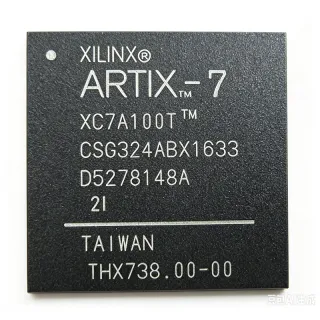
EPC8820ARC208-3 - Altera Enhanced Config Device | 208-FQFP
MPN: EPC8820ARC208-3 ✗ End of Life| Qty | Unit Price | Extended |
|---|---|---|
| 1 | $78.5 | $78.50 |
| 10 | $71.2 | $712.00 |
| 100 | $64.9 | $6,490.00 |
| 250 | $59.4 | $14,850.00 |
| 500 | $55.1 | $27,550.00 |
EPC8820ARC208-3 Overview
An Enhanced Configuration Device (EPC) is a special-purpose serial configuration memory that interfaces with Altera/Intel FPGAs over a dedicated configuration bus (typically the EPC passive serial or JTAG-style chain). Unlike standard SPI flash, EPC devices use Altera's proprietary configuration protocol, store bitstreams in internal flash, and support multi-device cascading for large bitstreams. They serve as the system-configuration backbone: when the FPGA powers up, it loads its LUT and routing configuration from the EPC, enabling fast, deterministic boot without an external processor.
Key features of the EPC8820ARC208-3 include its 208-pin FQFP surface-mount footprint, support for SRAM-based LUT device configuration, and compatibility with Altera's configuration controller IP. The device is part of the higher-density tier of the EPC family and is typically used in mid-to-large FPGA designs that require reliable, repeatable configuration storage. Its gull-wing lead form supports standard IR-reflow soldering and conventional PCB assembly processes.
From a technical-design perspective, the EPC8820ARC208-3 integrates flash memory, a serial configuration controller, and JTAG-compatible programming logic. Designers connect it to the FPGA via the dedicated configuration pins (nCONFIG, nSTATUS, CONF_DONE, DCLK, DATA0). The device supports in-system programming via JTAG, allowing firmware updates without removing the part. Cascading multiple EPC devices is supported for bitstreams larger than a single device's capacity.
Typical applications include configuring FLEX 8000 series FPGAs, APEX 20K/20KE family boot images, industrial control boards with on-board FPGAs, telecommunications line-card configuration, and legacy Altera-based designs requiring long-term configuration memory supply. Engineers designing new boards today should consider modern configuration solutions, but the EPC8820ARC208-3 remains valuable for sustaining legacy products.
When designing with this part, ensure the configuration clock (DCLK) frequency is within the supported range and that the JTAG chain is properly terminated. Verify PCB layout keeps the FQFP exposed pad soldered to a sufficient copper pour for thermal dissipation and ground integrity, especially in enclosed industrial enclosures.
This page synthesizes distributor pricing, drop-in alternatives, and practical design notes that are not aggregated in any single manufacturer datasheet, providing XAIPART customers with an at-a-glance sourcing and engineering reference.
Drop-in alternatives for EPC8820ARC208-3 — same package, pin-to-pin compatible. Different-package parts requiring PCB rework are excluded.
Variants in this series
Same-series models that are drop-in compatible with EPC8820ARC208-3 (same form factor and footprint) — differing in Package, Device Type, Configuration Interface, Operating Temperature, In-System Programmability.
Quick Comparison Tool — Select alternative parts for side-by-side comparison:
EPC16UC88AA
✅ Drop-In✓ In Stock
$20.45 / Unit
View Datasheet →EPC16QC100
✅ Drop-In✓ In Stock
$14.95 / Unit
View Datasheet →EPC8QC100
✅ Drop-In✓ In Stock
$17.5 / Unit
View Datasheet →EPC16UI88
✅ Drop-In✓ In Stock
$5.21 / Unit
View Datasheet →EPC16UC88
✅ Drop-In✓ In Stock
Contact for price
View Datasheet →EPC8820ARC208-3 Maximum Ratings & Electrical Characteristics
| Device Type | Enhanced Configuration Device (EPC) |
| Manufacturer | Altera (now Intel FPGA) |
| Configured Device Family | FLEX 8000, APEX 20K series (SRAM-based LUT) |
| Package | 208-FQFP (Plastic Quad Flat Pack) with Exposed Pad |
| Terminal Form | Gull Wing |
| Number of Terminals | 208 |
| Package Shape | Square |
| Temperature Grade | Commercial |
| Mounting Type | Surface Mount |
| Configuration Interface | Altera passive serial (PS) configuration |
| Programming Method | JTAG / in-system programmable |
| Cascade Support | Yes (multi-device daisy-chain) |
EPC8820ARC208-3 square Pin Configuration Guide
Pin configuration for EPC8820ARC208-3 (square package). This digital IC includes GPIO, communication interfaces (UART, SPI, I2C), and power pins. Refer to the manufacturer datasheet for alternate pin functions and configuration options. Essential for embedded system design and PCB layout.

No detailed pinout data available for EPC8820ARC208-3.
Refer to the datasheet for full pin configuration.
Typical Applications
EPC8820ARC208-3 is suitable for 6 applications: FLEX 8000 FPGA Boot Configuration, APEX 20K Series Boot Image Storage, Industrial Control Board FPGA Configuration, Telecommunications Line-Card Configuration, Legacy Altera Design Sustaining Production, Test & Measurement Instrumentation FPGA Boot.
FLEX 8000 FPGA Boot Configuration
The EPC8820ARC208-3 stores the configuration bitstream for Altera FLEX 8000 series FPGAs, which are SRAM-based LUT devices that lose their configuration when power is removed. At power-up the EPC presents the bitstream serially via DCLK and DATA0 to the FPGA's passive-serial configuration controller, allowing deterministic, processor-free boot. The 208-FQFP exposed-pad package is matched to the FLEX 8000A high-density footprint tier, where bitstreams routinely exceed several hundred kilobits. Using the EPC8820ARC208-3 eliminates the need for a boot PROM and the corresponding PCB area, while the JTAG interface supports in-system field updates.
Recommended
APEX 20K Series Boot Image Storage
APEX 20K and APEX 20KE family FPGAs require external configuration memory because their LUT and embedded-block architecture is SRAM-based. The EPC8820ARC208-3 fits this role by storing the full multi-megabit APEX bitstream and clocking it out via Altera's passive-serial protocol. The exposed-pad 208-FQFP package supports thermal dissipation for the higher in-system-programming currents that occur during JTAG reflash. Designers can cascade additional EPCs for bitstreams that exceed a single device's capacity, all sharing the same DCLK and CONF_DONE handshake.
Recommended
Industrial Control Board FPGA Configuration
Legacy industrial control boards using Altera FLEX 8000 or APEX FPGAs rely on the EPC8820ARC208-3 for non-volatile configuration. In factory-automation environments, deterministic power-up behavior is critical because controllers must boot to a known state without host intervention; the EPC delivers this guarantee. The 208-FQFP gull-wing package withstands industrial thermal and vibration profiles when properly soldered with adequate copper-pour thermal relief. JTAG reprogramming via the EPC enables field firmware updates through the board's test header, simplifying long-term maintenance.
Recommended
Telecommunications Line-Card Configuration
Telecommunications line cards built around Altera FPGAs use the EPC8820ARC208-3 to hold the FPGA bitstream and support remote JTAG reflash via in-band management interfaces. The exposed-pad 208-FQFP package provides sufficient thermal mass for the continuous read-while-programming operation common in field upgrades. Cascade-capable EPC chains allow the same card to host one large or multiple smaller FPGAs with a single configuration chain, reducing BOM count. Long-term component availability is a concern; OEMs typically qualify a second-source EPC or migrate to SPI flash plus configuration-controller IP during refresh cycles.
Recommended
Legacy Altera Design Sustaining Production
OEMs with deployed field units based on FLEX 8000 or APEX FPGAs continue to order the EPC8820ARC208-3 to sustain manufacturing of long-life products such as medical imaging subsystems, military radios, and avionics controllers. Distributors stocking remaining inventory (e.g., Rochester Electronics) serve this sustaining-production niche. The 208-FQFP footprint remains unchanged across EPC family generations, so qualified PCB designs accept multiple same-brand EPC density tiers. Lifecycle management should pair EPC stocking with periodic FPGA-firmware audits to extend product support windows.
Recommended
Test & Measurement Instrumentation FPGA Boot
Bench-top and ATE-class test instruments that integrate Altera FLEX 8000 or APEX FPGAs use the EPC8820ARC208-3 to boot the FPGA into a deterministic state at every power-up. Repeatable configuration is essential for calibrated measurement paths where LUT-encoded DSP coefficients must load identically each session. The 208-FQFP exposed-pad package tolerates the elevated ambient temperatures inside instrument enclosures and supports JTAG-driven calibration-bitstream updates during factory alignment. Engineers should verify the EPC's read-cycle timing against the FPGA's configuration-clock frequency to ensure reliable boot across temperature.
Recommended
Recommended Products Summary
Engineering reference data for EPC8820ARC208-3 — comparison, design guidance, and compliance information.
Selection Guide
Comparison with Alternatives
| Parameter | This Product | EPC16UC88AA | EPC16QC100 | EPC8QC100 | EPC16UI88 | EPC16UC88 |
|---|---|---|---|---|---|---|
| Brand | Altera | Altera | Altera | Altera | Altera | Altera |
| Package | 208-FQFP Exposed Pad | 208-FQFP Exposed Pad | 208-FQFP Exposed Pad | 208-FQFP Exposed Pad | 208-FQFP Exposed Pad | 208-FQFP Exposed Pad |
| Device Type | Enhanced Configuration Device (EPC8 tier) | Enhanced Configuration Device (EPC16 tier) | Enhanced Configuration Device (EPC16 tier) | Enhanced Configuration Device (EPC8 tier) | Enhanced Configuration Device (EPC16 tier) | Enhanced Configuration Device (EPC16 tier) |
| Target FPGA Family | FLEX 8000 / APEX 20K | FLEX 8000 / APEX 20K | FLEX 8000 / APEX 20K | FLEX 8000 / APEX 20K | FLEX 8000 / APEX 20K | FLEX 8000 / APEX 20K |
| Bitstream Density Tier | EPC8 | EPC16 (higher) | EPC16 (higher) | EPC8 (same) | EPC16 (higher) | EPC16 (higher) |
| JTAG In-System Programming | Yes | Yes | Yes | Yes | Yes | Yes |
| Cascade Support | Yes | Yes | Yes | Yes | Yes | Yes |
| Lifecycle Status | Obsolete | Obsolete | Obsolete | Obsolete | Obsolete | Obsolete |
| Temperature Grade | Commercial | Commercial | Commercial | Commercial | Industrial | Commercial |
Key Differentiators
- High-density EPC8 tier in 208-FQFP exposed-pad package (vs EPC2LC20)
- Within the 208-FQFP family, several Altera EPC density variants share the footprint (vs EPC16UC88AA)
- Industrial-temperature upgrade path exists within the same footprint (vs EPC16UI88)
Design Notes
The 208-FQFP exposed pad of the EPC8820ARC208-3 must be soldered to a continuous ground copper pour on the PCB. A starved thermal pad increases junction temperature during in-system programming, where the EPC draws elevated current. Recommended minimum: 1 sq inch of copper tied to ground with multiple thermal vias (0.3 mm drill, 1.0 mm pitch) directly under the exposed pad.
Route the DCLK and DATA0 configuration traces between the EPC8820ARC208-3 and the target FPGA as a short, impedance-controlled differential pair (or closely matched single-ended traces) with series-termination near the EPC driver. Keep these traces away from switching power and clock domains. Verify that the FPGA's CONF_DONE and nSTATUS pull-ups are present and that the EPC's open-drain outputs are pulled to the FPGA's VCCIO, not to 5V, when the FPGA I/O is 3.3V.
Do not cascade EPC devices from different density tiers (e.g., mixing EPC2 with EPC8) without verifying that all devices share the same configuration-clock frequency and command protocol. A common mistake is to leave JTAG chain termination (TCK pull-down, TMS pull-up) absent, causing unreliable in-system programming. Always confirm the EPC8820ARC208-3 variant matches the FPGA's expected bitstream width before committing to a board revision.
Compliance Information
RoHS, REACH, lead-free, halogen-free, and conflict-mineral status not present in the verified web data; left as 'unknown' per Data Authenticity Rules. AEC-Q100 not applicable because this is a configuration memory, not an automotive-grade IC. Compliance fields should be confirmed against the manufacturer's full material declaration before use in regulated products.