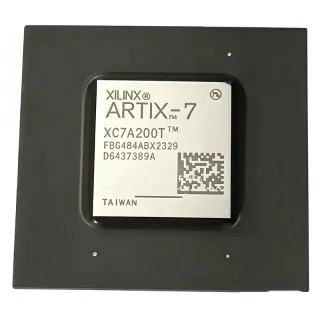
EPF10K50SQC240-1N - FLEX 10KS FPGA 50K Gates 240-PQFP | Intel
MPN: EPF10K50SQC240-1N ✗ End of Life| Qty | Unit Price | Extended |
|---|---|---|
| 1 | $95 | $95.00 |
| 10 | $88.5 | $885.00 |
| 100 | $79.2 | $7,920.00 |
| 500 | $72.8 | $36,400.00 |
| 1,000 | $67.5 | $67,500.00 |
EPF10K50SQC240-1N Overview
An FPGA (Field Programmable Gate Array) is a semiconductor integrated circuit built from an array of configurable logic blocks (CLBs), embedded memory, and programmable interconnect that designers program after manufacture. FPGAs sit in the broader hierarchy of programmable logic devices (PLDs), above simple CPLDs, and below custom ASICs in terms of integration density and NRE cost. The FLEX 10KS family from Altera pioneered embedded System-on-a-Programmable-Chip (SOPC) integration by combining a logic array fabric with dedicated Embedded Array Blocks (EABs) used as RAM, ROM, or multiplier functions.
Key features include 360 Logic Array Blocks (LABs), built-in Joint Test Action Group (JTAG) boundary-scan test circuitry compliant with IEEE Std. 1149.1-1990, and PCI Local Bus Specification Revision 2.2 compliance for both 3.3V and 5.0V operation at 33 MHz or 66 MHz on -1 speed grade devices. The 0.22 micrometer CMOS process delivers propagation delays as low as 0.6 ns in faster speed grades, while integrated clock management and PLL blocks simplify timing closure.
Architecturally, each LAB contains 10 Logic Elements (LEs), and each LE contains a 4-input look-up table, a programmable register, and a carry chain for arithmetic. EABs provide 2 Kbits of dual-port RAM each, and the same fabric can be configured as synchronous SRAM or read-only memory. The device supports in-system programmability via the serial configuration EPROM interface and ByteBlaster download cables.
Typical applications include telecommunications line cards, industrial motor control, PCI interface glue logic, glue logic between legacy microprocessors and peripherals, and digital signal processing front-ends. The wide 189-I/O count suits bus-intensive designs like 32-bit processor bridges and peripheral controllers. Designers often select this part for legacy system maintenance where the FLEX 10K silicon is already qualified.
A key design consideration is configuration storage: FPGAs require an external configuration EPROM (such as an EPC2 or EPC8) or a microcontroller to load the bitstream at power-up. The -1N suffix indicates commercial temperature grade (0C to 70C) and the slower -1 speed grade; engineers needing higher performance should evaluate -2 or -3 speed grades in the same footprint.
This page synthesizes distributor pricing, drop-in alternatives from the same FLEX 10K family, and practical design notes that complement the manufacturer datasheet.
Drop-in alternatives for EPF10K50SQC240-1N — same package, pin-to-pin compatible. Different-package parts requiring PCB rework are excluded.
Variants in this series
Same-series models that are drop-in compatible with EPF10K50SQC240-1N (same form factor and footprint) — differing in Operating Temperature, Family, Mounting Type, Process Technology, Package.
Quick Comparison Tool — Select alternative parts for side-by-side comparison:
EPF10K50SQC240-1
✅ Drop-In✓ In Stock
$142.5 / Unit
View Datasheet →EPF10K50EQC240-1
✅ Drop-In✓ In Stock
$26.8 / Unit
View Datasheet →EPF10K50EQC240-1N
✅ Drop-In✓ In Stock
$132.1 / Unit
View Datasheet →EPF10K50EQC240-2
✅ Drop-In✓ In Stock
$65 / Unit
View Datasheet →EPF10K50EQC240-3
✅ Drop-In✓ In Stock
$21 / Unit
View Datasheet →EPF10K50EQC240-2N
✅ Drop-In✓ In Stock
$87.2 / Unit
View Datasheet →EPF10K50EQI240-2N
✅ Drop-In✓ In Stock
$52.1 / Unit
View Datasheet →EPF10K50SQC240-1N Maximum Ratings & Electrical Characteristics
| Family | FLEX 10KS |
| Series | FLEX-10KS |
| Logic Elements / Cells | 2,880 |
| Typical Gates | 50,000 |
| System Gates | 40,960 |
| Number of LABs | 360 |
| User I/Os | 189 |
| Supply Voltage (Core) | 2.375 V to 2.625 V |
| Process Technology | 0.22 micrometer CMOS |
| Internal Frequency (max) | 250 MHz |
| Operating Temperature | 0C to +70C (Commercial) |
| Package | 240-PQFP / 240-BFQFP (32 x 32 mm) |
| Mounting Type | Surface Mount |
| Speed Grade | -1 |
| JTAG Support | IEEE Std. 1149.1-1990 compliant |
| PCI Compliance | PCI Local Bus Rev. 2.2 (3.3V and 5.0V at 33/66 MHz) |
| Configuration Method | Serial EPROM (EPC2/EPC8) or ByteBlaster |
EPF10K50SQC240-1N 240-pqfp / 240-bfqfp (32 x 32 mm) Pin Configuration Guide
Pin configuration for EPF10K50SQC240-1N (240-pqfp / 240-bfqfp (32 x 32 mm) package). This digital IC includes GPIO, communication interfaces (UART, SPI, I2C), and power pins. Refer to the manufacturer datasheet for alternate pin functions and configuration options. Essential for embedded system design and PCB layout.

No detailed pinout data available for EPF10K50SQC240-1N.
Refer to the datasheet for full pin configuration.
Typical Applications
EPF10K50SQC240-1N is suitable for 6 applications: Legacy Industrial Motor Control, PCI Bus Interface and Bridge Logic, Telecommunications Line Card Glue Logic, Test and Measurement Instrumentation Front-End, Aerospace and Defense Sustainment, Digital Signal Processing Pre-Processing.
Legacy Industrial Motor Control
The EPF10K50SQC240-1N fits legacy industrial motor control designs where FLEX 10K silicon is already qualified on the bill of materials. Its 50,000 typical gates and 360 LABs deliver sufficient logic capacity for PWM generation, encoder feedback decoding, and current-loop control algorithms running at 50-100 MHz. With 189 user I/Os the device handles multi-axis control without external bus expanders. The commercial 0C to 70C temperature range suits factory-floor cabinets, while the 240-PQFP package enables through-hole-friendly rework on legacy PCBs that were not designed for fine-pitch BGAs. Designers use it to extend the service life of installed equipment without re-qualifying a new FPGA family.
Recommended
PCI Bus Interface and Bridge Logic
The EPF10K50SQC240-1N is PCI Local Bus Specification Revision 2.2 compliant for 3.3V and 5.0V operation at 33 MHz on -1 speed grade devices. The 189 user I/Os comfortably accommodate a 32-bit PCI bus plus parity, interrupt, and side-band signals, leaving headroom for glue logic that bridges PCI to legacy ISA, VME, or proprietary backplanes. Embedded Array Blocks (EABs) implement 32-bit target/master state machines efficiently, while the 0.22 micrometer fabric sustains the required setup-and-hold timing margins. Industrial PCs and telecom line cards historically used this part as a PCI bridge before ASSP bridge chips became available.
Recommended
Telecommunications Line Card Glue Logic
Telecommunications line cards from the late 1990s and early 2000s used the EPF10K50SQC240-1N as glue logic between TDM framers, network processors, and backplane SERDES. The 50K-gate fabric absorbs protocol conversion, HDLC framing, and alarm-monitoring state machines without external MSI logic. EAB-based dual-port RAM buffers small payload cells between ingress and egress paths, and 189 I/Os fan out to multiple framers simultaneously. The 2.5V core and 3.3V I/O capability match the supply rails of that era's telecom silicon, simplifying power architecture. Today the part remains in service on legacy central-office equipment awaiting scheduled refresh.
Recommended
Test and Measurement Instrumentation Front-End
Bench-top test and measurement instruments of the late 1990s used the EPF10K50SQC240-1N as a flexible digital front-end that could be reconfigured for multiple product families. The 50K-gate capacity captures custom trigger logic, pattern generation, and parallel bus protocol decoding at sample rates up to 200 MHz. With 189 I/Os the device interfaces to A/D converter banks, front-panel keypads, and LCD displays without an external bus mux. The 240-PQFP package allows easy socket replacement during prototype iterations, a valuable feature for instrumentation R&D labs. Modern replacements use Cyclone III or Cyclone IV equivalents on adapter boards.
Recommended
Aerospace and Defense Sustainment
Aerospace sustainment programs use the EPF10K50SQC240-1N to support fielded avionics and military systems where re-design certification would cost millions. The 240-PQFP package, while dated, simplifies hand-rework on depot-shop benches that lack BGA rework stations. Commercial temperature grade (0C to 70C) variants are used in cabin equipment; industrial-grade FLEX 10KE counterparts serve avionics bays. Designers preserve the original bitstream IP and rely on authorized aftermarket distributors for replacement units. The JTAG boundary-scan interface streamlines depot-level board test using IEEE 1149.1 infrastructure already deployed on the flight line.
Recommended
Digital Signal Processing Pre-Processing
Pre-processing for digital signal processing subsystems historically used the EPF10K50SQC240-1N as a sample-rate converter and digital filter bank ahead of a dedicated DSP. EABs implement symmetric FIR coefficients efficiently, while the 360 LABs host parallel multiply-accumulate pipelines. The 189 user I/Os accept parallel data from A/D converters and output filtered streams to a downstream DSP or custom ASIC. At 250 MHz internal frequency, the part delivers sufficient throughput for audio-bandwidth and baseband signal processing. Designers use it to off-load deterministic pre-processing from software-defined DSPs and free CPU cycles for higher-layer algorithms.
Recommended
Recommended Products Summary
Engineering reference data for EPF10K50SQC240-1N — comparison, design guidance, and compliance information.
Selection Guide
Comparison with Alternatives
| Parameter | This Product | EPF10K50SQC240-1 | EPF10K50EQC240-1 | EPF10K50EQC240-1N | EPF10K50EQC240-2 | EPF10K50EQC240-3 | EPF10K50EQC240-2N | EPF10K50EQI240-2N |
|---|---|---|---|---|---|---|---|---|
| Package | 240-PQFP (32x32 mm) | 240-PQFP (32x32 mm) - same | 240-PQFP - same | 240-PQFP - same | 240-PQFP - same | 240-PQFP - same | 240-PQFP - same | 240-PQFP - same |
| Brand | Intel (formerly Altera) | Intel | Intel | Intel | Intel | Intel | Intel | Intel |
| Family | FLEX 10KS | FLEX 10KS | FLEX 10KE | FLEX 10KE | FLEX 10KE | FLEX 10KE | FLEX 10KE | FLEX 10KE |
| Logic Elements | 2,880 | 2,880 | 2,880 | 2,880 | 2,880 | 2,880 | 2,880 | 2,880 |
| Typical Gates | 50,000 | 50,000 | 50,000 | 50,000 | 50,000 | 50,000 | 50,000 | 50,000 |
| Speed Grade | -1 | -1 | -1 | -1 | -2 (faster) | -3 (faster) | -2 (faster) | -2 (faster) |
| Temperature Grade | Commercial (0C to 70C) | Commercial | Commercial | Commercial | Commercial | Commercial | Commercial | Industrial (-40C to +85C) |
| Lead-Free (N suffix) | Yes | No (leaded) | No (leaded) | Yes | No (leaded) | No (leaded) | Yes | Yes |
| User I/Os | 189 | 189 | 189 | 189 | 189 | 189 | 189 | 189 |
Key Differentiators
- FLEX 10KS family with built-in Embedded Array Blocks (vs EPF10K50EQC240-1)
- Lead-free N-suffix commercial grade (vs EPF10K50SQC240-1 (leaded))
- 189 user I/Os in 240-PQFP (vs EPF10K50EQC240-2N)
Design Notes
The EPF10K50SQC240-1N requires a tightly regulated 2.5V core supply at 2.375V to 2.625V. Decouple the core with a 100 uF bulk capacitor near the package plus 0.1 uF ceramic caps on each VCC pin pair. I/O banks require separate 3.3V rails with their own bulk decoupling; do not share decoupling between core and I/O supplies. The configuration logic draws inrush current during bitstream loading - size the regulator for at least 1 A peak transient. Refer to the FLEX 10K family datasheet power-section guidance for quiescent and active current estimates.
Estimated thermal behavior: at full logic utilization and 250 MHz toggle rate, the FLEX 10KS device dissipates approximately 0.5-1.0 W. The 240-PQFP package has limited heat dissipation compared to BGAs, so thermal relief copper pours connected to the ground plane are essential. For continuous high-temperature operation above 60C ambient, derate utilization to 70% or upgrade to a BGA variant. Forced-air cooling is recommended in enclosed industrial cabinets where the ambient can exceed 50C.
The 240-PQFP package has 0.5 mm pitch leads that require careful PCB layout. Use 0.15 mm trace width with 0.2 mm spacing on breakout traces and escape to inner layers within 5 mm of the package. Provide a continuous ground plane under the device for return-path integrity, especially for high-speed clocks and JTAG signals. For multi-layer boards, route configuration pins (DCLK, DATA0, nCONFIG, nSTATUS, CONF_DONE) as short as possible and away from switching signals. Add a 10 kohm pull-up to nCONFIG and CONF_DONE per Altera reference schematics.
Common pitfalls include forgetting to tie MSEL pins correctly for the desired configuration mode, leaving JTAG pins floating (which can cause unreliable boundary-scan operation), and using undersized configuration EPROMs that exceed the FLEX 10K bitstream size. Always verify configuration timing with the ByteBlaster download cable before relying on autonomous boot from EPC2 or EPC8. Additionally, do not assume -1 speed grade parts meet 66 MHz PCI timing; check the datasheet derating curves for your specific junction temperature and VCC tolerance.
Compliance Information
N suffix indicates lead-free terminal finish per Altera/Intel part-number convention. RoHS compliance inferred from N-suffix lead-free designation; specific REACH, halogen-free, and conflict-minerals documentation should be requested from Intel directly. AEC-Q100 not applicable for this commercial-grade FPGA.