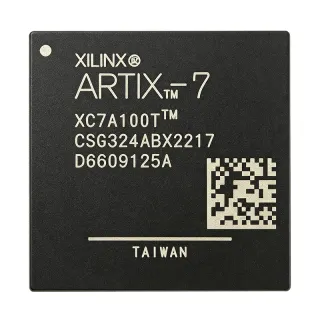
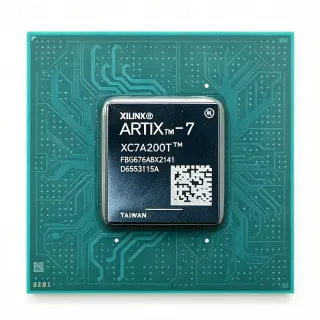
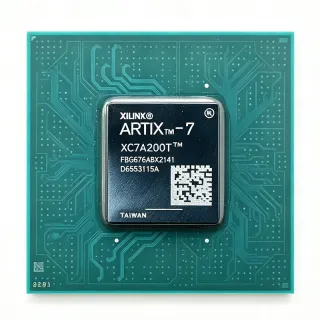
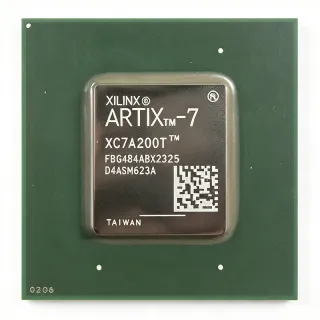
EPF10K50VFC484-3 - 50K FLEX-10K FPGA 484-BGA | Intel / Altera
MPN: EPF10K50VFC484-3 ✗ End of Life| Qty | Unit Price | Extended |
|---|---|---|
| 1 | $157.89 | $157.89 |
| 10 | $142.1 | $1,421.00 |
| 100 | $128.36 | $12,836.00 |
| 500 | $110.52 | $55,260.00 |
| 1,000 | $95.74 | $95,740.00 |
EPF10K50VFC484-3 Overview
An FPGA (Field-Programmable Gate Array) is a semiconductor integrated circuit that can be configured by the customer or designer after manufacturing to implement arbitrary digital logic. The FLEX 10K family is the industry's first embedded programmable logic device (PLD) family, providing System-on-a-Programmable-Chip (SOPC) integration by combining an embedded array for implementing megafunctions such as efficient memory and specialized I/O, with a logic array for general logic. Architecturally the EPF10K50VFC484-3 contains 360 logic array blocks (LABs), 2,880 logic elements, 13 embedded array blocks (EABs), and 291 user I/O pins - placing it in the mid-density class of the FLEX 10K hierarchy: FLEX 10K -> CPLD/FPGA hybrid family -> programmable logic device -> semiconductor IC.
Key features include 291 I/O, 5V-tolerant I/O buffers (per FLEX 10K family), in-system programmability via the serial configuration device interface, multi-volt I/O support for 5.0V/3.3V/2.5V operation, and embedded memory blocks configurable as RAM, ROM, or FIFO. Supply voltage spans 3.0V to 3.6V with the FLEX 10K core running on 3.3V. The 484-pin FineLine BGA package is 23 mm x 23 mm with a 1.0 mm ball pitch, providing high-density I/O for complex glue-logic and bus-interface applications.
Typical applications include high-volume glue logic, bus bridging and interface conversion, industrial control, telecommunications line cards, legacy system prototyping, and ASIC prototyping for SOPC (System-on-a-Programmable-Chip) emulation. The EPF10K50VFC484-3 is also widely used in educational and replacement scenarios because the FLEX 10K family is mature and well-supported by legacy toolchains (MAX+PLUS II and Quartus). Parts may ship as RoHS-compliant or leaded depending on date code; verify the specific date code before designing new production hardware.
Designers should note that the FLEX 10K family is in long-term legacy status: the part is no longer recommended for new designs (NRND) and is supported primarily through Rochester Electronics, Intel's authorized legacy distributor. When designing a replacement board, prefer the MAX II, Cyclone, or MAX 10 families for new designs, and use the EPF10K50VFC484-3 only when matching legacy footprints.
Drop-in alternatives for EPF10K50VFC484-3 — same package, pin-to-pin compatible. Different-package parts requiring PCB rework are excluded.
Variants in this series
Same-series models that are drop-in compatible with EPF10K50VFC484-3 (same form factor and footprint) — differing in Package, Family, Operating Temperature, Speed Grade, Embedded Array Blocks (EABs).
Quick Comparison Tool — Select alternative parts for side-by-side comparison:
EPF10K50SFC484-3
✅ Drop-In✓ In Stock
$195 / Unit
View Datasheet →EPF10K50VFC484-2
✅ Drop-In ⚠️ 参数待验证📋 Reference alternative (not in catalog)
EPF10K130EFC484-3
✅ Drop-In ⚠️ 参数待验证✓ In Stock
$178.92 / Unit
View Datasheet →EPF10K50EFC484-2
✅ Drop-In ⚠️ 参数待验证✓ In Stock
$52.75 / Unit
View Datasheet →EPF10K50VFC484-3 Maximum Ratings & Electrical Characteristics
| Manufacturer | Intel (formerly Altera) |
| Series | FLEX-10K |
| Device Type | FPGA - Field Programmable Gate Array |
| Logic Elements / Logic Array Blocks | 360 LABs / 2,880 LEs |
| Total RAM Bits | 40,960 bits |
| Embedded Array Blocks (EABs) | 13 EABs |
| Number of I/O | 291 I/O |
| Number of Gates (typical) | 50,000 gates |
| Logic Family | CMOS |
| Propagation Delay | 0.6 ns (per alternate source) |
| Internal Frequency (max) | 66.67 MHz (per alternate source) |
| Supply Voltage | 3.0 V to 3.6 V |
| Operating Temperature | 0C to +70C (commercial) |
| Speed Grade | -3 |
| Package | 484-BBGA (FineLine BGA), 23 x 23 mm, 1.0 mm pitch |
| Mounting Type | Surface Mount (BGA) |
| Programming Interface | Serial configuration device / JTAG |
EPF10K50VFC484-3 484-bbga (fineline bga), 23 x 23 mm, 1.0 mm pitch Pin Configuration Guide
Pin configuration for EPF10K50VFC484-3 (484-bbga (fineline bga), 23 x 23 mm, 1.0 mm pitch package). This digital IC includes GPIO, communication interfaces (UART, SPI, I2C), and power pins. Refer to the manufacturer datasheet for alternate pin functions and configuration options. Essential for embedded system design and PCB layout.

No detailed pinout data available for EPF10K50VFC484-3.
Refer to the datasheet for full pin configuration.
Typical Applications
EPF10K50VFC484-3 is suitable for 6 applications: Legacy Industrial Control & Automation, Telecommunications Line Cards & Bus Bridging, ASIC Prototyping & SOPC Emulation, Legacy Computer & Peripheral Interface Cards, Test & Measurement Instrumentation, Educational FPGA Training & University Labs.
Legacy Industrial Control & Automation
The EPF10K50VFC484-3 is well suited to legacy industrial control applications requiring 50K gates and 291 I/O in a 484-FBGA package. Its FLEX 10K embedded array blocks (13 EABs, 40,960 RAM bits) enable integrated state-machine and FIFO logic without external memory, while the 3.0-3.6V core with multi-volt I/O (5V/3.3V/2.5V) interfaces directly to legacy 5V peripherals. Speed grade -3 supports 66.67 MHz internal operation, sufficient for PLC scan loops and HMI controllers. This part is widely deployed in factory-floor equipment from the late 1990s and 2000s, where the FPGA performs glue logic, motor-control sequencing, and fieldbus protocol conversion. Replacement boards for aging industrial systems benefit from the FLEX 10K family because the legacy MAX+PLUS II and Quartus toolchains still support this device, simplifying code migration.
Recommended
Telecommunications Line Cards & Bus Bridging
The EPF10K50VFC484-3 serves in telecommunications line cards as a glue-logic bridge between TDM buses, framers, and network processors. With 291 user I/Os, it can drive wide parallel buses (16/32-bit data + control) while the 13 EABs implement FIFOs, lookup tables, and protocol-state buffers without external SRAM. The 484-FBGA package's 1.0 mm pitch suits high-density backplane layouts. The FLEX 10K architecture is asymmetric (logic + embedded array), making it efficient for telecommunication datapaths that mix control logic with high-throughput data buffers. Multi-volt I/O (5V/3.3V/2.5V) supports legacy telecom backplanes using 5V logic levels, while the 3.3V core keeps power dissipation manageable.
Recommended
ASIC Prototyping & SOPC Emulation
The EPF10K50VFC484-3 was historically used for ASIC prototyping and System-on-a-Programmable-Chip (SOPC) emulation because the FLEX 10K family pioneered the embedded-array architecture for ASIC-class logic density. At 50,000 typical gates with 2,880 logic elements, it emulates medium-complexity ASICs in pre-silicon validation, allowing firmware teams to develop and test against real hardware before tape-out. The embedded array blocks (EABs) implement RAM/ROM megafunctions that map directly to ASIC memory macros, while the logic array emulates random logic. Engineers today still use these parts in long-running emulation platforms where the design is frozen and only board-level testing is performed - the mature Quartus II toolchain supports VHDL/Verilog synthesis for this device.
Recommended
Legacy Computer & Peripheral Interface Cards
The EPF10K50VFC484-3 was widely deployed in PCI and VME interface cards, SCSI controllers, and high-speed printer controllers during the late 1990s. Its 291 I/Os and 50K-gate density are ideal for implementing complex bus-interface state machines (e.g., PCI target/initiator, VME master/slave) along with FIFOs and scatter-gather DMA engines. The 484-FBGA package provides the I/O count needed for 32-bit and 64-bit bus implementations. Replacement cards for legacy industrial PCs, military computers, and medical imaging systems still specify this part because of board-level pin compatibility and continued support in legacy Quartus designs.
Recommended
Test & Measurement Instrumentation
The EPF10K50VFC484-3 is found in older bench-top instruments including oscilloscopes, logic analyzers, and protocol testers where it performs real-time signal processing and trigger logic. With 50K gates of logic and 13 EABs providing 40 Kbits of embedded RAM, the device can implement deep capture buffers, complex trigger sequencers, and protocol decoders for parallel buses. Speed grade -3 supports 66.67 MHz operation, sufficient for capturing digital signals at rates up to ~50 MHz with appropriate clock multiplication. The FLEX 10K family's deterministic timing also makes it suitable for instrumentation applications where repeatable measurement latency matters.
Recommended
Educational FPGA Training & University Labs
Universities and technical training programs have historically used the EPF10K50VFC484-3 on development boards because the FLEX 10K family is well-documented in academic textbooks and laboratory manuals. While new curricula use Cyclone IV or MAX 10, the FLEX 10K remains valuable for teaching legacy design entry methods, hand-routing of BGA pins, and JTAG configuration fundamentals. With 50K gates, 291 I/Os, and 13 EABs, the device offers sufficient complexity for senior-level VHDL/Verilog projects. Used EPF10K50VFC484-3 boards are readily available on the secondary market at low cost, making them ideal for budget-constrained educational programs.
Recommended
Recommended Products Summary
Engineering reference data for EPF10K50VFC484-3 — comparison, design guidance, and compliance information.
Selection Guide
Comparison with Alternatives
| Parameter | This Product | EPF10K50SFC484-3 | EPF10K50VFC484-2 | EPF10K130EFC484-3 | EPF10K50EFC484-2 |
|---|---|---|---|---|---|
| Package | 484-FBGA (23x23 mm, 1.0 mm pitch) | 484-FBGA (same) | 484-FBGA (same) | 484-FBGA (same) | 484-FBGA (same) |
| Brand | Intel (formerly Altera) | Intel | Intel | Intel | Intel |
| Series | FLEX 10K | FLEX 10K | FLEX 10K | FLEX 10K | FLEX 10K |
| Logic Gates (typical) | 50,000 | 50,000 | 50,000 | 130,000 | 50,000 |
| Speed Grade | -3 | -3 | -2 (slower) | -3 | -2 (slower) |
| Total RAM Bits | 40,960 bits | 40,960 bits | 40,960 bits | 98,304 bits | 40,960 bits |
| Operating Temperature | 0C to +70C (commercial) | 0C to +70C (commercial) | 0C to +70C (commercial) | 0C to +70C (commercial) | 0C to +70C (commercial) |
| Supply Voltage (core) | 3.0V to 3.6V | 3.0V to 3.6V | 3.0V to 3.6V | 3.0V to 3.6V | 3.0V to 3.6V |
| Lifecycle Status | NRND (legacy) | NRND (legacy) | NRND (legacy) | NRND (legacy) | NRND (legacy) |
Key Differentiators
- Sole 50K-gate option with -3 speed grade in 484-FBGA (vs EPF10K50VFC484-2)
- Highest gate density option in 484-FBGA (vs EPF10K130EFC484-3)
- Mature legacy status with extensive design support (vs Modern Cyclone IV EP4CE30F23)
Design Notes
Estimated: at 3.3V core supply with 50K gates fully utilized, typical power dissipation for the EPF10K50VFC484-3 is approximately 0.5-1.0 W, well within the 484-FBGA package's thermal envelope. However, BGA packages have poor heat-spreading compared to leaded packages, so place at least four thermal vias in the central pad array and ensure adequate PCB copper pour. For dense designs exceeding 80% utilization, consider adding a heatsink or forced-air cooling.
The 484-FBGA package uses a 1.0 mm ball pitch, requiring PCB pads of 0.5 mm diameter with non-solder-mask-defined (NSMD) land pattern for reliable reflow. Per IPC-7351, use 4-6 mil trace-and-space rules and microvia stackups if routing through inner layers. Place at least 8 decoupling capacitors (0.1 uF + 10 uF bulk) around the BGA perimeter to suppress simultaneous switching noise on the 291 I/Os.
Do not confuse the EPF10K50VFC484-3 (3.3V core) with the EPF10K50EFC484 series (5V-tolerant variants). The 'V' suffix indicates 3.3V core only; the 'E' suffix indicates 5V-tolerant I/O. Mixing these parts on the same PCB will result in I/O voltage incompatibility. Also verify date codes: pre-2006 parts are typically non-RoHS (leaded), while later codes are RoHS-compliant. Confirm date code with the distributor before placing production orders.
With 291 user I/Os switching simultaneously, the EPF10K50VFC484-3 can generate substantial simultaneous switching noise (SSN). Per the FLEX 10K datasheet, use series damping resistors (22-33 ohm) on high-speed outputs, and follow the 3W routing rule for parallel buses. Multi-volt I/O banks should be grouped to share VCCIO planes; mixing 5V and 3.3V outputs on the same bank will damage the I/O buffers. The 0.6 ns propagation delay (per alternate-source data) requires controlled-impedance routing for frequencies above 50 MHz.
Compliance Information
RoHS / lead-free status depends on date code. Parts manufactured before 2006 are typically non-RoHS (leaded); later codes may be RoHS-compliant. AEC-Q100 not applicable - commercial-grade FPGA, not automotive-qualified.