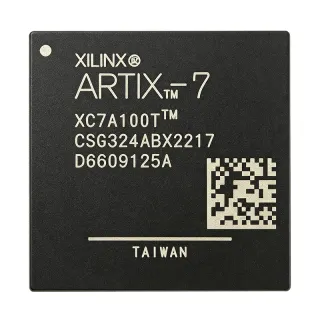
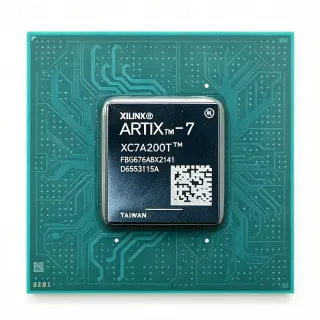
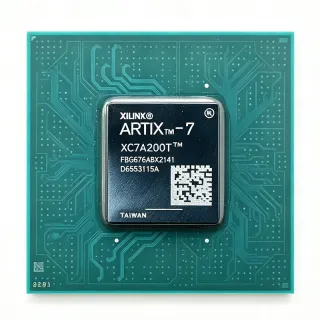
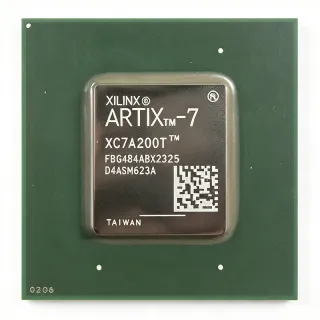
EPF6024ATC144-2 - 24K Gates FLEX 6000 FPGA | Intel | 144-TQFP
MPN: EPF6024ATC144-2 ✗ End of Life| Qty | Unit Price | Extended |
|---|---|---|
| 1 | $42.5 | $42.50 |
| 10 | $38.75 | $387.50 |
| 100 | $33.2 | $3,320.00 |
| 500 | $28.4 | $14,200.00 |
| 1,000 | $24.95 | $24,950.00 |
EPF6024ATC144-2 Overview
A Field Programmable Gate Array (FPGA) is a semiconductor integrated circuit composed of configurable logic blocks (CLBs), programmable interconnects, and I/O cells that can be re-programmed by the designer after manufacture. FPGAs sit in the programmable logic hierarchy between simple PLDs and high-density ASICs, offering parallel processing, deterministic timing, and in-system reprogrammability. The FLEX 6000 series is positioned as a low-cost, low-density family for glue logic, bus interfacing, and DSP co-processing where ASIC NRE is unjustified.
Key features of the EPF6024ATC144-2 include 1,960 logic elements, 117 maximum user I/O, embedded array blocks (EABs) for memory implementation, in-system programmability via the IEEE 1149.1 (JTAG) boundary-scan interface, and 3.3 V LVTTL/LVCMOS-compatible I/O. The device supports multi-voltage I/O with 5.0 V tolerance on inputs and operates over the commercial 0 °C to +70 °C junction temperature range (as indicated by the speed-grade and temperature suffix).
Architecturally, the FLEX 6000 family uses a continuous, hierarchical interconnect fabric (FastTrack) with row and column routing channels. Logic elements (LEs) are grouped into Logic Array Blocks (LABs), each containing 10 LEs. Embedded Array Blocks (EABs) provide 2 Kbits of SRAM (configurable as RAM, ROM, or FIFO) and can be cascaded to build wider/faster memory blocks without consuming general-purpose routing.
Typical applications include peripheral bus interfacing (PCI, ISA, VME bridges), digital signal processing front-ends, industrial control logic, glue-logic consolidation on multi-board systems, and legacy ASIC replacements where 24K gates is sufficient. Designers often choose the FLEX 6000 family for low-cost prototyping and short-run production where Cyclone or MAX series migration is impractical.
When designing with the EPF6024ATC144-2, pay attention to the JTAG chain integrity for ISP and use the Quartus II / MAX+PLUS II legacy toolchain for bitstream generation. Note that 5.0 V input tolerance depends on the specific I/O bank configuration; consult the device datasheet for absolute maximum ratings.
This page synthesizes distributor pricing, datasheet excerpts, drop-in alternatives, and engineering notes not found on a single manufacturer page.
Drop-in alternatives for EPF6024ATC144-2 — same package, pin-to-pin compatible. Different-package parts requiring PCB rework are excluded.
Variants in this series
Same-series models that are drop-in compatible with EPF6024ATC144-2 (same form factor and footprint) — differing in Package, Speed Grade, Process Technology, Operating Temperature, RoHS Status.
Quick Comparison Tool — Select alternative parts for side-by-side comparison:
EPF6024ATC144-3
✅ Drop-In✓ In Stock
$14.1 / Unit
View Datasheet →EPF6024ATC144-1
✅ Drop-In✓ In Stock
$8.2 / Unit
View Datasheet →EPF6024ATC144-2N
✅ Drop-In✓ In Stock
$20.95 / Unit
View Datasheet →EPF6024ATC144-10
✅ Drop-In✓ In Stock
$11.1 / Unit
View Datasheet →EPF6024ATC144
✅ Drop-In✓ In Stock
$21.8 / Unit
View Datasheet →EPF6024ATC144-2 Maximum Ratings & Electrical Characteristics
| Family | FLEX 6000 |
| Logic Elements / Cells | 1,960 |
| Gate Count | 24,000 gates |
| Maximum User I/O | 117 |
| Operating Frequency (max) | 166.67 MHz |
| Core Voltage | 3.3 V |
| I/O Voltage | 3.3 V (5.0 V tolerant inputs) |
| Process Technology | 0.42 µm CMOS SRAM |
| Programmable Interface | JTAG (IEEE 1149.1) / ISP |
| Embedded Memory | Embedded Array Blocks (EABs) - 2 Kbit each |
| Package | 144-pin TQFP (TQFP-144, 22x22 mm) |
| Operating Temperature | 0C to +70C (Commercial) |
| Mounting Type | Surface Mount |
| RoHS Status | unknown |
| Lead-Free | unknown |
EPF6024ATC144-2 144-pin tqfp (tqfp-144, 22x22 mm) Pin Configuration Guide
Pin configuration for EPF6024ATC144-2 (144-pin tqfp (tqfp-144, 22x22 mm) package). This digital IC includes GPIO, communication interfaces (UART, SPI, I2C), and power pins. Refer to the manufacturer datasheet for alternate pin functions and configuration options. Essential for embedded system design and PCB layout.

No detailed pinout data available for EPF6024ATC144-2.
Refer to the datasheet for full pin configuration.
Typical Applications
EPF6024ATC144-2 is suitable for 6 applications: PCI / ISA Bus Bridge Interface, Industrial Control Logic Consolidation, DSP Front-End Co-Processor, Legacy ASIC Replacement / Bridging, Telecom Line-Card Glue Logic, Test & Measurement Instrumentation Front-End.
PCI / ISA Bus Bridge Interface
The EPF6024ATC144-2 fits PCI/ISA bridge applications because its 24K gates and 117 user I/O pins comfortably accommodate the 32-bit multiplexed address/data bus, command/byte-enable decoding, and interrupt/arbitration glue logic required by PCI 2.1 or ISA-compatible designs. With 166.67 MHz internal frequency and FastTrack interconnect, the device sustains 33 MHz PCI target operation with deterministic timing closure. Designers typically route one TQFP-144 bank to the PCI connector and a second bank to the local CPU bus; 5.0 V input tolerance allows direct interface to legacy ISA peripherals without external level shifters. Compared to ASIC NRE, this approach is cost-effective for low-volume industrial or instrumentation boards where 24K gates is sufficient.
Recommended
Industrial Control Logic Consolidation
The EPF6024ATC144-2 is well suited to industrial control logic consolidation, replacing 5 to 15 discrete 74HC/TTL glue-logic packages on PLC backplanes, motor-control boards, and process-instrument front-ends with a single reprogrammable device. The 117 user I/O accommodate multi-channel encoder inputs, opto-isolated discrete I/O, and PWM generator signals, while Embedded Array Blocks (EABs) implement parameter tables and state-machine lookup memories. The 3.3 V core with 5.0 V tolerant inputs allows direct connection to legacy 5 V sensor interfaces. Note: industrial temperature grades (-N suffix) are required for uncontrolled environments; the standard -2 commercial variant is suitable only for controlled cabinet locations.
Recommended
DSP Front-End Co-Processor
In DSP front-end co-processor roles the EPF6024ATC144-2 implements FIR/IIR pre-filters, decimation stages, and FFT bit-reversal engines that feed external DSP processors or microcontrollers, leveraging its 1,960 logic cells and parallel hardware architecture. Distributed arithmetic and pipelined adder trees fit comfortably in 24K gates, while EAB-based coefficient ROMs eliminate external PROM chips. The 166.67 MHz internal Fmax supports sample rates up to 50 MSPS for narrowband IF processing. Legacy DSP designs in medical ultrasound, instrumentation, and military radios frequently retain the FLEX 6000 family for cost reasons despite device obsolescence.
Recommended
Legacy ASIC Replacement / Bridging
Designers use the EPF6024ATC144-2 as a turnkey replacement for obsolete masked ASICs in low-volume production runs, where mask NRE is unjustified but pinout and timing must match the legacy device. The 144-pin TQFP footprint with 117 user I/O mirrors many 1990s-era ASIC packages, and SRAM-based programmability enables last-minute design changes without re-spinning silicon. The device also serves as a bridging controller between modern microprocessors and legacy peripherals whose bus protocol differs. Because the FLEX 6000 family is obsolete, designers should budget for long-term availability risk and qualify a current-generation MAX II/MAX V/MAX 10 footprint-compatible migration path.
Recommended
Telecom Line-Card Glue Logic
Telecom line-card applications deploy the EPF6024ATC144-2 to implement TDM bus multiplexers, HDLC/framer glue logic, and timing-recovery state machines between DSP framers and backplane serializers. The 117 user I/O accommodate HDB3/B8ZS line coding outputs, alarm/status LEDs, and configuration EEPROM interfacing. EABs are used for channel-association lookup tables and tone-generation coefficient ROMs. The device's LVTTL/LVCMOS I/O standards and 33 MHz+ performance are adequate for E1/T1 line rates with margin. Telecom-grade temperature operation requires the -N suffix variant; standard commercial parts may be deployed in environmentally controlled central-office shelves.
Recommended
Test & Measurement Instrumentation Front-End
The EPF6024ATC144-2 is deployed in test and measurement instruments as a programmable waveform-routing switch, counter/divider chain, and custom triggering logic, replacing multiple 74-series logic packages and reducing BOM cost and board area. The 117 I/O accommodate BNC/RF front-panel matrix switching, multi-channel ADC/DAC handshake signals, and front-panel display multiplexing, while EABs implement trigger-pattern lookup tables. 5.0 V input tolerance allows direct interface to legacy logic analyzer pods. The 3.3 V core, however, requires careful power-rail sequencing when interfacing to 5.0 V peripherals; consult the device datasheet for absolute-maximum input ratings.
Recommended
Recommended Products Summary
Engineering reference data for EPF6024ATC144-2 — comparison, design guidance, and compliance information.
Selection Guide
Comparison with Alternatives
| Parameter | This Product | EPF6024ATC144-3 | EPF6024ATC144-1 | EPF6024ATC144-2N | EPF6024ATC144-10 | EPF6024ATC144 |
|---|---|---|---|---|---|---|
| Brand | Intel (formerly Altera) | Intel | Intel | Intel | Intel | Intel |
| Package | TQFP-144 (22x22 mm) | TQFP-144 (same) | TQFP-144 (same) | TQFP-144 (same) | TQFP-144 (same) | TQFP-144 (same) |
| Logic Cells / Elements | 1,960 | 1,960 | 1,960 | 1,960 | 1,960 | 1,960 |
| Gate Count | 24,000 gates | 24,000 gates | 24,000 gates | 24,000 gates | 24,000 gates | 24,000 gates |
| Maximum User I/O | 117 | 117 | 117 | 117 | 117 | 117 |
| Speed Grade | -2 (standard) | -3 (faster, ~33% higher Fmax) | -1 (slower) | -2 (industrial temp) | -10 | unsuffixed |
| Operating Temperature | 0C to +70C (Commercial) | 0C to +70C | 0C to +70C | -40C to +85C (Industrial) | 0C to +70C | 0C to +70C |
| Core Voltage | 3.3 V | 3.3 V | 3.3 V | 3.3 V | 3.3 V | 3.3 V |
| Lifecycle Status | Obsolete | Obsolete | Obsolete | Obsolete | Obsolete | Obsolete |
Key Differentiators
- Faster speed grade at the same 144-TQFP footprint (vs EPF6024ATC144-1)
- Industrial temperature range option available (vs EPF6024ATC144 (commercial))
- 117 user I/O - higher than many competitors in the same footprint (vs EPF6016ATC144-2 (FLEX 6016))
Design Notes
Estimated: at 166.67 MHz with all 117 I/O toggling at 33 MHz, core current draw is approximately 50 to 100 mA from VCCINT (3.3 V), plus I/O bank current depending on switching activity. Decouple each VCC/VCCINT pin with a 0.1 µF X7R ceramic placed within 3 mm of the pin, and add a 10 µF bulk capacitor near the package. The 5.0 V tolerant inputs draw VCCIO leakage through the input ESD structures when driven high, so verify total 5 V sink/source budgets if many inputs are tied to 5 V signals.
Route all clock signals on the inner layers with controlled impedance (50 ohm microstrip or stripline) and keep clock traces short. The TQFP-144 has only 117 user I/O; assign high-speed clocks and global buffer inputs to dedicated CLK pins to leverage the FLEX 6000 FastTrack low-skew clock network. Place the JTAG connector within 50 mm of the TQFP TDI/TDO/TCK/TMS pins to avoid signal-integrity issues during ISP programming.
Common pitfalls: (1) FLEX 6000 bitstreams are volatile - the FPGA loses configuration on every power-down, so an external EPC1/EPC2/EPC16 configuration memory is mandatory unless using JTAG-only boot; (2) Mixing 5 V and 3.3 V I/O banks requires careful VCCIO planning - each bank has its own VCCIO rail; (3) The MAX+PLUS II legacy toolchain does not run natively on 64-bit Windows 10/11 - use a Windows 7 VM or DOSBox for legacy compilation; (4) Do not exceed the absolute maximum I/O pin voltage of 5.5 V even though inputs are 5 V tolerant, or latch-up may occur.
Compliance Information
Compliance status not explicitly published in current distributor data; FLEX 6000 family predates RoHS but many date codes after 2006 may be RoHS-compliant - verify per lot with distributor or request material declaration.