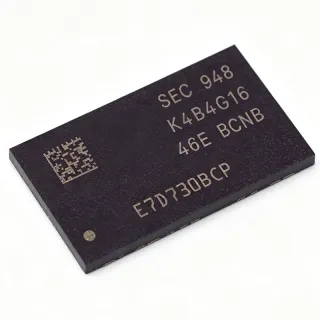
M29W160EB70N3E - 16Mbit NOR Flash 70ns 48-TSOP | Micron
MPN: M29W160EB70N3E ✓ Active| Qty | Unit Price | Extended |
|---|---|---|
| 1 | $2.35 | $2.35 |
| 10 | $2.12 | $21.20 |
| 100 | $1.95 | $195.00 |
| 500 | $1.85 | $925.00 |
| 1,000 | $1.76 | $1,760.00 |
Drop-in alternatives for M29W160EB70N3E — same package, pin-to-pin compatible. Different-package parts requiring PCB rework are excluded.
Quick Comparison Tool — Select alternative parts for side-by-side comparison:
M29W160EB70N3F
✅ Drop-In✓ In Stock
$1.01 / Unit
View Datasheet →M29W160FB70N3E
✅ Drop-In✓ In Stock
$3.58 / Unit
View Datasheet →M29W160FB70N3F
✅ Drop-In📋 Reference alternative (not in catalog)
M29W160ET70N3F
✅ Drop-In✓ In Stock
$2.8 / Unit
View Datasheet →M29W160EB70N3E Maximum Ratings & Electrical Characteristics
| Memory Type | FLASH - NOR |
| Memory Size | 16 Mbit (2M x8, 1M x16) |
| Organization | 2M x8 / 1M x16 |
| Access Time | 70 ns |
| Interface | Parallel |
| Supply Voltage (VCC) | 2.7 V to 3.6 V |
| Programming Time | 10 us (typical) |
| Cell Type | SLC NOR |
| Operating Temperature | -40C to +125C |
| Package / Case | 48-TFSOP (0.724 in, 18.40 mm width) |
| Mounting Type | Surface Mount |
| Packaging | Tray |
| Speed Grade | -70 |
| FBGA Code | N/A (TSOP package) |
M29W160EB70N3E 48-tfsop (0.724 in, 18.40 mm width) Pin Configuration Guide
Complete pinout information for M29W160EB70N3E (48-tfsop (0.724 in, 18.40 mm width) package). This digital IC includes GPIO, communication interfaces (UART, SPI, I2C), and power pins. Refer to the manufacturer datasheet for alternate pin functions and configuration options. Essential for embedded system design and PCB layout.

No detailed pinout data available for M29W160EB70N3E.
Refer to the datasheet for full pin configuration.
Safe Operating Area (SOA) & Thermal Characteristics
No official SOA curve available for this digital IC. Always operate within absolute maximum ratings specified in the datasheet. Ensure adequate cooling and derate as needed.
Typical Applications
M29W160EB70N3E is suitable for 6 applications: Industrial Controller Boot Firmware, Set-Top Box and Consumer Multimedia Boot Storage, Networking and Telecom Line Cards, Automotive Body and White-Goods Control Boards, Legacy System Maintenance and EOL Redemption, Embedded Data Logger Parameter Storage.
Industrial Controller Boot Firmware
The M29W160EB70N3E fits industrial PLC, motor-drive, and automation controller boot storage because its 70 ns access time allows the CPU to fetch reset and initialization code directly from flash (execute-in-place) without copying to RAM first. The 2M x8 / 1M x16 organization matches both 8-bit legacy buses on older controllers and 16-bit buses on modern MCUs, and the 2.7V-3.6V supply connects straight to a 3.3V rail. The bottom boot-block EB arrangement places small protected sectors at address 0, which is exactly where the reset vector and bootloader reside, so bootloader updates never touch the parameter blocks. Its -40C operating rating covers unheated factory-floor cabinets.
Recommended
Set-Top Box and Consumer Multimedia Boot Storage
Set-top boxes, DVB receivers, and home-media platforms conventionally boot from 16 Mbit parallel NOR. The M29W160EB70N3E's 70 ns random access removes wait states from the early boot phase, and the parallel interface integrates with the host SoC's static-memory controller without serial-flash boot ROM support. The 16 Mbit density comfortably holds the boot loader, rescue image, and parameter tables, while a companion NAND or SPI flash stores the bulk filesystem. Because the device is in the widely second-sourced 48-TSOP footprint, OEMs can qualify M29W160EB70N3F or FB variants without a PCB respin, protecting against allocation risk in high-volume consumer builds.
Recommended
Networking and Telecom Line Cards
Routers, switches, and telecom line cards use parallel NOR to hold the boot ROM, board-diagnostic image, and MAC/configuration data. The M29W160EB70N3E's on-chip state machine with status polling lets boot code verify program and erase completion reliably, and the byte/word selectable bus matches both legacy 8-bit management controllers and 16-bit forwarding-plane CPUs. The 70 ns access time keeps early diagnostics fast, and the block architecture allows field updates of the rescue image while the protected boot block remains untouched. TSOP-48 hand-solderable leads also simplify RMA-level rework compared with BGA-coded flash.
Recommended
Automotive Body and White-Goods Control Boards
Body-control modules, instrument clusters, and appliance controllers that retain legacy parallel-bus MCUs need a code store rated for wide temperature. The M29W160EB70N3E's cited -40C to +125C specification covers under-dash and near-engine-bay zones, while the single 2.7V-3.6V supply simplifies the power tree after load-dump-clamped regulators. The boot-block protection lets the OEM lock the bootloader against corruption during field firmware updates of application sectors. Where formal AEC-Q100 qualification is mandatory, verify the exact automotive suffix with Micron, or qualify the equivalent family variant documented for automotive programs.
Recommended
Legacy System Maintenance and EOL Redemption
Many deployed systems (medical devices, test instruments, industrial machines) were designed around 16 Mbit 48-TSOP parallel NOR that is now end-of-life at other vendors. The M29W160EB70N3E is a primary redemption path: it matches the industry-standard TSOP-48 footprint and M29W command set that most legacy drivers were written against, so substitution usually requires no software change. Verified drop-in alternatives M29W160EB70N3F and M29W160FB70N3E extend supply-chain depth. When maintaining such fleets, buy trays of a single date code to keep program/erase behavior uniform across spares.
Recommended
Embedded Data Logger Parameter Storage
Data loggers, metering devices, and gateways use the M29W160EB70N3E to hold calibration tables, event logs, and boot code in one 16 Mbit device. NOR's byte-level random read lets the MCU read a single log record in 70 ns without page overhead, while the block-erase architecture gives wear-managed sectors for frequently updated parameters. The 10 us typical byte programming time supports in-service parameter writes without stalling the application, and status polling replaces fragile fixed-delay timing. Because no external programming voltage is needed, the same 3.3V rail used for logic safely programs the device in the field.
Recommended
Recommended Products Summary
Engineering reference data for M29W160EB70N3E — comparison, design guidance, and compliance information.
Selection Guide
Comparison with Alternatives
| Parameter | This Product | M29W160EB70N3F | M29W160FB70N3E | M29W160FB70N3F | M29W160ET70N3F |
|---|---|---|---|---|---|
| Package | 48-TFSOP (18.40 mm) | 48-TFSOP (18.40 mm) - same | 48-TFSOP (18.40 mm) - same | 48-TFSOP (18.40 mm) - same | 48-TFSOP (18.40 mm) - same |
| Brand | Micron Technology | Micron Technology | Micron Technology | Micron Technology | Micron Technology |
| Density | 16 Mbit | 16 Mbit | 16 Mbit | 16 Mbit | 16 Mbit |
| Access Time | 70 ns | 70 ns | 70 ns | 70 ns | 70 ns |
| Organization | 2M x8 / 1M x16 | 2M x8 / 1M x16 | 2M x8 / 1M x16 | 2M x8 / 1M x16 | 2M x8 / 1M x16 |
| Supply Voltage | 2.7 V to 3.6 V | 2.7 V to 3.6 V | 2.7 V to 3.6 V | 2.7 V to 3.6 V | 2.7 V to 3.6 V |
| Block Architecture | Bottom boot block (EB) | Bottom boot block (EB) - same | FB block architecture - differs | FB block architecture - differs | Top boot block (ET) - differs |
| Replacement Effort | Reference | None - complete replacement per FindIC | None (hardware); verify software block map | None (hardware); verify software block map | Boot code relocation may be required |
Key Differentiators
- Identical-footprint successor suffix (vs M29W160EB70N3F)
- Bottom boot-block arrangement suits reset-vector code (vs M29W160ET70N3F)
- Industry-standard M29W command set (vs AMD/Spansion 16 Mbit TSOP NOR)
- Trade-off: block map differs from FB variants (vs M29W160FB70N3E)
Design Notes
Run the M29W160EB70N3E from the same 3.3V rail as the host bus, decoupled with at least 0.1 uF ceramic per VCC pin plus 4.7-10 uF bulk near the package. Erase operations draw the highest transient current, so verify rail droop stays above 2.7V during bulk erase; brownouts mid-erase are the leading cause of corrupted blocks in the field. If the rail can sag, add RC-controlled reset to the host so flash commands are not interrupted.
Do not substitute the EB (bottom boot) part with the ET (top boot) variant without moving the reset-vector code: the protected small blocks sit at opposite ends of the address map. Also, when replacing -N3E with -N3F or FB suffix parts, re-verify status-polling drivers and block-erase granularity in your bootloader even though the hardware footprint is identical. Time-based (delay-only) programming loops break across family revisions - always poll the datasheet status bits.
The 70 ns access time implies fast output edges on a parallel bus; on boards with TSOP-48 flash more than 50 mm from the CPU, add 22-33 ohm series resistors on data lines to control ringing and ground bounce, and keep the BYTE pin strapped solidly (not left floating) to fix bus width. Route address lines together to minimize skew; 0.5 mm-pitch TSOP leads support straightforward length-matched fanout.
For rework-friendly layouts, keep at least 2 mm clearance around the 48-TSOP body and avoid placing tall electrolytic capacitors adjacent to the package, since drag-soldering and hot-air rework of TSOP-48 needs nozzle access. Connect all VCC and GND pins; do not share a single via pair across the two supply rails on opposite sides of the package, or erase-current transients will modulate the reference ground for output drivers.
Compliance Information
The -E suffix in Micron's naming generally denotes lead-free/environmental package revision, but explicit RoHS/REACH/halogen-free statements were not present in the verified data retrieved for this page; confirm via Micron's product page compliance documents.