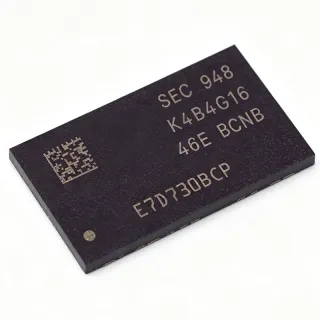
M29W160ET70N3F - 16Mb 70ns AEC-Q100 NOR Flash | Micron
MPN: M29W160ET70N3F ✓ Active| Qty | Unit Price | Extended |
|---|---|---|
| 1 | $4.2 | $4.20 |
| 10 | $3.85 | $38.50 |
| 100 | $3.45 | $345.00 |
| 500 | $3.1 | $1,550.00 |
| 1,000 | $2.8 | $2,800.00 |
Drop-in alternatives for M29W160ET70N3F — same package, pin-to-pin compatible. Different-package parts requiring PCB rework are excluded.
Quick Comparison Tool — Select alternative parts for side-by-side comparison:
M29W160FB70N3E
✅ Drop-In✓ In Stock
$3.58 / Unit
View Datasheet →M29W160ET70N3E
✅ Drop-In ⚠️ 参数待验证✓ In Stock
$4.5 / Unit
View Datasheet →M29W160EB80ZA3SE
✅ Drop-In✓ In Stock
$1.35 / Unit
View Datasheet →M29W800FT70ZA3SE
✅ Drop-In✓ In Stock
$1.38 / Unit
View Datasheet →M29W160ET70N3F Maximum Ratings & Electrical Characteristics
| Memory Type | Parallel NOR Flash |
| Memory Size | 16 Mbit (2 M x 8 / 1 M x 16) |
| Access Time | 70 ns |
| Supply Voltage | 3 V / 3.3 V |
| Technology | CMOS |
| Boot Block Architecture | Top boot |
| Bus Configuration | x8 / x16 selectable |
| Package | 48-pin TSOP |
| Mounting Type | Surface Mount |
| Temperature Grade | Automotive (AEC-Q100) |
| Qualification | AEC-Q100 qualified |
| Packaging | Tape and Reel |
| RoHS Status | RoHS-compliant package (F option) |
| Programming Interface | Parallel command set |
| Number of Terminals | 48 |
M29W160ET70N3F 48-pin tsop Pin Configuration Guide
Complete pinout information for M29W160ET70N3F (48-pin tsop package). This digital IC includes GPIO, communication interfaces (UART, SPI, I2C), and power pins. Refer to the manufacturer datasheet for alternate pin functions and configuration options. Essential for embedded system design and PCB layout.

No detailed pinout data available for M29W160ET70N3F.
Refer to the datasheet for full pin configuration.
Safe Operating Area (SOA) & Thermal Characteristics
No official SOA curve available for this digital IC. Always operate within absolute maximum ratings specified in the datasheet. Ensure adequate cooling and derate as needed.
Typical Applications
M29W160ET70N3F is suitable for 6 applications: Automotive ECU Boot Code Storage, Industrial Control Firmware Storage, Telecom and Networking Line Cards, Embedded Systems Code Storage (XIP), Automotive Infotainment and Cluster Boot Memory, Test and Measurement Instrument Firmware.
Automotive ECU Boot Code Storage
The M29W160ET70N3F is designed for automotive electronic control units that must store boot firmware in a reliably protected non-volatile region. Its AEC-Q100 qualification and automotive temperature grade satisfy in-vehicle stress requirements, while the top-boot architecture places protected boot blocks at the top of the address map, matching CPU boot vectors located at the end of the 16 Mbit space. The 70 ns access time permits zero-wait-state or minimal-wait-state code fetch on typical automotive microcontroller external buses, and the x8/x16 selectable bus lets designers match the ECU's 8-bit or 16-bit external memory interface without bus-width conversion logic. Single 3V/3.3V supply operation simplifies the power tree in 3.3V vehicle-electronics domains.
Recommended
Industrial Control Firmware Storage
Industrial controllers, PLC I/O modules, and motor-drive boards commonly use parallel NOR Flash to hold firmware because of its random-access, execute-in-place capability. The M29W160ET70N3F's 70 ns access time supports direct code execution from the parallel bus without shadowing to RAM at boot, reducing RAM requirements and startup time. The 16 Mbit density accommodates real-time operating systems plus application images, and the top-boot blocks can be hardware write-protected to prevent corruption from runaway code during field updates. The 3V/3.3V supply matches standard industrial logic rails, and the 48-pin TSOP surface-mount package suits wave-free, reflow-based industrial assembly with proven solder-joint reliability.
Recommended
Telecom and Networking Line Cards
Line cards, baseband boards, and network interface modules use parallel NOR Flash for boot ROM and configuration storage because NOR retains code integrity through power cycles and supports in-system update of the application region. The M29W160ET70N3F offers 16 Mbit in a space-efficient 48-pin TSOP, with the x16 mode providing 16-bit data fetches that double effective code-read throughput versus an 8-bit bus, an advantage on 16-bit embedded processor buses. The 70 ns grade sustains fast sequential reads during POST and image verification. RoHS-compliant tape-and-reel packing supports high-volume automated placement on telecom SMT lines.
Recommended
Embedded Systems Code Storage (XIP)
General-purpose embedded systems using external-bus microcontrollers benefit from the M29W160ET70N3F's execute-in-place capability: code runs directly from the 16 Mbit NOR array via the 70 ns parallel interface, avoiding the cost and boot latency of copying code into RAM. The BYTE pin selects x8 (2 M x 8) or x16 (1 M x 16) organization to match the host bus width, and the standard M29W160E command set is widely supported by flash programmer tooling and CPU memory-controller drivers. Top-boot protection safeguards the reset vector region during application-region field updates, and single-supply 3V/3.3V operation removes any programming-voltage generator from the design.
Recommended
Automotive Infotainment and Cluster Boot Memory
Instrument clusters and infotainment head units in vehicles require AEC-Q100-qualified code memory for their boot loaders. The M29W160ET70N3F's automotive temperature grade and qualification, combined with 70 ns random access, allow the graphics microcontroller to begin executing bootloader code immediately after reset. The 16 Mbit capacity holds the boot block plus a recovery image, while application code can live in larger serial or parallel memories. Top-boot write protection ensures the boot region survives OTA-style update failures, supporting ISO-aligned functional-safety recovery strategies in cluster designs.
Recommended
Test and Measurement Instrument Firmware
Bench instruments, data loggers, and sensor interfaces store monitor firmware and factory calibration tables in parallel NOR Flash for its reliability and random-access speed. The M29W160ET70N3F provides 16 Mbit in the industry-standard 48-pin TSOP footprint, allowing drop-in use across instrument revisions where the footprint is already designed in. The 70 ns access time supports fast boot-time self-test code execution, and the x8 mode simplifies interfacing to 8-bit MCU external buses in cost-sensitive designs. Block-protection features prevent accidental overwrite of calibration constants stored in dedicated blocks.
Recommended
Recommended Products Summary
Engineering reference data for M29W160ET70N3F — comparison, design guidance, and compliance information.
Selection Guide
Comparison with Alternatives
| Parameter | This Product | M29W160FB70N3E | M29W160ET70N3E | M29W160EB80ZA3SE | M29W800FT70ZA3SE |
|---|---|---|---|---|---|
| Package | 48-pin TSOP | 48-pin TSOP - same | 48-pin TSOP - same | TFBGA-48 - different (ball package) | TSOP-48 - same footprint |
| Brand | Micron Technology | Micron Technology | Micron Technology | Micron Technology | Micron Technology |
| Density | 16 Mbit | 16 Mbit | 16 Mbit | 16 Mbit | 8 Mbit |
| Access Time | 70 ns | 70 ns | 70 ns | 80 ns | 70 ns |
| Boot Block | Top boot | Bottom boot | Top boot | Bottom boot | Top boot |
| Automotive AEC-Q100 | Yes | Yes | [DATA_NEEDED] | Yes (A3SE automotive suffix) | Yes (A3SE automotive suffix) |
| Bus Width | x8 / x16 | x8 / x16 | x8 / x16 | x8 / x16 | x8 / x16 |
| Packaging | Tape & Reel (F suffix) | Tape & Reel (E suffix) | Tape & Reel | Tape & Reel | Tape & Reel |
Key Differentiators
- Automotive AEC-Q100 qualification with top-boot protection (vs M29W160FB70N3E)
- 70 ns access time vs 80 ns TFBGA variant (vs M29W160EB80ZA3SE)
- Double the code density in the same footprint (vs M29W800FT70ZA3SE)
Design Notes
Boot-block orientation is the most common substitution error in the M29W160E family. The 'T' suffix (top boot) places protected blocks at the top of the address map; 'B' (bottom boot) places them at address 0. Swapping M29W160ET70N3F for M29W160FB70N3E on the same PCB works electrically, but the CPU will fetch the reset vector from an unprotected application block, corrupting boot code on first field update. Verify the host CPU boot-vector address against the boot-block position before approving any alternate.
Decouple VCC with a 0.1 uF ceramic capacitor per supply pin, placed within a few millimeters of the TSOP-48 pins, plus bulk capacitance at the board level. During program and erase operations the device draws transient current spikes; inadequate decoupling shows up as program-verify failures. The BYTE pin must be strapped firmly to VCC (x8) or GND (x16) - do not leave it floating, as floating strap on parallel NOR buses causes intermittent bus-width switching during brownout.
Keep the address bus to the Flash short and length-match data lines where possible; 70 ns access-time margin is comfortable, but ringing on long unterminated parallel buses can cause address bit errors at the sampling edge. Series-termination resistors (22-33 ohm) on data lines are a low-cost mitigation on boards with trace lengths above roughly 10 cm. Avoid routing the Flash bus adjacent to high dV/dt switching nodes of DC-DC converters to prevent coupled glitches during program/erase cycles.
Compliance Information
The F suffix per Micron part-numbering denotes a RoHS-compliant package with tape-and-reel packing. AEC-Q100 automotive qualification confirmed by distributor listings (datasheets.com, Partstack).