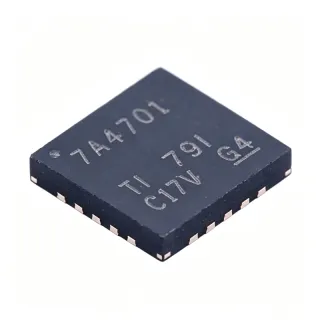
OPA396 - 1MHz 24uA Precision RRIO Op Amp | Texas Instruments
MPN: OPA396 ✓ Active| Qty | Unit Price | Extended |
|---|---|---|
| 1 | $1.15 | $1.15 |
| 10 | $0.98 | $9.80 |
| 100 | $0.79 | $79.00 |
| 500 | $0.65 | $325.00 |
| 1,000 | $0.52 | $520.00 |
Drop-in alternatives for OPA396 — same package, pin-to-pin compatible. Different-package parts requiring PCB rework are excluded.
Quick Comparison Tool — Select alternative parts for side-by-side comparison:
OPA348DCKT
✅ Drop-In ⚠️ 参数待验证📋 Reference alternative (not in catalog)
OPA391DCKT
⚡ Same Package ⚠️ 参数待验证📋 Reference alternative (not in catalog)
OPA2396DCKR
⚡ Same Package📋 Reference alternative (not in catalog)
MCP6001T-E/OT
✅ Drop-In ⚠️ 参数待验证📋 Reference alternative (not in catalog)
MAX4230AUT+T
✅ Drop-In ⚠️ 参数待验证📋 Reference alternative (not in catalog)
OPA396 Maximum Ratings & Electrical Characteristics
| Channels | 1 |
| Gain-Bandwidth Product | 1 MHz |
| Quiescent Current (per amp) | 23.5 uA |
| Supply Voltage Range | 1.7 V to 5.5 V |
| Input Bias Current | 10 fA (typ) |
| Offset Voltage (max) | 100 uV |
| Offset Drift | 1.2 uV/C |
| Input/Output Type | Rail-to-Rail Input and Output (RRIO) |
| Operating Temperature | -40C to +125C |
| Package | SC-70-5 (DCK) |
| Mounting Type | Surface Mount |
| Unity-Gain Stable | Yes |
| Output Stage | Class-AB rail-to-rail (CMOS) |
| Input Stage | CMOS |
| Family | OPAx396 (OPA396 / OPA2396 / OPA4396) |
| RoHS Status | Compliant |
OPA396 Pin Configuration
| Pin 1 | OUT — Amplifier output (rail-to-rail) |
| Pin 2 | V- — Negative supply / ground |
| Pin 3 | IN+ — Non-inverting input (rail-to-rail) |
| Pin 4 | IN- — Inverting input (rail-to-rail) |
| Pin 5 | V+ — Positive supply, 1.7 V to 5.5 V |
Safe Operating Area (SOA) & Thermal Characteristics
No official SOA curve available for this component. Always operate within absolute maximum ratings specified in the datasheet. Ensure adequate cooling and derate as needed.
Typical Applications
OPA396 is suitable for 6 applications: Photodiode Transimpedance Amplification, Battery-Powered Portable Instrumentation, Portable Medical and Health Monitoring, IoT Sensor Node Signal Conditioning, Low-Power Active Filters, Industrial High-Gain Analog Front Ends.
Photodiode Transimpedance Amplification
The OPA396 fits photodiode TIA circuits because its 10 fA input bias current contributes essentially zero dark-current error, and the rail-to-rail input stage accepts photocurrent signals approaching the 0 V rail on single 1.7 V to 5.5 V supplies. Placed with the photodiode into the inverting input and a feedback resistor (tens to hundreds of kilohms), it converts current to voltage with high DC accuracy at only 23.5 uA supply current. A feedback capacitor compensates diode capacitance for stability; the 1 MHz gain-bandwidth supports moderate closed-loop bandwidths in portable optical sensing.
Recommended
Battery-Powered Portable Instrumentation
In battery-powered instruments, the OPA396 extends runtime with only 23.5 uA quiescent current while still providing 1 MHz bandwidth and 100 uV max offset for accurate signal conditioning. Operating down to 1.7 V, it runs directly from a single alkaline or lithium coin cell, and its rail-to-rail output swings to the rails so the full ADC input range is usable as the battery discharges. In a sensor front end, it amplifies bridge or thermistor signals before the ADC; the 1.2 uV/C drift keeps calibration intact over the industrial -40C to +125C temperature range.
Recommended
Portable Medical and Health Monitoring
Portable medical devices such as glucose meters, pulse sensors, and wearable health monitors need precision amplification with strict power budgets. The OPA396's 10 fA bias current and 100 uV offset preserve the accuracy of high-impedance bio-electrode and optical sensor signals, while 23.5 uA quiescent current maximizes battery life in always-on monitoring modes. The SC-70-5 package minimizes PCB area in compact wearable enclosures, and RRIO operation at 1.7 V to 5.5 V suits both coin-cell and single-cell Li-ion rails, with rail-to-rail output driving low-speed ADCs directly without an extra buffer stage.
Recommended
IoT Sensor Node Signal Conditioning
In IoT sensor nodes, the OPA396 conditions weak sensor outputs (thermistors, strain gauges, gas sensors) ahead of a microcontroller ADC while drawing negligible supply current from energy-harvesting or battery sources. Its RRIO input reads signals down to ground and its output swings fully at low supplies, maximizing effective ADC resolution; 1 MHz bandwidth leaves margin for anti-aliasing filter gain stages. With 23.5 uA consumption and sub-100 uV offset, designers can duty-cycle the amplifier rail or leave it always-on, and the SC-70-5 footprint keeps node cost and size low.
Recommended
Low-Power Active Filters
The OPA396 implements Sallen-Key and multiple-feedback active filters in low-power signal chains, where its unity-gain stability and 1 MHz gain-bandwidth support filter corner frequencies into the tens of kilohertz with adequate Q headroom. At 23.5 uA per amplifier, multi-pole filter designs remain practical in battery products, and RRIO output prevents clipping of filter pass-band signals near the rails. The 100 uV maximum offset keeps DC offsets in the filter passband minimal, avoiding wasted ADC dynamic range, and the CMOS input stage keeps bias-current-induced errors negligible with high-value resistors.
Recommended
Industrial High-Gain Analog Front Ends
For industrial sensor transmitters operating from -40C to +125C, the OPA396 provides high-gain amplification with 1.2 uV/C offset drift, so calibration survives wide temperature swings. Supplied from a 3.3 V or 5 V rail, it amplifies millivolt-level sensor signals 50x to 100x while consuming only 23.5 uA, useful in loop-powered and energy-constrained field instruments. The class-AB rail-to-rail output drives ADC inputs or filter stages, and its high speed-to-power ratio leaves closed-loop bandwidth margin even at gains of 100, keeping settling times short in multiplexed data-acquisition systems.
Recommended
Recommended Products Summary
Engineering reference data for OPA396 — comparison, design guidance, and compliance information.
Selection Guide
Comparison with Alternatives
| Parameter | This Product | OPA348DCKT | OPA391DCKT | MCP6001T-E/OT | MAX4230AUT+T |
|---|---|---|---|---|---|
| Package | SC-70-5 (DCK) | SC-70-5 (DCK) - same | SC-70-5 (DCK) - same | SC-70-5 (SOT-353) - same footprint class | SC-70-5 - same |
| Brand | Texas Instruments | Texas Instruments | Texas Instruments | Microchip Technology | Maxim Integrated |
| Gain-Bandwidth | 1 MHz | 1 MHz | 100 kHz | 1 MHz | 10 MHz |
| Quiescent Current | 23.5 uA | 38 uA | 17.5 uA | 100 uA | 1.7 mA |
| Offset Voltage (max) | 100 uV | 500 uV | 120 uV | 4.5 mV | 1 mV |
| Input Bias Current | 10 fA | 1 pA | 10 pA | 1 pA | 1 pA |
| Supply Voltage Range | 1.7 V to 5.5 V | 2.5 V to 5.5 V | 1.8 V to 5.5 V | 1.8 V to 6.0 V | 2.5 V to 5.5 V |
| I/O Type | RRIO | RRIO | RRIO | RRIO | RRIO |
Key Differentiators
- Ultra-low 10 fA input bias current (vs MCP6001T-E/OT)
- Best speed-to-power ratio in class (vs MCP6001T-E/OT)
- Precision 100 uV max offset with 1.2 uV/C drift (vs OPA348DCKT)
Design Notes
Place a 0.1 uF ceramic decoupling capacitor within 2 mm of the V+ pin with a low-impedance via to ground. For transimpedance designs, add a guard ring driven by a low-impedance node at the same potential as the input around the IN+ / IN- traces to reduce PCB leakage, since the 10 fA bias current is meaningless if board leakage dominates. Keep feedback traces short and remove solder-mask under the high-impedance node for lowest leakage.
The 1 MHz gain-bandwidth imposes a stability constraint: in transimpedance amplifiers the feedback capacitor value must account for photodiode capacitance, roughly Cf = sqrt(Cin / (2*pi*Rf*GBW)). In high-gain (noise-gain > 10) configurations, closed-loop bandwidth shrinks proportionally - verify phase margin with the datasheet open-loop gain curves. Do not exceed 5.5 V absolute maximum supply; the 1.7 V minimum leaves little headroom at coin-cell end-of-life, so verify output swing requirements at 1.7 V.
Although quiescent current is only 23.5 uA, the class-AB output can deliver higher load-current pulses; current limiting is not a substitute for proper supply bypassing. For active filters, keep noise gain below the datasheet phase-margin limits at the target frequency. When driving capacitive loads directly, isolate with a small series resistor (e.g., 50-100 ohm) to prevent ringing, per the TI OPAx396 datasheet application section.
Compliance Information
RoHS compliant per TI product page for the OPA396 family; REACH/halogen details not stated in provided data.