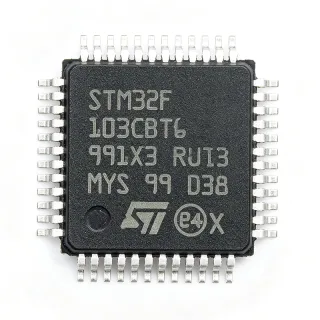
PIC16C54-10I/SS - 8-bit OTP MCU 12 I/O 10MHz | Microchip | SSOP-20
MPN: PIC16C54-10I/SS ✓ Active| Qty | Unit Price | Extended |
|---|---|---|
| 1 | $3.6993 | $3.70 |
| 10 | $3.45 | $34.50 |
| 100 | $2.95 | $295.00 |
| 500 | $2.5 | $1,250.00 |
| 1,000 | $2.1 | $2,100.00 |
PIC16C54-10I/SS Overview
A microcontroller (MCU) is a single-chip computer that integrates a CPU, memory, and peripherals on one die. The PIC16C54 belongs to the original PIC16C5x family of 8-bit microcontrollers, the foundational architecture that established Microchip's RISC-based mid-range core. Within the broader taxonomy it is classified as an 8-bit MCU -> embedded microcontroller -> integrated circuit -> semiconductor.
Key features include 12-bit-wide instructions, an 8-bit data path, a two-level deep hardware stack, direct/indirect/relative addressing modes, and a single 8-bit real-time clock/counter (TMR0) with an 8-bit prescaler. The device supports 33 single-word instructions with a 2:1 code compression advantage over competitors, only 12 special function hardware registers, and a 4 MHz internal oscillator option on selected derivatives.
Architecturally the PIC16C54 uses a Harvard-style RISC core with separate program and data buses, executed from EPROM/OTP for one-time programmable production volumes. The 10 MHz rating supports a 100 ns instruction cycle, enabling deterministic control loop execution in cost-sensitive industrial and embedded applications.
Typical use cases are low-cost 8-bit control for appliance interfaces, LED drivers, simple sensor readers, and battery-powered devices. Industrial temperature grade -40C to +85C and ceramic-equivalent SSOP-20 thermal robustness make it suitable for factory floor electronics.
When designing with this part, remember the 12 I/O budget is shared with the MCLR, oscillator, and TMR0 pins; verify your pin allocation against the SSOP-20 datasheet pinout. The OTP memory cannot be re-programmed, so order pre-programmed units or use the PIC16F54 flash equivalent for development iterations.
This page synthesizes distributor pricing, drop-in PIC16C5x family alternatives, and practical design considerations not consolidated on the manufacturer datasheet.
Drop-in alternatives for PIC16C54-10I/SS — same package, pin-to-pin compatible. Different-package parts requiring PCB rework are excluded.
Variants in this series
Same-series models that are drop-in compatible with PIC16C54-10I/SS (same form factor and footprint) — differing in Package, Program Memory Size, Timers, Operating Temperature, Mounting Type.
Quick Comparison Tool — Select alternative parts for side-by-side comparison:
PIC16C54-10/SS
✅ Drop-In✓ In Stock
$1.55 / Unit
View Datasheet →PIC16C54C-10I/SS
✅ Drop-In📋 Reference alternative (not in catalog)
PIC16C54A-10I/SS
✅ Drop-In📋 Reference alternative (not in catalog)
PIC16F54-I/SS
✅ Drop-In📋 Reference alternative (not in catalog)
PIC16C54-10I/P
✅ Drop-In ⚠️ 参数待验证✓ In Stock
$1.18 / Unit
View Datasheet →PIC16C54-10E/SS
✅ Drop-In ⚠️ 参数待验证✓ In Stock
$1.74 / Unit
View Datasheet →PIC16C54-10I/SS Maximum Ratings & Electrical Characteristics
| Manufacturer | Microchip Technology |
| Series | PIC16C5x |
| Core Processor | PIC |
| Core Size | 8-bit |
| Program Memory Type | OTP (One-Time Programmable) |
| Program Memory Size | 768 bytes (512 x 12-bit words) |
| Data RAM | 25 bytes |
| Number of I/O Pins | 12 |
| Maximum CPU Frequency | 10 MHz |
| Instruction Cycle Time | 100 ns at 10 MHz |
| Number of Instructions | 33 single-word instructions |
| Hardware Stack Depth | 2 levels |
| Timers | 1 x 8-bit TMR0 with 8-bit prescaler |
| Oscillator Type | External RC/External Crystal/Internal (selected variants) |
| Operating Temperature Range | -40C to +85C (Industrial grade, -I suffix) |
| Package | 20-pin SSOP (0.209 inch, 5.30 mm width) |
| Mounting Type | Surface Mount |
PIC16C54-10I/SS Pin Configuration
| Pin 1 | RA2 — Digital I/O port A bit 2 |
| Pin 2 | RA3 — Digital I/O port A bit 3 |
| Pin 3 | RA4/T0CKI — Digital I/O port A bit 4 / TMR0 clock input |
| Pin 4 | MCLR — Master Clear reset input (active low) |
| Pin 5 | VSS — Ground reference |
| Pin 6 | RB0/INT — Digital I/O port B bit 0 / external interrupt input |
| Pin 7 | RB1 — Digital I/O port B bit 1 |
| Pin 8 | RB2 — Digital I/O port B bit 2 |
| Pin 9 | RB3 — Digital I/O port B bit 3 |
| Pin 10 | RB4 — Digital I/O port B bit 4 |
| Pin 11 | RB5 — Digital I/O port B bit 5 |
| Pin 12 | RB6 — Digital I/O port B bit 6 |
| Pin 13 | RB7 — Digital I/O port B bit 7 |
| Pin 14 | VSS — Ground reference |
| Pin 15 | OSC1/CLKIN — Oscillator input / external clock input |
| Pin 16 | OSC2/CLKOUT — Oscillator output / clock output (crystal mode) |
| Pin 17 | RC0 — Digital I/O port C bit 0 |
| Pin 18 | RC1 — Digital I/O port C bit 1 |
| Pin 19 | RC2 — Digital I/O port C bit 2 |
| Pin 20 | RC3 — Digital I/O port C bit 3 |
Typical Applications
PIC16C54-10I/SS is suitable for 7 applications: Appliance Control Panels, LED Lighting Controllers, Simple Sensor Interfaces, Battery-Powered Remote Controls, Industrial Timer and Counter Modules, Automotive Interior Accessories, Educational and Hobbyist Projects.
Appliance Control Panels
The PIC16C54-10I/SS fits appliance front-panel control with its 12 I/O pins sufficient for 7-segment LED multiplexing, keypads, and relay drivers. The 768 bytes OTP program memory holds compiled control firmware for washing machine, microwave, and dishwasher interfaces. Industrial -40C to +85C rating handles kitchen and laundry thermal environments, while the SSOP-20 surface-mount package supports high-density PCB assembly. The 10 MHz core executes 100 ns per instruction, fast enough for debounced key scanning and PWM buzzer drive without timing jitter. The TMR0 8-bit timer with 8-bit prescaler provides the timing base for delay loops, sensor polling intervals, and watchdog-style firmware flow control typical in cost-8 appliances.
Recommended
LED Lighting Controllers
The PIC16C54-10I/SS is well-suited for simple LED driver controllers in decorative and architectural lighting products. Its 12 I/O can drive multiple LED channels via PWM-emulated bit-banging or external driver ICs, while the 768 bytes OTP stores color sequences, fade tables, and dimming curves. The 25 bytes RAM is adequate for state variables in animation logic without requiring external memory. Industrial temperature grade supports indoor commercial luminaires. Compared to larger PIC MCUs, the PIC16C54 saves BOM cost in volume production. The SSOP-20 package enables compact PCB designs alongside LED driver chips like the CL88030 or discrete MOSFET arrays for high-current RGBW channels.
Recommended
Simple Sensor Interfaces
The PIC16C54-10I/SS handles basic sensor front-end processing for cost-sensitive applications like thermistor readers, photodiode interfaces, and switch-debounce modules. The TMR0 timer captures pulse widths from sensors like HC-SR04 ultrasonic or PIR motion detectors, while 12 I/O lines interface multiple digital sensors simultaneously. The 768 bytes OTP holds lookup-based linearization tables, threshold comparisons, and UART-emulated transmit routines for sensor data reporting. Industrial temperature grade ensures reliable operation in outdoor enclosures. The deterministic 100 ns instruction cycle supports precise timing for capacitive touch sensing using the charge-transfer method documented in Microchip application notes.
Recommended
Battery-Powered Remote Controls
The PIC16C54-10I/SS is suited to IR remote controls, RF key fobs, and wireless sensor transmitters where low BOM cost dominates. The 12 I/O can scan 4x4 key matrices plus drive an IR LED or SAW transmitter enable line. The 25 bytes RAM is sufficient for transmit buffer and key debounce state, while 768 bytes OTP holds command encoding tables for protocols like NEC, RC5, or proprietary OOK schemes. Industrial temperature grade supports automotive key fobs and outdoor remote applications. The SSOP-20 surface-mount package supports miniaturized PCB designs. Compared to PIC16F series, the PIC16C54 OTP variant is favored for high-volume remote control production where firmware is fixed.
Recommended
Industrial Timer and Counter Modules
The PIC16C54-10I/SS excels at standalone industrial timer, process-counter, and event-logger modules that require deterministic execution and long-term reliability. The TMR0 8-bit timer with 8-bit prescaler delivers 256 x 256 = 65536-cycle timing range for seconds-to-hours intervals at 10 MHz. Industrial -40C to +85C grade handles factory floor ambient conditions including unheated enclosures. The 12 I/O drives 7-segment displays via BCD decoder ICs like CD4511 and accepts discrete inputs from optical encoders or contact-closure sensors. The deterministic 100 ns instruction cycle and 2-level hardware stack support interrupt-free cooperative firmware. Compared to PIC16F series, OTP version provides lower cost for fixed-function industrial controllers.
Recommended
Automotive Interior Accessories
The PIC16C54-10I/SS is suitable for low-end automotive interior accessories like cabin LED strips, cup-holder illuminators, USB charger indicators, and simple HVAC mode selectors. The 12 I/O controls RGB LED strings, button inputs, and indicator drivers. Industrial -40C to +85C grade handles cabin thermal range, though under-hood applications would require the PIC16C54-10E/SS extended grade. The 768 bytes OTP stores fixed automotive firmware including CAN/LIN emulation if needed via bit-banged UART. Compared to AEC-Q100 qualified PIC16F variants, the PIC16C54 is acceptable for non-safety accessories. The SSOP-20 package enables compact PCB designs behind dashboard trim panels.
Recommended
Educational and Hobbyist Projects
The PIC16C54-10I/SS is widely used in electronics education for teaching 8-bit RISC architecture, assembly programming, and embedded design fundamentals. The 33-instruction PIC16C5x instruction set is documented in textbooks and online tutorials, making it ideal for university courses and hobbyist learning. The 768 bytes OTP program memory is sufficient for student projects like digital clocks, dice simulators, and traffic light controllers. Compared to modern PIC16F or PIC18F parts, the PIC16C54's stripped-down architecture (2-level stack, no interrupts on base revision) forces students to learn fundamentals like polled I/O and manual stack management. Industrial temp grade supports classroom lab environments.
Recommended
Recommended Products Summary
Engineering reference data for PIC16C54-10I/SS — comparison, design guidance, and compliance information.
Selection Guide
Comparison with Alternatives
| Parameter | This Product | PIC16C54-10/SS | PIC16C54C-10I/SS | PIC16C54A-10I/SS | PIC16F54-I/SS |
|---|---|---|---|---|---|
| Package | 20-SSOP (5.30 mm width) | 20-SSOP (5.30 mm width) - same | 20-SSOP (5.30 mm width) - same | 20-SSOP (5.30 mm width) - same | 20-SSOP (5.30 mm width) - same |
| Brand | Microchip Technology | Microchip Technology | Microchip Technology | Microchip Technology | Microchip Technology |
| Program Memory Type | OTP (768 bytes) | OTP (768 bytes) | OTP (768 bytes) | OTP (768 bytes) | Flash (768 bytes) |
| Data RAM | 25 bytes | 25 bytes | 25 bytes | 25 bytes | 25 bytes |
| Number of I/O Pins | 12 | 12 | 12 | 12 | 12 |
| Maximum CPU Frequency | 10 MHz | 10 MHz | 10 MHz | 10 MHz | 10 MHz |
| Operating Temperature Range | -40C to +85C (Industrial) | 0C to +70C (Commercial) | -40C to +85C (Industrial) | -40C to +85C (Industrial) | -40C to +85C (Industrial) |
| Number of Instructions | 33 single-word | 33 single-word | 33 single-word | 33 single-word | 33 single-word |
Key Differentiators
- Established PIC16C5x RISC core with 33 single-word instructions (vs PIC16F54-I/SS)
- OTP memory yields lower per-unit cost than Flash at volume (vs PIC16F54-I/SS)
- Industrial -40C to +85C temperature grade (vs PIC16C54-10/SS)
- Compact SSOP-20 surface-mount package with 5.30 mm body (vs PIC16C54-10I/P (PDIP-20))
Design Notes
Estimated: at 5V supply, 10 MHz clock, and all 12 I/O driving 5 mA loads, the PIC16C54-10I/SS draws approximately 15-20 mA active current. The OTP programming voltage (typically 13V on MCLR pin during programming) must NOT be present during normal operation; ensure the MCLR pull-up circuit clamps below 0.2*VDD for proper reset. For battery-powered applications, use the PIC sleep mode by stopping the oscillator and waking via MCLR or WDT (if available on the specific silicon revision).
Place a 100 nF decoupling capacitor within 5 mm of the VDD pin (pin 14 in SSOP-20), with the ground return to the nearest VSS pin (pin 5 or 15). For oscillator stability, keep the crystal or resonator traces short and surrounded by ground pour; external capacitor loading values must match the Microchip PIC16C5x oscillator table for the selected frequency (typically 15-33 pF for 10 MHz crystal). Do not route switching signals under the oscillator area to avoid coupling.
The PIC16C54 base revision does NOT support interrupts; peripheral events must be polled using TMR0 or external pin state. The 2-level hardware stack means deeply nested CALLs will overwrite the return address - design firmware with max 2 subroutine nesting depth. OTP memory cannot be re-programmed; a single programming error requires a new part. Always verify code in PIC16F54-I/SS flash equivalent before committing to OTP volume orders. The CONFIG word fuse settings (oscillator type, WDT, code protect) must be set correctly at OTP programming time.
The SSOP-20 5.30 mm body has 0.65 mm pin pitch - design PCB pads to IPC-7351 nominal standard with adequate solder mask dam between pads to prevent solder bridges during reflow. Expose a thermal pad on the top copper layer below the SSOP to aid thermal dissipation; though the PIC16C54 is low-power, this helps production yield. Keep high-current traces (motor drivers, relay coils) at least 3 mm away from the oscillator traces and the MCLR reset pin to avoid EMI-induced resets.
The 10 MHz instruction rate means 100 ns per instruction; digital I/O toggling should be synchronized to avoid metastability on asynchronous inputs. For multi-MCU shared-bus communication, use the PIC16C5x's I/O bit-banged protocols with proper setup/hold timing per the datasheet AC characteristics. TMR0 input capture accuracy depends on the oscillator precision; use a crystal rather than RC oscillator if timing accuracy better than 5% is required.
Compliance Information
RoHS and REACH compliance status not explicitly stated in verified distributor data as of 2026-09-16. Microchip's PIC16C5x family datasheet (DS30414D) should be consulted for the exact compliance markings per specific date code. Not AEC-Q100 qualified; PIC16C54 family is generally targeted at industrial and consumer markets rather than automotive safety-critical applications. For automotive AEC-Q100 applications, consider PIC16F or dsPIC families explicitly listed as Q1 or Q100 grade.