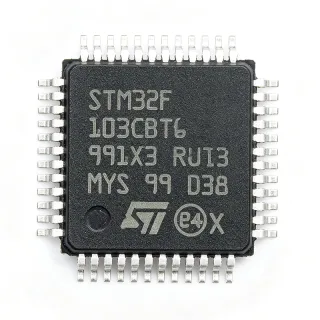
PIC16C54-RCI/SS - 8-bit 4MHz 768B OTP MCU 20-SSOP | Microchip
MPN: PIC16C54-RCI/SS ✗ End of Life| Qty | Unit Price | Extended |
|---|---|---|
| 1 | $1.7565 | $1.76 |
| 10 | $1.58 | $15.80 |
| 100 | $1.39 | $139.00 |
| 500 | $1.2 | $600.00 |
| 1,000 | $1.05 | $1,050.00 |
PIC16C54-RCI/SS Overview
A PIC microcontroller (Peripheral Interface Controller) is a Harvard-architecture 8-bit MCU family that uses a separate program and data bus, enabling most instructions to execute in a single instruction cycle. PIC16C5x devices sit at the foundation of Microchip's 8-bit portfolio, predating the flash-based PIC16F5x line, and are historically used in simple logic-replacement, timer, sensor-interface, and consumer-control applications where low cost and small footprint outweigh reprogrammability.
Key features include a RISC instruction set with 33 single-word instructions, a two-level deep hardware stack, direct/indirect/relative addressing modes, a single 8-bit real-time clock/counter (TMR0) with an 8-bit programmable prescaler, and seven or eight special-function hardware registers. The -RCI temperature grade typically denotes an industrial operating range of -40C to +85C, with the 'C' suffix identifying the CMOS-process revision.
The PIC16C54-RCI/SS is OTP, meaning the program memory can be written only once - a contract between cost and flexibility versus flash-based F-series parts. The 'SS' suffix designates the 20-pin SSOP (Shrink Small Outline Package) footprint, which provides a denser alternative to the 18-pin PDIP for space-constrained assemblies while remaining hand-solderable with standard techniques.
Typical applications include appliance control, low-end remote controllers, LED lighting sequencers, battery chargers, security-system keypads, and simple sensor/actuator nodes. The minimal instruction set and two-level stack favour shallow call-depth firmware rather than complex state machines.
When designing with this device, note that PIC16C5x parts use a 12-bit program counter and two-level hardware stack, so deeply nested subroutines are not possible. For new designs, Microchip recommends the flash-based PIC16F54 as the modern replacement, which preserves the pinout while adding reprogrammability.
Drop-in alternatives for PIC16C54-RCI/SS — same package, pin-to-pin compatible. Different-package parts requiring PCB rework are excluded.
Variants in this series
Same-series models that are drop-in compatible with PIC16C54-RCI/SS (same form factor and footprint) — differing in Package, Program Memory Size, Program Memory Type, Operating Temperature, Timers.
Quick Comparison Tool — Select alternative parts for side-by-side comparison:
PIC16C54C-04I/SS
✅ Drop-In✓ In Stock
$1.34 / Unit
View Datasheet →PIC16C54A-04I/SS
✅ Drop-In✓ In Stock
$1.05 / Unit
View Datasheet →PIC16C54-10I/SS
✅ Drop-In✓ In Stock
$2.1 / Unit
View Datasheet →PIC16C54CT-20I/SO
✅ Drop-In✓ In Stock
$0.95 / Unit
View Datasheet →PIC16C54-RCE/SS
✅ Drop-In✓ In Stock
$1.74 / Unit
View Datasheet →PIC16C54-RCI/SS Maximum Ratings & Electrical Characteristics
| Family | PIC 16C |
| Core | 8-bit RISC |
| Core Size | 8-bit |
| Program Memory Type | OTP (One-Time-Programmable) |
| Program Memory Size | 768 B (512 x 12) |
| RAM Size | 25 B |
| Instruction Width | 12-bit |
| Number of Instructions | 33 |
| Oscillator / Clock Speed | 4 MHz |
| I/O Pins | 12 (typical for 20-pin PIC16C5x) |
| Timers | 1 x 8-bit (TMR0) with programmable prescaler |
| Hardware Stack | 2-level |
| Addressing Modes | Direct, Indirect, Relative |
| Operating Temperature | -40C to +85C (industrial grade) |
| Package | 20-SSOP (Shrink Small Outline) |
| Package Pin Count | 20 |
| Mounting Type | Surface Mount |
PIC16C54-RCI/SS Pin Configuration
| Pin 1 | RA2 — Port A I/O bit 2 (PIC16C5x standard) |
| Pin 2 | RA3 — Port A I/O bit 3 |
| Pin 3 | RA4/T0CKI — Port A bit 4 / Timer0 clock input |
| Pin 4 | MCLR — Master Clear (reset) input, active low |
| Pin 5 | VSS — Ground reference |
| Pin 6 | RB0 — Port B I/O bit 0 |
| Pin 7 | RB1 — Port B I/O bit 1 |
| Pin 8 | RB2 — Port B I/O bit 2 |
| Pin 9 | RB3 — Port B I/O bit 3 |
| Pin 10 | RB4 — Port B I/O bit 4 |
| Pin 11 | RB5 — Port B I/O bit 5 |
| Pin 12 | RB6 — Port B I/O bit 6 |
| Pin 13 | RB7 — Port B I/O bit 7 |
| Pin 14 | VSS — Ground reference (or auxiliary VSS on some PIC16C5x) |
| Pin 15 | OSC2 — Oscillator output / RC connection |
| Pin 16 | OSC1 — Oscillator input |
| Pin 17 | RA0 — Port A I/O bit 0 |
| Pin 18 | RA1 — Port A I/O bit 1 |
| Pin 19 | VDD — Positive supply voltage |
| Pin 20 | VDD — Positive supply voltage (second VDD pin) |
Typical Applications
PIC16C54-RCI/SS is suitable for 7 applications: Appliance Control (Washer, Dishwasher, Microwave UI), Low-End Remote Controllers and IR Transmitters, LED Lighting Sequencers and Decorative Controllers, Battery Charger State-Machine Controllers, Security System Keypads and Simple Sensor Nodes, Toys, Hobby Kits, and Educational Development Boards, Industrial Logic-Replacement and Timer Modules.
Appliance Control (Washer, Dishwasher, Microwave UI)
The PIC16C54-RCI/SS fits cost-sensitive appliance user-interface and timer modules thanks to its 4 MHz instruction rate, 25-byte RAM, and one 8-bit TMR0 with prescaler. OTP memory locks firmware once validated, eliminating field reprogramming concerns. The 20-SSOP package saves board space versus the older 18-pin PDIP, allowing denser front-panel PCB designs. Its -40C to +85C industrial temperature range covers indoor appliance environments, and the deterministic single-cycle instruction set keeps interrupt latency predictable for keypad-scanning firmware typical in microwave and dishwasher control boards.
Recommended
Low-End Remote Controllers and IR Transmitters
For simple IR-remote or RF-remote transmitter designs, the PIC16C54-RCI/SS provides just enough horsepower - 768 B OTP, 33 single-word instructions, and one timer - to encode button-scan logic and carrier-frequency generation. The 2-level hardware stack supports shallow subroutines suitable for command-frame encoding. OTP memory is acceptable because remote firmware rarely changes. The 20-SSOP package fits slim handheld enclosures, and the 4 MHz clock derives accurate 38 kHz IR carrier timing via software bit-banging or TMR0 interrupts. Industrial temperature grade handles consumer indoor use.
Recommended
LED Lighting Sequencers and Decorative Controllers
The PIC16C54-RCI/SS suits LED chasers, holiday light controllers, and decorative dimmers where low cost and small footprint matter more than reprogrammability. Its 12 I/O pins directly drive multiple LED strings via transistors, and TMR0 generates precise blink or PWM patterns without extra peripherals. The OTP lock-in is ideal for fixed-pattern designs. The 20-SSOP fits inline strip-controller PCBs, and the 4 MHz clock supports smooth 8-bit PWM at audio rates. Designers can reuse proven PIC16C5x firmware libraries across product variants.
Recommended
Battery Charger State-Machine Controllers
In low-power NiCd, NiMH, or single-cell Li-ion charger modules, the PIC16C54-RCI/SS implements the charge-state machine, current-sense timing, and end-of-charge detection. Its 12-bit instruction width fits compact look-up tables for voltage/temperature thresholds, and TMR0 provides accurate minute-scale timing for timer-based termination. The 25-byte RAM is sufficient for status flags and counters. OTP prevents firmware corruption in noisy SMPS environments. The 20-SSOP footprint integrates easily into compact charger PCBs alongside sense resistors and FETs.
Recommended
Security System Keypads and Simple Sensor Nodes
The PIC16C54-RCI/SS powers security keypads, door/window sensor transmitters, and PIR motion-detector logic where deterministic code execution is critical. OTP eliminates firmware-tampering risk, and the 2-level stack supports the shallow firmware typical of scan-and-transmit loops. The 4 MHz clock drives the TMR0-based debounce and rolling-code timing. The 20-SSOP package suits miniaturized PCB assemblies behind keypads or inside sensor housings. Industrial temperature grade handles indoor security installations and unheated vestibules.
Recommended
Toys, Hobby Kits, and Educational Development Boards
The PIC16C54-RCI/SS is well-matched to educational embedded kits, beginner microcontroller trainers, and low-cost hobby toys because of its simple PIC16C5x instruction set (33 single-word instructions, 2-level hardware stack). Students learn RISC fundamentals without complex peripherals. OTP enforces a one-programmer-per-student workflow for classroom labs. The 20-SSOP package mounts on standard SOIC-to-DIP breakout boards, simplifying breadboarding. Industrial temperature grade tolerates classroom environments, and the 4 MHz clock supports traditional 'blink an LED' tutorials and timer exercises.
Recommended
Industrial Logic-Replacement and Timer Modules
The PIC16C54-RCI/SS replaces legacy 4000-series CMOS logic gates and discrete timers in industrial control panels, sequencing relays, motor-run timers, and conveyor controllers. Its programmable OTP replaces hardwired logic with flexible firmware revisions locked at production time. The 12 I/O pins drive multiple relays via drivers, and TMR0 provides precise on/off timing. The 20-SSOP fits dense control-panel PCBs. Industrial temperature grade covers factory-floor conditions, and the 4 MHz clock supports accurate millisecond timing for conveyor and motor-control sequences.
Recommended
Recommended Products Summary
Engineering reference data for PIC16C54-RCI/SS — comparison, design guidance, and compliance information.
Selection Guide
Comparison with Alternatives
| Parameter | This Product | PIC16C54C-04I/SS | PIC16C54A-04I/SS | PIC16C54-10I/SS | PIC16C54CT-20I/SO | PIC16C54-RCE/SS |
|---|---|---|---|---|---|---|
| Package | 20-SSOP | 20-SSOP - same | 20-SSOP - same | 20-SSOP - same | 20-SOIC (300 mil) - same pin count | 20-SSOP - same |
| Brand | Microchip Technology | Microchip Technology | Microchip Technology | Microchip Technology | Microchip Technology | Microchip Technology |
| Core | 8-bit RISC | 8-bit RISC | 8-bit RISC | 8-bit RISC | 8-bit RISC | 8-bit RISC |
| Program Memory | 768 B (512 x 12) OTP | 768 B (512 x 12) EPROM/Flash variant | 768 B (512 x 12) EPROM | 768 B (512 x 12) OTP/EPROM | 768 B (512 x 12) OTP/EPROM | 768 B (512 x 12) OTP |
| Clock Speed | 4 MHz | 4 MHz | 4 MHz | 10 MHz | 20 MHz | 4 MHz |
| RAM | 25 B | 25 B | 25 B | 25 B | 25 B | 25 B |
| Temperature Grade | Industrial (-40C to +85C) | Industrial (-40C to +85C) | Industrial (-40C to +85C) | Industrial (-40C to +85C) | Industrial (-40C to +85C) | Extended (higher upper limit) |
| Lifecycle Status | NRND | Production (newer revision) | Production | Production | Production | Production |
| Unit Price (1pc) | ~$1.76 | Comparable | Comparable | Comparable | Comparable | Comparable |
Key Differentiators
- Same 20-SSOP footprint across all listed drop-in alternatives (vs PIC16C54C-04I/SS)
- Extended-temperature grade option in same package (vs PIC16C54-RCE/SS)
- Higher-speed alternative available in 20-SOIC (vs PIC16C54CT-20I/SO)
Design Notes
Estimated: PIC16C5x parts have a 2-level hardware stack only - subroutine nesting deeper than 2 levels corrupts the return PC. Avoid recursive or deeply nested call chains. For state machines, use iterative loops or a software stack in RAM. Deep nesting is the most common firmware pitfall when porting from PIC16F or PIC18 platforms.
Place decoupling capacitors (100 nF ceramic + optional 10 uF bulk) within 5 mm of the VDD/VSS pins. The 20-SSOP package has two VDD pins (typically pin 19 and pin 20) and VSS; ensure both VDD pins are decoupled. Keep the OSC1/OSC2 traces short and shielded from noisy I/O lines to avoid clock jitter in 4 MHz crystal mode.
Estimated: at 4 MHz and 5V VDD, the PIC16C54 draws approximately 1-2 mA active and microamps in sleep mode (per typical PIC16C5x family datasheet curves - verify exact figure in your revision). Add MCLR pull-up (typically 10 kohm) and ensure the brown-out / watchdog configuration matches application needs. For battery-powered nodes, leverage sleep mode aggressively to extend life.
The 20-SSOP package has a 0.65 mm pitch - finer than the 1.27 mm SOIC - so PCB land patterns must follow the SSOP (not SOIC) JEDEC standard. Mis-using a SOIC footprint will not align the pins. For hand-soldering, use fine-tip iron and 0.4 mm lead solder; reflow is strongly preferred for production. Maintain 0.2 mm clearance between adjacent lands.
Compliance Information
RoHS/REACH status not explicitly listed in the verified web data for PIC16C54-RCI/SS; marked as unknown per Data Authenticity Rule 1. AEC-Q100 not applicable - PIC16C54 family is not automotive-qualified; use a PIC16F1xx or PIC18 automotive part for AEC-Q100 applications.