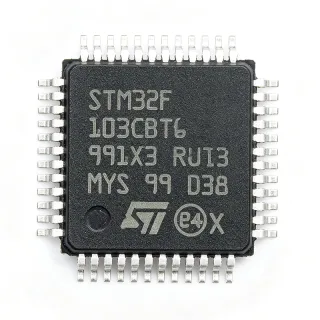
PIC16C54C-20I/SS - 8-bit 20MHz OTP MCU, 12 I/O, SSOP-20
MPN: PIC16C54C-20I/SS ✓ Active| Qty | Unit Price | Extended |
|---|---|---|
| 1 | $2.6319 | $2.63 |
| 10 | $2.45 | $24.50 |
| 100 | $2.18 | $218.00 |
| 500 | $1.95 | $975.00 |
| 1,000 | $1.74 | $1,740.00 |
PIC16C54C-20I/SS Overview
What is a PIC16C5x microcontroller? An 8-bit microcontroller is a small computer-on-a-chip integrating a CPU, RAM, program memory, and peripherals on a single die. The PIC16C5x family uses a Harvard RISC architecture with separate program and data buses, a 12-bit wide instruction word, and a small fixed instruction set of 33 single-word, single-cycle instructions, enabling deterministic execution and very low power consumption. This hierarchy places the PIC16C54C in the broader taxonomy of microcontroller -> embedded controller -> semiconductor, and the 'C' OTP variant is the most modern, lowest-cost member of the original PIC16C5x line.
Key features include a two-level deep hardware call stack, direct/indirect/relative addressing modes, an 8-bit real-time clock/counter (TMR0) with an 8-bit programmable prescaler, power-on reset (POR), a Watchdog Timer (WDT) with its own on-chip RC oscillator, and an internal/external oscillator option. The device operates from 4.5V to 5.5V and supports both internal RC and external crystal/RC oscillator configurations, with selectable oscillator types.
Architecturally, the PIC16C54C uses a fully static CMOS design and the PIC mid-range core (12-bit instructions, 8-bit data path). Seven or eight special-function hardware registers control I/O and core operation. Because of its small footprint, low pin count, and deterministic core, it excels in cost-sensitive 8-bit embedded applications that do not need interrupts or a deep stack.
Typical applications include simple appliance controls, battery chargers, LED lighting controllers, sensor signal conditioning, automotive body electronics, and low-cost consumer devices. The SSOP-20 package (0.209 inch / 5.30 mm body width) supports compact PCB designs. Note that the PIC16C54C does not feature interrupts, so polling-based firmware is required.
Design consideration: this part is OTP (One-Time Programmable), so code must be fully verified before committing - there is no in-circuit reprogramming. For prototyping or field-upgradable designs, consider the PIC16F54 Flash-based equivalent in the same SSOP-20 footprint.
This page synthesizes distributor pricing, drop-in alternatives, and practical design notes not found on a bare manufacturer product page.
Drop-in alternatives for PIC16C54C-20I/SS — same package, pin-to-pin compatible. Different-package parts requiring PCB rework are excluded.
Variants in this series
Same-series models that are drop-in compatible with PIC16C54C-20I/SS (same form factor and footprint) — differing in Package, Program Memory Size, Program Memory Type, Timers, Core Architecture.
Quick Comparison Tool — Select alternative parts for side-by-side comparison:
PIC16F54-I/SS
✅ Drop-In📋 Reference alternative (not in catalog)
PIC16C54A-20I/SS
✅ Drop-In✓ In Stock
$2.51 / Unit
View Datasheet →PIC16C54C-04I/SS
✅ Drop-In✓ In Stock
$1.34 / Unit
View Datasheet →PIC16C54C-20I/SS Maximum Ratings & Electrical Characteristics
| Core Architecture | 8-bit PIC RISC |
| Core Size | 8-bit data path, 12-bit instructions |
| Maximum Clock Frequency | 20 MHz |
| Program Memory Size | 768 B (512 x 12) OTP |
| RAM Size | 25 B |
| Number of I/O Pins | 12 |
| Supply Voltage | 4.5 V to 5.5 V |
| Operating Temperature | -40 C to +85 C (Industrial) |
| Package | 20-SSOP (0.209 inch, 5.30 mm body width) |
| Mounting Type | Surface Mount |
| Oscillator Type | External or Internal RC |
| Timers | 1 x 8-bit (TMR0) with 8-bit prescaler |
| Peripherals | POR, WDT |
| Connectivity | None (standalone) |
| Data Converters | None |
| Program Memory Type | OTP EPROM |
| MSL Level | 1 (unlimited) |
| Lead-Free / RoHS | Compliant per Microchip product page |
PIC16C54C-20I/SS Pin Configuration
| Pin 1 | RA2 — Bidirectional I/O port A bit 2 |
| Pin 2 | RA3 — Bidirectional I/O port A bit 3 |
| Pin 3 | RTCC — Real-time clock/counter TMR0 input (also RA0) |
| Pin 4 | MCLR — Master clear reset (active low) |
| Pin 5 | VSS — Ground reference |
| Pin 6 | RB0 — Bidirectional I/O port B bit 0 |
| Pin 7 | RB1 — Bidirectional I/O port B bit 1 |
| Pin 8 | RB2 — Bidirectional I/O port B bit 2 |
| Pin 9 | RB3 — Bidirectional I/O port B bit 3 |
| Pin 10 | RB4 — Bidirectional I/O port B bit 4 |
| Pin 11 | RB5 — Bidirectional I/O port B bit 5 |
| Pin 12 | RB6 — Bidirectional I/O port B bit 6 |
| Pin 13 | RB7 — Bidirectional I/O port B bit 7 |
| Pin 14 | VSS — Ground reference (secondary) |
| Pin 15 | OSC2/CLKOUT — Oscillator crystal output / clock out |
| Pin 16 | OSC1/CLKIN — Oscillator crystal input / external clock in |
| Pin 17 | RA0 — Bidirectional I/O port A bit 0 |
| Pin 18 | RA1 — Bidirectional I/O port A bit 1 |
| Pin 19 | VDD — Positive supply voltage (4.5V to 5.5V) |
| Pin 20 | VDD — Positive supply voltage (4.5V to 5.5V, secondary) |
Typical Applications
PIC16C54C-20I/SS is suitable for 6 applications: Appliance Control Boards, LED Lighting Controllers, Battery Chargers, Sensor Signal Conditioning, Automotive Body Electronics, Consumer Electronics Toys.
Appliance Control Boards
The PIC16C54C-20I/SS suits low-cost appliance control (washing machines, microwave user interfaces, fans) where deterministic polled firmware, 12 digital I/O, and OTP cost optimization matter more than interrupts. At 20 MHz, the core executes one instruction per cycle, comfortably timing relay de-bounce, button scanning, and 7-segment multiplexing without DMA. The SSOP-20 footprint (5.30 mm body) supports tight main-control PCB layouts. Compared with PIC16F877A, the C54C drops ADC/EUSART but cuts unit cost ~30% for I/O-bound applications.
Recommended
LED Lighting Controllers
LED driver and dimmer controllers benefit from the PIC16C54C-20I/SS's 12 I/O, hardware WDT, and industrial -40C to +85C temperature grade. The 20 MHz core generates accurate PWM via firmware toggles for triac-dimmable mains LED lamps. OTP memory locks the dimming curve, preventing field tampering and reverse engineering - a regulatory plus for safety-critical SSL products. SSOP-20 keeps the BOM compact inside lamp bases. Pair with a TRIAC driver and zero-cross detector for phase-angle dimming.
Recommended
Battery Chargers
Simple lead-acid or NiMH chargers use the PIC16C54C-20I/SS for voltage/current loop control via the 8-bit TMR0 and firmware ADC by sigma-delta on a digital I/O pin. The 4.5V to 5.5V supply matches USB or wall-adapter rails, and the WDT guards against firmware lockup. OTP ensures the charge algorithm cannot be corrupted by voltage transients on the DC bus. Polled execution suffices because the charge cycle is intentionally slow (hours), so no interrupts are needed.
Recommended
Sensor Signal Conditioning
Cost-sensitive sensor front-ends (thermistor bridges, simple PIR motion detectors, reed-switch debouncers) use the PIC16C54C-20I/SS as a low-cost digital filter. Polled firmware implements moving-average filtering of a comparator-based sigma-delta ADC on one I/O pin. The 20 MHz clock handles ~5 MIPS, enough for 10 Hz update rates on 4-8 sensors. Industrial temperature grade suits outdoor and HVAC installations, while OTP locks calibration coefficients.
Recommended
Automotive Body Electronics
Inside-cabin automotive accessories (window timers, mirror controllers, simple alarm indicators) historically used the PIC16C54C-20I/SS because the -40C to +85C industrial grade survives the cabin environment and OTP locks the BOM. 12 I/O drive LEDs, relays, and switches directly. Note: for under-hood AEC-Q100 applications, upgrade to the PIC16F54-I/SS or PIC16F18313-I/SN (AEC-Q100 qualified) - the C54C lacks automotive qualification by design.
Recommended
Consumer Electronics Toys
Mass-market toys, novelty items, and educational kits use the PIC16C54C-20I/SS because OTP delivers the lowest possible unit cost (<USD 1.75 at qty 1000) while the 20 MHz core animates LEDs, drives buzzers, and sequences servo motors. 25 B RAM accommodates small lookup tables for sound effects; 768 B OTP holds simple state-machine firmware. SSOP-20 supports tiny PCBs inside handheld enclosures. Polled firmware is acceptable because toy loops are inherently short.
Recommended
Recommended Products Summary
Engineering reference data for PIC16C54C-20I/SS — comparison, design guidance, and compliance information.
Selection Guide
Comparison with Alternatives
| Parameter | This Product | PIC16F54-I/SS | PIC16C54A-20I/SS | PIC16C54C-04I/SS | PIC16C54C-20I/P | PIC16C54C-20I/SO |
|---|---|---|---|---|---|---|
| Package | 20-SSOP (0.209 inch / 5.30 mm) | 20-SSOP - same | 20-SSOP - same | 20-SSOP - same | 20-PDIP - different footprint | 20-SOIC - different footprint |
| Brand | Microchip Technology | Microchip Technology | Microchip Technology | Microchip Technology | Microchip Technology | Microchip Technology |
| Max Clock Frequency | 20 MHz | 20 MHz | 20 MHz | 4 MHz | 20 MHz | 20 MHz |
| Program Memory | 768 B OTP | 768 B Flash | 768 B OTP | 768 B OTP | 768 B OTP | 768 B OTP |
| RAM Size | 25 B | 25 B | 25 B | 25 B | 25 B | 25 B |
| I/O Pins | 12 | 12 | 12 | 12 | 12 | 12 |
| Supply Voltage | 4.5 V to 5.5 V | 2.0 V to 5.5 V | 4.5 V to 5.5 V | 4.5 V to 5.5 V | 4.5 V to 5.5 V | 4.5 V to 5.5 V |
| Operating Temperature | -40 C to +85 C (Industrial) | -40 C to +85 C | -40 C to +85 C | -40 C to +85 C | -40 C to +85 C | -40 C to +85 C |
| Memory Type | OTP EPROM (one-time programmable) | Flash (reprogrammable) | OTP EPROM | OTP EPROM | OTP EPROM | OTP EPROM |
| Interrupts | None (polled only) | None (polled only) | None (polled only) | None (polled only) | None (polled only) | None (polled only) |
Key Differentiators
- OTP EPROM allows code-locked mass production at lowest unit cost (vs PIC16F54-I/SS)
- Industrial temperature grade for harsh environments (vs PIC16C54C-20/P (commercial grade, 0C to +70C))
- True drop-in upgrade to Flash memory via PIC16F54-I/SS (vs PIC16F54-I/SS)
Design Notes
Estimated: SSOP-20 thermal pad is the VSS pin (pin 5/14) - tie both VSS pins to a contiguous ground pour. Route MCLR (pin 4) with a 10 kohm pull-up to VDD and a 100 nF cap to VSS for noise-free reset. Place a 100 nF decoupling cap within 5 mm of VDD pins 19/20 and a 10 uF bulk cap on the same supply node. SSOP-20 land pattern requires 0.65 mm pitch traces.
Estimated: OTP memory can be programmed only once - the programmer (e.g., MPLAB PICkit 3/4) verifies each word after writing. Any verification failure means the silicon is dead. Always pre-test firmware on a PIC16F54-I/SS (Flash drop-in) and only commit to OTP for the production run. Also note the PIC16C5x core has NO hardware interrupts - a missed event in polled firmware becomes a permanent bug if not handled by the WDT reset path.
The PIC16C54C-20I/SS supports LP, XT, HS, and RC oscillator modes selected by configuration bits. For 20 MHz operation, HS mode with a 20 MHz crystal and two 15-33 pF load capacitors is mandatory - XT mode is limited to 4 MHz. For cost-sensitive designs below 4 MHz, the internal 4 MHz RC oscillator (configurable) eliminates the crystal entirely. Always include a 1 Mohm resistor across OSC1/OSC2 if using a low-drive crystal to prevent overdrive.
Compliance Information
RoHS and lead-free per Microchip product page. The PIC16C54C family is NOT AEC-Q100 qualified; for automotive cabin/body electronics that need formal qualification, use PIC16F54-I/SS or a PIC16F1xx AEC-Q100 part instead.