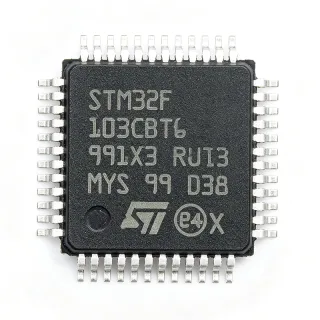
PIC16C54C-40/SS - 8-bit 40MHz OTP MCU 512B EPROM | Microchip
MPN: PIC16C54C-40/SS ✗ End of Life| Qty | Unit Price | Extended |
|---|---|---|
| 1 | $1.85 | $1.85 |
| 10 | $1.72 | $17.20 |
| 100 | $1.55 | $155.00 |
| 500 | $1.38 | $690.00 |
| 1,000 | $1.22 | $1,220.00 |
PIC16C54C-40/SS Overview
An 8-bit microcontroller (MCU) is a single-chip computer that integrates a CPU, RAM, non-volatile program memory, and peripheral I/O on one silicon die. The PIC16C5X family belongs to the baseline RISC architecture family from Microchip - a class of ultra-small microcontrollers characterized by a 12-bit instruction word, 33 single-cycle instructions, and a two-stack hardware call depth. In the broader taxonomy, an MCU sits below microprocessor and above ASIC: it is a programmable logic device used for embedded control, distinguishing it from fixed-function power management ICs, amplifiers, and interface ICs.
Key features of the PIC16C54C-40/SS include 33 single-cycle instructions (200 ns instruction cycle at 20 MHz oscillator), an 8-bit timer/counter with 8-bit programmable prescaler, a watchdog timer with on-chip RC oscillator, power-on reset, and code protection. The 40 MHz speed grade is the fastest variant in the family. The 12 I/O pins each source up to 20 mA and sink up to 25 mA, sufficient to drive LEDs and small relays directly without buffer transistors.
The PIC16C54C uses a Harvard RISC architecture with separate program and data buses, allowing instruction fetch to occur in parallel with data access. The reduced instruction set and predictable single-cycle execution simplify real-time control loops. The 8-bit data path and 12-bit instruction width make this device code-density optimized for small state machines rather than numeric processing.
Typical applications include automotive subsystems (body controllers, remote keyless entry transmitters), appliance control (microwave ovens, washing machines, coffee makers), industrial remote controls, security systems, and low-end consumer electronics. The 12-bit instruction word gives unusually high code density for a RISC MCU, allowing small programs to fit in the 512-word OTP.
When designing with this part, note that the EPROM (one-time-programmable) memory cannot be erased, so plan for code-development using a windowed CERDIP version before committing to OTP for production. The 2-level hardware stack supports only two nested subroutine calls - structured programs must avoid deep nesting or simulate additional stack depth in software.
This page synthesizes distributor pricing, drop-in pin-compatible alternatives from the same PIC16C5X family, and practical design notes not collected in any single datasheet, complementing the manufacturer documentation with procurement-grade data.
Drop-in alternatives for PIC16C54C-40/SS — same package, pin-to-pin compatible. Different-package parts requiring PCB rework are excluded.
Variants in this series
Same-series models that are drop-in compatible with PIC16C54C-40/SS (same form factor and footprint) — differing in Timers, Program Memory Size, Package, Program Memory Type, Maximum Clock Frequency.
Quick Comparison Tool — Select alternative parts for side-by-side comparison:
PIC16C54C-20I/SS
✅ Drop-In✓ In Stock
$1.74 / Unit
View Datasheet →PIC16C54C-04/SS
✅ Drop-In✓ In Stock
$0.65 / Unit
View Datasheet →PIC16C54C-04I/SS
✅ Drop-In✓ In Stock
$1.34 / Unit
View Datasheet →PIC16C54A-20/SS
✅ Drop-In📋 Reference alternative (not in catalog)
PIC16C54A-04/SS
✅ Drop-In✓ In Stock
$1.18 / Unit
View Datasheet →PIC16F54-I/SS
✅ Drop-In📋 Reference alternative (not in catalog)
PIC16C54C-40/SS Maximum Ratings & Electrical Characteristics
| Program Memory Type | OTP EPROM (One-Time-Programmable) |
| Program Memory Size | 512 x 12 words (768 bytes) |
| RAM Size | 25 bytes |
| CPU Core | PIC16C5X 8-bit RISC (baseline) |
| Instruction Set Size | 33 instructions, all single-cycle |
| Maximum Clock Frequency | 40 MHz |
| Instruction Cycle Time | 100 ns (at 40 MHz) |
| Supply Voltage | 4.5 V to 5.5 V |
| I/O Pins | 12 |
| Timers | 1 x 8-bit timer/counter with 8-bit prescaler |
| Watchdog Timer | Yes (on-chip RC oscillator) |
| Hardware Stack | 2 levels |
| I/O Source Current | 20 mA (max per pin) |
| I/O Sink Current | 25 mA (max per pin) |
| Package Type | 20-pin SSOP (0.209 inch / 5.30 mm body) |
| Operating Temperature | 0C to +70C (commercial) |
| Mounting Type | Surface Mount |
PIC16C54C-40/SS Pin Configuration
| Pin 1 | RA2 — Bidirectional I/O port A bit 2 |
| Pin 2 | RA3 — Bidirectional I/O port A bit 3 |
| Pin 3 | T0CKI — Timer 0 clock input / RA4 |
| Pin 4 | MCLR/VPP — Master Clear reset input / programming voltage |
| Pin 5 | VSS — Ground reference |
| Pin 6 | RB0 — Bidirectional I/O port B bit 0 |
| Pin 7 | RB1 — Bidirectional I/O port B bit 1 |
| Pin 8 | RB2 — Bidirectional I/O port B bit 2 |
| Pin 9 | RB3 — Bidirectional I/O port B bit 3 |
| Pin 10 | RB4 — Bidirectional I/O port B bit 4 |
| Pin 11 | RB5 — Bidirectional I/O port B bit 5 |
| Pin 12 | RB6 — Bidirectional I/O port B bit 6 |
| Pin 13 | RB7 — Bidirectional I/O port B bit 7 |
| Pin 14 | VSS — Ground reference (secondary) |
| Pin 15 | OSC2 — Crystal/Resonator oscillator output |
| Pin 16 | OSC1 — Crystal/Resonator oscillator input |
| Pin 17 | VDD — Positive supply voltage |
| Pin 18 | RA0 — Bidirectional I/O port A bit 0 |
| Pin 19 | RA1 — Bidirectional I/O port A bit 1 |
| Pin 20 | VDD — Positive supply voltage (secondary) |
Typical Applications
PIC16C54C-40/SS is suitable for 6 applications: Remote Keyless Entry (RKE) Transmitters, Microwave Oven Control Boards, Washing Machine Control Logic, Security System PIR Sensor Modules, Industrial Remote Control Handsets, Coffee Maker and Small Appliance Controllers.
Remote Keyless Entry (RKE) Transmitters
The PIC16C54C-40/SS is well suited to automotive remote keyless entry (RKE) transmitters because its 33 single-cycle instructions and 100 ns instruction cycle at 40 MHz provide deterministic timing for rolling-code encryption and Manchester-encoded RF modulation. The 512-word OTP holds compact rolling-code algorithms while the 12 I/O pins drive an RF encoder IC, three or four PCB-mounted pushbuttons, and an LED indicator. Operating from a CR2032 coin cell through a 3.3V regulator, the part draws microamp-level idle current thanks to the SLEEP instruction. The SSOP-20 package fits inside compact keyfob enclosures.
Recommended
Microwave Oven Control Boards
The PIC16C54C-40/SS provides the timing and relay-control brain for entry-level microwave oven control boards, replacing discrete 4000-series CMOS logic. Its 8-bit timer with 8-bit prescaler generates cook-time intervals up to 99:99 minutes while the 12 I/O pins drive a 4-digit 7-segment multiplexed display, key matrix scan, magnetron relay, turntable motor relay, and buzzer. The 40 MHz instruction cycle eliminates display flicker. The SSOP-20 footprint mounts on the same board outline used for decades, easing transition to newer part numbers.
Recommended
Washing Machine Control Logic
White-goods washing machine controllers use the PIC16C54C-40/SS as the cycle state machine, sequencing wash, rinse, and spin phases based on user-selected program and water-level sensor inputs. The 12 I/O lines control a 7-segment LED driver, multiple triac outputs for the motor and pump relays, lid-switch sensing, and door-lock feedback. The hardware watchdog timer with on-chip RC oscillator resets the MCU if a triac-driving program path hangs, improving field reliability. The commercial temperature grade suits indoor appliance environments.
Recommended
Security System PIR Sensor Modules
Passive infrared (PIR) motion sensor modules for security alarms leverage the PIC16C54C-40/SS to qualify and time-window the analog output of a dual-element pyroelectric sensor. The 40 MHz instruction cycle executes a digital low-pass filter and pulse-counting algorithm in real time, suppressing false triggers from RF noise and thermal transients. The 512-word OTP stores fixed threshold parameters. The 12 I/O pins drive an alarm-output relay, a walk-test LED, and a tamper switch input. The SSOP-20 fits inside standard ceiling-mount PIR enclosures.
Recommended
Industrial Remote Control Handsets
Crane, hoist, and forklift remote-control handsets use the PIC16C54C-40/SS to scan a 4x3 button matrix, validate button combinations, and emit a PWM-modulated carrier to the receiver. The 40 MHz instruction cycle generates button-debounce delays and PWM timing with sub-microsecond jitter. The 12 I/O lines connect to the keypad scan, status LEDs, and a single RF modulator IC. Industrial-grade variants (-40C to +85C) of the same die are available with -I suffixes for outdoor or factory-floor temperature exposure.
Recommended
Coffee Maker and Small Appliance Controllers
Entry-level drip coffee makers, toaster ovens, and rice cookers use the PIC16C54C-40/SS as the timer-and-mode controller. The 8-bit timer/counter maintains elapsed brew time while the 12 I/O pins drive a 2-digit 7-segment display, three or four mode pushbuttons, a heating-element triac, and a buzzer for end-of-cycle indication. The OTP memory holds the factory-default brew profile. With $1.22 pricing at 1000-piece quantities, the part keeps bill-of-materials cost low for consumer-grade small appliances.
Recommended
Recommended Products Summary
Engineering reference data for PIC16C54C-40/SS — comparison, design guidance, and compliance information.
Selection Guide
Comparison with Alternatives
| Parameter | This Product | PIC16C54C-20I/SS | PIC16C54C-04/SS | PIC16C54C-04I/SS | PIC16C54A-20/SS | PIC16C54A-04/SS | PIC16F54-I/SS |
|---|---|---|---|---|---|---|---|
| Brand | Microchip Technology | Microchip Technology | Microchip Technology | Microchip Technology | Microchip Technology | Microchip Technology | Microchip Technology |
| Package | 20-pin SSOP | 20-pin SSOP - same | 20-pin SSOP - same | 20-pin SSOP - same | 20-pin SSOP - same | 20-pin SSOP - same | 20-pin SSOP - same |
| Maximum Clock Frequency | 40 MHz | 20 MHz (-50%) | 4 MHz (-90%) | 4 MHz (-90%) | 20 MHz (-50%) | 4 MHz (-90%) | 20 MHz (-50%) |
| Supply Voltage | 4.5 V to 5.5 V | 3.0 V to 5.5 V (wider) | 3.0 V to 5.5 V (wider) | 3.0 V to 5.5 V (wider) | 3.0 V to 5.5 V (wider) | 3.0 V to 5.5 V (wider) | 2.0 V to 5.5 V (widest) |
| Program Memory | 512 x 12 OTP EPROM | 512 x 12 OTP EPROM - same | 512 x 12 OTP EPROM - same | 512 x 12 OTP EPROM - same | 512 x 12 OTP EPROM - same | 512 x 12 OTP EPROM - same | 512 x 14 Flash (reprogrammable) |
| RAM Size | 25 bytes | 25 bytes - same | 25 bytes - same | 25 bytes - same | 25 bytes - same | 25 bytes - same | 25 bytes - same |
| I/O Pins | 12 | 12 - same | 12 - same | 12 - same | 12 - same | 12 - same | 12 - same |
| Operating Temperature | 0C to +70C (commercial) | -40C to +85C (industrial) | 0C to +70C (commercial) | -40C to +85C (industrial) | 0C to +70C (commercial) | 0C to +70C (commercial) | -40C to +85C (industrial) |
| Memory Type | OTP EPROM (one-time) | OTP EPROM - same | OTP EPROM - same | OTP EPROM - same | OTP EPROM - same | OTP EPROM - same | Flash (reprogrammable) |
Key Differentiators
- Highest speed grade in the PIC16C54C SSOP family (vs PIC16C54C-20I/SS)
- Faster than -04 speed grade with same SSOP pinout (vs PIC16C54C-04/SS)
- Faster than flash-based PIC16F54-I/SS equivalent (vs PIC16F54-I/SS)
Design Notes
PIC16C54C uses OTP EPROM, so once programmed the device cannot be erased or re-tested. Always develop and debug code on a JW (windowed CERDIP) variant or on a PIC16F54 flash equivalent first. After committing code to OTP, the only way to revise is to scrap and re-order parts. OTP programming also requires a high-voltage VPP pulse on the MCLR pin (typically 13V), which must be sourced from a programming fixture - the part cannot be programmed in-circuit.
Place a 0.1 uF ceramic decoupling capacitor within 1 cm of the VDD pin and a bulk 10 uF tantalum or aluminum capacitor near the MCU. The PIC16C54C-40/SS at 40 MHz draws approximately 10 mA active and 5 uA in SLEEP mode, so a 10 uF bulk cap is sufficient. For battery-powered designs, enable the watchdog timer in SLEEP to wake the MCU every ~2.3 seconds for sensor polling.
Keep the oscillator traces (OSC1, OSC2) as short as possible and route them over a continuous ground plane to minimize EMI. For a 40 MHz crystal oscillator, keep traces under 5 mm and place a guard ground trace around them. If using an external clock source, drive OSC1 only and leave OSC2 floating - do not connect both to reduce radiated emissions.
PIC16C54C's 2-level hardware stack limits nested subroutine calls. Plan assembly programs to avoid more than one nested call, or simulate additional stack depth in software using a reserved RAM area. Programs that exceed 2 levels of call can corrupt the return address and behave erratically - this is a common migration surprise when moving code from PIC16F1xxx (8-level stack) to PIC16C5X.
Compliance Information
RoHS/REACH/lead-free status not explicitly stated in the Verified Web Data for the PIC16C54C-40/SS; marked as unknown. PIC16C54C family is NRND per Microchip product page and is not AEC-Q100 qualified for automotive safety applications.