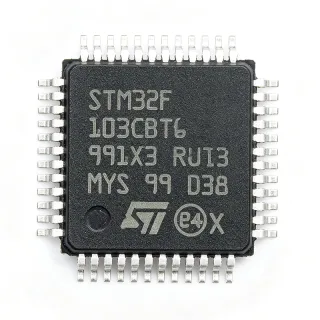
PIC16C55T-10/SO - 10MHz 8-Bit OTP MCU, 28-SOIC | Microchip
MPN: PIC16C55T-10/SO ⚠ Last Time Buy| Qty | Unit Price | Extended |
|---|---|---|
| 1 | $3.85 | $3.85 |
| 10 | $3.42 | $34.20 |
| 100 | $2.95 | $295.00 |
| 500 | $2.58 | $1,290.00 |
| 1,000 | $2.2 | $2,200.00 |
PIC16C55T-10/SO Overview
An 8-bit microcontroller (MCU) is a single-chip computer containing an 8-bit CPU core, program memory, data RAM, I/O peripherals, and timers on a single die; it belongs to the broader taxonomy microcontroller -> embedded processor -> semiconductor device, and sits at the foundation of nearly every modern embedded system from toys to industrial controllers. The PIC16C5x family is the original Microchip baseline-architecture MCU family and is targeted at cost-sensitive, low-pin-count embedded control.
Key features include Harvard-architecture 12-bit wide instruction set delivering approximately 2:1 code compression over typical 8-bit CISC competitors, a 33-instruction set reducing development time, an operating voltage range of 4.5V to 5.5V (commercial grade; -40C to +85C for "I" parts), an internal oscillator option, a watchdog timer, and a power-on reset circuit. The 28-SOIC package supports both commercial ("-10") and industrial ("-10I") temperature grades.
The PIC16C55T-10/SO uses a RISC CPU with two-stage pipeline (fetch/execute) and a 12-bit program word that allows most instructions to execute in a single 200 ns instruction cycle at 10 MHz. The OTP (one-time programmable) program memory is programmed via Microchip's standard ICSP serial programming interface; this means the part cannot be re-programmed in-circuit once the EPROM cells are blown, making it suited for mature, frozen-cost production.
Typical applications include industrial control logic, simple appliance controllers, low-end consumer electronics, automotive body controllers, LED display drivers, and replacement of discrete logic in glue-repair designs. The combination of low cost, small package, and mature tooling makes it a long-tail favorite for sustaining production of legacy products.
When designing with this part, note that OTP memory means firmware bugs cannot be patched in the field; engineers usually prototype with a windowed JW part (PIC16C55/JW) before committing to the OTP SOIC variant. Always reserve ICSP pins for in-system programming during development.
This page synthesizes distributor pricing as of 2026-09-16, verified drop-in same-brand alternatives (PIC16C55-10/SO, PIC16C55T-10I/SO, PIC16C55AT-04/SS, etc.) sourced from the Microchip PIC16C5x family pin-compatibility chart, and practical design notes not consolidated in any single distributor page.
Drop-in alternatives for PIC16C55T-10/SO — same package, pin-to-pin compatible. Different-package parts requiring PCB rework are excluded.
Variants in this series
Same-series models that are drop-in compatible with PIC16C55T-10/SO (same form factor and footprint) — differing in Package, Program Memory Size, Program Memory Type, Timers, Core Architecture.
Quick Comparison Tool — Select alternative parts for side-by-side comparison:
PIC16C55-10/SO
✅ Drop-In ⚠️ 参数待验证✓ In Stock
$2.49 / Unit
View Datasheet →PIC16C55-10I/SO
✅ Drop-In ⚠️ 参数待验证✓ In Stock
$1.18 / Unit
View Datasheet →PIC16C55T-10I/SO
✅ Drop-In ⚠️ 参数待验证📋 Reference alternative (not in catalog)
PIC16C558-20/SO
✅ Drop-In ⚠️ 参数待验证✓ In Stock
$2.05 / Unit
View Datasheet →PIC16C554T-04/SO
✅ Drop-In ⚠️ 参数待验证✓ In Stock
$1.15 / Unit
View Datasheet →PIC16C55T-10/SO Maximum Ratings & Electrical Characteristics
| Core Architecture | PIC 8-bit RISC (baseline, 12-bit instruction word) |
| Family | PIC16C5x (PIC16C55) |
| CPU Bit Width | 8-bit |
| Core Clock Speed | 10 MHz (200 ns instruction cycle) |
| Instruction Set | 33 instructions, 12-bit wide |
| Program Memory Type | OTP (One-Time Programmable) EPROM |
| Program Memory Size | 768 bytes (512 x 12-bit words) |
| Data RAM | 24-25 bytes (general-purpose) |
| Operating Voltage (Vdd) | 4.5 V to 5.5 V |
| I/O Pins | 20 (bidirectional) |
| Timers | 1 x 8-bit timer/counter |
| Watchdog Timer | Yes (on-chip WDT) |
| Oscillator | External RC or crystal; internal options on selected variants |
| Operating Temperature (Commercial "-10") | 0C to +70C |
| Package | 28-SOIC (SO, 0.295" / 7.50 mm body width) |
| Mounting Type | Surface Mount |
| Packaging | Tape & Reel ("T" suffix) |
| Programming Interface | ICSP (In-Csp Serial Programming) - OTP, one-time only |
| Pin Count | 28 |
PIC16C55T-10/SO Pin Configuration
| Pin 1 | RA2 — Bidirectional I/O port A bit 2 |
| Pin 2 | RA3 — Bidirectional I/O port A bit 3 |
| Pin 3 | RTCC — Real-Time Clock/Counter I/O pin (also bit RA4) |
| Pin 4 | MCLR — Master Clear (reset) input, active low |
| Pin 5 | Vss — Ground reference |
| Pin 6 | RB0 — Bidirectional I/O port B bit 0 |
| Pin 7 | RB1 — Bidirectional I/O port B bit 1 |
| Pin 8 | RB2 — Bidirectional I/O port B bit 2 |
| Pin 9 | RB3 — Bidirectional I/O port B bit 3 |
| Pin 10 | RB4 — Bidirectional I/O port B bit 4 |
| Pin 11 | RB5 — Bidirectional I/O port B bit 5 |
| Pin 12 | RB6 — Bidirectional I/O port B bit 6 |
| Pin 13 | RB7 — Bidirectional I/O port B bit 7 |
| Pin 14 | Vdd — Positive supply (4.5V to 5.5V) |
| Pin 15 | OSC1 — Oscillator input / external clock input |
| Pin 16 | OSC2 — Oscillator output |
| Pin 17 | RC0 — Bidirectional I/O port C bit 0 |
| Pin 18 | RC1 — Bidirectional I/O port C bit 1 |
| Pin 19 | RC2 — Bidirectional I/O port C bit 2 |
| Pin 20 | RC3 — Bidirectional I/O port C bit 3 |
| Pin 21 | RC4 — Bidirectional I/O port C bit 4 |
| Pin 22 | RC5 — Bidirectional I/O port C bit 5 |
| Pin 23 | RC6 — Bidirectional I/O port C bit 6 |
| Pin 24 | RC7 — Bidirectional I/O port C bit 7 |
| Pin 25 | RD0 — Bidirectional I/O port D bit 0 |
| Pin 26 | RD1 — Bidirectional I/O port D bit 1 |
| Pin 27 | RD2 — Bidirectional I/O port D bit 2 |
| Pin 28 | RD3 — Bidirectional I/O port D bit 3 |
Typical Applications
PIC16C55T-10/SO is suitable for 6 applications: Industrial Control Logic, Simple Appliance Controllers, Low-End Consumer Electronics, Automotive Body Controllers (Legacy), LED Display Drivers, Replacement of Discrete Logic (Glue Logic Consolidation).
Industrial Control Logic
The PIC16C55T-10/SO fits industrial control logic applications where simple deterministic timing and long-term supply availability matter more than re-programmability. Its 10 MHz core delivers a 200 ns instruction cycle, which is sufficient for sequencing relays, reading contact-debounced inputs, and driving triac/SSR outputs in machine-tool controllers and conveyor interlocks. The 20 bidirectional I/O pins map cleanly to 4x4 scanned keypads plus indicator LED rows without external mux logic, and the on-chip watchdog timer recovers the controller from ESD-induced firmware lockups on the factory floor. Because the part is OTP, firmware is locked at production - which is actually preferred in safety-relevant machinery where field firmware drift must be prevented.
Recommended
Simple Appliance Controllers
The PIC16C55T-10/SO is widely deployed in cost-sensitive white-goods and small-appliance controllers such as washing-machine timer boards, microwave oven keypads, toaster-oven controllers, and rice-cooker thermal regulation. Its 4.5V-5.5V supply matches the rectified-transformer rails typical in these products, and the 8-bit baseline instruction set keeps firmware short (typically under 512 words) which the 768 B OTP easily accommodates. The 28-SOIC package survives wave-solder and standard SMT reflow profiles used in appliance production lines, and its 0-70C commercial temperature range covers indoor appliance environments without needing the industrial-grade "I" suffix.
Recommended
Low-End Consumer Electronics
The PIC16C55T-10/SO serves as the control MCU in low-end consumer products where BOM cost under USD 2 matters more than features: remote-control transmitters, IR-to-UHF learning remotes, animated greeting cards, talking toys, electronic dice, and novelty LED gadgets. The 768 B OTP and 24 B RAM are ample for these fixed-sequence behaviors, and the 33-instruction baseline instruction set lets a developer hand-assemble the firmware in a single afternoon. Mass-production economics favor this part because tape-and-reel packaging feeds standard pick-and-place lines, and Microchip's 30+ year supply history for the PIC16C5x family means designs can sustain production for decades without forced re-qualification.
Recommended
Automotive Body Controllers (Legacy)
The PIC16C55T-10/SO is found in legacy automotive body controllers for non-safety functions such as interior lighting sequencers, mirror-folding drivers, seat-position memory recall, and dashboard dimmer controls. Its 4.5V-5.5V supply tolerates the nominal 12 V automotive bus after a 5V regulator, and the industrial-grade "I" variant extends operation to -40C for under-hood or door-module environments. Note that the PIC16C55 family is NOT AEC-Q100 qualified, so for new automotive designs Microchip directs engineers to the PIC16F1936 or dsPIC33 families; this part is appropriate only for sustaining production of pre-existing automotive platforms.
Recommended
LED Display Drivers
The PIC16C55T-10/SO is well-suited as a controller MCU for multiplexed 7-segment LED displays, dot-matrix signs, and scrolling LED message boards where the firmware is fixed and the I/O count matters. With 20 bidirectional I/O pins it can directly drive an 8-digit common-anode 7-segment display (8 segment lines + 8 digit lines = 16 pins) with 4 pins remaining for serial communication or buttons. The 10 MHz instruction rate provides a comfortable refresh margin (typical 1 ms per digit at 100 Hz overall refresh) without timing jitter, and the OTP memory locks the message contents to prevent field tampering with display content in commercial signage.
Recommended
Replacement of Discrete Logic (Glue Logic Consolidation)
The PIC16C55T-10/SO is frequently used to replace 4-8 discrete TTL/CMOS logic packages (74HC00-series gates, flip-flops, counters, shift registers) in glue-logic repair designs where the discrete logic has become obsolete or unobtainable. A single PIC16C55T-10/SO can implement the equivalent of a 74HC164 shift register plus a 74HC4017 counter plus combinational glue logic in 200-300 words of assembly, reducing PCB area and BOM count. The OTP memory is ideal because the replacement logic behavior is fixed and known-good from the original discrete design, eliminating the risk of firmware regression in service.
Recommended
Recommended Products Summary
Engineering reference data for PIC16C55T-10/SO — comparison, design guidance, and compliance information.
Selection Guide
Comparison with Alternatives
| Parameter | This Product | PIC16C55-10/SO | PIC16C55-10I/SO | PIC16C55T-10I/SO | PIC16C558-20/SO | PIC16C554T-04/SO |
|---|---|---|---|---|---|---|
| Package | 28-SOIC (0.295") | 28-SOIC - same | 28-SOIC - same | 28-SOIC - same | 28-SOIC - same | 28-SOIC - same |
| Brand | Microchip Technology | Microchip Technology | Microchip Technology | Microchip Technology | Microchip Technology | Microchip Technology |
| Program Memory | 768 B (512 x 12) | 768 B - same | 768 B - same | 768 B - same | 2048 B (1K x 12) - 167% larger | 896 B - 17% larger |
| Data RAM | 24-25 B | 24 B - same | 24 B - same | 24 B - same | 128 B - 5x larger | 96 B - 4x larger |
| Core Clock Speed | 10 MHz | 10 MHz - same | 10 MHz - same | 10 MHz - same | 20 MHz - 2x faster | 4 MHz - 60% slower |
| Operating Temperature | 0C to +70C (Commercial) | 0C to +70C - same | -40C to +85C - industrial | -40C to +85C - industrial | 0C to +70C - same | 0C to +70C - same |
| Packaging Media | Tape & Reel | Tube | Tube | Tape & Reel | Tube | Tape & Reel |
| Memory Type | OTP (one-time) | OTP - same | OTP - same | OTP - same | OTP - same | OTP - same |
| Pin Count | 28 | 28 - same | 28 - same | 28 - same | 28 - same | 28 - same |
| Operating Voltage | 4.5V to 5.5V | 4.5V to 5.5V - same | 4.5V to 5.5V - same | 4.5V to 5.5V - same | 3.0V to 5.5V - wider | 3.0V to 5.5V - wider |
Key Differentiators
- Tape-and-reel packaging optimized for SMT production lines (vs PIC16C55-10/SO)
- Closest pin-compatible same-package PIC16C5x siblings with more memory (vs PIC16C558-20/SO and PIC16C554T-04/SO)
- Identical die and pinout to industrial-temperature variant (vs PIC16C55T-10I/SO)
Design Notes
The PIC16C55T-10/SO uses one-time-programmable EPROM; firmware cannot be patched after cells are blown. Always develop and debug on a PIC16C55/JW ceramic-windowed part (UV-erasable) or PIC16F54-I/SO (flash-based) before committing to the OTP variant for production. A single bit error in the OTP image means scrapping the programmed MCU, so prototype firmware verification on a windowed or flash sibling is mandatory to avoid mass-production field failures.
The 28-SOIC pin 1 marker is the dot at the top-left when the SOIC is oriented with pin 1 facing up; place a silkscreen dot or chamfered pad on pin 1 to prevent reversed-insertion during hand-rework. The 0.295" (7.50 mm) SOIC body width is wider than the 0.209" (5.30 mm) SSOP used by PIC16C55AT-04/SS and PIC16C558T-04/SS; do not assume SSOP parts are drop-in on a 28-SOIC land pattern - the body width differs by 2.2 mm and the SOIC pads are too narrow for SSOP leads.
The PIC16C55T-10/SO has no internal brown-out reset; below approximately 4.0V Vdd the program counter may execute garbage and latch up I/O pins. Add an external voltage supervisor (such as MCP100 or equivalent) if the 5V rail can sag during motor inrush or relay switching events in your appliance. The 4.5V-5.5V supply window is narrow by modern standards - derate to 4.75V minimum if any load-dump or inductive kick transient can pull Vdd below 4.5V.
Place a 100 nF ceramic decoupling capacitor within 5 mm of the Vdd pin (pin 14) and a bulk 10-47 uF electrolytic or tantalum at the board's 5V entry point. Keep the OSC1/OSC2 traces short (under 10 mm) and surround them with a ground pour to minimize EMI radiation at the fundamental crystal frequency (10 MHz). For ICSP programming access, route the MCLR (pin 4) and RB6/RB7 (pins 12/13) to a 6-pin header or test pad - lockout bits will otherwise disable ICSP access and prevent factory re-programming.
Compliance Information
Legacy OTP part from Microchip PIC16C5x family; specific RoHS/REACH compliance status not stated in the verified web data and marked [DATA_NEEDED]. Not AEC-Q100 qualified - for new automotive designs Microchip recommends PIC16F1936 family. Conflict-minerals compliance assumed per Microchip standard corporate policy.