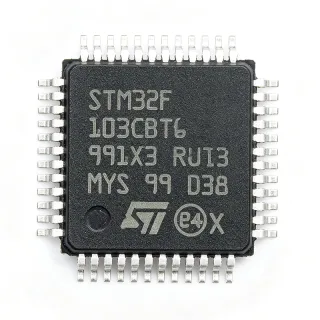
PIC16C57CT-20I/SO - 8-Bit 20MHz CMOS OTP MCU | Microchip | 28-SOIC
MPN: PIC16C57CT-20I/SO ✓ Active| Qty | Unit Price | Extended |
|---|---|---|
| 1 | $6.5 | $6.50 |
| 10 | $5.85 | $58.50 |
| 100 | $5.2 | $520.00 |
| 500 | $4.55 | $2,275.00 |
| 1,000 | $4.05 | $4,050.00 |
PIC16C57CT-20I/SO Overview
An 8-bit microcontroller (MCU) is a single-chip computer that integrates a CPU, RAM, non-volatile program memory, and peripheral I/O. The PIC16C5X architecture specifically belongs to the PIC (Peripheral Interface Controller) family, characterized by Harvard architecture with separate program and data buses, RISC instruction sets, and OTP/EPROM program memory for low-cost, high-volume embedded designs. In the broader system hierarchy, MCUs sit below microprocessors (MPUs) and above discrete logic ICs in the embedded computing taxonomy, forming the backbone of consumer appliances, automotive subsystems, and industrial controllers where deterministic real-time response and minimal BOM cost are paramount.
Key features of the PIC16C57CT-20I/SO include 33 single-word instructions, an 8-bit timer/counter, watchdog timer for code execution integrity, 20 bidirectional I/O pins capable of source/sink up to 25 mA per pin for direct LED drive, and a 12-bit instruction word that simplifies instruction decoding. The device also features a power-on reset (POR) circuit, brown-out detection, and a programmable code-protection mechanism to safeguard firmware IP. CMOS fabrication yields typical operating current under 2 mA at 5V/4 MHz and standby current below 1 uA, well-suited for battery-backed appliances.
From an architectural perspective, the PIC16C5X implements a two-stage pipeline with single-cycle instruction fetch (except for program branches), allowing deterministic 100ns instruction execution at 20 MHz. The 8-level hardware stack and direct/indirect addressing modes simplify C and assembly firmware porting from earlier PIC16C5X designs. Program memory is one-time programmable (OTP) via EPROM cells, which historically offered faster prototyping than mask-ROM during low-volume product ramps.
Typical applications for the PIC16C57CT-20I/SO include white-goods and appliance controllers, security keypads and alarm panels, automotive interior accessories (non-safety-critical), consumer IR remote controls, and industrial sensor interface modules. Its industrial temperature rating makes it appropriate for factory-floor sensor conditioning where consumer-grade MCUs would fail.
When designing with this part, note that OTP memory cannot be electrically erased and is not suited for firmware that requires frequent field updates; consider the flash-based PIC16F57 as a development upgrade path. The 28-SOIC wide-body footprint (7.50 mm) is pin-compatible with the PIC16C57C family, allowing easy migration between commercial (PIC16C57C-20/SO), industrial (PIC16C57CT-20I/SO), and extended (PIC16C57C-20E/SO) temperature grades.
This page synthesizes distributor pricing, pin-compatible drop-in alternatives (PIC16C57C family), and practical design notes not consolidated on the manufacturer datasheet.
Drop-in alternatives for PIC16C57CT-20I/SO — same package, pin-to-pin compatible. Different-package parts requiring PCB rework are excluded.
Variants in this series
Same-series models that are drop-in compatible with PIC16C57CT-20I/SO (same form factor and footprint) — differing in Package, Program Memory Size, Program Memory Type, Operating Temperature, Family.
Quick Comparison Tool — Select alternative parts for side-by-side comparison:
PIC16C57CT-20I/SS
✅ Drop-In✓ In Stock
$3.15 / Unit
View Datasheet →PIC16C57CT-04I/SS
✅ Drop-In✓ In Stock
$4.1 / Unit
View Datasheet →PIC16C57C-20/SO
✅ Drop-In✓ In Stock
$2.89 / Unit
View Datasheet →PIC16C57C-20I/SS
✅ Drop-In✓ In Stock
$0.9 / Unit
View Datasheet →PIC16C57C-20E/SO
✅ Drop-In✓ In Stock
$2.55 / Unit
View Datasheet →PIC16C57CT-20I/SO Maximum Ratings & Electrical Characteristics
| Series | PIC16C5X |
| Core Processor | PIC |
| Core Size | 8-bit |
| Program Memory Type | OTP EPROM |
| Program Memory Size | 2K x 12 (3 KB) |
| RAM Size | 72 bytes |
| Number of I/O Pins | 20 |
| Clock Speed (Maximum) | 20 MHz |
| Instruction Cycle Time | 200 ns (at 20 MHz) |
| Supply Voltage Range | 4.5 V to 5.5 V |
| Operating Temperature Range | -40C to +85C (Industrial) |
| Number of Instructions | 33 |
| Timer/Counters | 1 x 8-bit |
| Watchdog Timer | Yes |
| Package Type | 28-pin SOIC (Wide, 7.50 mm) |
| Mounting Type | Surface Mount |
| Lead-Free / RoHS | Lead-containing windowed package - non-RoHS |
| ROM Type | UVPROM (erasable, OTP cells) |
| Temperature Grade | Industrial (I) |
PIC16C57CT-20I/SO Pin Configuration
| Pin 1 | RA2 — Bidirectional digital I/O, PORTA bit 2 |
| Pin 2 | RA3 — Bidirectional digital I/O, PORTA bit 3 |
| Pin 3 | RA4/T0CKI — Bidirectional digital I/O / Timer0 clock input, PORTA bit 4 |
| Pin 4 | MCLR — Master Clear (Reset) input, active low |
| Pin 5 | VSS — Ground reference |
| Pin 6 | RB0/INT — Bidirectional digital I/O / External interrupt input, PORTB bit 0 |
| Pin 7 | RB1 — Bidirectional digital I/O, PORTB bit 1 |
| Pin 8 | RB2 — Bidirectional digital I/O, PORTB bit 2 |
| Pin 9 | RB3 — Bidirectional digital I/O, PORTB bit 3 |
| Pin 10 | RB4 — Bidirectional digital I/O, PORTB bit 4 |
| Pin 11 | RB5 — Bidirectional digital I/O, PORTB bit 5 |
| Pin 12 | RB6 — Bidirectional digital I/O, PORTB bit 6 |
| Pin 13 | RB7 — Bidirectional digital I/O, PORTB bit 7 |
| Pin 14 | VSS — Ground reference |
| Pin 15 | OSC1/CLKIN — Oscillator input / external clock input |
| Pin 16 | OSC2/CLKOUT — Oscillator output / clock output (Fosc/4) |
| Pin 17 | RC0 — Bidirectional digital I/O, PORTC bit 0 |
| Pin 18 | RC1 — Bidirectional digital I/O, PORTC bit 1 |
| Pin 19 | RC2 — Bidirectional digital I/O, PORTC bit 2 |
| Pin 20 | RC3 — Bidirectional digital I/O, PORTC bit 3 |
| Pin 21 | RC4 — Bidirectional digital I/O, PORTC bit 4 |
| Pin 22 | RC5 — Bidirectional digital I/O, PORTC bit 5 |
| Pin 23 | RC6 — Bidirectional digital I/O, PORTC bit 6 |
| Pin 24 | RC7 — Bidirectional digital I/O, PORTC bit 7 |
| Pin 25 | RA0 — Bidirectional digital I/O, PORTA bit 0 |
| Pin 26 | RA1 — Bidirectional digital I/O, PORTA bit 1 |
| Pin 27 | VDD — Positive supply voltage, 4.5-5.5V |
| Pin 28 | VDD — Positive supply voltage, 4.5-5.5V |
Typical Applications
PIC16C57CT-20I/SO is suitable for 7 applications: White-Goods Appliance Controller, Security Keypad and Alarm Panel, Automotive Interior Accessory, Consumer IR Remote Control, HVAC Thermostat Module, Industrial Sensor Interface Card, Educational and Hobbyist Development Platform.
White-Goods Appliance Controller
The PIC16C57CT-20I/SO fits washing machine, dishwasher, and microwave-oven controllers because its 2K x 12 OTP program memory stores appliance state-machine firmware while the 20 digital I/O pins directly drive relays, valves, and seven-segment displays. The 25 mA source/sink per pin eliminates external driver transistors for LED indicators and low-current solenoid coils. Its 20 MHz clock (200 ns instruction cycle) handles real-time keypad scanning and motor PWM within tight control loops. The industrial -40C to +85C rating covers laundry-room and kitchen thermal environments.
Recommended
Security Keypad and Alarm Panel
The PIC16C57CT-20I/SO powers security keypads and intrusion alarm panels by leveraging its 33 single-word RISC instructions to implement debounced key scanning, PIN validation, and siren-event timing on a single chip. With 72 bytes of RAM, it buffers recent alarm events while the 8-bit watchdog timer forces a controller reset on firmware lockup, a critical safety feature for unattended security hardware. The 4.5-5.5V supply aligns with backup-battery 6V lead-acid float voltage, simplifying power-tree design. OTP program memory protects proprietary alarm protocols from external read-out.
Recommended
Automotive Interior Accessory
Non-safety-critical automotive interior accessories (window switches, mirror controllers, ambient lighting) historically use the PIC16C57CT-20I/SO because its industrial temperature grade spans under-dash thermal conditions (-40C to +85C) and the 20 I/O pins drive motors and LED strips directly. The 100 ns deterministic instruction cycle enables precise motor-position PWM control without jitter. The wide-body SOIC-28 package (7.50 mm) withstands automotive vibration profiles better than QFN alternatives of the same era. Note: this part is not AEC-Q100 qualified; consider AEC-Q100-qualified PIC16F equivalents for new automotive programs.
Recommended
Consumer IR Remote Control
Battery-powered IR remote controls benefit from the PIC16C57CT-20I/SO's sub-2 mA active current at 5V/4 MHz and sub-1 uA standby current, extending coin-cell and AAA battery life across years of standby. The 33-instruction RISC set is sufficient to encode NEC, RC5, and SIRC IR protocols in 2K x 12 of program memory while leaving headroom for custom button mappings. Its 20 I/O pins scan 4x5 keypad matrices typical of streaming-stick and TV remote designs. OTP program memory locks the IR protocol to prevent reverse-engineering of proprietary TV/STB command sets.
Recommended
HVAC Thermostat Module
Wall-mounted HVAC thermostat modules use the PIC16C57CT-20I/SO to read thermistor inputs, manage setpoint buttons, and switch 24 VAC relay coils via the 25 mA I/O pins. The 8-bit timer generates the PWM duty cycle for fan-speed control while the watchdog timer recovers the controller from RF-induced firmware stalls on the thermostat wiring. The 72-byte RAM stores daily programming schedules. The 4.5-5.5V supply rails are easily derived from a 24 VAC transformer + rectifier + 5V LDO. Industrial temperature grade handles attic and basement installations.
Recommended
Industrial Sensor Interface Card
Factory-floor sensor-interface cards use the PIC16C57CT-20I/SO to read 4-20 mA loop currents, encode values to serial protocols, and trigger alarm outputs on threshold violations. The 20 MHz clock supports 9600-115200 baud UART emulation for Modbus RTU slave operation; the watchdog timer prevents the sensor card from hanging on industrial EMI events. The wide SOIC-28 package tolerates conformal coating and wash processes better than QFN alternatives. Industrial -40C to +85C rating covers unheated cabinet installations near motors and transformers.
Recommended
Educational and Hobbyist Development Platform
The PIC16C57CT-20I/SO is a popular teaching MCU in university embedded-systems courses and hobbyist projects because its 33-instruction RISC set is small enough to memorize in one semester yet representative of modern RISC architectures. The windowed ceramic SOIC package allows UV erasure and reprogramming on student lab kits. Its SOIC-28 wide-body footprint is breadboard-friendly via SOIC-to-DIP adapters. The Microchip PICSTART Plus and PRO MATE II programmers are widely available in surplus markets, making it an accessible low-cost teaching platform.
Recommended
Recommended Products Summary
Engineering reference data for PIC16C57CT-20I/SO — comparison, design guidance, and compliance information.
Selection Guide
Comparison with Alternatives
| Parameter | This Product | PIC16C57CT-20I/SS | PIC16C57CT-04I/SS | PIC16C57C-20/SO | PIC16C57C-20I/SS | PIC16C57C-20E/SO |
|---|---|---|---|---|---|---|
| Brand | Microchip Technology | Microchip Technology | Microchip Technology | Microchip Technology | Microchip Technology | Microchip Technology |
| Package | SOIC-28 (Wide, 7.50 mm) | SSOP-28 (smaller pitch, same family) | SSOP-28 (smaller pitch) | SOIC-28 (Wide) - same footprint | SSOP-28 (smaller pitch) | SOIC-28 (Wide) - same footprint |
| Clock Speed (Max) | 20 MHz | 20 MHz | 4 MHz (-80%) | 20 MHz | 20 MHz | 20 MHz |
| Program Memory | 2K x 12 OTP EPROM (3 KB) | 2K x 12 OTP EPROM | 2K x 12 OTP EPROM | 2K x 12 OTP EPROM | 2K x 12 OTP EPROM | 2K x 12 OTP EPROM |
| RAM Size | 72 bytes | 72 bytes | 72 bytes | 72 bytes | 72 bytes | 72 bytes |
| I/O Pins | 20 | 20 | 20 | 20 | 20 | 20 |
| Supply Voltage | 4.5 V to 5.5 V | 4.5 V to 5.5 V | 4.5 V to 5.5 V | 4.5 V to 5.5 V | 4.5 V to 5.5 V | 4.5 V to 5.5 V |
| Operating Temperature | -40C to +85C (Industrial) | -40C to +85C (Industrial) | -40C to +85C (Industrial) | 0C to +70C (Commercial) | -40C to +85C (Industrial) | -40C to +125C (Extended) |
| Program Memory Type | OTP EPROM (windowed) | OTP EPROM (windowed) | OTP EPROM (windowed) | OTP EPROM (windowed) | OTP EPROM (windowed) | OTP EPROM (windowed) |
Key Differentiators
- Industrial temperature grade in same SOIC-28 footprint (vs PIC16C57C-20/SO)
- Higher clock speed vs -04 grade variant (vs PIC16C57CT-04I/SS)
- Narrower temperature window than extended grade (vs PIC16C57C-20E/SO)
Design Notes
The OTP EPROM cells cannot be electrically erased - only UV exposure through the ceramic window (~12,000 uW/cm2 for 20 minutes) clears them. For development and production engineering, plan for a PIC16F57-I/SO equivalent in the prototype stage and migrate to PIC16C57CT-20I/SO once firmware is frozen, or budget for a windowed package plus UV eraser. The ceramic SOIC-28 package contains lead-bearing glass and is NOT RoHS compliant - migrate to PIC16F57 for EU markets.
Place a 0.1 uF ceramic decoupling capacitor as close as possible to the VDD pin (pin 27 or 28) and a bulk 10 uF tantalum or electrolytic capacitor on the same VDD trace within 1 inch. Tie both VDD pins (27 and 28) together at the IC and route them as a star to the decoupling network. Keep the OSC1/OSC2 crystal traces short (< 0.5 inch) and guarded with a ground pour to reduce EMI susceptibility. The MCLR reset line (pin 4) should be pulled to VDD through a 10 kohm resistor with a 0.1 uF cap to ground for noise immunity.
When driving relays or solenoids from I/O pins, add a flyback diode (1N4148 or Schottky) directly across the inductive load, with the diode cathode at the high-voltage side. Each I/O pin can source or sink up to 25 mA, but the total package dissipation limit (typically 800 mW for the SOIC-28 wide-body) restricts simultaneous high-current drive on all 20 pins. For high-current (> 25 mA) outputs, use the I/O pin to drive a discrete MOSFET or Darlington pair instead of direct connection.
Compliance Information
Ceramic windowed SOIC-28 package contains lead-bearing glass seal; part is NOT RoHS compliant per package construction. Not AEC-Q100 qualified - use AEC-Q100-qualified PIC16F or PIC18 alternatives for automotive safety-critical applications.