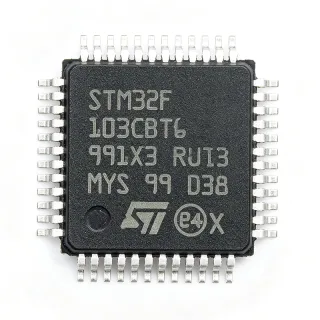
PIC16C66T-10/SO - 8-Bit 10MHz OTP MCU | Microchip | 28-SOIC
MPN: PIC16C66T-10/SO ✗ End of Life| Qty | Unit Price | Extended |
|---|---|---|
| 1 | $8.2 | $8.20 |
| 10 | $7.38 | $73.80 |
| 100 | $6.55 | $655.00 |
| 500 | $5.85 | $2,925.00 |
| 1,000 | $5.2 | $5,200.00 |
PIC16C66T-10/SO Overview
What is an OTP microcontroller? An OTP (One-Time Programmable) microcontroller is a type of embedded computing device whose program memory can be written to exactly once after manufacture, using a standard device programmer. OTP MCUs occupy a middle ground between mask-ROM parts (programmed at the fab, lowest per-unit cost at high volume) and flash-based MCUs (reprogrammable in-circuit). They are favored for low-to-medium volume production where the unit cost is lower than equivalent flash parts and the firmware is stable.
Key features include 33 digital I/O lines, a Harvard RISC architecture with only 35 single-word instructions, and 200ns single-cycle instruction execution (except program branches, which take two cycles). The device integrates analog peripherals (8-channel 8-bit ADC), three timers (Timer0, Timer1, Timer2), a USART, and a synchronous serial port (SSP) supporting SPI and I2C. The PIC16C66 also includes a watchdog timer with its own on-chip RC oscillator for reliable operation.
Architecturally, the PIC16C66 uses a 14-bit instruction word and an 8-bit data path, with separate program and data buses (Harvard architecture) that allow instruction fetch and data access in a single cycle. The CMOS design provides low power consumption with operating voltage from 4.0V to 6.0V, making it suitable for both battery and line-powered applications.
Typical applications include industrial control systems, consumer electronics, automotive subsystems (non-safety-critical), appliance controls, and embedded instrumentation. The wide peripheral set also makes it suitable for sensor-interface hubs and simple motor-control front-ends.
When designing with this device, note that the OTP memory means firmware must be fully validated before programming; emulator or windowed (JW) versions are available for development. The 28-SOIC package is suitable for hand-soldering and rework but requires care with thermal profiling during reflow.
This page synthesizes distributor pricing, drop-in alternatives, and practical design notes not found in the manufacturer datasheet alone.
Drop-in alternatives for PIC16C66T-10/SO — same package, pin-to-pin compatible. Different-package parts requiring PCB rework are excluded.
Variants in this series
Same-series models that are drop-in compatible with PIC16C66T-10/SO (same form factor and footprint) — differing in Package, ADC, Family, Watchdog Timer, Timers.
Quick Comparison Tool — Select alternative parts for side-by-side comparison:
PIC16C66-10/SO
✅ Drop-In📋 Reference alternative (not in catalog)
PIC16C66-20I/SO
✅ Drop-In✓ In Stock
$6.42 / Unit
View Datasheet →PIC16C66-04E/SO
✅ Drop-In📋 Reference alternative (not in catalog)
PIC16C66-20/SO
✅ Drop-In📋 Reference alternative (not in catalog)
PIC16C66-04I/SO
✅ Drop-In✓ In Stock
$5.1 / Unit
View Datasheet →PIC16F877A-I/SO
✅ Drop-In📋 Reference alternative (not in catalog)
PIC16C66T-10/SO Maximum Ratings & Electrical Characteristics
| Family | PIC16C6X |
| Core | 8-bit RISC PIC |
| CPU Architecture | Harvard, 14-bit instruction word |
| Maximum Clock Speed | 10 MHz |
| Instruction Cycle Time | 200 ns (single-cycle) |
| Program Memory Type | OTP (One-Time Programmable) EPROM |
| Program Memory Size | 14 KB (8K x 14) |
| RAM | 368 bytes |
| Data EEPROM | Not present |
| I/O Pins | 33 |
| ADC | 8 channels, 8-bit |
| Timers | 3 (Timer0, Timer1, Timer2) |
| Communication Peripherals | USART (SCI), SSP (SPI/I2C) |
| Operating Voltage | 4.0 V to 6.0 V |
| Operating Temperature Grade | Commercial (0C to +70C) |
| Package | 28-pin SOIC (SO) - 300 mil |
| Mounting Type | Surface Mount |
| Packaging | Tape and Reel (T) |
| RoHS Status | Non-compliant (contains lead, windowed/OTP family) |
| Watchdog Timer | Yes, with dedicated on-chip RC oscillator |
PIC16C66T-10/SO Pin Configuration
| Pin 1 | MCLR — Master Clear (reset) input, active low |
| Pin 2 | RA0/AN0 — Port A bit 0 / Analog input 0 |
| Pin 3 | RA1/AN1 — Port A bit 1 / Analog input 1 |
| Pin 4 | RA2/AN2 — Port A bit 2 / Analog input 2 |
| Pin 5 | RA3/AN3/VREF — Port A bit 3 / Analog input 3 / ADC reference |
| Pin 6 | RA4/T0CKI — Port A bit 4 / Timer0 clock input |
| Pin 7 | RA5/AN4/SS — Port A bit 5 / Analog input 4 / SPI slave select |
| Pin 8 | VSS — Ground reference |
| Pin 9 | OSC1/CLKIN — Oscillator input / external clock input |
| Pin 10 | OSC2/CLKOUT — Oscillator output / clock output |
| Pin 11 | RC0/T1OSO/T1CKI — Port C bit 0 / Timer1 oscillator output / Timer1 clock input |
| Pin 12 | RC1/T1OSI/CCP2 — Port C bit 1 / Timer1 oscillator input / Capture/Compare/PWM 2 |
| Pin 13 | RC2/CCP1 — Port C bit 2 / Capture/Compare/PWM 1 |
| Pin 14 | RC3/SCK/SCL — Port C bit 3 / SPI clock / I2C clock |
| Pin 15 | RC4/SDI/SDA — Port C bit 4 / SPI data in / I2C data |
| Pin 16 | RC5/SDO — Port C bit 5 / SPI data out |
| Pin 17 | RC6/TX/CK — Port C bit 6 / USART transmit / USART clock |
| Pin 18 | RC7/RX/DT — Port C bit 7 / USART receive / USART data |
| Pin 19 | VSS — Ground reference |
| Pin 20 | VDD — Positive supply voltage (4.0V to 6.0V) |
| Pin 21 | RB0/INT — Port B bit 0 / External interrupt |
| Pin 22 | RB1 — Port B bit 1 |
| Pin 23 | RB2 — Port B bit 2 |
| Pin 24 | RB3 — Port B bit 3 |
| Pin 25 | RB4 — Port B bit 4 |
| Pin 26 | RB5 — Port B bit 5 |
| Pin 27 | RB6 — Port B bit 6 |
| Pin 28 | RB7 — Port B bit 7 |
Typical Applications
PIC16C66T-10/SO is suitable for 6 applications: Industrial Control Systems, Consumer Electronics Appliance Control, Automotive Body Electronics (Legacy), Embedded Instrumentation and Data Acquisition, Sensor Interface Hubs, Simple Motor Control Front-Ends.
Industrial Control Systems
The PIC16C66T-10/SO's 14KB OTP program memory, 33 I/O lines, and integrated ADC/USART make it a strong fit for industrial control applications such as PLC I/O modules, sensor-interface hubs, and machine-status indicators. The 10 MHz core provides 5 MIPS, sufficient for closed-loop PID and sequencing logic. Its 4.0V to 6.0V supply matches 5V industrial rails, and the 28-SOIC package withstands the thermal and vibration profile of factory-floor equipment when properly soldered with underfilled or conformally coated assemblies.
Recommended
Consumer Electronics Appliance Control
In consumer appliances such as washing machines, microwave ovens, and HVAC thermostats, the PIC16C66T-10/SO provides the precise timing control and sensor readout capability needed. The 3 timers (Timer0/1/2) handle motor PWM, debounced keypad scanning, and RTC tick generation. The 8-channel 8-bit ADC reads temperature, humidity, or weight sensors. OTP memory locks the firmware against field tampering - a benefit for manufacturers protecting proprietary control algorithms.
Recommended
Automotive Body Electronics (Legacy)
For non-safety-critical automotive body modules such as seat controllers, mirror adjusters, and interior lighting, the PIC16C66T-10/SO is used in established production lines. The USART links to body control networks, while the SSP supports SPI-driven LED driver ICs. However, for new automotive designs, Microchip recommends AEC-Q100-qualified parts such as the PIC16F family with Q-1 suffixes. The 28-SOIC package handles under-hood vibration when mounted with proper mechanical retention.
Recommended
Embedded Instrumentation and Data Acquisition
The PIC16C66T-10/SO is well-suited to compact bench instruments and panel meters where its 8-bit ADC, USART data-logging output, and small 28-SOIC footprint enable dense PCB layouts. The integrated ADC samples up to 8 analog channels with 8-bit resolution - sufficient for thermocouple-grade readings through external amplification. OTP memory ensures the calibration coefficients and scaling tables cannot drift or be overwritten in the field, which is critical for regulated measurement instruments.
Recommended
Sensor Interface Hubs
The PIC16C66T-10/SO serves as a sensor aggregation hub in distributed systems, reading multiple analog and digital sensors via its ADC and SSP, then forwarding the data over USART to a central controller. The 368-byte RAM supports a reasonable local buffer for packet assembly. With 33 I/O lines, the device can directly drive indicator LEDs, buzzer outputs, and rotary encoder inputs without external glue logic. OTP memory locks the sensor calibration constants at programming time.
Recommended
Simple Motor Control Front-Ends
The PIC16C66T-10/SO can act as a low-cost motor-control front-end for small DC motors, fans, and stepper drivers. Timer2 provides PWM generation, while the ADC reads back current-sense amplifier outputs for basic closed-loop control. The 5 MIPS instruction throughput is adequate for trapezoidal commutation at moderate RPM. The 28-SOIC package mounts close to the power stage for short gate-drive traces. For safety-critical motor control, pair with an external watchdog supervisor.
Recommended
Recommended Products Summary
Engineering reference data for PIC16C66T-10/SO — comparison, design guidance, and compliance information.
Selection Guide
Comparison with Alternatives
| Parameter | This Product | PIC16C66-10/SO | PIC16C66-20I/SO | PIC16C66-04E/SO | PIC16F877A-I/SO |
|---|---|---|---|---|---|
| Brand | Microchip Technology | Microchip Technology | Microchip Technology | Microchip Technology | Microchip Technology |
| Package | 28-SOIC | 28-SOIC - same | 28-SOIC - same | 28-SOIC - same | 28-SOIC - same |
| Maximum Clock Speed | 10 MHz | 10 MHz | 20 MHz | 4 MHz | 20 MHz |
| Program Memory Type | OTP (14 KB) | OTP (14 KB) | OTP (14 KB) | OTP (14 KB) | Flash (14 KB) |
| Operating Voltage | 4.0 V to 6.0 V | 4.0 V to 6.0 V | 4.0 V to 6.0 V | 4.0 V to 6.0 V | 2.0 V to 5.5 V |
| Temperature Range | Commercial (0C to +70C) | Commercial (0C to +70C) | Industrial (-40C to +85C) | Extended (-40C to +125C) | Industrial (-40C to +85C) |
| RoHS Compliant | No | No | No | No | Yes (Pb-free) |
| In-Circuit Reprogrammable | No (OTP) | No (OTP) | No (OTP) | No (OTP) | Yes (Flash/ICSP) |
| ADC Resolution | 8-bit | 8-bit | 8-bit | 8-bit | 10-bit |
Key Differentiators
- Tape-and-reel packaging for high-volume SMT assembly (vs PIC16C66-10/SO)
- 10 MHz speed grade optimized for power-sensitive commercial applications (vs PIC16C66-20I/SO)
- Drop-in compatibility with the flash-based PIC16F877A-I/SO (vs PIC16F877A-I/SO)
Design Notes
The PIC16C66T-10/SO uses OTP memory - the firmware must be 100% validated before programming. There is no field-upgrade path. If development cycles are expected, prototype with the windowed ceramic (JW) version or the PIC16F877A-I/SO, then port the final code to the OTP part for production. Budget 5-10 extra OTP parts per build for programming yield losses.
Place a 0.1 uF ceramic decoupling capacitor as close as possible to the VDD pin (pin 20) with the ground return tied directly to the nearest VSS pin (pin 19). For designs with switching peripherals, add a 10 uF tantalum or aluminum bulk capacitor on the supply rail. The PIC16C66 has separate analog (AVdd) and digital supply considerations through the VREF pin - if precision ADC readings are needed, decouple AVREF with its own 0.1 uF + 10 uF network.
Keep the crystal or external clock traces to OSC1/OSC2 (pins 9/10) short and shielded by a ground pour to minimize EMI pickup. Route the MCLR line (pin 1) with a 10 kohm pull-up to VDD and a 100 nF cap to ground for debouncing; avoid long parallel runs with high-frequency signals. For 28-SOIC footprint designs intended to support both PIC16C66 and PIC16F877A, verify that the pinout matches - some flash variants reassign one or two peripheral pins.
Compliance Information
PIC16C OTP family predates RoHS requirements and uses lead-bearing terminal finishes. Not AEC-Q100 qualified; for automotive applications migrate to PIC16F Q-1 variants. Reach SVHC declaration per Microchip product page. Halogen-free status not explicitly stated in available data.