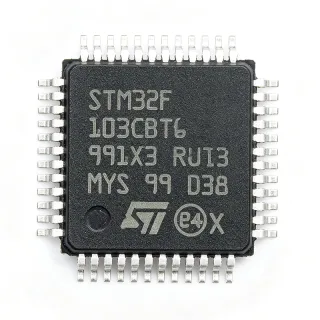
PIC16C66T-20/SO - 8-Bit 20MHz OTP MCU 14KB | Microchip
MPN: PIC16C66T-20/SO ✗ End of Life| Qty | Unit Price | Extended |
|---|---|---|
| 1 | $12.45 | $12.45 |
| 10 | $11.1 | $111.00 |
| 100 | $9.85 | $985.00 |
| 500 | $8.92 | $4,460.00 |
| 1,000 | $8.2 | $8,200.00 |
PIC16C66T-20/SO Overview
A microcontroller (MCU) is a single-chip computer containing a CPU core, non-volatile program memory, working RAM, and programmable I/O peripherals. Within the broader taxonomy, the PIC16C66 sits as a mid-range 8-bit MCU under Microchip's classic PIC16C OTP family, which was widely adopted in the late 1990s and early 2000s for cost-sensitive embedded control. The 8-bit RISC Harvard architecture executes 35 single-word instructions, with all instructions completing in one cycle except program branches (two cycles), giving an effective throughput close to one instruction per clock.
Key features of the PIC16C66T-20/SO include 22 digital I/O pins arranged across multiple ports, three timer/counter modules (Timer0, Timer1, and Timer2), a synchronous serial port configurable as SPI or I2C, a USART for asynchronous serial communication, an 8-bit ADC with up to 8 input channels, and a capture/compare/PWM (CCP) module. The device supports DC to 20 MHz clock input across a 2.5 V to 6.0 V supply range, integrated power-on reset, brown-out reset, watchdog timer with dedicated oscillator, and programmable code protection.
The PIC16C66's architecture separates program and data buses (Harvard), allowing instruction fetch and data access to occur in the same clock cycle. This yields deterministic instruction timing that simplifies real-time control. OTP program memory enables rapid prototyping with one-week-turn ROM mask follow-up for production volumes - a design pattern Microchip promoted throughout the 1990s industrial and appliance market.
Typical applications include appliance controllers (washing machines, microwave ovens, HVAC thermostats), industrial automation (sensor conditioning, motor speed control), automotive body electronics (window lift, seat control, instrument cluster peripherals), consumer electronics (remote controls, toys, small appliances), and embedded data-acquisition front-ends. The 22 I/O and 8-channel ADC are well-matched to multi-sensor control boards requiring both analog measurement and digital actuation.
When designing with this part, note that OTP memory cannot be reprogrammed in-circuit, so firmware must be validated on a windowed (UV-erasable) PIC16C66-20/JW or PIC16F-series flash equivalent before committing to OTP production units. Always provide bulk decoupling (100 nF plus 10 uF) close to VDD/VSS and reserve the MCLR pin for a proper reset network to avoid spurious brown-out events.
This page synthesizes distributor pricing, drop-in PIC16C66 family variants, and practical design considerations not collected in the original 1990s Microchip datasheet.
Drop-in alternatives for PIC16C66T-20/SO — same package, pin-to-pin compatible. Different-package parts requiring PCB rework are excluded.
Variants in this series
Same-series models that are drop-in compatible with PIC16C66T-20/SO (same form factor and footprint) — differing in Package, ADC, Family, Watchdog Timer, Timers.
Quick Comparison Tool — Select alternative parts for side-by-side comparison:
PIC16C66-20/SO
✅ Drop-In📋 Reference alternative (not in catalog)
PIC16C66T-10/SO
✅ Drop-In✓ In Stock
$5.2 / Unit
View Datasheet →PIC16C66T-10E/SO
✅ Drop-In✓ In Stock
$5.8 / Unit
View Datasheet →PIC16C66-20I/SO
✅ Drop-In✓ In Stock
$6.42 / Unit
View Datasheet →PIC16C66-04I/SO
✅ Drop-In✓ In Stock
$5.1 / Unit
View Datasheet →PIC16C66-20/SP
✅ Drop-In✓ In Stock
$4.61 / Unit
View Datasheet →PIC16F876A-I/SO
✅ Drop-In📋 Reference alternative (not in catalog)
PIC16C66T-20/SO Maximum Ratings & Electrical Characteristics
| Core Architecture | 8-bit PIC RISC (Harvard) |
| Family | PIC16C6X (mid-range OTP) |
| Instruction Set | 35 single-word instructions |
| Max CPU Clock | 20 MHz |
| Program Memory | 14 KB (8K x 14) OTP |
| RAM | 368 bytes |
| I/O Pins | 22 |
| ADC | 8-bit, up to 8 channels |
| Timers | 3 (Timer0, Timer1, Timer2) |
| Serial Interfaces | SSP (SPI/I2C) + USART |
| CCP Module | 1 (Capture/Compare/PWM) |
| Operating Voltage | 2.5 V to 6.0 V |
| Operating Temperature | 0C to +70C (Commercial) |
| Package | 28-SOIC (7.50 mm body width, gull wing) |
| Watchdog Timer | Yes, dedicated WDT oscillator |
| Brown-out Reset | Yes |
| Power-on Reset | Yes |
| Program Code Protection | Yes (programmable) |
PIC16C66T-20/SO Pin Configuration
| Pin 1 | MCLR/VPP — Master Clear (Reset) input / programming voltage |
| Pin 2 | RA0/AN0 — PORTA bit 0 / ADC input 0 |
| Pin 3 | RA1/AN1 — PORTA bit 1 / ADC input 1 |
| Pin 4 | RA2/AN2 — PORTA bit 2 / ADC input 2 |
| Pin 5 | RA3/AN3/VREF — PORTA bit 3 / ADC input 3 / VREF+ |
| Pin 6 | RA4/T0CKI — PORTA bit 4 / Timer0 clock input |
| Pin 7 | RA5/AN4/SS — PORTA bit 5 / ADC input 4 / SPI slave select |
| Pin 8 | OSC1/CLKIN — Oscillator crystal input / external clock in |
| Pin 9 | OSC2/CLKOUT — Oscillator crystal output / clock out |
| Pin 10 | RC0/T1OSO/T1CKI — PORTC bit 0 / Timer1 oscillator output / Timer1 clock |
| Pin 11 | RC1/T1OSI/CCP2 — PORTC bit 1 / Timer1 oscillator input / CCP2 |
| Pin 12 | RC2/CCP1 — PORTC bit 2 / Capture Compare PWM 1 |
| Pin 13 | RC3/SCK/SCL — PORTC bit 3 / SPI clock / I2C clock |
| Pin 14 | RC4/SDI/SDA — PORTC bit 4 / SPI data in / I2C data |
| Pin 15 | RC5/SDO — PORTC bit 5 / SPI data out |
| Pin 16 | RC6/TX/CK — PORTC bit 6 / USART transmit / USART clock |
| Pin 17 | RC7/RX/DT — PORTC bit 7 / USART receive / USART data |
| Pin 18 | VSS — Ground reference |
| Pin 19 | VDD — Positive supply voltage |
| Pin 20 | RB0/INT — PORTB bit 0 / external interrupt |
| Pin 21 | RB1 — PORTB bit 1 |
| Pin 22 | RB2 — PORTB bit 2 |
| Pin 23 | RB3/PGM — PORTB bit 3 / low-voltage programming |
| Pin 24 | RB4 — PORTB bit 4 |
| Pin 25 | RB5 — PORTB bit 5 |
| Pin 26 | RB6/PGC — PORTB bit 6 / ICSP clock |
| Pin 27 | RB7/PGD — PORTB bit 7 / ICSP data |
| Pin 28 | VSS — Ground reference |
Typical Applications
PIC16C66T-20/SO is suitable for 6 applications: Appliance Control (White Goods), Industrial Sensor Conditioning and Control, Automotive Body Electronics (Legacy Modules), Consumer Electronics Remote and User Interface, HVAC Thermostat and Environmental Controller, Embedded Data Acquisition Front-End.
Appliance Control (White Goods)
The PIC16C66T-20/SO fits white-goods appliance controllers - washing machines, dishwashers, and microwave ovens - because its 22 I/O pins can directly drive relay coils, triac gate interfaces, and seven-segment LED or VFD displays. The 20 MHz RISC core delivers deterministic cycle timing needed for triac zero-crossing and motor PWM commutation, while the 8-bit ADC with eight channels reads thermistor, water-level, and door-switch sensors without external multiplexing. Built-in brown-out and watchdog timer with a dedicated oscillator protect against mains-brown-out misoperation in noisy power environments. The commercial 0C-70C temperature range suits indoor appliance enclosures.
Recommended
Industrial Sensor Conditioning and Control
Industrial sensor-front-end boards leverage the PIC16C66T-20/SO's 22 digital I/O and 8-bit, 8-channel ADC to scan thermistor, pressure, and 4-20 mA loop transducers while outputting PWM or analog control signals to actuators. The 20 MHz core enables up to 5 kHz ADC sampling, sufficient for closed-loop motor speed, hydraulic proportional valve, or PID temperature control loops. SSP plus USART peripherals allow SPI/I2C inter-MCU networking or RS-232/485 host communication. Brown-out reset and watchdog timer with dedicated oscillator ensure reliable recovery from industrial EMI events.
Recommended
Automotive Body Electronics (Legacy Modules)
Legacy automotive body modules - window lift, seat position, mirror adjustment, and instrument-cluster peripherals - used the PIC16C66T-20/SO because its 22 I/O drive the H-bridge enable and direction lines plus feedback encoder inputs. The PIC16C6X family's 14 KB OTP was adequate for state-machine control code while the 368-byte RAM held running encoder counters. Although the part is NRND and not AEC-Q100 qualified, modules already in production continue to use it; new automotive designs should migrate to the AEC-Q100-qualified PIC18F family.
Recommended
Consumer Electronics Remote and User Interface
Consumer remote controls, small appliances, and toys benefit from the PIC16C66T-20/SO's low-cost OTP memory and built-in USART for IR or RF link protocols. The 22 I/O directly scan matrix keypads up to 8x8 or drive LCD segments without external logic, and the 20 MHz cycle supports bit-banged Manchester or RC5/RC6 IR carrier generation. The 8-bit ADC reads battery voltage and trim pots. Brown-out reset prevents lockup on weak batteries, extending user-replaceable battery life in handheld products.
Recommended
HVAC Thermostat and Environmental Controller
HVAC thermostat and environmental-controller boards use the PIC16C66T-20/SO to read multiple thermistor temperature sensors via the 8-bit ADC, drive triac-controlled fan speeds via PWM on the CCP module, and communicate with indoor units over USART or SSP. The 14 KB OTP holds look-up tables for proportional control curves and scheduler state, while 368 bytes of RAM buffers setpoint and sensor history. Brown-out reset protects the controller during compressor inrush events that briefly sag the supply rail.
Recommended
Embedded Data Acquisition Front-End
Embedded 8-channel data-acquisition front-ends pair the PIC16C66T-20/SO with external analog multiplexers or sensor bridges, using its ADC to digitize, the USART to stream packets to a host PC, and the SSP to log to external EEPROM. The 20 MHz core supports up to 5 kHz aggregate sample rate across eight channels - well-matched to industrial process monitoring of slowly varying signals such as strain gauge, RTD, or pH probe inputs. Watchdog timer with dedicated oscillator protects unattended logger installations against firmware lockup.
Recommended
Recommended Products Summary
Engineering reference data for PIC16C66T-20/SO — comparison, design guidance, and compliance information.
Selection Guide
Comparison with Alternatives
| Parameter | This Product | PIC16C66-20/SO | PIC16C66T-10/SO | PIC16C66-20I/SO | PIC16C66-04I/SO | PIC16F876A-I/SO |
|---|---|---|---|---|---|---|
| Brand | Microchip Technology | Microchip Technology | Microchip Technology | Microchip Technology | Microchip Technology | Microchip Technology |
| Package | 28-SOIC | 28-SOIC - same | 28-SOIC - same | 28-SOIC - same | 28-SOIC - same | 28-SOIC - same |
| Max Clock | 20 MHz | 20 MHz | 10 MHz | 20 MHz | 4 MHz | 20 MHz |
| Program Memory | 14 KB OTP | 14 KB OTP | 14 KB OTP | 14 KB OTP | 14 KB OTP | 8 KB Flash |
| RAM | 368 bytes | 368 bytes | 368 bytes | 368 bytes | 368 bytes | 368 bytes |
| I/O Pins | 22 | 22 | 22 | 22 | 22 | 22 |
| ADC | 8-bit, 8-ch | 8-bit, 8-ch | 8-bit, 8-ch | 8-bit, 8-ch | 8-bit, 8-ch | 10-bit, 8-ch |
| Temperature Grade | Commercial 0C-70C | Commercial 0C-70C | Commercial 0C-70C | Industrial -40C to +85C | Industrial -40C to +85C | Industrial -40C to +85C |
| Memory Type | OTP | OTP | OTP | OTP | OTP | Flash |
| Lifecycle Status | NRND | NRND | NRND | NRND | NRND | Active |
Key Differentiators
- Tape-and-reel packaging for high-volume automated assembly (vs PIC16C66-20/SO)
- Pin-compatible flash upgrade path to PIC16F876A-I/SO (vs PIC16F876A-I/SO)
- Industrial temperature variant available in same package (vs PIC16C66-20I/SO)
Design Notes
Place a 100 nF ceramic decoupling capacitor within 5 mm of the VDD pin (pin 20) and a 10 uF bulk tantalum or aluminum electrolytic on the same supply trace. The PIC16C66T-20/SO has separate analog (VDD) and digital VSS pins; both must be returned to a low-impedance ground plane. Estimated: with 22 I/O lines switching simultaneously at 20 MHz, peak transient current can reach 80 mA - the bulk capacitor prevents supply droop that would corrupt ADC conversions.
The PIC16C66T-20/SO uses One-Time Programmable memory that cannot be erased or rewritten. Validate firmware on a windowed (UV-erasable) PIC16C66-20/JW or a flash-based PIC16F876A-I/SO (pin-compatible) before committing to OTP production. Failed OTP units are scrap - there is no recovery path. Always order a 5-10% overage to cover programming rejects and field returns.
Route the oscillator traces (OSC1/OSC2, pins 8-9) as short, symmetrical lengths with the crystal and load capacitors placed within 5 mm of the MCU. Keep high-current switching traces (relay coils, triac gates) at least 10 mm away from the analog ADC inputs (RA0-RA5) to avoid conducted/coupled noise. A single-point ground where analog VSS and digital VSS meet at the regulator prevents ground-loop ADC errors.
The PIC16C66's 8-bit ADC draws approximately 500 uA of analog supply current during conversion - this can droop the VDD rail if the source impedance exceeds 10 ohms. Use a separate low-pass RC (10 ohm + 10 uF) on AVdd/AVss if available, or decouple the VDD pin with at least 10 uF bulk plus 100 nF ceramic. Sample-and-hold acquisition time must be programmed to a minimum of 19.2 us per the datasheet for 10-bit accuracy (or 4 us for 8-bit) to avoid ADC channel-to-channel crosstalk.
Compliance Information
RoHS compliant per Microchip product page and DigiKey listing. The PIC16C6X family is NRND (Not Recommended for New Designs) as of 2026-09-18 - new automotive programs should select AEC-Q100-qualified PIC18F/K devices instead.