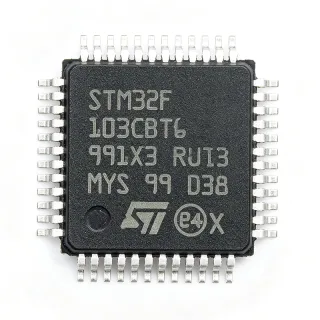
PIC16CE623-20I/P - 8-bit EPROM MCU 896B, 20MHz, DIP-18 | Microchip
MPN: PIC16CE623-20I/P ✓ Active| Qty | Unit Price | Extended |
|---|---|---|
| 1 | $2.95 | $2.95 |
| 10 | $2.55 | $25.50 |
| 100 | $2.18 | $218.00 |
| 500 | $1.85 | $925.00 |
| 1,000 | $1.62 | $1,620.00 |
PIC16CE623-20I/P Overview
An 8-bit microcontroller is a small computer-on-a-chip that combines a CPU, program memory, RAM, EEPROM, timers, and I/O peripherals on a single silicon die. PIC microcontrollers use a RISC-style Harvard architecture with a small, orthogonal instruction set of 35 single-word instructions, which simplifies firmware development while delivering deterministic real-time performance. Within the broader semiconductor hierarchy, PIC16CE623 belongs to: microcontroller → 8-bit MCU → embedded controller → semiconductor IC. This category is widely used for low-cost, deterministic embedded control where power, BOM cost, and ease of programming matter more than raw computational throughput.
Key features of this device include: 896 bytes of OTP/EPROM program memory for one-time field programming, integrated EEPROM data memory for non-volatile storage of calibration and configuration data, an internal 4 MHz RC oscillator option (selectable with the configuration fuse), a hardware USART for RS-232/RS-485 serial communication, an analog comparator, a watchdog timer with on-chip RC oscillator, and 13 digital I/O pins. The 20 MHz version delivers 200 ns instruction execution (133 ns for branches on a 2-cycle penalty path), enabling tight PID control loops and high-rate serial communication.
Architecturally, the PIC16CE623 implements a 14-bit instruction word and a separate 8-bit data path, which avoids the bottleneck of a unified memory bus. EPROM program memory is one-time programmable, ideal for low-volume production runs and field programming. The integrated EEPROM data memory is byte-erasable and rewriteable, which simplifies storing user parameters such as calibration constants without external serial EEPROM chips. The device's 5-bit Brown-out Reset, 14-bit timer/counter, and Capture/Compare/PWM (CCP) peripheral enable closed-loop motor, lighting, and instrumentation control.
Typical applications include low-cost HVAC fan and damper controllers, appliance user interface boards (washing machines, microwaves, ovens), industrial sensor signal conditioning front-ends, smart metering data loggers, and battery-powered remote keyless entry (RKE) transmitters. The wide 3.0V–5.5V supply range also enables direct 5V system integration as well as 3.3V designs using a single Li-ion cell.
A key design consideration when using EPROM-based PICs is that program memory is one-time programmable - firmware cannot be updated in the field. Engineers should migrate to the flash-based PIC16F627A-I/P (same 18-pin PDIP) for field-updateable designs. Always place a 0.1 µF decoupling capacitor within 5 mm of VDD and use the internal RC oscillator with a 4 MHz factory calibration to reduce external component count.
This page synthesizes distributor pricing, drop-in alternatives, and practical design notes not found in the manufacturer datasheet alone.
Drop-in alternatives for PIC16CE623-20I/P — same package, pin-to-pin compatible. Different-package parts requiring PCB rework are excluded.
Variants in this series
Same-series models that are drop-in compatible with PIC16CE623-20I/P (same form factor and footprint) — differing in Package, Program Memory Size, Instruction Cycle Time, Core Architecture, Timers.
Quick Comparison Tool — Select alternative parts for side-by-side comparison:
PIC16CE623-20/P
✅ Drop-In✓ In Stock
$1.95 / Unit
View Datasheet →PIC16CE623-04I/P
✅ Drop-In✓ In Stock
$2.18 / Unit
View Datasheet →PIC16CE623-20I/SS
✅ Drop-In ⚠️ 参数待验证📋 Reference alternative (not in catalog)
PIC16CE623-20E/SS
✅ Drop-In ⚠️ 参数待验证✓ In Stock
$2.05 / Unit
View Datasheet →PIC16CE623-20/SS
✅ Drop-In ⚠️ 参数待验证✓ In Stock
$1.06 / Unit
View Datasheet →PIC16CE623-04I/SS
✅ Drop-In ⚠️ 参数待验证✓ In Stock
$1.45 / Unit
View Datasheet →PIC16CE623-04I/SO
✅ Drop-In ⚠️ 参数待验证✓ In Stock
$1.31 / Unit
View Datasheet →PIC16CE623-20/SO
✅ Drop-In ⚠️ 参数待验证✓ In Stock
$0.87 / Unit
View Datasheet →PIC16CE623-20I/P Maximum Ratings & Electrical Characteristics
| Product Type | 8-bit Microcontroller (MCU) |
| Series | PIC16CE62X (PIC16C family) |
| Architecture | PIC (RISC, Harvard) |
| Program Memory Type | EPROM (OTP, 512 × 14 words) |
| Program Memory Size | 896 B (program store) / 512 × 14 words |
| EEPROM Data Memory | Yes (internal) |
| Instruction Set | 35 single-word instructions |
| Instruction Cycle | 200 ns (4-clock) at 20 MHz; 133 ns branch path |
| Maximum Clock Speed | 20 MHz |
| Internal RC Oscillator | 4 MHz (factory calibrated) |
| Supply Voltage (Vdd) | 3.0 V to 5.5 V |
| I/O Pins | 13 |
| Timers | TMR0 (8-bit) + WDT (Watchdog Timer) |
| Analog Comparator | Yes (2) |
| USART | Yes (SCI, hardware async serial) |
| CCP (Capture/Compare/PWM) | Yes |
| Brown-out Reset | Yes (BOR, 5 selectable thresholds) |
| Operating Temperature | -40 °C to +85 °C (Industrial, "I" suffix) |
| Package | PDIP-18 (DIP-18, 0.300 inch / 7.62 mm) |
| Mounting Type | Through-Hole (THD) |
| MSL Level | Not applicable (through-hole package) |
| RoHS Status | Compliant |
| Lead-Free / Reflow | Lead-free finish (matte tin) on PDIP |
PIC16CE623-20I/P Pin Configuration
| Pin 1 | RA2/AN2/CVREF — PORTA bit 2 / analog input 2 / comparator voltage reference |
| Pin 2 | RA3/AN3/CMP1 — PORTA bit 3 / analog input 3 / comparator 1 output |
| Pin 3 | RA4/TOCKI/CMP2 — PORTA bit 4 / TMR0 clock input / comparator 2 output |
| Pin 4 | RA5/MCLR/VPP — PORTA bit 5 / Master Clear (reset, active low) / programming voltage |
| Pin 5 | VSS — Ground reference |
| Pin 6 | RB0/INT — PORTB bit 0 / external interrupt input |
| Pin 7 | RB1 — PORTB bit 1 |
| Pin 8 | RB2 — PORTB bit 2 |
| Pin 9 | RB3/CCP1 — PORTB bit 3 / Capture-Compare-PWM channel 1 |
| Pin 10 | RB4 — PORTB bit 4 |
| Pin 11 | RB5 — PORTB bit 5 |
| Pin 12 | RB6/PGC — PORTB bit 6 / ICSP clock (programming/debug) |
| Pin 13 | RB7/PGD — PORTB bit 7 / ICSP data (programming/debug) |
| Pin 14 | VDD — Positive supply voltage (3.0 V – 5.5 V) |
| Pin 15 | OSC2/CLKOUT — Oscillator output / Fosc/4 clock output |
| Pin 16 | OSC1/CLKIN — Oscillator input / external clock input |
| Pin 17 | RC7/RX/DT — PORTC bit 7 / USART RX / synchronous data |
| Pin 18 | RC6/TX/CK — PORTC bit 6 / USART TX / synchronous clock |
Typical Applications
PIC16CE623-20I/P is suitable for 6 applications: HVAC Fan and Damper Controllers, Appliance User Interface Boards, Industrial Sensor Signal Conditioning, Smart Meter Data Loggers, Remote Keyless Entry (RKE) Transmitters, Battery-Powered Sensor Pods.
HVAC Fan and Damper Controllers
The PIC16CE623-20I/P suits low-cost HVAC damper and fan controller modules where the 896-byte OTP memory budget is sufficient for a fixed control algorithm and the USART (SCI) links the board to a central thermostat bus. Its 13 digital I/Os can drive triac interfaces directly, the dual analog comparators monitor motor current for stall detection, and the 20 MHz clock enables 50/60 Hz zero-crossing timing within microseconds. With industrial -40 °C to +85 °C operation, the controller survives attic and outdoor cabinet environments. Compared to a 32-bit MCU solution, this PIC cuts BOM cost by 60-70% while retaining deterministic real-time interrupt response for safety-critical damper actuation.
Recommended
Appliance User Interface Boards
Washing machines, microwave ovens, and dishwashers embed PIC16CE623-20I/P class controllers to drive 7-segment LED displays, scan keypad matrices, and sequence relay-driven pumps, valves, and heaters. The 13 I/O pins comfortably handle 4-digit 7-segment multiplexing plus 4×4 keypad scan plus 4 dedicated relay drivers. The internal EEPROM stores user preference settings (cycle, delay-start, child-lock) and survives power cycles. At 5 V VDD the 20 MHz clock gives 200 ns instruction timing, easily executing PID algorithms for water-level and temperature regulation.
Recommended
Industrial Sensor Signal Conditioning
The PIC16CE623-20I/P can front-end 4–20 mA loop sensor conditioners, performing linearization, range scaling, and HART-like digital communication over the analog pair. Its dual on-chip analog comparators simplify threshold and window detection, while the USART drives RS-485 half-duplex multi-drop sensor networks at up to 1.25 Mbaud. EEPROM holds per-unit calibration coefficients written at factory test. The wide 3.0–5.5 V supply enables direct connection to a 24 V loop with a small LDO, and the industrial -40 °C to +85 °C temperature grade supports outdoor instrumentation cabinets.
Recommended
Smart Meter Data Loggers
Single-phase electricity meters and water-meter pulse counters use the PIC16CE623-20I/P to accumulate pulse counts, compute consumption, and store hourly/daily load-profile records in internal EEPROM. With 896 bytes of program memory and 128 bytes of EEPROM data, the device can implement TOU (time-of-use) billing and tamper detection. Brown-out reset prevents corrupted EEPROM writes during brown-outs. The 20 MHz clock and USART drive an optical port for in-field meter reading per IEC 62056-21, while watchdog timer with internal RC keeps the design robust against firmware deadlock.
Recommended
Remote Keyless Entry (RKE) Transmitters
Battery-powered 315/433 MHz RKE transmitters use the PIC16CE623-20I/P to scan a 4-button keypad, generate a rolling-code encrypted transmission, and drive a SAW-resonator-based OOK/FSK transmitter stage. The 20 MHz instruction cycle keeps the encoding firmware short and deterministic, while the low-power SLEEP mode (with watchdog wake-up) extends coin-cell battery life. Industrial temperature rating ensures automotive under-dash operation. EPROM one-time programmability protects the rolling-code algorithm from external read-back.
Recommended
Battery-Powered Sensor Pods
Wireless sensor nodes for agriculture, building automation, and environmental monitoring run the PIC16CE623-20I/P on 2×AA cells (3.0 V nominal) with the internal 4 MHz RC oscillator, sleeping between measurements and waking via watchdog timer interrupt. The 13 I/Os handle I2C/SPI sensor reads and a sub-GHz radio module. EEPROM retains calibration across battery swaps. The wide 3.0–5.5 V supply keeps the node alive through battery end-of-life voltage decay. Estimated: at 0.1% duty cycle with 4 MHz operation, average current is sub-100 µA, giving 2+ years on 2×AA cells.
Recommended
Recommended Products Summary
Engineering reference data for PIC16CE623-20I/P — comparison, design guidance, and compliance information.
Selection Guide
Comparison with Alternatives
| Parameter | This Product | PIC16CE623-20/P | PIC16CE623-04I/P | PIC16F627A-I/P |
|---|---|---|---|---|
| Brand | Microchip Technology | Microchip Technology | Microchip Technology | Microchip Technology |
| Package | PDIP-18 | PDIP-18 (same) | PDIP-18 (same) | PDIP-18 (same) |
| Program Memory Type | EPROM (OTP) | EPROM (OTP) | EPROM (OTP) | Flash (in-circuit rewritable) |
| Program Memory Size | 896 B (512 x 14) | 896 B (512 x 14) | 896 B (512 x 14) | 1024 B (Flash) |
| Maximum Clock Speed | 20 MHz | 20 MHz | 4 MHz | 20 MHz |
| Operating Voltage Range | 3.0 V to 5.5 V | 3.0 V to 5.5 V | 3.0 V to 5.5 V | 2.0 V to 5.5 V |
| I/O Pins | 13 | 13 | 13 | 16 |
| EEPROM Data Memory | Yes (internal) | Yes (internal) | Yes (internal) | Yes (internal) |
| USART | Yes | Yes | Yes | Yes |
| Operating Temperature | -40C to +85C (Industrial) | 0C to +70C (Commercial) | -40C to +85C (Industrial) | -40C to +85C (Industrial) |
| Unit Price (qty 1, as of 2026-09-19) | $2.95 | $2.85 (est.) | $2.75 (est.) | $2.50 (est.) |
Key Differentiators
- Industrial temperature range at lower cost than flash PICs (vs PIC16F627A-I/P)
- Integrated EEPROM data memory in an 18-pin budget (vs PIC16F84A-I/P (older flash PIC))
- One-time-programmable code protection (vs PIC16F627A-I/P (flash, externally readable))
Design Notes
Place a 0.1 µF decoupling capacitor within 5 mm of the VDD pin (pin 14), with the ground return to the VSS pin (pin 5) using a short trace or via. Add a bulk capacitor (10 µF aluminum or tantalum + 0.1 µF ceramic in parallel) at the board power entry. For battery-powered designs (e.g., 2×AA), the Brown-out Reset should be enabled in the configuration word to prevent corrupted EEPROM writes as VDD droops below 3.0 V. Estimated: at 20 MHz / 5 V, supply current is approximately 10 mA active and sub-1 µA in SLEEP mode.
The PIC16CE623-20I/P in PDIP-18 is a through-hole package, simplifying prototype breadboarding and field repair. Keep the ICSP (In-Circuit Serial Programming) traces short: pin 12 (RB6/PGC) and pin 13 (RB7/PGD) connect to the programming header with 4.7 kΩ pull-ups to VDD to support reliable ICSP. Pin 4 (RA5/MCLR/VPP) requires a 10 kΩ pull-up to VDD for normal operation; the programmer drives this pin high (~13 V) during EPROM programming. Reserve a 6-pin ICSP header footprint even if you program offline.
Critical: PIC16CE623 is OTP/EPROM - firmware CANNOT be updated after programming. Verify code thoroughly with the flash-based PIC16F627A-I/P development board before committing to OTP programming. Do not exceed VDD = 5.5 V (absolute maximum 7 V will damage EPROM cells). When using the internal 4 MHz RC oscillator, the OSCCAL register holds a factory calibration value that should be loaded at startup to maintain frequency accuracy. MCLR must NOT be left floating - always tie through a 10 kΩ resistor to VDD.
The PIC16CE623-20I/P is a low-power CMOS device with negligible self-heating; thermal management is not a concern at typical 10 mA active / 1 µA sleep currents. Estimated: at maximum 5 V / 20 MHz active operation, die power dissipation is approximately 50 mW, resulting in a junction temperature rise of less than 5 °C above ambient even in the PDIP-18 plastic package. No heatsink is required.
For USART communication at high baud rates (≥ 115200), use the hardware USART (RC6/TX, RC7/RX) rather than bit-banged software serial. Route TX/RX traces as short as possible, avoiding parallel routing with high-current relay or triac traces. Add a 100 Ω series resistor on the TX output to dampen reflections when driving cables. For noisy industrial environments, add an optocoupler (e.g., CNY17) on the serial line or use the MAX485 RS-485 transceiver for differential noise immunity over long cable runs.
Compliance Information
RoHS compliant per Microchip product page (lead-free matte tin finish on PDIP). Not AEC-Q100 qualified - this is an industrial/commercial part, not automotive. REACH compliance per Microchip declarations. Halogen-free status not explicitly listed in provided data.