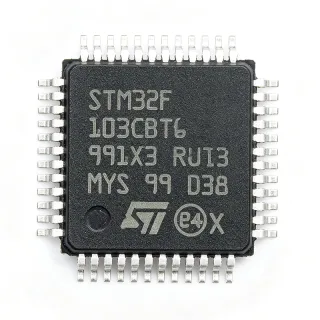
PIC16CE623-04I/SO - 8-bit OTP MCU 896B | 13 I/O | SOIC-18
MPN: PIC16CE623-04I/SO ✓ Active| Qty | Unit Price | Extended |
|---|---|---|
| 1 | $2.3824 | $2.38 |
| 10 | $2.14 | $21.40 |
| 100 | $1.86 | $186.00 |
| 500 | $1.55 | $775.00 |
| 1,000 | $1.31 | $1,310.00 |
PIC16CE623-04I/SO Overview
A microcontroller (MCU) is an integrated circuit that combines a CPU core, program memory, RAM, and configurable peripherals on a single die. The PIC16CE62X family belongs to the mid-range PICmicro lineage, sitting between the baseline 8-bit PIC10/12/16 families and the enhanced 16-bit dsPIC/PIC24 architectures. Compared with discrete logic, an MCU reduces BOM count and PCB area by replacing timers, counters, glue logic, and communication glue with on-chip peripherals. The PIC16CE623 specifically adds EEPROM data memory, allowing non-volatile storage of calibration constants, configuration data, and user-set parameters without external serial EEPROMs.
Key features include 35 single-word instructions (most executed in one instruction cycle, two for program branches), a programmable watchdog timer with on-chip RC oscillator, an internal 4 MHz oscillator option, and a 5-channel 8-bit analog-to-digital converter (ADC) on related family members. The PIC16CE623 also includes two analog comparators and a programmable voltage reference, enabling on-board signal conditioning. With 13 bidirectional I/O pins capable of sourcing/sinking 25 mA per pin, the device can directly drive LEDs, relays, and small solenoids.
The device is fabricated in CMOS technology with EPROM program storage and integrated EEPROM data, powered from a single 2.5V to 5.5V supply. It is offered in industrial temperature grade, making it suitable for harsh-environment embedded designs. Per Microchip documentation, all PIC16CE62X parts share the same instruction set and core peripherals, simplifying code migration within the family.
Typical applications include appliance controls, sensor signal conditioning, security and access control panels, low-end remote controls, automotive body electronics subsystems, and small industrial timers and counters. The combination of EPROM, EEPROM, comparators, and 13 I/O makes it well-suited to designs that need analog threshold detection plus logic control in one chip.
When designing with PIC16CE623-04I/SO, note that OTP (One-Time-Programmable) memory cannot be erased, so firmware bugs require device replacement. For prototype development, the pin-compatible PIC16F62X Flash-based family (e.g., PIC16F627A) provides in-circuit reprogrammability on the same 18-pin SOIC footprint.
This page synthesizes distributor pricing, drop-in alternatives, comparison data, and design notes not found in a single manufacturer datasheet view, helping engineers evaluate replacement options and board-level trade-offs.
Drop-in alternatives for PIC16CE623-04I/SO — same package, pin-to-pin compatible. Different-package parts requiring PCB rework are excluded.
Variants in this series
Same-series models that are drop-in compatible with PIC16CE623-04I/SO (same form factor and footprint) — differing in Package, Program Memory Size, Operating Temperature, Core Architecture, Instruction Cycle Time.
Quick Comparison Tool — Select alternative parts for side-by-side comparison:
PIC16CE623-04/P
✅ Drop-In ⚠️ 参数待验证📋 Reference alternative (not in catalog)
PIC16CE623T-04I/SO
✅ Drop-In ⚠️ 参数待验证✓ In Stock
$2.1 / Unit
View Datasheet →PIC16CE623-20I/SO
✅ Drop-In ⚠️ 参数待验证📋 Reference alternative (not in catalog)
PIC16CE624-04I/SO
✅ Drop-In ⚠️ 参数待验证✓ In Stock
$1.62 / Unit
View Datasheet →PIC16CE625-04I/SO
✅ Drop-In ⚠️ 参数待验证✓ In Stock
$2.45 / Unit
View Datasheet →PIC16F627A-I/SO
✅ Drop-In📋 Reference alternative (not in catalog)
PIC16F628A-I/SO
✅ Drop-In📋 Reference alternative (not in catalog)
PIC16CE623-04I/SO Maximum Ratings & Electrical Characteristics
| Core Architecture | 8-bit PIC Mid-Range |
| Program Memory Type | OTP EPROM |
| Program Memory Size | 896 B (0.875 KB) |
| RAM Size | 96 B |
| EEPROM Data Memory | 128 B |
| Maximum Clock Frequency | 20 MHz (external input) |
| Instruction Cycle Time | 200 ns @ 20 MHz |
| Speed Grade | 04 (4 MHz nominal) |
| I/O Pins | 13 |
| Operating Voltage (Vdd) | 2.5 V to 5.5 V |
| Operating Temperature | -40 C to +85 C (Industrial, "I") |
| Package | SOIC-18 (0.295" / 7.50 mm width) |
| Mounting Type | Surface Mount |
| Instruction Set | 35 single-word instructions |
| MSL Level | 1 (unlimited floor life) |
| RoHS Status | Compliant (lead-free) |
| On-chip Peripherals | Watchdog timer, internal 4 MHz oscillator, comparators |
PIC16CE623-04I/SO Pin Configuration
| Pin 1 | RA2 — Bidirectional I/O / analog channel 2 |
| Pin 2 | RA3 — Bidirectional I/O / analog channel 3 |
| Pin 3 | RA4 — Bidirectional I/O / T0CKI clock input |
| Pin 4 | MCLR/Vpp — Master Clear (reset) / programming voltage |
| Pin 5 | Vss — Ground reference |
| Pin 6 | RB0/INT — Bidirectional I/O / external interrupt |
| Pin 7 | RB1 — Bidirectional I/O |
| Pin 8 | RB2 — Bidirectional I/O |
| Pin 9 | RB3 — Bidirectional I/O |
| Pin 10 | RB4 — Bidirectional I/O |
| Pin 11 | RB5 — Bidirectional I/O |
| Pin 12 | RB6 — Bidirectional I/O / ICD clock |
| Pin 13 | RB7 — Bidirectional I/O / ICD data |
| Pin 14 | Vdd — Positive supply (2.5 V to 5.5 V) |
| Pin 15 | OSC1/RA7 — Crystal oscillator input / I/O |
| Pin 16 | OSC2/RA6 — Crystal oscillator output / I/O |
| Pin 17 | RA0 — Bidirectional I/O / analog channel 0 |
| Pin 18 | RA1 — Bidirectional I/O / analog channel 1 |
Typical Applications
PIC16CE623-04I/SO is suitable for 6 applications: Appliance Control Boards, Analog Sensor Signal Conditioning, Security and Access Control Panels, Industrial Timer and Counter Modules, Remote Control and IR Transmitter/Receiver, Automotive Body Electronics Subsystems.
Appliance Control Boards
The PIC16CE623-04I/SO's 13 bidirectional I/O pins (each rated up to 25 mA source/sink) and 128-byte EEPROM make it ideal for appliance control boards such as washing machine timers, microwave ovens, and dishwasher controllers. Its 35-instruction PIC mid-range core executes a full sense-process-actuate loop in well under 200 ns, easily handling keypad scanning, seven-segment multiplexing, and triac/relay actuation in real time. The OTP EPROM program memory locks final firmware to prevent unauthorized modification in high-volume consumer products. Wide 2.5 V to 5.5 V Vdd allows direct drive from rectified 5 V rails or 3 V battery backup, while the -40 C to +85 C industrial grade tolerates under-cabinet heat. Recommended companion MPNs: PIC16CE623-04I/P (DIP version for hand-soldered prototypes) and PIC16F627A-I/SO (Flash alternative for firmware-iteration development).
Recommended
Analog Sensor Signal Conditioning
The PIC16CE623-04I/SO integrates two analog comparators with a programmable voltage reference on-chip, enabling direct connection to thermistor, photodiode, and strain-gauge bridges without external op-amps. Its 8-bit ADC-compatible I/O pin structure supports threshold detection and slow-loop ADC via successive approximation using a comparator-based topology in software. The 96-byte RAM accommodates 8 to 10 sample averaging for noise-immune threshold decisions, while the 128-byte EEPROM stores calibration constants that survive power cycles. Industrial -40 C to +85 C operation handles outdoor and under-hood sensor modules. Per the Microchip datasheet, the comparator output can trigger an interrupt to wake the CPU, reducing average current in battery-powered sensor nodes. Recommended companion MPNs: PIC16CE625-04I/SO (more code space for complex filtering) and MCP6002 (external rail-to-rail op-amp if higher precision is needed).
Recommended
Security and Access Control Panels
The PIC16CE623-04I/SO's 13 I/O pins accommodate up to a 4x4 keypad matrix (8 lines) plus indicator LEDs, buzzer, magnetic-door sensor input, and relay output, fitting a complete access-control panel on one chip. The 128-byte EEPROM retains user PIN codes and configuration across power loss, while OTP EPROM locks the firmware against tampering in deployed systems. The PIC mid-range core's 200 ns instruction cycle handles keypad debounce, PIN validation, and lock-actuation timing within tight response budgets. Industrial temperature operation supports outdoor keypad housings in cold climates. The on-chip watchdog timer prevents lockup in unattended installations. Recommended companion MPNs: PIC16CE624-04I/SO (more code space for cryptographic PIN storage) and 25LC040 (external SPI EEPROM for event logging).
Recommended
Industrial Timer and Counter Modules
The PIC16CE623-04I/SO's on-chip timers (TMR0, TMR1, TMR2) and capture/compare capability (via the CCP module on Flash equivalents) deliver precise industrial timing, event counting, and pulse-width measurement at up to 20 MHz. The 35-instruction PIC core runs deterministic timing loops without an RTOS, simplifying safety-critical timer design. EEPROM retention (typically 100k cycles) accommodates long-life counter presets, and OTP EPROM prevents unauthorized code modification in machine builders' deployed controllers. The 25 mA I/O drive directly interfaces to optocouplers and SSR trigger inputs, while the -40 C to +85 C industrial temperature grade handles factory-floor heat. Recommended companion MPNs: PIC16F628A-I/SO (Flash + PWM for variable-duty-cycle timers) and HCNR200 (high-linearity analog optoisolator for mains-isolated counter inputs).
Recommended
Remote Control and IR Transmitter/Receiver
The PIC16CE623-04I/SO's low-power CMOS design, 2.5 V to 5.5 V Vdd, and ability to source/sink 25 mA per pin suit battery-powered IR remote controls where the MCU directly drives an IR LED without a driver transistor. The 35-instruction core generates NEC, RC5, or SIRC protocol bitstreams via tight software loops at 20 MHz with 200 ns resolution. EEPROM stores paired-device IDs and last-channel state. The industrial temperature grade supports garage-door and outdoor-gate remote applications. Recommended companion MPNs: PIC16CE625-04I/SO (larger OTP for multi-protocol firmware) and TSOP38238 (matched IR receiver module) and IRLML6402 (P-MOSFET IR LED switch alternative).
Recommended
Automotive Body Electronics Subsystems
The PIC16CE623-04I/SO is well-suited for non-powertrain automotive body modules such as interior lighting controllers, seat-position memories, mirror adjusters, and HVAC mode switches. Its -40 C to +85 C industrial grade handles cabin and under-hood-close thermal stress, while the 13 I/O pins and 25 mA sink/source capability directly drive small relays, solenoids, and LED strings without external drivers. The 128-byte EEPROM retains user preferences (mirror position, climate presets) across battery disconnects. OTP EPROM locks production firmware against field tampering. For under-hood applications exceeding +85 C, the PIC16CE623-04E/SO (extended grade) is the drop-in upgrade. Recommended companion MPNs: PIC16CE624-04I/SO (extra code for multi-zone logic) and MCP1700 (3.3 V LDO for sensor rails).
Recommended
Recommended Products Summary
Engineering reference data for PIC16CE623-04I/SO — comparison, design guidance, and compliance information.
Selection Guide
Comparison with Alternatives
| Parameter | This Product | PIC16CE623-04/P | PIC16CE623-20I/SO | PIC16CE624-04I/SO | PIC16CE625-04I/SO | PIC16F627A-I/SO |
|---|---|---|---|---|---|---|
| Brand | Microchip Technology | Microchip Technology | Microchip Technology | Microchip Technology | Microchip Technology | Microchip Technology |
| Package | SOIC-18 | PDIP-18 (not SMD; same die) | SOIC-18 - same | SOIC-18 - same | SOIC-18 - same | SOIC-18 - same |
| Program Memory | 896 B OTP EPROM | 896 B OTP EPROM | 896 B OTP EPROM | 1.75 KB OTP EPROM | 3.5 KB OTP EPROM | 1.75 KB Flash |
| RAM | 96 B | 96 B | 96 B | 96 B | 128 B | 224 B |
| EEPROM | 128 B | 128 B | 128 B | 128 B | 128 B | 128 B |
| Max Clock | 20 MHz (04 grade) | 20 MHz (04 grade) | 20 MHz (20 grade) | 20 MHz | 20 MHz | 20 MHz + 4 MHz internal |
| I/O Pins | 13 | 13 | 13 | 13 | 13 | 16 |
| Program Memory Type | OTP EPROM | OTP EPROM | OTP EPROM | OTP EPROM | OTP EPROM | Flash (reprogrammable) |
| Operating Temperature | -40 C to +85 C | -40 C to +85 C | -40 C to +85 C | -40 C to +85 C | -40 C to +85 C | -40 C to +85 C |
Key Differentiators
- Lowest unit cost in the PIC16CE62X family (vs PIC16CE625-04I/SO)
- Flash reprogrammability for development and field updates (vs PIC16F627A-I/SO)
- Highest operating frequency ceiling in the family (vs PIC16CE623-20I/SO)
Design Notes
OTP EPROM cannot be erased or rewritten. Any firmware bug in a programmed batch results in scrapped silicon, so PIC16CE623 designs demand rigorous code verification using the PIC16F627A or PIC16F628A Flash equivalent on the same SOIC-18 footprint during development. Validate the entire firmware build on the Flash part, then port to PIC16CE623 only after every interrupt vector, register write, and timing constant is locked.
Place a 100 nF decoupling capacitor as close as physically possible to the Vdd pin (pin 14) of the SOIC-18 package, plus a bulk 10 uF tantalum or aluminum electrolytic cap on the same Vdd trace within 25 mm. For designs using the analog comparators, add a ferrite bead or 10 ohm resistor between digital Vdd and analog AVdd, with separate analog ground return to Vss (pin 5). Keep the MCLR/Vpp pin (pin 4) tied to Vdd through a 10 kohm pull-up to avoid spurious resets.
Estimated: At 20 MHz clock and 5 V Vdd, the PIC16CE623 typically draws 3 to 5 mA active current. Sleep current with watchdog disabled drops below 1 uA per the Microchip datasheet. For battery-powered designs, enable the watchdog timer only after firmware boot to minimize average current, and use the internal 4 MHz RC oscillator instead of an external crystal when 4 MHz timing precision is acceptable.
When driving long PCB traces or cables from RA0-RA4 or RB0-RB7, add a 100 ohm series resistor close to the MCU pin to dampen transmission-line ringing. The 25 mA source/sink capability means these outputs can directly drive 5 V logic but should never be back-driven above Vdd or below Vss, or latch-up may occur. For I2C or SPI bit-banged on GPIO, keep bus capacitance below 100 pF for reliable operation at 100 kHz.
Compliance Information
RoHS-compliant lead-free SOIC-18 per Microchip product page; industrial temperature grade -40 C to +85 C. Not AEC-Q100 qualified (industrial grade only). For automotive applications requiring AEC-Q100, consider PIC16F627A-I/SO automotive-grade equivalent.