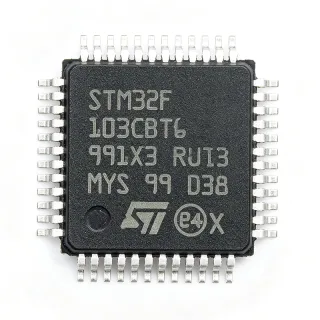
PIC16F15325T-E/JQVAO - 8-bit MCU, 14KB Flash, 32MHz | Microchip
MPN: PIC16F15325T-E/JQVAO ✓ Active| Qty | Unit Price | Extended |
|---|---|---|
| 1 | $1.18 | $1.18 |
| 10 | $1.07 | $10.70 |
| 100 | $0.95 | $95.00 |
| 500 | $0.86 | $430.00 |
| 1,000 | $0.78 | $780.00 |
| 3,000 | $0.69 | $2,070.00 |
PIC16F15325T-E/JQVAO Overview
An 8-bit microcontroller (MCU) is a single-chip computer that integrates a CPU, memory, and peripherals on one die. The PIC16F15325 belongs to the 8-bit microcontroller -> PIC16 family -> PIC16F153xx sub-family -> low-power enhanced mid-range product line within the broader microcontroller (MCU) -> embedded processor -> semiconductor taxonomy. This classification matters because 8-bit MCUs optimize for low cost, deterministic interrupt response, and extremely low active/sleep power, which differ fundamentally from 32-bit Cortex-M parts that target higher throughput.
Key features include eXtreme Low-Power (XLP) technology with deep-sleep currents in the nanoamp range, Core Independent Peripherals (CIPs) that offload tasks from the CPU, Intelligent Analog with on-chip op amps, and AEC-Q100 automotive qualification that supports under-the-hood and body-electronics deployment. The 16-pin UQFN package reduces PCB area to roughly 16 mm^2, enabling miniaturized modules while still exposing enough I/O for sensor hubs, lighting controllers and LIN nodes.
The architecture combines a Harvard RISC instruction set, 14-bit instruction word, and a wide peripheral set, allowing deterministic execution at 32 MHz (8 MIPS). Internal voltage regulation supports 2.3 V to 5.5 V operation, and on-chip nonvolatile data EEPROM (224 bytes typical for this family) preserves calibration and trim data through power cycles. The combination of CIPs and XLP enables fully autonomous sensor sampling in sleep mode, which is why this family is favored in battery-powered IoT and automotive sensor nodes.
Typical applications include automotive body and sensor nodes, IoT edge sensors, low-power wireless modules, LED driving and intelligent lighting, battery management and consumer appliances. The wide operating voltage and AEC-Q100 grade make it equally suitable for industrial control and human-machine interface boards.
When designing with this device, allocate one of the 12 I/O pins for an in-circuit serial programming (ICSP) clock/data pair to retain field upgradeability. Note that the UQFN package requires careful land-pattern design and a small thermal pad for reliable reflow.
This page synthesizes verified distributor pricing, drop-in alternatives from the same PIC16F153xx family, and practical design notes not found in the manufacturer datasheet.
Drop-in alternatives for PIC16F15325T-E/JQVAO — same package, pin-to-pin compatible. Different-package parts requiring PCB rework are excluded.
Variants in this series
Same-series models that are drop-in compatible with PIC16F15325T-E/JQVAO (same form factor and footprint) — differing in ADC, Core Architecture, Package, DAC, PWM Channels.
Quick Comparison Tool — Select alternative parts for side-by-side comparison:
PIC16F15325-E/JQ
✅ Drop-In✓ In Stock
$0.95 / Unit
View Datasheet →PIC16F15325-E/JQVAO
✅ Drop-In📋 Reference alternative (not in catalog)
PIC16F15325-I/P
✅ Drop-In✓ In Stock
$0.86 / Unit
View Datasheet →PIC16F15325T-E/JQVAO Maximum Ratings & Electrical Characteristics
| Core Architecture | PIC16 Enhanced Mid-Range (8-bit RISC, 14-bit instruction word) |
| Program Memory (Flash) | 14 KB (8K x 14) |
| Data SRAM | 1 KB |
| Data EEPROM | 224 bytes (typical for PIC16F153xx family) |
| Maximum CPU Speed | 32 MHz (8 MIPS) |
| Operating Voltage Range | 2.3 V to 5.5 V |
| I/O Pins | 12 |
| PWM Channels | 4 |
| ADC | 10-bit |
| DAC | 5-bit |
| Comparators | 2 |
| CWG (Complementary Waveform Generator) | Yes |
| EUSART | 2 |
| SPI / I2C | Yes (both) |
| Package | 16-pin UQFN (4x4 mm) with EP |
| Automotive Qualification | AEC-Q100 |
| Operating Temperature | -40C to +125C (extended, per -E suffix) |
| Mounting Type | Surface Mount |
| RoHS Status | Compliant |
PIC16F15325T-E/JQVAO Pin Configuration
| Pin 1 | RA5 — Bidirectional I/O / ADC input |
| Pin 2 | RA4 — Bidirectional I/O / ADC input |
| Pin 3 | RA3/MCLR — Bidirectional I/O / Master Clear (reset) |
| Pin 4 | RA2 — Bidirectional I/O / ADC input |
| Pin 5 | RA1 — Bidirectional I/O / ADC input / DAC ref |
| Pin 6 | RA0 — Bidirectional I/O / ADC input / DAC output |
| Pin 7 | VSS — Ground reference |
| Pin 8 | RA7 — Bidirectional I/O |
| Pin 9 | RA6 — Bidirectional I/O |
| Pin 10 | RC0 — Bidirectional I/O |
| Pin 11 | RC1 — Bidirectional I/O |
| Pin 12 | RC2 — Bidirectional I/O |
| Pin 13 | RC3 — Bidirectional I/O / I2C/SPI |
| Pin 14 | RC4 — Bidirectional I/O / I2C/SPI |
| Pin 15 | RC5 — Bidirectional I/O |
| Pin 16 | VDD — Positive supply (2.3 V to 5.5 V) |
Typical Applications
PIC16F15325T-E/JQVAO is suitable for 6 applications: Automotive Body Control Modules, IoT Edge Sensor Nodes, Smart LED Lighting Drivers, Battery Management Systems, Industrial Sensor Hubs, Consumer Appliance Control Boards.
Automotive Body Control Modules
The PIC16F15325T-E/JQVAO fits automotive body controllers because of its AEC-Q100 grade, 32 MHz / 8 MIPS throughput, 12 I/O, and 2 EUSART for LIN/CAN transceivers. With 14 KB Flash and 1 KB SRAM, the device comfortably holds body-control state machines, debounce logic, and LED-fade algorithms without external memory. The 2.3-5.5 V operating range supports direct connection to 5 V body domains, while nanoamp XLP sleep current preserves quiescent drain in always-on body nodes such as door modules, mirror controllers, and seat-position memories. Compared with general-purpose 8-bit MCUs, the AEC-Q100 qualification removes the need for additional component-level qualification on OEM programs.
Recommended
IoT Edge Sensor Nodes
For battery-powered IoT edge sensors, the PIC16F15325T-E/JQVAO delivers 14 KB Flash for application + wireless stack, 1 KB SRAM for sensor buffering, and XLP nanoamp sleep current that stretches coin-cell life past 5 years. The integrated 10-bit ADC, 5-bit DAC, and 2 comparators handle analog sensor conditioning (temperature, humidity, PIR, gas) without external amplifiers. The 4 PWM and CWG blocks can drive IR emitters, buzzers, or LED indicators while the CPU remains asleep, leveraging CIPs for autonomous operation. The 4x4 mm UQFN footprint enables sensor modules that fit inside standard 1/2-inch ceiling-mount enclosures.
Recommended
Smart LED Lighting Drivers
The PIC16F15325T-E/JQVAO drives intelligent LED lighting because the 4 PWM channels plus Complementary Waveform Generator (CWG) provide dead-band-controlled half-bridge drive for high-brightness LEDs at high dimming ratios without CPU overhead. The 32 MHz core executes lookup-table-driven dimming curves, while the 10-bit ADC reads ambient light sensors and 2 comparators provide zero-cross detection. The 14 KB Flash stores multi-channel color profiles and DMX-style address frames. AEC-Q100 qualification makes it suitable for automotive interior ambient lighting where reliability and temperature range (-40C to +125C) are non-negotiable.
Recommended
Battery Management Systems
In lithium-ion battery management, the PIC16F15325T-E/JQVAO monitors individual cell voltages via its 10-bit ADC across 12 I/O pins while its 2 comparators provide hardware over-voltage/under-voltage cutoffs independent of firmware latency. The 14 KB Flash accommodates cell-balancing algorithms, state-of-charge estimators, and SMBus comms, while 1 KB SRAM buffers telemetry frames. XLP sleep modes below 100 nA allow permanent-pack monitoring without measurable quiescent drain. AEC-Q100 qualification extends the part to e-mobility battery packs where temperature swing and vibration exceed commercial grade.
Recommended
Industrial Sensor Hubs
The PIC16F15325T-E/JQVAO operates reliably on 24 V industrial rails via a simple LDO to 3.3 V or 5 V, and its 2 EUSART plus SPI/I2C interfaces bridge Modbus RTU, IO-Link, and local sensor I2C chains. The 32 MHz throughput executes PID loops for pressure transmitters, flow meters, and valve actuators while the 5-bit DAC drives 4-20 mA loops through external op amps. The 16-pin UQFN (4x4 mm) enables IP67-rated stainless-steel sensor housings where PCB width is constrained. Industrial-grade (-40C to +125C) operation survives cabinet heat and outdoor enclosures.
Recommended
Consumer Appliance Control Boards
The PIC16F15325T-E/JQVAO fits washing machines, dishwashers, and microwave oven control boards where its 4 PWM drives motor and buzzer tones, the 10-bit ADC reads temperature and humidity sensors, and the 5-bit DAC trims reference voltages. The 14 KB Flash stores user-interface state machines, multi-language menus, and safety interlocks. CIPs offload button-debounce and rotary-encoder handling to hardware, reducing firmware complexity. Surface-mount UQFN packaging supports conformal-coated boards that survive humid laundry-room environments across a 10-year product lifetime.
Recommended
Recommended Products Summary
Engineering reference data for PIC16F15325T-E/JQVAO — comparison, design guidance, and compliance information.
Selection Guide
Comparison with Alternatives
| Parameter | This Product | PIC16F15325-E/JQ | PIC16F15325-E/JQVAO | PIC16F15325-I/P |
|---|---|---|---|---|
| Brand | Microchip Technology | Microchip Technology | Microchip Technology | Microchip Technology |
| Package | 16-pin UQFN (4x4 mm) | 16-pin UQFN (4x4 mm) - same | 16-pin UQFN (4x4 mm) - same | 16-pin UQFN (4x4 mm) - same |
| Flash Memory | 14 KB | 14 KB | 14 KB | 14 KB |
| SRAM | 1 KB | 1 KB | 1 KB | 1 KB |
| Maximum Frequency | 32 MHz | 32 MHz | 32 MHz | 32 MHz |
| Operating Temperature | -40C to +125C (Automotive -E) | -40C to +125C (Automotive -E) | -40C to +125C (Automotive -E) | -40C to +85C (Industrial -I) |
| Automotive Qualification | AEC-Q100 | AEC-Q100 | AEC-Q100 | Not qualified (industrial) |
| Shipping Format | Tape & Reel (T=) | Tube (no VAO suffix) | Tray (VAO) | Tube (industrial) |
| I/O Pins | 12 | 12 | 12 | 12 |
Key Differentiators
- AEC-Q100 automotive qualification in a sub-20 mm^2 footprint (vs PIC16F15325-I/P)
- Tape-and-reel shipping format for high-volume automotive SMT lines (vs PIC16F15325-E/JQVAO)
- Core Independent Peripherals (CIPs) enable autonomous sensor sampling (vs PIC16F15324T-I/7NVAO)
Design Notes
The 16-pin UQFN (4x4 mm) package has a center exposed thermal pad that MUST be soldered to a ground plane for mechanical reliability and thermal dissipation. Recommended land is approximately 1.6x1.6 mm with 0.3 mm via array (8-12 micro-vias at 0.2 mm drill). Paste stencil apertures should be slightly reduced (80-90% area) on the thermal pad to prevent solder balling under the package during reflow.
Place a 100 nF ceramic decoupling capacitor within 2 mm of the VDD pin (pin 16) and a 4.7 uF bulk capacitor on the supply rail to suppress the inrush current during Flash programming. For battery applications using XLP sleep, add a 10 kohm pull-up on MCLR (pin 3) and route the ICSP clock pin away from analog ADC traces to avoid injected noise during programming cycles.
Do not leave the MCLR pin floating - use a 10 kohm pull-up to VDD or, for production boards, route it to a dedicated reset supervisor. Avoid using the DAC output (RA0) as a high-current driver; the 5-bit DAC is intended for low-current reference generation (under 1 mA). When using the CWG for half-bridge drive, ensure dead-band is configured to prevent shoot-through; refer to the Microchip TB3133 application note for CWG tuning.
Estimated: At 32 MHz full-speed execution with all I/O toggling, expect ~10 mA active current dissipating roughly 50 mW from a 5 V supply. The UQFN-16 thermal resistance theta_JA of approximately 80 C/W yields a junction rise of 4 C above ambient - well within the 125 C automotive limit. For sealed IP67 enclosures, derate ambient by 10-15 C to account for stagnant air.
Compliance Information
AEC-Q100 qualified per Hotenda listing. RoHS and REACH compliance confirmed via Microchip product page. Lead-free and halogen-free packaging per Microchip environmental statement.