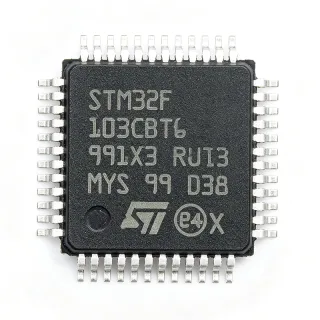
PIC16F15356-I/ML - 8-Bit 32MHz MCU, 28KB Flash, 28-QFN | Microchip
MPN: PIC16F15356-I/ML ✓ Active| Qty | Unit Price | Extended |
|---|---|---|
| 1 | $1.86 | $1.86 |
| 10 | $1.72 | $17.20 |
| 100 | $1.49 | $149.00 |
| 500 | $1.31 | $655.00 |
| 1,000 | $1.18 | $1,180.00 |
PIC16F15356-I/ML Overview
An 8-bit microcontroller (MCU) is a single-chip computer built around an 8-bit data path, integrating a CPU, non-volatile program memory (FLASH), volatile data memory (RAM), timers, communication peripherals, and interrupt logic on one silicon die. Within the broader taxonomy, an 8-bit MCU belongs to the microcontroller category, which itself is a subfamily of microprocessors and computing ICs, ultimately classified as integrated circuits (semiconductors). The 8-bit architecture remains dominant in cost- and power-sensitive applications where 32-bit performance is unnecessary.
Key features of the PIC16F15356-I/ML include four 10-bit PWM outputs, a 10-bit ADC, a 5-bit/8-bit DAC, comparators, four Configurable Logic Cells (CLC), a Complementary Waveform Generator (CWG), and dual EUSART plus SPI/I2C interfaces. The device supports up to 28KB of FLASH (16K x 14 words) and 2KB RAM, offering headroom for applications requiring larger state machines or wireless protocol stacks.
Architecturally, the PIC16F15356 uses Microchip's enhanced mid-range core with a 14-bit instruction word and a hardware stack, providing deterministic interrupt latency and a single-cycle instruction execution path. The XLP technology targets nanowatt-level sleep currents, making battery-powered applications feasible.
Typical applications include IoT sensor nodes, low-power wireless remote controls, consumer appliances, LED lighting controllers, battery management systems, and small industrial automation controllers. The combination of CWG, CLC, and multiple PWM channels makes it well-suited for motor-control and power-conversion control loops.
When designing with this MCU, prioritize the XLP sleep modes for battery applications and reserve at least one CLC for glue logic to reduce external component count. Use the on-board 10-bit ADC with internal FVR reference to minimize external precision components.
This page synthesizes distributor pricing, drop-in pin-compatible alternatives, and practical design notes that go beyond the manufacturer datasheet summary.
Drop-in alternatives for PIC16F15356-I/ML — same package, pin-to-pin compatible. Different-package parts requiring PCB rework are excluded.
Variants in this series
Same-series models that are drop-in compatible with PIC16F15356-I/ML (same form factor and footprint) — differing in ADC, Comparators, PWM Channels, Package, SPI / I2C.
Quick Comparison Tool — Select alternative parts for side-by-side comparison:
PIC16F15355-I/ML
✅ Drop-In📋 Reference alternative (not in catalog)
PIC16F15354-I/ML
✅ Drop-In📋 Reference alternative (not in catalog)
PIC16F15345-I/ML
✅ Drop-In📋 Reference alternative (not in catalog)
PIC16F15344-I/ML
✅ Drop-In📋 Reference alternative (not in catalog)
PIC16F15325-I/ML
✅ Drop-In📋 Reference alternative (not in catalog)
PIC16F15256-I/SP
✅ Drop-In📋 Reference alternative (not in catalog)
PIC16F15356-I/ML Maximum Ratings & Electrical Characteristics
| Core Architecture | 8-bit PIC enhanced mid-range (14-bit instruction word) |
| Program Memory (FLASH) | 28 KB (16K x 14 words) |
| Data RAM | 2 KB |
| Maximum CPU Speed | 32 MHz |
| Operating Voltage (VDD) | 2.3 V to 5.5 V |
| Package | 28-pin QFN (6x6 mm) with EP |
| Temperature Grade | Industrial -40C to +85C |
| ADC | 10-bit |
| DAC | 5-bit / 8-bit |
| PWM Channels | 4 x 10-bit |
| Comparators | Yes |
| CLC (Configurable Logic Cells) | 4 |
| CWG (Complementary Waveform Generator) | Yes |
| EUSART | 2 |
| SPI / I2C | Yes (MSSP) |
| XLP Low-Power Technology | Yes (nanowatt sleep) |
| RoHS Status | Compliant |
PIC16F15356-I/ML Pin Configuration
| Pin 1 | RA2 — Bidirectional I/O, analog input |
| Pin 2 | RA3 — Bidirectional I/O, analog input |
| Pin 3 | RA4 — Bidirectional I/O, analog input |
| Pin 4 | RA5 — Bidirectional I/O, analog input |
| Pin 5 | VSS — Ground reference |
| Pin 6 | RA6 — Bidirectional I/O, OSC2 |
| Pin 7 | RA7 — Bidirectional I/O, OSC1 |
| Pin 8 | VDD — Positive supply (2.3V-5.5V) |
| Pin 9 | RA1 — Bidirectional I/O, ICSPCLK |
| Pin 10 | RA0 — Bidirectional I/O, ICSPDAT |
| Pin 11 | RC5 — Bidirectional I/O, analog input |
| Pin 12 | RC4 — Bidirectional I/O, analog input |
| Pin 13 | RC3 — Bidirectional I/O, analog input, SCL |
| Pin 14 | RC2 — Bidirectional I/O, analog input, SDA |
| Pin 15 | RC1 — Bidirectional I/O, analog input |
| Pin 16 | RC0 — Bidirectional I/O, analog input |
| Pin 17 | RC6 — Bidirectional I/O, TX/CK |
| Pin 18 | RC7 — Bidirectional I/O, RX/DT |
| Pin 19 | VSS — Ground (second pin for EP) |
| Pin 20 | VDD — Positive supply (second pin) |
| Pin 21 | RB0 — Bidirectional I/O, analog input, INT |
| Pin 22 | RB1 — Bidirectional I/O, analog input |
| Pin 23 | RB2 — Bidirectional I/O, analog input |
| Pin 24 | RB3 — Bidirectional I/O, analog input |
| Pin 25 | RB4 — Bidirectional I/O, analog input |
| Pin 26 | RB5 — Bidirectional I/O, analog input |
| Pin 27 | RB6 — Bidirectional I/O, ICSPCLK |
| Pin 28 | RB7 — Bidirectional I/O, ICSPDAT |
| Pin 29 | EP — Exposed pad - thermal/ground, must be soldered to PCB ground |
Typical Applications
PIC16F15356-I/ML is suitable for 6 applications: Battery-Powered IoT Sensor Node, LED Lighting Controller, Low-Power Wireless Remote Control, Small Industrial Sensor Hub, Consumer Appliance Control Board, Portable Health Monitoring Device.
Battery-Powered IoT Sensor Node
The PIC16F15356-I/ML is an excellent fit for battery-powered IoT sensor nodes thanks to its eXtreme Low-Power (XLP) sleep modes that drop current consumption into the nanowatt range. The 28KB FLASH and 2KB RAM comfortably hold a sub-1GHz wireless protocol stack such as LoRaWAN or a lightweight mesh, while the 10-bit ADC paired with the internal Fixed Voltage Reference (FVR) enables accurate battery and sensor measurements without external precision components. Placed between a coin cell and the radio module, it serves as the system controller that wakes on timer interrupt, samples the sensor, transmits, and returns to sleep. The four Configurable Logic Cells (CLC) reduce external glue logic for the sensor's interrupt line and timing edges. Designers should budget deep-sleep current below 1 uA to achieve multi-year battery life.
Recommended
LED Lighting Controller
The PIC16F15356-I/ML controls multi-channel LED drivers using its four 10-bit PWM outputs and Complementary Waveform Generator (CWG), which can drive half-bridges for high-power LED strings. The 32MHz core executes Color Rendering Index (CRI) compensation and dimming algorithms without taxing the timing budget, while the 10-bit ADC samples photodiode feedback for closed-loop brightness control. Compared with discrete 555-based PWM chains, the integrated CWG and CLCs shrink the BOM to a single MCU plus FET bridge. Use a 4x CLC to synthesize dead-time insertion in hardware, freeing the CPU for color-mixing math.
Recommended
Low-Power Wireless Remote Control
The PIC16F15356-I/ML fits handheld remote controls where battery life and responsive button scanning drive the design. Its XLP sleep currents below 1 uA and fast wake-up time from the on-chip LFINTOSC allow multi-year coin-cell operation. The CLC blocks implement hardware keyboard scanning and debounce, while the CWG can drive an IR LED directly for sub-carrier modulation at 38 kHz carrier. The integrated EUSART and MSSP provide both IR and RF paths from the same MCU. The 28-QFN (6x6mm) package fits inside slim handheld enclosures.
Recommended
Small Industrial Sensor Hub
The PIC16F15356-I/ML is suitable for industrial sensor hubs interfacing 4-20mA loops, thermistors, and digital outputs via its 10-bit ADC, comparators, and dual EUSART. The industrial -40C to +85C temperature grade supports factory floor operation. The CLC blocks can implement hardware threshold detection on analog inputs, while the CWG drives an alarm buzzer or solid-state relay without CPU intervention. The 28KB FLASH fits Modbus or IO-Link device stacks, and the 2KB RAM supports command buffering. For ATEX/IECEx zones, the MCU pairs with an external barrier.
Recommended
Consumer Appliance Control Board
The PIC16F15356-I/ML serves as the central controller in small kitchen and home appliances such as coffee makers, rice cookers, and air purifiers. The 32MHz core executes multi-sensor state machines for temperature, humidity, and motor feedback in real time. The four PWM channels drive heating elements, fans, and pumps, while the CWG generates complementary FET drive for a BLDC or induction motor. The CLC reduces external logic around user interfaces with capacitive touch buttons and rotary encoders. The 28-QFN package fits in the slim control board inside a compact appliance chassis.
Recommended
Portable Health Monitoring Device
The PIC16F15356-I/ML is well-suited to portable health and wellness devices such as pulse oximeters, glucose meters, and wearable fitness bands. Its XLP sleep currents extend battery life to weeks on a single CR2032 cell. The 10-bit ADC captures PPG or bio-impedance signals, while the comparators implement hardware threshold detection to wake the MCU only when a meaningful event occurs. The CLC blocks replace several external op-amps and logic gates, reducing BOM cost. The 28-QFN (6x6mm) footprint fits inside compact wearable enclosures, and the SPI/I2C interfaces connect directly to BLE modules for smartphone data sync.
Recommended
Recommended Products Summary
Engineering reference data for PIC16F15356-I/ML — comparison, design guidance, and compliance information.
Selection Guide
Comparison with Alternatives
| Parameter | This Product | PIC16F15355-I/ML | PIC16F15354-I/ML | PIC16F15345-I/ML | PIC16F15344-I/ML |
|---|---|---|---|---|---|
| Brand | Microchip Technology | Microchip Technology | Microchip Technology | Microchip Technology | Microchip Technology |
| Package | 28-QFN (6x6) | 28-QFN (6x6) - same | 28-QFN (6x6) - same | 28-QFN (6x6) - same | 28-QFN (6x6) - same |
| FLASH (KB) | 28 | 14 (-50%) | 7 (-75%) | 14 (-50%) | 7 (-75%) |
| RAM (KB) | 2 | 1 (-50%) | 1 (-50%) | 1 (-50%) | 1 (-50%) |
| Max CPU Speed (MHz) | 32 | 32 | 32 | 32 | 32 |
| PWM Channels | 4 x 10-bit | 4 x 10-bit | 4 x 10-bit | 4 x 10-bit | 4 x 10-bit |
| CLC Blocks | 4 | 4 | 4 | 4 | 4 |
| EUSART | 2 | 2 | 2 | 2 | 2 |
| Operating Voltage (V) | 2.3 to 5.5 | 2.3 to 5.5 | 2.3 to 5.5 | 2.3 to 5.5 | 2.3 to 5.5 |
| Temperature Grade | Industrial -40C to +85C | Industrial -40C to +85C | Industrial -40C to +85C | Industrial -40C to +85C | Industrial -40C to +85C |
Key Differentiators
- Highest FLASH density in 28-QFN PIC16F153xx family (vs PIC16F15355-I/ML)
- Latest generation CIP peripheral set (CLC, CWG, NCO) (vs PIC16F15256-I/SP)
- Dual EUSART plus SPI/I2C in 28-QFN footprint (vs PIC16F15344-I/ML)
Design Notes
Use the PIC16F15356-I/ML's XLP sleep modes (Doze, Idle, Sleep with RTCC) to drop average current to single-digit microamps. For battery applications, configure the LFINTOSC at 31 kHz during sleep and switch to HFINTOSC only when active. A 1 uF X7R bypass on VDD plus a 100 nF decoupling cap within 3 mm of the VDD pin is mandatory for stable operation.
The 28-QFN (6x6mm) package has an exposed pad (EP) that must be soldered to the PCB ground plane for thermal dissipation and electrical grounding. Use a 4x4 via array (0.3 mm vias) connecting the EP to a large inner ground pour. Failing to solder the EP can cause thermal stress, exceeding operating temperature limits, or erratic resets.
Do not leave the MCLR pin floating - tie it to VDD through a 10 kohm pull-up or use the internal MCLR disabled configuration in CONFIG words. Avoid driving the ICSP pins (RA0/RA1/RB6/RB7) directly with external logic without isolation resistors if you intend to use In-Circuit Serial Programming. Always disable unused peripherals via the PMD registers to minimize sleep current.
Keep the analog reference (VREF+) trace short and away from PWM switching lines. Place the ADC input RC filter within 5 mm of the analog pin. Route the 32 MHz HFINTOSC clock trace in a guarded ground channel to minimize EMI coupling into sensitive analog inputs.
Compliance Information
RoHS and REACH compliant per Microchip product page. Not AEC-Q100 qualified - for automotive designs, choose a designated AEC-Q100 PIC16 variant.