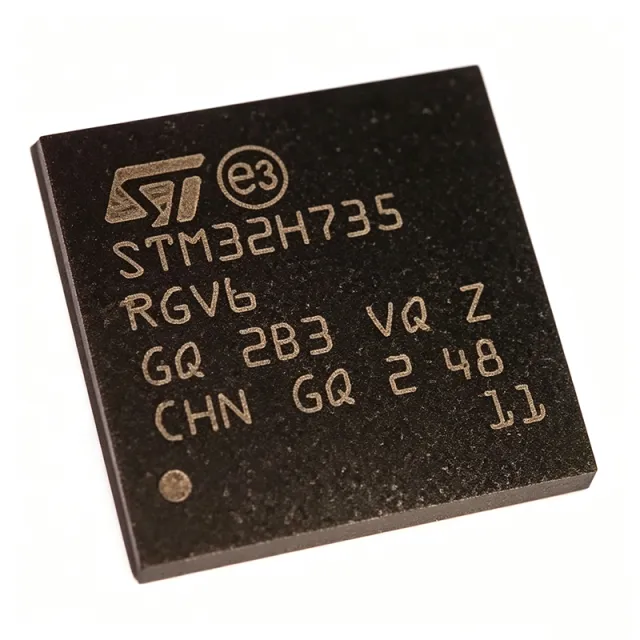
STM32H735RGV6 - 550MHz Cortex-M7 MCU with 1MB Flash | STMicroelectronics
MPN: STM32H735RGV6 ✓ Active| Qty | Unit Price | Extended |
|---|---|---|
| 1 | $23.7273 | $23.73 |
| 10 | $17.1364 | $171.36 |
| 100 | $15.1591 | $1,515.91 |
| 500 | $14.5 | $7,250.00 |
| 1,000 | $13.8409 | $13,840.90 |
Drop-in alternatives for STM32H735RGV6 — same package, pin-to-pin compatible. Different-package parts requiring PCB rework are excluded.
Quick Comparison Tool — Select alternative parts for side-by-side comparison:
STM32H750VBT6
✓ In Stock
$8.5 / Unit
View Datasheet →STM32H735IGK6
📋 Reference alternative (not in catalog)
STM32H735RGV6T6
📋 Reference alternative (not in catalog)
STM32H743RGV6
📋 Reference alternative (not in catalog)
GD32H757VMT6
📋 Reference alternative (not in catalog)
STM32H735RGV6 Maximum Ratings & Electrical Characteristics
| Core Processor | ARM Cortex-M7 |
| Core Architecture | ARM |
| Core Size | 32-Bit |
| Speed | 550 MHz |
| Program Memory Size | 1 MB (1M x 8) |
| Program Memory Type | FLASH |
| RAM Size | 564 KB |
| Number of I/O | [DATA_NEEDED: Number of I/O] |
| Package / Case | 68-VFQFPN (8x8) |
| Mounting Type | Surface Mount |
| Operating Temperature | -40°C to +85°C |
| Supply Voltage Range | 1.62V to 3.6V |
| Data Converters | 12-bit ADC up to 5 MSPS |
| Connectivity | Ethernet, USB OTG HS, FDCAN, SPI, I2C, UART, SAI |
| RoHS Status | Compliant |
STM32H735RGV6 Pin Configuration
| Pin 1 | VDD — Digital power supply |
| Pin 2 | VSS — Digital ground |
| Pin 3 | PA0 — GPIO / ADC input |
| Pin 4 | PA1 — GPIO / ADC input |
| Pin 5 | PA2 — GPIO / USART2_TX |
| Pin 6 | PA3 — GPIO / USART2_RX |
| Pin 7 | VSSA — Analog ground |
| Pin 8 | VDDA — Analog power supply |
| Pin 9 | PA4 — GPIO / DAC_OUT1 |
| Pin 10 | PA5 — GPIO / DAC_OUT2 |
| Pin 11 | PA6 — GPIO / SPI1_MISO |
| Pin 12 | PA7 — GPIO / SPI1_MOSI |
| Pin 13 | PB0 — GPIO / TIM3_CH3 |
| Pin 14 | PB1 — GPIO / TIM3_CH4 |
| Pin 15 | PB2 — GPIO / BOOT1 |
| Pin 16 | PB10 — GPIO / I2C2_SCL |
| Pin 17 | PB11 — GPIO / I2C2_SDA |
| Pin 18 | VDD — Digital power supply |
| Pin 19 | VSS — Digital ground |
| Pin 20 | PB12 — GPIO / SPI2_NSS |
| Pin 21 | PB13 — GPIO / SPI2_SCK |
| Pin 22 | PB14 — GPIO / SPI2_MISO |
| Pin 23 | PB15 — GPIO / SPI2_MOSI |
| Pin 24 | PC13 — GPIO / RTC_AF1 |
| Pin 25 | PC14 — GPIO / OSC32_IN |
| Pin 26 | PC15 — GPIO / OSC32_OUT |
| Pin 27 | PH0 — OSC_IN |
| Pin 28 | PH1 — OSC_OUT |
| Pin 29 | NRST — Reset |
| Pin 30 | VDD — Digital power supply |
| Pin 31 | VSS — Digital ground |
| Pin 32 | PC0 — GPIO / ADC input |
| Pin 33 | PC1 — GPIO / ADC input |
| Pin 34 | PC2 — GPIO / ADC input |
| Pin 35 | PC3 — GPIO / ADC input |
| Pin 36 | VREF+ — ADC reference voltage |
| Pin 37 | VDDA — Analog power supply |
| Pin 38 | VSSA — Analog ground |
| Pin 39 | PC4 — GPIO / I2S1_MCK |
| Pin 40 | PC5 — GPIO / I2S1_SCK |
| Pin 41 | PB3 — GPIO / SPI1_SCK |
| Pin 42 | PB4 — GPIO / SPI1_NSS |
| Pin 43 | PB5 — GPIO / I2C1_SMBA |
| Pin 44 | PB6 — GPIO / I2C1_SCL |
| Pin 45 | PB7 — GPIO / I2C1_SDA |
| Pin 46 | BOOT0 — Boot mode selection |
| Pin 47 | PB8 — GPIO / FDCAN1_RX |
| Pin 48 | PB9 — GPIO / FDCAN1_TX |
| Pin 49 | VDD — Digital power supply |
| Pin 50 | VSS — Digital ground |
| Pin 51 | PE0 — GPIO / TIM4_CH1 |
| Pin 52 | PE1 — GPIO / TIM4_CH2 |
| Pin 53 | PE2 — GPIO / SAI1_SD_A |
| Pin 54 | PE3 — GPIO / SAI1_SD_B |
| Pin 55 | PE4 — GPIO / SAI1_FS_A |
| Pin 56 | PE5 — GPIO / SAI1_SCK_A |
| Pin 57 | PE6 — GPIO / SAI1_MCLK_A |
| Pin 58 | PE7 — GPIO / TIM1_CH1 |
| Pin 59 | PE8 — GPIO / TIM1_CH2 |
| Pin 60 | PE9 — GPIO / TIM1_CH3 |
| Pin 61 | PE10 — GPIO / TIM1_CH4 |
| Pin 62 | PE11 — GPIO / TIM1_CH1N |
| Pin 63 | PE12 — GPIO / TIM1_CH2N |
| Pin 64 | PE13 — GPIO / TIM1_CH3N |
| Pin 65 | PE14 — GPIO / TIM1_CH4N |
| Pin 66 | PE15 — GPIO / TIM1_BKIN |
| Pin 67 | VDD — Digital power supply |
| Pin 68 | VSS — Digital ground |
Safe Operating Area (SOA) & Thermal Characteristics
No official SOA curve available for this digital IC. Always operate within absolute maximum ratings specified in the datasheet. Ensure adequate cooling and derate as needed.
Typical Applications
STM32H735RGV6 is suitable for 6 applications: Industrial Automation, Motor Control, Medical Devices, Smart Home Hub, Audio Processing, Human-Machine Interface (HMI).
Industrial Automation
The STM32H735RGV6 is ideal for industrial automation due to its high-speed Cortex-M7 core, rich connectivity (Ethernet, FDCAN), and advanced timers. It can handle PLC logic, robotics control, and real-time monitoring. The 550 MHz clock enables fast response times, while the 1 MB flash and 564 KB SRAM support complex control algorithms. The wide temperature range (-40°C to +85°C) ensures reliability in harsh factory environments. Its cryptographic accelerator enhances secure communication protocols like OPC UA.
Recommended
Motor Control
The STM32H735RGV6 excels in motor control applications, particularly field-oriented control (FOC) of BLDC and PMSM motors. Its 550 MHz core and 12-bit ADCs with up to 5 MSPS enable high-bandwidth current sensing and precise PWM generation. The advanced timers provide complementary outputs with dead-time insertion, essential for inverter stages. The device's DSP instructions and FPU accelerate complex control algorithms like sensorless observers. With a wide supply voltage range, it can interface directly with motor driver ICs.
Recommended
Medical Devices
The STM32H735RGV6 is suitable for medical devices such as patient monitors, infusion pumps, and diagnostic equipment. Its high performance enables real-time signal processing for ECG, SpO2, and other biosignals. The cryptographic accelerator ensures secure data transmission, complying with healthcare regulations. The device's low power consumption and wide temperature range make it reliable for continuous operation. The rich peripheral set includes ADCs for sensor interfacing and communication interfaces for connectivity.
Recommended
Smart Home Hub
The STM32H735RGV6 can serve as the central processor in smart home hubs, managing multiple protocols like Zigbee, Z-Wave, and Wi-Fi. Its high clock speed and ample memory support complex home automation logic and voice recognition. The device's connectivity options (Ethernet, USB, UART) allow seamless integration with various smart devices. The Chrom-ART Accelerator enhances graphical user interfaces on connected displays. Its security features protect user data and device integrity.
Recommended
Audio Processing
The STM32H735RGV6 is well-suited for audio processing applications such as smart speakers, audio interfaces, and soundbars. Its 550 MHz Cortex-M7 core with FPU can handle audio codecs, DSP effects, and voice recognition. The SAI interface supports multiple audio protocols like I2S and TDM, enabling connection to high-quality DACs and ADCs. The device's large memory allows buffering of audio streams. The cryptographic accelerator can secure audio content for DRM.
Recommended
Human-Machine Interface (HMI)
The STM32H735RGV6 is ideal for advanced HMIs in industrial and consumer products. Its Chrom-ART Accelerator offloads 2D graphics rendering from the CPU, enabling smooth animations on TFT displays. The device supports external memory via FMC for framebuffers. With multiple communication interfaces, it can connect to touch controllers, encoders, and other input devices. The high clock speed ensures responsive user interfaces.
Recommended
Recommended Products Summary
Engineering reference data for STM32H735RGV6 — comparison, design guidance, and compliance information.
Selection Guide
Comparison with Alternatives
| Parameter | This Product | STM32H735IGK6 | STM32H735RGV6T6 | STM32H743RGV6 | STM32H750VBT6 | GD32H757VMT6 |
|---|---|---|---|---|---|---|
| Package | 68-VFQFPN (8x8) | UFBGA176 | LQFP64 | LQFP64 | LQFP100 | LQFP100 |
| Brand | STMicroelectronics | STMicroelectronics | STMicroelectronics | STMicroelectronics | STMicroelectronics | GigaDevice |
| Core Speed | 550 MHz | 550 MHz | 550 MHz | 480 MHz | 480 MHz | 550 MHz |
| Flash Memory | 1 MB | 1 MB | 1 MB | 2 MB | 128 KB | 2 MB |
| SRAM | 564 KB | 564 KB | 564 KB | 1 MB | 1 MB | 1 MB |
| Cryptographic Acceleration | Yes (AES, DES, 3DES, Hash) | Yes | Yes | Yes | Yes | Yes |
| Ethernet | Yes | Yes | Yes | Yes | Yes | Yes |
| Operating Temperature | -40°C to +85°C | -40°C to +85°C | -40°C to +85°C | -40°C to +85°C | -40°C to +85°C | -40°C to +85°C |
Key Differentiators
- Higher clock speed than STM32H743 (vs STM32H743RGV6)
- More flash memory than STM32H750 (vs STM32H750VBT6)
- Same performance as GD32H757 with ST ecosystem (vs GD32H757VMT6)
Design Notes
The STM32H735RGV6 requires a clean power supply. Use a 100nF decoupling capacitor on each VDD pin and a 4.7uF bulk capacitor on the main supply. For the analog supply (VDDA), use a ferrite bead and a 1uF capacitor to filter noise. The core voltage (1.2V) can be generated internally via the LDO or externally via SMPS for better efficiency. Ensure the VCAP pin is connected to a 2.2uF capacitor as specified in the datasheet.
The VFQFPN68 package has a thermal resistance (theta_JA) of approximately 45°C/W. At 550 MHz with all peripherals active, power dissipation can reach 500mW, resulting in a temperature rise of 22.5°C above ambient. For high-power applications, ensure adequate airflow or a heatsink. The exposed pad should be soldered to a large copper area on the PCB to improve heat dissipation.
For the VFQFPN68 package, use a 0.5mm pitch land pattern. Ensure the exposed pad is connected to ground with multiple vias for thermal and electrical performance. Keep high-speed signals (Ethernet, USB) impedance-controlled and routed with proper ground planes. Place the crystal oscillator close to the OSC_IN/OSC_OUT pins with load capacitors as specified.
Compliance Information
RoHS compliant per STMicroelectronics. Not AEC-Q100 qualified; for automotive, consider STM32H7A3 series.