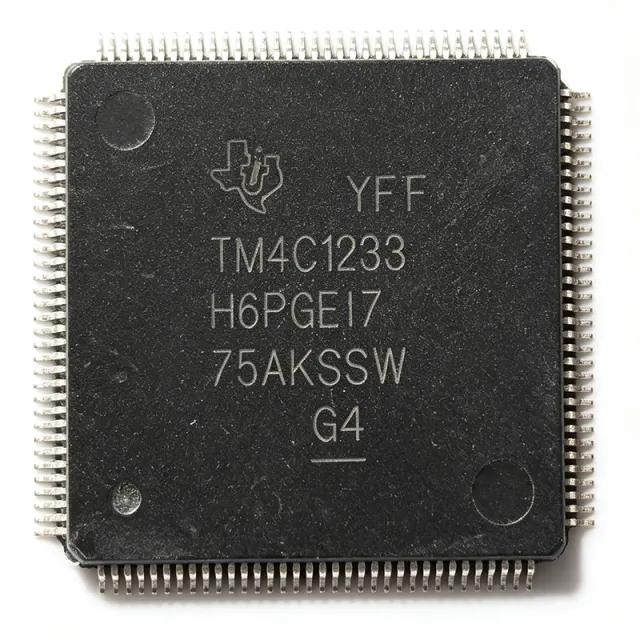
TM4C1233H6PGE - 80MHz Cortex-M4F MCU 256KB | Texas Instruments
MPN: TM4C1233H6PGE ✓ Active| Qty | Unit Price | Extended |
|---|---|---|
| 1 | $10.95 | $10.95 |
| 10 | $9.86 | $98.60 |
| 100 | $8.8 | $880.00 |
| 500 | $7.92 | $3,960.00 |
| 1,000 | $7.15 | $7,150.00 |
Drop-in alternatives for TM4C1233H6PGE — same package, pin-to-pin compatible. Different-package parts requiring PCB rework are excluded.
Quick Comparison Tool — Select alternative parts for side-by-side comparison:
TM4C1233H6PGEI
✅ Drop-In📋 Reference alternative (not in catalog)
TM4C123GH6PGE
✅ Drop-In ⚠️ 参数待验证📋 Reference alternative (not in catalog)
TM4C1231H6PGE
✅ Drop-In ⚠️ 参数待验证📋 Reference alternative (not in catalog)
TM4C123BH6PGE
✅ Drop-In ⚠️ 参数待验证📋 Reference alternative (not in catalog)
TM4C123FH6PGE
✅ Drop-In ⚠️ 参数待验证📋 Reference alternative (not in catalog)
TM4C1233H6PGE Maximum Ratings & Electrical Characteristics
| Core Processor | ARM Cortex-M4F |
| Core Size | 32-bit |
| Maximum Clock Frequency | 80 MHz |
| Flash Memory | 256 KB |
| SRAM | 32 KB |
| CAN Channels | 2 |
| USB | USB 2.0 Device |
| RTC | Yes (battery-backed hibernate module) |
| FPU | Yes (single-precision) |
| MPU | Yes |
| ADC Resolution | 12-bit |
| Package | 144-LQFP (20x20 mm) |
| Mounting Type | Surface Mount |
| Series | Tiva C Series TM4C123x |
TM4C1233H6PGE 144-lqfp (20x20 mm) Pin Configuration Guide
Complete pinout information for TM4C1233H6PGE (144-lqfp (20x20 mm) package). This digital IC includes GPIO, communication interfaces (UART, SPI, I2C), and power pins. Refer to the manufacturer datasheet for alternate pin functions and configuration options. Essential for embedded system design and PCB layout.

No detailed pinout data available for TM4C1233H6PGE.
Refer to the datasheet for full pin configuration.
Safe Operating Area (SOA) & Thermal Characteristics
No official SOA curve available for this digital IC. Always operate within absolute maximum ratings specified in the datasheet. Ensure adequate cooling and derate as needed.
Typical Applications
TM4C1233H6PGE is suitable for 6 applications: Factory Automation and PLC Nodes, Remote Monitoring and Telemetry, Test and Measurement Equipment, Electronic Point-of-Sale Machines, HVAC and Building Control, Fire and Security Systems.
Factory Automation and PLC Nodes
The TM4C1233H6PGE fits factory automation nodes because its dual CAN 2.0 controllers provide native fieldbus connectivity, while the 80 MHz Cortex-M4F with hardware FPU executes deterministic control loops for actuators and I/O scanning. In a typical deployment the MCU runs an RTOS, services CAN frames with hardware message objects to minimize CPU load, and uses its 12-bit ADCs and PWM generators for analog I/O and actuator drive. The 256 KB flash accommodates protocol stacks and OTA-updatable firmware via a CAN bootloader, reducing maintenance visits. Its industrial peripheral mix and real-time NVIC interrupt latency make it a dependable mid-range automation controller where higher-end Sitara devices would be over-budget.
Recommended
Remote Monitoring and Telemetry
For remote monitoring equipment, the TM4C1233H6PGE offers a low-power hibernate module with battery-backed RTC for time-stamped logging and wake-on-event operation, extending battery life in unattended sites. The 80 MHz Cortex-M4F processes sensor samples - including FFT-based vibration analytics using DSP instructions and the FPU - while 256 KB flash stores data logging firmware and 32 KB SRAM buffers telemetry frames. Dual CAN and multiple UARTs connect to modems and local fieldbus simultaneously. Firmware can be updated in the field through a UART or CAN bootloader, which is critical for geographically dispersed installations where physical access is costly and downtime directly impacts monitoring continuity.
Recommended
Test and Measurement Equipment
The TM4C1233H6PGE serves benchtop and portable test instruments where its 12-bit ADCs, timers, and PWM/DAC-companion peripherals implement stimulus and capture channels, while the 80 MHz Cortex-M4F with FPU performs calibration math, averaging, and DSP filtering on the fly. USB 2.0 device connectivity provides a plug-and-play interface to host PC software without external bridge chips, and the hibernate RTC timestamps logged measurements. The 256 KB flash holds multiple instrument profiles and a USB bootloader for firmware updates shipped as field upgrades. Deterministic NVIC interrupt response keeps time-critical measurement loops stable, making the MCU a cost-effective control core for handheld meters and industrial calibrators.
Recommended
Electronic Point-of-Sale Machines
Electronic point-of-sale hardware benefits from the TM4C1233H6PGE's USB 2.0 device interface for PC and payment-terminal connectivity, plus multiple UARTs and SSI for receipt printers, card readers, and keypads. The 80 MHz Cortex-M4F handles transaction state machines and display refresh with headroom, and the battery-backed RTC in the hibernate module maintains correct transaction timestamps through power interruptions - essential for receipt integrity. The 256 KB flash supports secure bootloader architectures and in-field firmware updates, while CAN provides an option for networked POS clusters in retail back-office topologies. Its industrial temperature robustness also suits kiosk and vending machine deployments with wide environmental ranges.
Recommended
HVAC and Building Control
In HVAC and building automation controllers, the TM4C1233H6PGE combines dual CAN 2.0 for BACnet-oriented fieldbus segments, 12-bit ADCs for temperature and pressure sensing, and PWM outputs for damper and valve actuation. The 80 MHz Cortex-M4F executes PID control loops - accelerated by the hardware FPU - for precise temperature and airflow regulation, while the hibernate module's RTC maintains schedules through brownouts. With 256 KB flash there is room for protocol stacks, trending logs, and a CAN/UART field-update bootloader that lets facility teams patch firmware without dismantling control panels. Its peripheral breadth consolidates sensing, actuation, and communication on one 144-pin LQFP device, cutting BOM cost.
Recommended
Fire and Security Systems
Fire alarm and security panels leverage the TM4C1233H6PGE's battery-backed hibernate RTC for event time-stamping, dual CAN for networked panel-to-panel communication, and multiple UART/GPIO resources for zone monitoring and siren drive. The 80 MHz Cortex-M4F runs supervisory state machines and sensor-line algorithms with deterministic interrupt latency, while the 256 KB flash holds certification-critical firmware that can be updated via a locked-down bootloader. The 32 KB SRAM comfortably hosts event queues for alarm history. Robust peripherals, real-time response, and fieldbus options let one MCU consolidate detection processing, annunciation, and network reporting - an economical architecture for distributed life-safety and access-control installations.
Recommended
Recommended Products Summary
Engineering reference data for TM4C1233H6PGE — comparison, design guidance, and compliance information.
Selection Guide
Comparison with Alternatives
| Parameter | This Product | TM4C1233H6PGEI | TM4C123GH6PGE | TM4C1231H6PGE |
|---|---|---|---|---|
| Package | 144-LQFP (20x20 mm) | 144-LQFP (20x20 mm) - same | 144-LQFP (20x20 mm) - same | 144-LQFP (20x20 mm) - same |
| Brand | Texas Instruments | Texas Instruments | Texas Instruments | Texas Instruments |
| Core / Clock | Cortex-M4F, 80 MHz | Cortex-M4F, 80 MHz | Cortex-M4F, 80 MHz | Cortex-M4F, 80 MHz |
| Flash | 256 KB | 256 KB | 256 KB | 256 KB |
| SRAM | 32 KB | 32 KB | 32 KB | 32 KB |
| CAN Controllers | 2 | 2 | 2 | [DATA_NEEDED] |
| USB | USB 2.0 Device | USB 2.0 Device | USB 2.0 Device/Host | [DATA_NEEDED] |
| Temperature Grade | Commercial [DATA_NEEDED: exact range] | Extended industrial (I suffix) | [DATA_NEEDED] | [DATA_NEEDED] |
Key Differentiators
- Dual CAN 2.0 controllers in the 123x family (vs TM4C1231H6PGE)
- Extended temperature availability (vs TM4C1233H6PGEI)
- Hardware FPU at low cost tier (vs STM32F4 class (cross-brand, functional comparison))
Design Notes
Budget the 32 KB SRAM before committing to middleware: a full USB device stack plus an RTOS with TCP or CANopen layers can consume 10-15 KB, leaving limited headroom for buffers. Estimate worst-case heap and stack use with the linker map and runtime watermarking. If your application requires more RAM, evaluate the TM4C123GH6PGE or step up to the TM4C129x class, which shares TivaWare tooling for easier migration.
The 144-LQFP (20x20 mm) exposes a 0.5 mm pin pitch - use 4-mil trace/space design rules and place a solid ground plane on layer 2. Decouple every VDD pin pair with 0.1 uF ceramics placed within 2 mm of the pins, plus one bulk 10 uF capacitor per supply domain. Keep the CAN transceiver close to the CAN pins with a series common-mode choke toward the connector to improve EMC performance in industrial cabinets.
For firmware updates in deployed units, implement the TI ROM/flash bootloader over CAN or UART from the start of the project rather than retrofitting it. Reserve the designated bootloader pins and verify that your RS-485 or CAN physical layer is active during reset. This avoids costly service visits and enables field patching of security and automation firmware - a pattern used throughout TI's Tiva C reference designs.
Compliance Information
Compliance status not stated in provided web data. Verify RoHS/REACH status on the TI product page quality section (ti.com/product/TM4C1233H6PGE) before procurement.