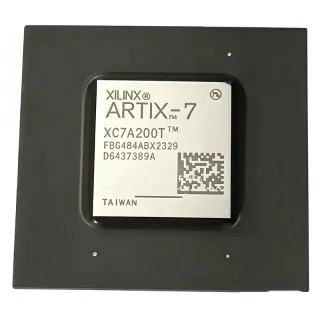
EP20K200CF484I9 - APEX 20KC 200K Gates FPGA, 484-BGA | Altera
MPN: EP20K200CF484I9 ✗ End of Life| Qty | Unit Price | Extended |
|---|---|---|
| 1 | $285 | $285.00 |
| 10 | $245 | $2,450.00 |
| 100 | $195 | $19,500.00 |
| 500 | $160 | $80,000.00 |
| 1,000 | $138 | $138,000.00 |
EP20K200CF484I9 Overview
A Field-Programmable Gate Array (FPGA) is a reconfigurable semiconductor whose logic resources, routing, and I/O are defined after manufacture by a user-supplied bitstream, allowing the same silicon to implement arbitrary digital circuits, glue logic, glue-less bus bridges, or even soft processor cores. FPGAs sit above fixed-function ASICs and CPLDs in the programmable logic hierarchy and below fully custom ASICs in non-recurring engineering cost; APEX 20KC devices are Altera (now Intel) high-density, SRAM-based FPGAs positioned for system-on-a-programmable-chip (SOPC) designs.
Key features include 200K typical gates, 8,320 logic cells, embedded system blocks (ESBs) for RAM/ROM, fast I/O with support for multiple I/O standards, in-system programmability via JTAG, and an industrial operating temperature grade. The CF484 suffix denotes the 484-ball FineLine BGA package, the I denotes industrial temperature (-40 C to +100 C junction), and the 9 indicates speed grade -9 (the slowest of the EP20K200 speed grades, optimized for lower cost rather than maximum Fmax).
This part is suitable for high-throughput telecommunications, networking, and DSP pipelines; PCI/CompactPCI bus bridges; complex state machines in industrial control; and prototyping prior to ASIC migration. The APEX 20KC architecture was EOL'd by Altera/Intel in 2008, so this MPN is now sourced primarily through authorized aftermarket distributors and broker inventory. Engineer caution: confirm RoHS/lead-free status and date code with the supplier before qualifying for new designs.
Drop-in alternatives for EP20K200CF484I9 — same package, pin-to-pin compatible. Different-package parts requiring PCB rework are excluded.
Variants in this series
Same-series models that are drop-in compatible with EP20K200CF484I9 (same form factor and footprint) — differing in Package, Speed Grade, Process Technology, Family, RoHS Status.
Quick Comparison Tool — Select alternative parts for side-by-side comparison:
EP20K200CF484I8
✅ Drop-In✓ In Stock
$471.1 / Unit
View Datasheet →EP20K200CF484I8N
✅ Drop-In✓ In Stock
$612.8 / Unit
View Datasheet →EP20K200CF484I7
✅ Drop-In✓ In Stock
$89.5 / Unit
View Datasheet →EP20K200CF484C9N
✅ Drop-In✓ In Stock
$201.04 / Unit
View Datasheet →EP20K200CF484C9
✅ Drop-In✓ In Stock
$201.04 / Unit
View Datasheet →EP20K200CF484C8
✅ Drop-In✓ In Stock
$410.75 / Unit
View Datasheet →EP20K200CF484I9 Maximum Ratings & Electrical Characteristics
| Series | APEX 20KC |
| Family | APEX 20KC (APEX 20K with ESB/CAM) |
| Process Technology | 0.15 um CMOS |
| Typical Gates | 200,000 |
| Logic Elements (Cells) | 8,320 |
| Maximum User I/O | 376 |
| Dedicated Inputs | 4 |
| Total Terminals | 484 (balls) |
| Package | 484-ball FineLine BGA (FBGA), 1.00 mm pitch |
| Core Supply Voltage (VCCINT) | 1.8 V nominal (1.71 V to 1.89 V) |
| Operating Temperature Grade | Industrial (I) |
| Junction Temperature Range | -40 C to +100 C |
| Speed Grade | -9 (lowest speed in EP20K200 family) |
| Configuration Method | SRAM, JTAG in-system programmable |
| RoHS Status | unknown - confirm with supplier (legacy part) |
| Lifecycle | Obsolete - EOL announced by Altera/Intel in 2008 |
EP20K200CF484I9 484-ball fineline bga (fbga), 1.00 mm pitch Pin Configuration Guide
Pin configuration for EP20K200CF484I9 (484-ball fineline bga (fbga), 1.00 mm pitch package). This digital IC includes GPIO, communication interfaces (UART, SPI, I2C), and power pins. Refer to the manufacturer datasheet for alternate pin functions and configuration options. Essential for embedded system design and PCB layout.

No detailed pinout data available for EP20K200CF484I9.
Refer to the datasheet for full pin configuration.
Typical Applications
EP20K200CF484I9 is suitable for 6 applications: Telecommunications Backplane Bridging, Industrial Control and Factory Automation, DSP and Pre-/Post-Processing Pipelines, ASIC Prototyping and Emulation, PCI / CompactPCI Bridge and Adapter Cards, Legacy Avionics and Defense Systems.
Telecommunications Backplane Bridging
The EP20K200CF484I9 is well-suited to legacy telecom backplane bridging designs where 200K gates of logic and 376 I/O pins are needed to glue together TDM buses, UTOPIA interfaces, and proprietary line-card fabrics. Its industrial temperature grade and 1.8 V core fit into -48 V telecom shelves with isolated intermediate bus converters. The 484-FBGA package supports the high pin count required for parallel bus bridging without sacrificing board space. Designers value the APEX 20KC embedded system blocks (ESBs) for building FIFOs and protocol converters on-chip. Because the part is obsolete, source from authorized aftermarket distributors and verify date code.
Recommended
Industrial Control and Factory Automation
In industrial control cabinets, the EP20K200CF484I9 provides the I/O density and logic capacity required for multi-axis motion controllers, PLC backplanes, and proprietary field-bus gateways. The 376 user I/O can directly drive 24 V opto-isolated inputs and PWM outputs without external bus expanders. Its industrial junction range (-40 C to +100 C) tolerates cabinet temperature rise from adjacent power devices. The APEX 20KC ESBs efficiently implement deterministic CAM-based protocol recognition. Programs compiled for speed grade -9 typically run at 70-80 MHz internal, more than adequate for PLC scan cycles.
Recommended
DSP and Pre-/Post-Processing Pipelines
The EPEX 20KC's embedded system blocks and 200K-gate fabric make the EP20K200CF484I9 a strong fit for DSP pre/post-processing, including FIR/IIR filter banks, FFT address generation, and video format conversion. Logic cells are efficiently used for arithmetic datapaths while ESBs implement coefficient tables and dual-port RAM line buffers. Designers pair this FPGA with external DAC/ADC for IF sampling chains. The 250 MHz-class toggle rate at speed grade -8/-7 comfortably handles SD/HD video line rates. The obsolete status means designs should plan a migration path to Cyclone or MAX 10 for new production.
Recommended
ASIC Prototyping and Emulation
The EP20K200CF484I9 historically served as a fast-turnaround prototyping vehicle for ASICs targeting 0.18-micron processes. Engineers map RTL into Quartus II, validate system behavior in real hardware, then commit the design to silicon. The 200K-gate capacity covers mid-complexity SoC blocks, while the 376 I/O bring out wide internal buses for logic-analyzer probing. Industrial temperature grade supports bench and chamber validation across -40 C to +100 C. The 484-FBGA package is compatible with standard prototyping adapter sockets, easing bring-up on existing ASIC-emulation PCBs.
Recommended
PCI / CompactPCI Bridge and Adapter Cards
Long-life PCI and CompactPCI adapter designs continue to rely on the EP20K200CF484I9 because the 200K-gate fabric is large enough to host a full PCI target/master core plus application logic, and the 484-FBGA exposes enough balls to drive 32- or 64-bit PCI/PCI-X with parity. Industrial temperature grade suits PICMG 2.0 chassis in outdoor telecom or industrial sites. The APEX 20KC ESBs implement scatter-gather DMA descriptor tables without consuming LUTs. Engineers continue to maintain these cards in the field long after the silicon was EOL'd; sourcing via authorized aftermarket is critical for avionics and rail programs.
Recommended
Legacy Avionics and Defense Systems
Many avionics LRUs (line-replaceable units) and defense subsystems still reference the EP20K200CF484I9 in their bills of materials because the design was certified against this exact part number and qualification re-work is cost-prohibitive. The industrial temperature grade, hermetic-friendly 484-FBGA, and 1.8 V core meet the thermal and EMI envelopes typical of DO-160 environments. Bitstreams are stable in SRAM configuration memory, so identical silicon can be re-qualified across hardware revisions. Continued supply through authorized aftermarket distributors with full traceability supports long-term sustainment programs.
Recommended
Recommended Products Summary
Engineering reference data for EP20K200CF484I9 — comparison, design guidance, and compliance information.
Selection Guide
Comparison with Alternatives
| Parameter | This Product | EP20K200CF484I8 | EP20K200CF484I8N | EP20K200CF484I7 | EP20K200CF484C9N | EP20K200CF484C9 | EP20K200CF484C8 |
|---|---|---|---|---|---|---|---|
| Brand | Altera | Altera | Altera | Altera | Altera | Altera | Altera |
| Package | 484-FBGA (1.00 mm pitch) | 484-FBGA (1.00 mm pitch) - same | 484-FBGA (1.00 mm pitch) - same | 484-FBGA (1.00 mm pitch) - same | 484-FBGA (1.00 mm pitch) - same | 484-FBGA (1.00 mm pitch) - same | 484-FBGA (1.00 mm pitch) - same |
| Speed Grade | -9 | -8 | -8 | -7 | -9 | -9 | -8 |
| Temperature Grade | Industrial (-40 C to +100 C junction) | Industrial | Industrial | Industrial | Commercial (0 to +85 C) | Commercial (0 to +85 C) | Commercial (0 to +85 C) |
| Logic Cells | 8,320 | 8,320 | 8,320 | 8,320 | 8,320 | 8,320 | 8,320 |
| Typical Gates | 200,000 | 200,000 | 200,000 | 200,000 | 200,000 | 200,000 | 200,000 |
| User I/O | 376 | 376 | 376 | 376 | 376 | 376 | 376 |
| Core Voltage | 1.8 V | 1.8 V | 1.8 V | 1.8 V | 1.8 V | 1.8 V | 1.8 V |
| Pb-Free Finish | unknown | unknown | yes (N suffix) | unknown | yes (N suffix) | unknown | unknown |
| Lifecycle | Obsolete (EOL 2008) | Obsolete (EOL 2008) | Obsolete (EOL 2008) | Obsolete (EOL 2008) | Obsolete (EOL 2008) | Obsolete (EOL 2008) | Obsolete (EOL 2008) |
Key Differentiators
- Identical die and package across all listed alternatives (vs EP20K200CF484I8)
- Industrial temperature grade with Pb-free option (vs EP20K200CF484C9N)
- Pin-compatible with the entire EP20K200CF484 family (vs EP20K200CB652C7ES)
Design Notes
The 484-FBGA package of the EP20K200CF484I9 dissipates full-device power primarily through the die and the BGA ball grid; design a continuous ground plane on the top layer directly beneath the package and stitch thermal vias into inner power/ground layers. Without a 4-layer stack-up with dedicated ground, junction-to-ambient thermal resistance (theta_JA) can exceed 18 C/W and limit industrial-grade headroom. For sustained internal activity above 60% utilization, validate with a thermal probe on a representative device.
Route the 1.8 V VCCINT plane as a solid island directly under the 484-FBGA, and place 10 uF + 0.1 uF + 1 nF decoupling triplets within 2 mm of each VCCINT ball group. Separate VCCIO planes for each I/O bank are mandatory because APEX 20KC banks do not tolerate mixed-voltage operation without per-bank supply filtering. Use 50 ohm controlled impedance for clock and global buffer traces longer than 25 mm to avoid ringing on the JTAG and configuration signals.
Because the EP20K200CF484I9 is obsolete, do not assume distributors have RoHS-compliant stock; always request a C-of-C and date code, and validate the part marking against the Altera/Intel device marking convention before mounting. Mixing speed-grade silicon on the same board can cause hold-time failures at high toggling rates, especially with I7/I8 versus I9 designs; keep one speed grade per PCB revision. Finally, never omit the external configuration PROM or JTAG header - re-programming after a failed firmware load is otherwise impossible without BGA rework.
Place the EPC configuration device or JTAG header on the same board edge that the assembly house can reach without removing the heatsink; BGA reballing to access configuration pins is the most common field failure mode. Reserve a no-connect keep-out under any PBGA center balls that route through the package core, and avoid via-in-pad unless the fab process explicitly supports it - EP20K200CF484I9 boards are sensitive to microvia voids under the die shadow.
Compliance Information
Compliance status for the EP20K200CF484I9 is not stated in the verified distributor index; confirm with supplier C-of-C. APEX 20KC is a legacy family EOL'd in 2008, so original Altera/Intel compliance statements may no longer apply to current date codes on the open market.