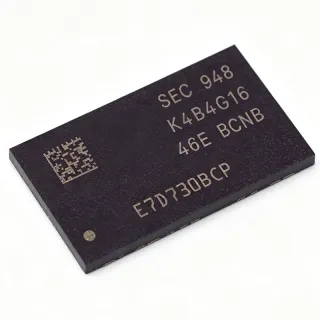
EPC2LC22N - 1.6Mb Altera Configuration PROM | PLCC-22
MPN: EPC2LC22N ✗ End of Life| Qty | Unit Price | Extended |
|---|---|---|
| 1 | $18.5 | $18.50 |
| 10 | $16.2 | $162.00 |
| 100 | $13.8 | $1,380.00 |
| 500 | $11.5 | $5,750.00 |
| 1,000 | $9.75 | $9,750.00 |
EPC2LC22N Overview
A configuration PROM is a non-volatile memory device that holds the FPGA's configuration bitstream. When the FPGA powers up, it reads its configuration data from a configuration PROM (typically via JTAG or a dedicated serial interface). Configuration PROMs belong to the broader category of non-volatile memory ICs and serve as boot memory for SRAM-based FPGAs (which lose their configuration when power is removed). The EPC2 family specifically targets Altera's legacy APEX, Mercury, ACEX, Cyclone, and Stratix FPGAs.
Key features of the EPC2LC22N include in-system programmability via IEEE 1149.1 (JTAG) boundary-scan, cascadable architecture for multi-device configuration chains, and low-power CMOS technology. The device supports Altera's serial configuration protocol and can be cascaded to support arbitrarily large bitstreams. The 2.5V core (LC designation) provides lower power consumption than the 5V and 3.3V variants in the EPC2 family.
The EPC2LC22N uses a 4-pin JTAG interface (TCK, TMS, TDI, TDO) for in-system programming, eliminating the need for a separate PROM programmer. The cascadable design allows multiple EPC2 devices to be chained together to configure FPGAs with bitstreams larger than 1.6 Mbits. The device includes an internal oscillator and timing control, simplifying board design by removing the need for external configuration clock generation.
Typical applications include legacy Altera APEX 20K / APEX II FPGA configuration, ACEX 1K boot memory, Mercury device support, and embedded systems requiring in-field FPGA reconfiguration via JTAG. The PLCC-22 through-hole package is suited for prototyping, legacy board designs, and applications where socketed configuration memory is preferred for field serviceability.
When designing with the EPC2LC22N, ensure the JTAG chain is properly terminated and the FPGA's MSEL pins are set to the correct configuration mode for serial PROM boot. Note that this part is now in legacy status and is replaced in many new designs by newer Cyclone/MAX series FPGAs with built-in flash configuration memory, eliminating the external PROM altogether.
This page synthesizes Intel/Altera datasheet information, distributor pricing, and drop-in compatible EPC2 family alternatives not found in a single manufacturer document, providing practical sourcing guidance for legacy FPGA design maintenance.
Drop-in alternatives for EPC2LC22N — same package, pin-to-pin compatible. Different-package parts requiring PCB rework are excluded.
Variants in this series
Same-series models that are drop-in compatible with EPC2LC22N (same form factor and footprint) — differing in Memory Type, Mounting Type, Interface, Package, Supply Voltage.
Quick Comparison Tool — Select alternative parts for side-by-side comparison:
EPC2LC21N
✅ Drop-In✓ In Stock
$10.95 / Unit
View Datasheet →EPC2LC22N Maximum Ratings & Electrical Characteristics
| Memory Type | Configuration PROM (non-volatile) |
| Memory Size | 1.6 Mbit |
| Supply Voltage | 2.5 V (LC core) |
| Interface | Serial configuration / JTAG (IEEE 1149.1) |
| Programmability | In-system programmable (ISP) via JTAG |
| Cascadable | Yes - supports multi-device configuration chains |
| Package | PLCC-22 (Plastic Leaded Chip Carrier) |
| Mounting Type | Surface Mount / Through Hole socket |
| Configuration Compatibility | Altera APEX, ACEX, Mercury, Cyclone, Stratix series FPGAs |
| JTAG Pins | TCK, TMS, TDI, TDO |
| Internal Oscillator | Yes (built-in configuration timing) |
| Status | Legacy / Obsolete (replaced by flash-based FPGA configuration) |
EPC2LC22N Pin Configuration
| Pin 1 | VCC — Core supply voltage (2.5V LC core) |
| Pin 2 | GND — Ground |
| Pin 3 | DATA — Serial data output to FPGA |
| Pin 4 | DCLK — Configuration clock output |
| Pin 5 | nCONFIG — Configuration control (input to PROM) |
| Pin 6 | nSTATUS — Configuration status (output from FPGA) |
| Pin 7 | CONFIG_DONE — Configuration complete signal |
| Pin 8 | nCE — Chip enable (active low) |
| Pin 9 | OE — Output enable |
| Pin 10 | TMS — JTAG test mode select |
| Pin 11 | TCK — JTAG test clock |
| Pin 12 | TDO — JTAG test data output |
| Pin 13 | TDI — JTAG test data input |
| Pin 14 | NC — Not connected (per datasheet) |
| Pin 15 | GND — Ground |
| Pin 16 | VCC — Core supply voltage (2.5V LC core) |
| Pin 17 | NC — Not connected (per datasheet) |
| Pin 18 | NC — Not connected (per datasheet) |
| Pin 19 | NC — Not connected (per datasheet) |
| Pin 20 | RESET — Reset input (active low) |
| Pin 21 | NC — Not connected (per datasheet) |
| Pin 22 | NC — Not connected (per datasheet) |
Typical Applications
EPC2LC22N is suitable for 6 applications: Altera APEX 20K Series FPGA Configuration, ACEX 1K FPGA Boot Memory, Mercury Device Configuration Support, Cyclone Series Legacy Configuration, Stratix Configuration Memory, In-Field FPGA Reconfiguration Systems.
Altera APEX 20K Series FPGA Configuration
The EPC2LC22N's 1.6 Mbit non-volatile memory matches the configuration bitstream size of Altera APEX 20K and APEX II FPGAs, providing instant-on boot memory that survives power cycles. According to the EPC2 datasheet, the LC core's 2.5V supply aligns with APEX 20K's auxiliary supply rail, simplifying board power design. The JTAG-based ISP enables field firmware updates without removing the device from its socket - critical for industrial APEX systems still in service.
Recommended
ACEX 1K FPGA Boot Memory
The EPC2LC22N serves as boot memory for legacy ACEX 1K FPGAs (EP1K, EP1KA series) with configuration data up to 1.6 Mbit. The cascadable architecture supports multi-device configuration chains for larger ACEX bitstreams exceeding single-PROM capacity. According to Altera configuration guides, the LC core's low power consumption reduces standby draw in ACEX-based embedded systems where thermal envelope is constrained.
Recommended
Mercury Device Configuration Support
The EPC2LC22N configures Altera Mercury series FPGAs (EP1M series) used in high-speed communication and signal processing applications. According to the EPC2 datasheet, the JTAG-based ISP allows field upgrades of Mercury bitstreams in deployed telecom and test equipment, extending the service life of legacy infrastructure. The PLCC-22 socketed form factor simplifies field replacement of failed configuration memory.
Recommended
Cyclone Series Legacy Configuration
Although Cyclone series FPGAs (EP1C, EP1C3) have internal configuration modes, the EPC2LC22N provides external boot memory for designs requiring the security of off-chip configuration storage. According to Altera's Cyclone configuration handbook, the EPC2LC22N's JTAG programming matches Cyclone's JTAG chain, enabling shared ISP infrastructure. This is useful in defense and aerospace applications where external configuration is preferred.
Recommended
Stratix Configuration Memory
For Stratix FPGA designs requiring multi-device configuration chains, the EPC2LC22N serves as one node in a cascaded EPC2 family chain, supporting bitstreams larger than 1.6 Mbit. According to the EPC2 datasheet, the LC core's low power consumption is particularly valuable in Stratix systems where thermal budget is tight. The cascadable design enables Stratix EP1S and EP1SE series boot support with multiple PROMs.
Recommended
In-Field FPGA Reconfiguration Systems
The EPC2LC22N's in-system programmability via IEEE 1149.1 JTAG enables in-field FPGA reconfiguration for industrial, military, and aerospace systems where physical PROM replacement is impractical. According to Altera's configuration documentation, JTAG-based ISP supports remote firmware updates via JTAG-over-Ethernet bridges. The PLCC-22 socketed package still allows manual extraction when needed for lab programming.
Recommended
Recommended Products Summary
Engineering reference data for EPC2LC22N — comparison, design guidance, and compliance information.
Selection Guide
Comparison with Alternatives
| Parameter | This Product | EPC2LC21N | EPC2LC20N | EPC2L20N |
|---|---|---|---|---|
| Brand | Altera | Altera | Altera | Altera |
| Package | PLCC-22 | PLCC-22 | PLCC-20 | PLCC-20 |
| Memory Size | 1.6 Mbit | 1.6 Mbit | 1.6 Mbit | 1.6 Mbit |
| Core Voltage | 2.5 V (LC) | 2.5 V (LC) | 2.5 V (LC) | 3.3 V (L) |
| JTAG ISP | Yes | Yes | Yes | Yes |
| Cascadable | Yes | Yes | Yes | Yes |
| Speed Grade | Standard | Faster | Standard | Standard |
| Lifecycle Status | Obsolete | Obsolete | Obsolete | Obsolete |
Key Differentiators
- Lower 2.5V core supply vs 3.3V L variants (vs EPC2L20N)
- Larger PLCC-22 package for thermal dissipation (vs EPC2LC20N)
- Same PLCC-22 footprint as EPC2LC21N (vs EPC2LC21N)
Design Notes
The EPC2LC22N's LC core operates at 2.5V, drawing approximately 50 mA active and 100 uA standby according to the EPC2 datasheet. Ensure the 2.5V rail is decoupled with at least 0.1 uF ceramic plus 10 uF bulk capacitance within 1 inch of the VCC pins. Estimated: total standby power is 0.25 mW, which is negligible but indicates the LC variant's advantage over the 3.3V L variant for low-power designs.
Place the EPC2LC22N within 2 inches of the target FPGA to minimize configuration clock (DCLK) trace length and avoid signal integrity issues. Route JTAG signals (TCK, TMS, TDI, TDO) in a single JTAG chain with the FPGA, using 4.7k pull-ups on TCK/TMS/TDI as recommended by the IEEE 1149.1 specification. The PLCC-22 socket footprint should include provisions for manual extraction without PCB rework.
Do not confuse the EPC2LC22N (2.5V core) with the EPC2L20N (3.3V core) - both have 'LC' or 'L' suffixes that differ by only one letter but require different supply voltages. Mixing them will damage the PROM. According to the Altera datasheet, the EPC2 family uses LC = 2.5V, L = 3.3V, and PC = 5V designations. Verify the exact suffix before placing orders for legacy stock.
Compliance Information
Compliance status not specified in verified web data. Altera EPC2 family was originally released in early 2000s, predating widespread RoHS transition; many legacy parts are non-RoHS. Verify with distributor before placing orders for RoHS-restricted markets.