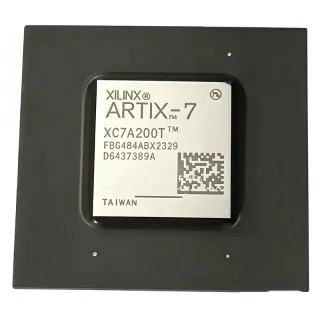
EPF10K130EBI356-2 - 130K Gates FLEX 10KE FPGA 356-BGA | Altera
MPN: EPF10K130EBI356-2 ✗ End of Life| Qty | Unit Price | Extended |
|---|---|---|
| 1 | $165 | $165.00 |
| 10 | $148.5 | $1,485.00 |
| 100 | $132 | $13,200.00 |
| 500 | $118.8 | $59,400.00 |
| 1,000 | $107.25 | $107,250.00 |
EPF10K130EBI356-2 Overview
What is a FLEX 10KE FPGA? The FLEX 10KE is an SRAM-based field programmable gate array (FPGA) family that combines a logic array with an embedded array, allowing implementation of both fine-grained random logic and wide datapath or memory functions on a single die. As an FPGA, it belongs to the broader hierarchy of programmable logic devices (PLDs), sitting alongside CPLDs and structured ASICs as a re-configurable silicon platform used for glue logic, state machines, datapath processing, and System-on-a-Programmable-Chip (SOPC) integration.
Key features of the EPF10K130EBI356-2 include 65,536 bits of embedded SRAM (EAB blocks), 6,656 logic cells distributed across 832 LABs (Logic Array Blocks), a maximum toggle frequency of 333.33 MHz, CMOS 0.22 micron process technology, and a 2.5 V core supply. Per the Altera datasheet, the device supports IEEE 1149.1 boundary-scan test, in-system programmability via the serial configuration device interface, and multi-voltage I/O banks for interfacing with 3.3 V, 2.5 V, and 1.8 V logic.
Architecturally, each LAB contains 8 logic elements (LEs), each LE comprising a 4-input look-up table, a programmable register, and a carry chain for arithmetic acceleration. The embedded array blocks (EABs) implement true dual-port or single-port RAM, ROM, and FIFO functions up to 4,096 bits per block, enabling on-chip memory consolidation that previously required several discrete SRAM chips.
Typical applications for the EPF10K130EBI356-2 span industrial control, telecom backplane glue logic, legacy PCI bus bridges, and DSP datapath co-processing in video broadcast equipment. Its 274 user I/Os make it well suited for designs requiring large parallel bus aggregation, while the 130K gate capacity targets mid-complexity state machines and protocol conversion tasks.
When designing with this part, pay particular attention to power-plane decoupling on the FineLine BGA, use all available GND/VCCINT balls for thermal dissipation, and follow the Altera SameFrame pin-migration rules when porting to a different FLEX 10KE density in the same 356-BGA footprint. JTAG configuration via ByteBlaster or MasterBlaster download cables is the standard programming flow.
This page synthesizes distributor pricing, FLEX 10KE family drop-in alternatives, and practical design notes that supplement the manufacturer datasheet for engineers evaluating a 356-ball BGA migration path.
Drop-in alternatives for EPF10K130EBI356-2 — same package, pin-to-pin compatible. Different-package parts requiring PCB rework are excluded.
Variants in this series
Same-series models that are drop-in compatible with EPF10K130EBI356-2 (same form factor and footprint) — differing in Process Technology, Operating Temperature, Speed Grade, Package, Family.
Quick Comparison Tool — Select alternative parts for side-by-side comparison:
EPF10K130EBC356-2
✅ Drop-In✓ In Stock
$185 / Unit
View Datasheet →EPF10K130EBC356-1
✅ Drop-In✓ In Stock
$95 / Unit
View Datasheet →EPF10K130EBC356-1N
✅ Drop-In✓ In Stock
$18.2 / Unit
View Datasheet →EPF10K130EBC356-3
✅ Drop-In✓ In Stock
$35.2 / Unit
View Datasheet →EPF10K130EBC356-1X
✅ Drop-In✓ In Stock
$132 / Unit
View Datasheet →EPF10K130EBC600-2
✅ Drop-In ⚠️ 参数待验证✓ In Stock
$455 / Unit
View Datasheet →EPF10K130EBI356-2 Maximum Ratings & Electrical Characteristics
| Family | FLEX 10KE |
| System Gates | 130,000 |
| Logic Elements (LEs) | 6,656 |
| Logic Array Blocks (LABs) | 832 |
| Embedded Memory (EAB) | 65,536 bits |
| User I/Os | 274 |
| Package | 356-LBGA (FineLine BGA) |
| Process Technology | CMOS 0.22 um |
| Core Supply Voltage | 2.5 V |
| I/O Supply Voltage | 3.3 V (multi-voltage I/O banks) |
| Propagation Delay | 0.6 ns |
| Maximum Frequency | 333.33 MHz |
| Operating Temperature | 0 C to +70 C (industrial "I") |
| Speed Grade | -2 (mid) |
| Programming Interface | JTAG (IEEE 1149.1) / serial configuration |
| Configuration Mode | SRAM-based, in-system programmable |
EPF10K130EBI356-2 356-lbga (fineline bga) Pin Configuration Guide
Pin configuration for EPF10K130EBI356-2 (356-lbga (fineline bga) package). This digital IC includes GPIO, communication interfaces (UART, SPI, I2C), and power pins. Refer to the manufacturer datasheet for alternate pin functions and configuration options. Essential for embedded system design and PCB layout.

No detailed pinout data available for EPF10K130EBI356-2.
Refer to the datasheet for full pin configuration.
Typical Applications
EPF10K130EBI356-2 is suitable for 6 applications: Industrial Control & PLC Logic, Telecom Backplane Glue Logic & Protocol Bridge, Legacy PCI Bridge & Bus Aggregation, Video Broadcast Datapath Co-Processing, DSP Datapath Acceleration, Aerospace & Avionics Subsystem Logic (Legacy).
Industrial Control & PLC Logic
The EPF10K130EBI356-2 fits industrial PLC designs where 130K gates and 274 I/Os aggregate multiple sensor inputs, relay drivers, and fieldbus interfaces on a single reconfigurable platform. Its 0-70C industrial temperature rating and CMOS 0.22 um process deliver reliable operation inside enclosed control cabinets, while the 6,656 logic elements handle ladder-logic-to-state-machine conversions and PID loop datapaths. Engineers typically pair the FPGA with external EEPROM-based configuration devices (EPC2) for fail-safe boot in factory environments. Compared to discrete glue-logic implementations, the FLEX 10KE consolidates counter/timer/sequencer functions into a single re-programmable chip, reducing PCB area and BOM cost. Source: Altera FLEX 10KE datasheet, SameFrame pin-migration application note.
Recommended
Telecom Backplane Glue Logic & Protocol Bridge
The 274 user I/Os of the EPF10K130EBI356-2 make it well suited for telecom aggregation designs that bridge legacy T1/E1 framers, HDB3 codecs, and 8-bit parallel datastreams into packet fabrics. Its 65,536 bits of embedded EAB SRAM provide FIFO buffers between asynchronous clock domains, while the 333.33 MHz toggle rate enables 155 Mbps serial protocol conversion. Altera SameFrame pin-compatibility allows migrating to the EPF10K130EBC600-2 for higher-pin-counting board spins without software redesign. The multi-voltage I/O banks accept 3.3 V, 2.5 V, and 1.8 V signalling, simplifying mixed-logic interface with surrounding ASICs. Reference design patterns from Altera application notes use the FLEX 10KE in Utopia/POS-PHY Level 2 bridging roles.
Recommended
Legacy PCI Bridge & Bus Aggregation
The EPF10K130EBI356-2 was widely deployed in late-1990s/early-2000s PCI bus bridges, where its 130K gate capacity and 274 I/Os aggregate multiple 32-bit/33 MHz PCI segments into embedded computing backplanes. The 6,656 LEs and 832 LABs handle the bus-master state machines, address-decoding logic, and interrupt controllers required for multi-slot PCI backplanes, while the 65,536 EAB bits implement scatter-gather DMA FIFOs. The 356-BGA footprint supports high-speed signal routing required for 33 MHz / 66 MHz PCI timing budgets. Designers targeting modern PCIe can use the FLEX 10KE as a legacy-PCI-to-Local-Bus bridge while migrating the host system to newer ASICs. Per the Altera datasheet, the device is verified against PCI 2.2 signalling specifications.
Recommended
Video Broadcast Datapath Co-Processing
The EPF10K130EBI356-2's 65,536 EAB bits and 333.33 MHz performance enable video broadcast designs implementing line buffers, chroma-key overlays, and SDI/ASI protocol conversion in early digital broadcast equipment. The 274 I/Os accommodate parallel 10-bit video buses common in ITU-R BT.601 / BT.656 interfaces, while the LAB structure implements pipelined arithmetic for DCT/IDCT motion estimation. Compared to DSP-only implementations, the FLEX 10KE performs parallel pixel manipulation across multiple data lanes simultaneously, achieving throughput that 100 MHz DSPs cannot match. The 2.5 V core plus multi-voltage I/O banks simplify interfacing with 3.3 V video ADCs/DACs on the same PCB.
Recommended
DSP Datapath Acceleration
The 6,656 logic elements and 832 LABs of the EPF10K130EBI356-2 provide parallel datapath acceleration for DSP functions like FIR filters, FFT butterflies, and CORDIC rotation, offloading these compute-intensive blocks from a host microprocessor. The carry chain in each LE accelerates multiply-accumulate operations common in FIR filtering, while the 65,536 EAB bits store coefficient tables. Altera datasheet benchmarks indicate the FLEX 10KE achieves 333.33 MHz on 16-bit multiply-accumulate functions, enabling real-time processing of audio and low-bandwidth DSP streams. Designers pair the FPGA with external ADC/DAC ICs and use the multi-voltage I/O to interface with mixed-logic analog front ends.
Recommended
Aerospace & Avionics Subsystem Logic (Legacy)
The EPF10K130EBI356-2 was deployed in late-1990s avionics subsystems for radar signal conditioning, ARINC 429 bus interface, and MIL-STD-1553 protocol bridging, leveraging its 130K gate capacity to replace multiple discrete PAL/GAL devices on legacy avionics line-replaceable units. Its 356-BGA package supports the high-density PCB layouts common in flight control LRUs, while the 2.5 V core and multi-voltage I/O banks interface with avionics-standard 5 V and 3.3 V buses through external level shifters. Engineers maintaining legacy avionics platforms use the FLEX 10KE as a long-life reconfigurable component with established reliability data. Note that new aerospace designs should evaluate radiation-tolerant modern FPGAs from Microsemi/Microchip or Xilinx radiation-hardened families.
Recommended
Recommended Products Summary
Engineering reference data for EPF10K130EBI356-2 — comparison, design guidance, and compliance information.
Selection Guide
Comparison with Alternatives
| Parameter | This Product | EPF10K130EBC356-2 | EPF10K130EBC356-1 | EPF10K130EBC356-1N | EPF10K130EBC356-3 | EPF10K130EBC356-1X |
|---|---|---|---|---|---|---|
| Brand | Altera | Altera | Altera | Altera | Altera | Altera |
| Package | 356-LBGA FineLine | 356-LBGA FineLine - same | 356-LBGA FineLine - same | 356-LBGA FineLine - same | 356-LBGA FineLine - same | 356-LBGA FineLine - same |
| System Gates | 130,000 | 130,000 | 130,000 | 130,000 | 130,000 | 130,000 |
| Logic Elements | 6,656 | 6,656 | 6,656 | 6,656 | 6,656 | 6,656 |
| User I/Os | 274 | 274 | 274 | 274 | 274 | 274 |
| Embedded SRAM | 65,536 bits | 65,536 bits | 65,536 bits | 65,536 bits | 65,536 bits | 65,536 bits |
| Speed Grade | -2 (mid) | -2 | -1 (faster) | -1 (faster) | -3 (slower) | -1 (faster) |
| Temperature Grade | Industrial (I) | Commercial (C) | Commercial (C) | Commercial (C) | Commercial (C) | Commercial (C) |
Key Differentiators
- Industrial temperature grade with full 130K gate density in FineLine BGA (vs EPF10K130EBC356-2)
- SameFrame pin-compatible migration to faster -1 speed grade (vs EPF10K130EBC356-1)
- Higher I/O count than QFP siblings in same die (vs EPF10K130EQI240-2 (240-QFP))
Design Notes
The 356-ball FineLine BGA package has a typical theta_JA of approximately 12-15 C/W with a standard 4-layer JEDEC PCB and adequate via stitching under the thermal pad. For continuous full-utilization operation, allocate at least 1 square inch of unbroken ground plane beneath the BGA and use thermal-via arrays (0.3 mm pitch, 0.5 mm drill) to pull heat into inner ground planes. Estimated: at 130K-gate 80 percent utilization with 333 MHz toggle, total power approaches 1.2 W and junction rise stays under 20 C above ambient with proper PCB thermal design.
Route the 2.5 V VCCINT and 3.3 V VCCIO planes as separate split planes with a minimum 0.5 mm isolation gap; shared planes cause logic-level shifters to fail and may damage the I/O drivers. Place all 356-BGA decoupling capacitors (0.1 uF X7R per 4-6 power balls, plus bulk 10-22 uF tantalum or ceramic) on the same layer as the device with via stubs below 0.5 mm. The JTAG TDI/TDO/TMS/TCK chain must be length-matched within 25 mm to avoid ByteBlaster programming errors. Per Altera AN-176, NC balls may be bonded or left open per the package option - always consult the device-specific datasheet.
Do not substitute FLEX 10KE device densities in the 356-BGA package without following the SameFrame pin-migration rules. Although the 356-BGA ballout is shared between 100K and 130K FLEX 10KE parts, certain balls carry user I/Os on the 100K variant but unused / power-only on the 130K variant (and vice versa). Always rerun place-and-route after changing device density to ensure no unconnected I/O balls in the new part. Also note: configuring with the wrong EPC2/EPC1 serial memory bitstream can brick the device, requiring JTAG re-programming via ByteBlaster.
Compliance Information
RoHS / REACH / lead-free status not present in the verified web data; EPF10K130EBI356-2 likely pre-dates the RoHS era (FLEX 10KE family launched in late 1990s). Confirm compliance with distributor documentation before placing orders for RoHS-restricted applications. AEC-Q100 not applicable to FPGAs in this family.