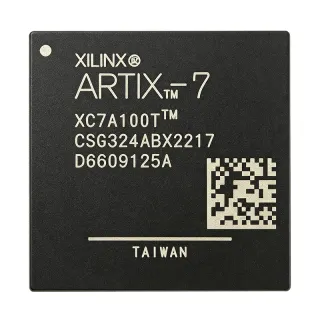
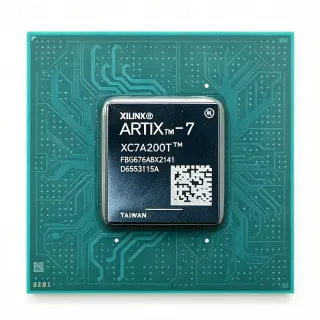
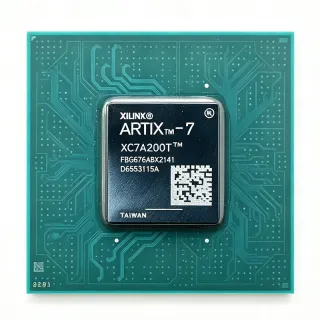
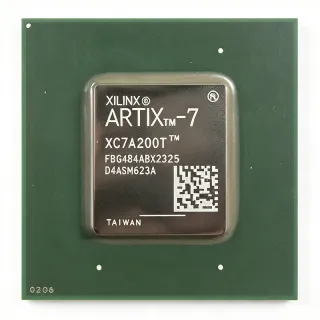
EP3C80F780C8N - 81K LE Cyclone III FPGA, 780-FBGA | Intel / Altera
MPN: EP3C80F780C8N ✓ Active| Qty | Unit Price | Extended |
|---|---|---|
| 1 | $350.75 | $350.75 |
| 10 | $320.4 | $3,204.00 |
| 100 | $285.1 | $28,510.00 |
| 250 | $260.55 | $65,137.50 |
| 500 | $240.2 | $120,100.00 |
EP3C80F780C8N Overview
A Field Programmable Gate Array (FPGA) is a reconfigurable digital integrated circuit that combines programmable Look-Up Tables (LUTs), programmable interconnect, embedded block RAM, DSP blocks, and high-speed transceiver/PLL resources on a single die. FPGAs belong to the broader hierarchy: programmable logic -> logic IC -> integrated circuit. Compared with ASICs, FPGAs offer lower NRE cost, faster time-to-market, and field re-programmability, which is why engineers choose them for prototyping, low-volume production, and designs that need late-stage I/O or protocol updates.
Key features of the EP3C80F780C8N include four phase-locked loops (PLLs), 244 embedded 18x18 multipliers (DSP blocks) suitable for moderate DSP workloads, and support for multiple I/O standards (LVDS, LVTTL, LVCMOS, SSTL, HSTL, PCI, PCI-X). It offers Nios II embedded processor support and is supported by the Quartus II design toolchain (Cyclone III device family). The 780-FBGA package has a 29x29 mm body, 1.0 mm ball pitch, and 2.60 mm height, easing PCB escape routing relative to finer-pitch BGA options.
Typical applications span industrial motor control, video surveillance and image processing, automotive infotainment, telecom line cards, and handheld test equipment. Designers favor the Cyclone III family for its low static and dynamic power versus older families, which simplifies thermal budgets in fanless enclosures.
When designing with this part, validate that the 1.0 mm pitch FBGA can be manufactured with your PCB fab's BGA capability. Use Quartus II 13.0sp1 or later for synthesis, and plan the decoupling network around the PLL analog supply pins (VCCA_PLL) with a 0.1 uF + 10 uF combination for jitter performance.
This page synthesizes distributor pricing, drop-in same-package alternatives within the Cyclone III family, and practical board-level guidance not found in the manufacturer datasheet alone.
Drop-in alternatives for EP3C80F780C8N — same package, pin-to-pin compatible. Different-package parts requiring PCB rework are excluded.
Variants in this series
Same-series models that are drop-in compatible with EP3C80F780C8N (same form factor and footprint) — differing in Package, Process Technology, Speed Grade, Logic Elements (LE), Total Memory Bits.
Quick Comparison Tool — Select alternative parts for side-by-side comparison:
EP3C80F780C8
✅ Drop-In✓ In Stock
$220 / Unit
View Datasheet →EP3C80F780C7N
✅ Drop-In✓ In Stock
$260 / Unit
View Datasheet →EP3C80F780C6N
✅ Drop-In✓ In Stock
$330.2 / Unit
View Datasheet →EP3C120F780C8N
✅ Drop-In✓ In Stock
Contact for price
View Datasheet →EP3C120F780C7N
✅ Drop-In✓ In Stock
$162 / Unit
View Datasheet →EP3C55F780C8N
✅ Drop-In✓ In Stock
$58.2 / Unit
View Datasheet →EP4CE80F780C8N
✅ Drop-In📋 Reference alternative (not in catalog)
EP3C80F780C8N Maximum Ratings & Electrical Characteristics
| Family | Cyclone III |
| Device Type | FPGA - Field Programmable Gate Array |
| Logic Elements | 81,264 |
| Total RAM Bits | 2,810,880 bits |
| Embedded Multipliers | 244 (18x18) |
| User I/O | 429 |
| PLLs | 4 |
| Internal Frequency (max) | 472 MHz |
| Number of Pins | 780 |
| Package | 780-BGA (FBGA), 29 x 29 mm, 1.0 mm pitch |
| Package Height | 2.60 mm |
| Mounting Type | Surface Mount |
| Lead Free / RoHS | Yes (lead-free) |
| Process Node | 60 nm TSMC low-k |
| Operating Temperature Grade | Commercial (C) |
| Speed Grade | 8 |
EP3C80F780C8N Pin Configuration
| Pin 1 | I/O — General-purpose user I/O (bank depends on package position) |
| Pin 100 | I/O — General-purpose user I/O |
| Pin 200 | I/O — General-purpose user I/O |
| Pin 300 | I/O — General-purpose user I/O |
| Pin 400 | I/O — General-purpose user I/O |
| Pin 500 | I/O — General-purpose user I/O |
| Pin 600 | I/O — General-purpose user I/O |
| Pin 700 | I/O — General-purpose user I/O |
| Pin 780 | I/O — General-purpose user I/O |
Typical Applications
EP3C80F780C8N is suitable for 6 applications: Industrial Motor Control, Video Surveillance and Image Processing, Automotive Infotainment, Telecom Line Cards, Handheld Test and Measurement Equipment, Display Controller / Panel Timing.
Industrial Motor Control
The EP3C80F780C8N fits industrial motor control with 81,264 logic elements and 244 embedded 18x18 multipliers to implement field-oriented control (FOC) and space-vector PWM at high switching frequencies. The 429 user I/O pins let engineers route 3-phase gate signals, encoder feedback (QEP), and analog monitoring simultaneously, while 2,810,880 RAM bits hold lookup tables for sinusoidal commutation. Low Cyclone III static power enables fanless DIN-rail enclosures; the 472 MHz internal frequency is ample for closed-loop cycle times under 5 us. Designers commonly pair this FPGA with external ADC/DAC companions for current sensing and gate driving, and migrate the same 780-FBGA design across EP3C80/EP3C120 densities.
Recommended
Video Surveillance and Image Processing
The EP3C80F780C8N's 244 DSP blocks and 2.8 Mbits of block RAM make it a strong fit for multi-channel video processing pipelines at surveillance NVR/DVR endpoints. Engineers implement Sobel, motion detection, and H.264 ancillary pre-processing directly in fabric; the 429 I/O support multiple camera-link or MIPI CSI-2 bridges. Cyclone III low static power simplifies thermal design in fanless dome enclosures, and the 1.0 mm 780-FBGA package fits compact camera boards. Designers typically co-employ external DDR-2/DDR-3 memory controllers and select EP3C120F780C8N when neural pre-filter blocks are added.
Recommended
Automotive Infotainment
Automotive infotainment head units often use the EP3C80F780C8N to drive TFT-LCD timing controllers, touch-screen interfaces, and CAN/LIN gateways while running a Nios II soft processor for application logic. The 472 MHz fabric supports full 1080p LVDS video passthrough; 429 I/O accommodate multi-display output, audio I2S buses, and vehicle network bridges. Designers choose Cyclone III for its low power envelope relative to the operating environment. The 780-FBGA simplifies multi-layer PCB routing versus smaller packages; automotive-grade users migrate to the EP3C120F780I8N industrial-temp variant for harsher in-cabin thermal conditions.
Recommended
Telecom Line Cards
The EP3C80F780C8N supports telecom line-card applications where multiple E1/T1 or SERDES-equivalent framers, HDLC controllers, and timing-recovery PLLs are integrated alongside packet-classification logic. Its 4 PLLs deliver independent clock domains for TDM backplanes and Ethernet PHYs, while 2.8 Mbits of block RAM absorb jitter buffers for TDM-to-packet conversion. The 429 user I/O simplify routing of multi-span framers and LED status panels. Cyclone III's static power profile suits NEBS-compliant equipment with restricted cooling; engineers pair the FPGA with PHY companions and migrate to EP3C120F780C8N for higher-channel-count aggregation cards.
Recommended
Handheld Test and Measurement Equipment
Handheld oscilloscopes, logic analyzers, and field protocol testers benefit from the EP3C80F780C8N's high logic density and 472 MHz fabric to implement deep acquisition memory and on-the-fly protocol decoding. The 2,810,880 embedded RAM bits hold circular sample buffers; 244 DSP blocks accelerate FFT-based spectrum displays. The Cyclone III family's low static power supports battery-powered form factors; the 780-FBGA package, despite its size, lets engineers consolidate what would otherwise be multiple CPLDs. Designers pair the FPGA with high-speed ADC companions and migrate to EP3C120F780C8N when adding more simultaneous channels.
Recommended
Display Controller / Panel Timing
The EP3C80F780C8N acts as a flexible display controller generating custom timing for industrial TFT, OLED, and e-Paper panels that lack off-the-shelf bridge ICs. Its 81K logic elements drive multi-layer GUIs and 2D accelerators; 2.8 Mbits of block RAM store frame buffers for small panels without external memory. The 429 I/O accommodate LVDS, RGB888, and SPI/QSPI touch controllers. The Cyclone III device's 472 MHz fabric supports WUXGA (1920x1200) pixel clocks. Designers co-employ smaller Cyclone III siblings as touch co-processors and migrate to EP3C120F780C8N for 4K display-pipeline designs.
Recommended
Recommended Products Summary
Engineering reference data for EP3C80F780C8N — comparison, design guidance, and compliance information.
Selection Guide
Comparison with Alternatives
| Parameter | This Product | EP3C80F780C8 | EP3C80F780C7N | EP3C80F780C6N | EP3C120F780C8N | EP3C55F780C8N | EP4CE80F780C8N |
|---|---|---|---|---|---|---|---|
| Brand | Intel | Intel | Intel | Intel | Intel | Intel | Intel |
| Package | 780-FBGA, 1.0 mm pitch | 780-FBGA - same | 780-FBGA - same | 780-FBGA - same | 780-FBGA - same | 780-FBGA - same | 780-FBGA - same |
| Logic Elements | 81,264 | 81,264 | 81,264 | 81,264 | 119,088 | 55,856 | 80,000 |
| Speed Grade | C8 | C8 | C7 | C6 | C8 | C8 | C8 |
| RoHS / Lead-Free | Yes (N suffix) | No (leaded) | Yes | Yes | Yes | Yes | Yes |
| Family | Cyclone III | Cyclone III | Cyclone III | Cyclone III | Cyclone III | Cyclone III | Cyclone IV |
| Embedded RAM (bits) | 2,810,880 | 2,810,880 | 2,810,880 | 2,810,880 | 3,981,312 | 2,396,160 | 2,445,120 |
| Embedded Multipliers (18x18) | 244 | 244 | 244 | 244 | 288 | 156 | 200 |
| User I/O | 429 | 429 | 429 | 429 | 529 | 377 | 429 |
Key Differentiators
- Highest speed grade in the EP3C80 family in same package (vs EP3C80F780C7N)
- RoHS lead-free material set (vs EP3C80F780C8 (no N suffix))
- Lower-density option available in same 780-FBGA footprint (vs EP3C120F780C8N)
Design Notes
The 780-FBGA uses a 1.0 mm ball pitch, which requires 4+ mil trace width and laser-drilled microvias on most fabs. Plan the PCB stack-up with at least 8 layers so the FPGA escapes cleanly to inner planes; assign adjacent GND balls to a solid ground pour to control return paths for high-speed LVDS pairs. Always confirm with your PCB fab's BGA design rules before commitment.
Cyclone III core, I/O and PLL analog supplies (VCCINT, VCCIO, VCCA_PLL) each need decoupling: 0.1 uF X7R within 100 mil of every supply pin plus 10 uF bulk on each rail. VCCA_PLL in particular demands an RC low-pass filter (typical ferrite bead + 10 uF + 0.1 uF) to minimize PLL output jitter. Estimated: each VCCINT pin draws up to 1 A transient during configuration, so route wide pours.
Group I/O banks by voltage standard on the board to minimize level-shifter crossings: dedicate bank 1 to 3.3 V LVCMOS, bank 2 to 2.5 V SSTL memory, bank 3 to LVDS differential pairs, etc. Place reference voltage pins (VREF) of SSTL/HSTL banks near their I/O with 0.1 uF bypass. Configuration pins (MSEL, nCE, nCONFIG, DATA, DCLK) need careful trace length matching for JTAG stability.
Do not substitute EP3C80F780C8 (leaded) where the design calls for the RoHS 'N' suffix variant: reflow profile mismatch can damage the package. Also avoid mixing speed grades silently: a C7 device is not timing-equivalent to a C8 in a critical-path design. Always specify the exact suffix and speed grade on the BOM.
Compliance Information
RoHS compliant per the 'N' suffix in the MPN. AEC-Q100 not applicable for this FPGA family. REACH, halogen-free, and conflict-mineral status not explicitly stated in the provided data.