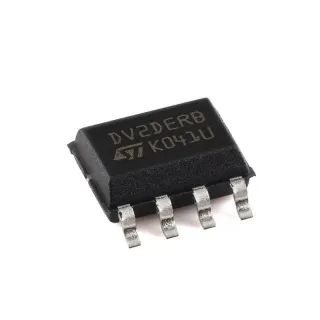
RS9116N-DB00-CC1-B2A - Dual-Band Wi-Fi + BT5 Module | Silicon Labs
MPN: RS9116N-DB00-CC1-B2A ✓ Active| Qty | Unit Price | Extended |
|---|---|---|
| 1 | $14.5 | $14.50 |
| 10 | $13.1 | $131.00 |
| 100 | $11.8 | $1,180.00 |
| 500 | $10.6 | $5,300.00 |
| 1,000 | $9.55 | $9,550.00 |
RS9116N-DB00-CC1-B2A Overview
A wireless connectivity module is a self-contained RF subsystem that integrates the radio transceiver, RF front end, crystal, and regulatory-certified antenna matching network into one certified unit. Modules sit above discrete SoCs in the system hierarchy (module -> RF subsystem -> connectivity IC -> wireless SoC) because they shorten time to market: the RF design is pre-validated, and FCC, IC, and ETSI/CE certifications carry over to the host product, eliminating costly in-house regulatory testing.
Key features include simultaneous 2.4 GHz and 5 GHz band support for 802.11n clients and access points, dual-mode Bluetooth 5 for classic and low-energy links, and host interfacing over SDIO or USB. The module is FCC, IC, and ETSI/CE certified, and Silicon Labs supplies drivers for Linux and other high-level operating systems. Power-optimized performance extends battery life in portable designs while maintaining extended range.
The -B2A suffix denotes the factory-preloaded firmware version, per the ordering information in the RS9116 CC1 datasheet; -B2B variants differ only in firmware. The RS9116N targets n-Link deployments, where the networking stack runs on the host Linux application processor and the module handles the wireless PHY/MAC. Operating modes include Wi-Fi Client, Wi-Fi Access Point, and Simultaneous Client plus Access Point, with up to 50 Mbps Wi-Fi application throughput per Silicon Labs n-Link documentation.
Typical applications include industrial gateways and routers, Linux-based embedded systems needing certified dual-band connectivity, medical and instrumentation devices streaming data over Wi-Fi with a Bluetooth 5 provisioning path, and smart-building infrastructure.
Design consideration: the module does not include an antenna, so an external antenna with matching 50-ohm feed must be selected and placed per the Silicon Labs layout guidance to preserve certification limits.
This page adds value beyond the datasheet by synthesizing distributor availability, drop-in firmware-variant alternatives, cross-brand comparison candidates, and practical design notes in one reference.
Drop-in alternatives for RS9116N-DB00-CC1-B2A — same package, pin-to-pin compatible. Different-package parts requiring PCB rework are excluded.
Variants in this series
Same-series models that are drop-in compatible with RS9116N-DB00-CC1-B2A (same form factor and footprint) — differing in Bluetooth Version.
Quick Comparison Tool — Select alternative parts for side-by-side comparison:
RS9116W-DB00-CC1-B2A
✅ Drop-In✓ In Stock
$13.6 / Unit
View Datasheet →RS9116N-DB00-CC1-B00
✅ Drop-In📋 Reference alternative (not in catalog)
RS9116W-DB00-CC0-B2A
✅ Drop-In📋 Reference alternative (not in catalog)
IW416
✅ Drop-In📋 Reference alternative (not in catalog)
BCM4343W
✅ Drop-In📋 Reference alternative (not in catalog)
RS9116N-DB00-CC1-B2A Specifications (manufacturer-published)
| Protocol | 802.11 a/b/g/n, 802.11j, dual-mode Bluetooth 5 |
| Frequency Bands | 2.4 GHz and 5 GHz (dual band) |
| Wi-Fi Throughput | Up to 50 Mbps application throughput (n-Link) |
| Bluetooth Version | Bluetooth 5.0 dual-mode (BR/EDR + LE) |
| Host Interface | SDIO or USB |
| Operating Modes | Wi-Fi Client, Wi-Fi AP, Simultaneous Client + AP |
| Antenna | Not included (external antenna required) |
| Mounting Type | Surface Mount |
| Regulatory Certification | FCC, IC, ETSI/CE |
| Firmware Preloaded | B2A factory firmware version |
| Driver Support | Linux and other high-level operating systems (n-Link) |
RS9116N-DB00-CC1-B2A Interfaces & Connectors
RS9116N-DB00-CC1-B2A exposes the following interfaces and connectors as published by the manufacturer: Wireless, Bluetooth. Expansion header pinout, connector pin numbering, and electrical limits are defined in the manufacturer documentation.
| Wireless | Up to 50 Mbps application throughput (n-Link) |
| Bluetooth | Bluetooth 5.0 dual-mode (BR/EDR + LE) |
Refer to the manufacturer documentation for the full expansion header pinout and connector pin numbering.
Typical Applications
RS9116N-DB00-CC1-B2A is suitable for 6 applications: Industrial IoT Gateways, Embedded Linux Boards and SBCs, Medical and Diagnostic Devices, Smart Building and Building Automation, Video and Surveillance Systems, Portable and Battery-Powered Devices.
Industrial IoT Gateways
The RS9116N-DB00-CC1-B2A fits industrial gateways because its n-Link architecture offloads nothing critical: the module handles 802.11 a/b/g/n on both 2.4 GHz and 5 GHz while the Linux gateway processor runs the full networking stack, supporting up to 50 Mbps application throughput. Dual-band operation lets the gateway avoid congested 2.4 GHz factory spectrum by using 5 GHz backhaul. FCC, IC, and ETSI/CE certification of the module shortens product certification timelines, and the simultaneous Client+Access-Point mode allows a device to both join an upstream network and serve local wireless sensors from one radio.
Recommended
Embedded Linux Boards and SBCs
For single-board computers and embedded Linux designs, the RS9116N-DB00-CC1-B2A connects over SDIO or USB, the two interfaces most commonly routed from application processors. Silicon Labs provides n-Link drivers for Linux, so the module integrates as a standard wireless device with the networking stack on the host. The 2.4/5 GHz dual-band 802.11n radio plus dual-mode Bluetooth 5 consolidates two connectivity functions into one certified footprint, saving board area. The B2A factory firmware ships production-ready, and firmware-only variants (-B2B) let teams update stacks without hardware changes.
Recommended
Medical and Diagnostic Devices
Connected medical instrumentation benefits from the module's certified RF subsystem: FCC, IC, and ETSI/CE certification of the RS9116N-DB00-CC1-B2A reduces the regulatory burden on the end device. The 5 GHz band supports clean high-throughput links for streaming waveform or image data, while dual-mode Bluetooth 5 provides a low-energy provisioning and telemetry channel. Power-optimized performance with extended range suits battery-powered portable diagnostics. Operating as a Wi-Fi Client under host control, the module keeps patient-data network policy enforcement on the host processor rather than in module firmware.
Recommended
Smart Building and Building Automation
Smart-building controllers use the RS9116N-DB00-CC1-B2A as both Wi-Fi Access Point for commissioning smartphones and Wi-Fi Client for cloud uplink, thanks to the simultaneous Client+AP operating mode documented in Silicon Labs n-Link material. Dual-mode Bluetooth 5 handles BLE beaconing and NFC-free device onboarding. The 5 GHz support allows coexistence planning in dense RF environments such as hotels and offices. Because the module is certified, panel builders can deploy the same PCB across regions, adjusting only the antenna to satisfy local market variants.
Recommended
Video and Surveillance Systems
Wireless camera nodes stream video over the module's 5 GHz 802.11n link, where the 50 Mbps n-Link application throughput supports compressed HD streams. The RS9116N-DB00-CC1-B2A attaches to the camera SoC via SDIO, keeping H.264 encoding and network stack on the host. Bluetooth 5 LE enables installation-time setup from a mobile app before the camera joins the 5 GHz network. Extended-range, power-optimized RF characteristics help reach outdoor APs, and the certified module design avoids per-camera RF recertification.
Recommended
Portable and Battery-Powered Devices
The power-optimized performance profile of the RS9116N-DB00-CC1-B2A extends battery life in portable instruments and data loggers. The host can place the module in low-power states between transmission windows while retaining the Bluetooth 5 LE channel for wake-on-connect scenarios. Dual-band Wi-Fi lets the device select the least-congested band for reliable uploads in crowded environments. Since the module is drop-in compatible across firmware variants, a single PCB serves both Wi-Fi-first (n-Link) and MCU-based (WiSeConnect) product tiers, amortizing layout and certification cost across a product family.
Recommended
Recommended Products Summary
Engineering reference data for RS9116N-DB00-CC1-B2A — comparison, design guidance, and compliance information.
Selection Guide
Comparison with Alternatives
| Parameter | This Product | RS9116W-DB00-CC1-B2A | RS9116N-DB00-CC1-B00 | IW416 | BCM4343W |
|---|---|---|---|---|---|
| Brand | Silicon Labs | Silicon Labs | Silicon Labs | NXP Semiconductors | Broadcom |
| Wi-Fi Bands | 2.4 GHz + 5 GHz | 2.4 GHz + 5 GHz | 2.4 GHz + 5 GHz | 2.4 GHz + 5 GHz | 2.4 GHz (single band) |
| Wi-Fi Standards | 802.11 a/b/g/n + 802.11j | 802.11 a/b/g/n | 802.11 a/b/g/n | 802.11 a/b/g/n | 802.11 b/g/n |
| Bluetooth | Dual-mode Bluetooth 5.0 | Dual-mode Bluetooth 5 | Dual-mode Bluetooth 5 | Bluetooth 5 | Bluetooth 4.x (older) |
| Host Interface | SDIO or USB | SDIO or USB | SDIO or USB | SDIO 3.0 / PCIe / UART | SDIO + UART |
| Software Stack | n-Link (host/Linux) | WiSeConnect (embedded) | n-Link (host/Linux) | NXP driver stack | Broadcom/Cypress driver stack |
Key Differentiators
- Dual-band (2.4/5 GHz) plus 802.11j in one module (vs BCM4343W)
- Current-generation Bluetooth 5.0 dual-mode (vs BCM4343W)
- Firmware-only variant flexibility (vs RS9116W-DB00-CC1-B2A)
Design Notes
The module does not include an antenna, so the external antenna choice directly determines range and certification compliance. Use a 50-ohm controlled-impedance feed line from the module RF pad to the antenna connector or chip antenna, keep the feed as short as practical, and reserve a ground keep-out and matching-network footprint (series/shunt pads) so minor detuning from enclosure effects can be corrected. Follow the Silicon Labs CC1 module layout guidance in the RS9116 CC1 datasheet to stay within FCC, IC, and ETSI/CE emission masks.
Wi-Fi TX bursts draw significant peak current from the 3.3 V-class supply rail; dimension the host regulator and bulk capacitance so rail droop during 802.11n TX bursts does not reset the module. Place a low-ESR bulk capacitor near the module supply pins in addition to the decoupling recommended in the datasheet. Verify the rail during simultaneous Client+AP operation, where TX duty cycle is highest, and confirm the host can service SDIO/USB traffic at the expected throughput before committing the layout.
Ordering the wrong firmware suffix is the most common mistake: -B2A and -B2B differ only in factory-preloaded firmware (confirmed by Silicon Labs community support, June 2025), and N-family (n-Link, host-stack) versus W-family (WiSeConnect, embedded-stack) parts are not interchangeable in software despite identical hardware. Confirm your software architecture (Linux host vs MCU) before selecting the MPN suffix, and check datasheet Section 8.4 Ordering Information for the exact variant mapping.
Compliance Information
Module carries FCC, IC, and ETSI/CE radio certifications per Silicon Labs product page. Environmental compliance (RoHS/REACH) not stated in provided web data.