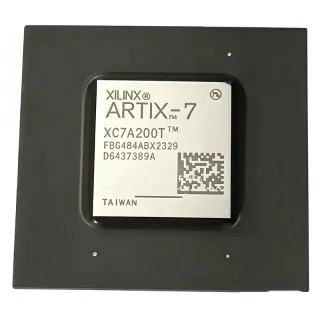
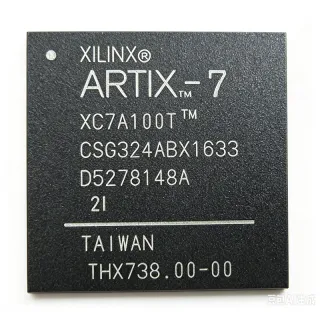
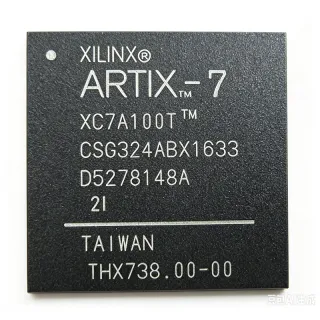
EP4CGX22BF14C8N - Cyclone IV GX FPGA, 22K LE, 169-LBGA | Intel
MPN: EP4CGX22BF14C8N ✓ Active| Qty | Unit Price | Extended |
|---|---|---|
| 1 | $36.5 | $36.50 |
| 10 | $33.2 | $332.00 |
| 100 | $28.95 | $2,895.00 |
| 500 | $24.6 | $12,300.00 |
| 1,000 | $21.4 | $21,400.00 |
EP4CGX22BF14C8N Overview
A Field-Programmable Gate Array (FPGA) is a semiconductor device containing programmable logic blocks, interconnect, and I/O that designers can reconfigure after manufacture. Cyclone IV GX sits in the FPGA family hierarchy: Cyclone IV GX -> Cyclone IV -> Cyclone family -> low-power FPGA -> programmable logic device -> semiconductor. The 'GX' suffix denotes integrated transceivers, distinguishing it from the Cyclone IV E (logic-only) and Cyclone IV GX variants used in communication and bridging roles.
Key features include 21,280 logic elements, 594 Kbits of embedded RAM (M9K blocks), 72 18x18 multipliers supporting DSP up to 260 MHz, two PLLs, and up to 83 user I/O pins. The transceiver block supports PCIe Gen1 hard IP plus 3.125 Gbps serial links, enabling protocol bridging, I/O expansion, and chip-to-chip interfacing without external PHY ICs.
The architecture is built on a 60 nm process node with a 1.2 V core supply. Its low-power positioning makes it attractive for high-volume, cost-sensitive products that still require programmable logic and serial connectivity. The device supports commercial temperature grades (0C to +85C) per the 'C' speed-grade suffix, with industrial variants distinguished by an 'I' suffix.
Typical applications include industrial control, broadcast video bridging, low-cost PCIe endpoint cards, USB 3.0 / SATA sideband logic, motor control, and automotive infotainment pre-processing. The combination of integrated transceivers, embedded memory, and DSP blocks makes the EP4CGX22 a versatile glue-logic and protocol-conversion engine.
A critical design consideration is power-rail sequencing: the Cyclone IV GX requires well-regulated 1.2 V core, 2.5 V analog PLL, and 3.3 V I/O supplies with specific ramp-order requirements. Designers must follow Intel's reference schematics and the Quartus Prime pin-planner to avoid configuration failures.
This page synthesizes distributor pricing, same-package Cyclone IV GX variants, and practical design notes not found in the manufacturer datasheet alone, helping engineers shorten the selection cycle for volume FPGAs in the Cyclone IV family.
Drop-in alternatives for EP4CGX22BF14C8N — same package, pin-to-pin compatible. Different-package parts requiring PCB rework are excluded.
Variants in this series
Same-series models that are drop-in compatible with EP4CGX22BF14C8N (same form factor and footprint) — differing in Package, Transceivers, RoHS Status, Operating Temperature, Speed Grade.
Quick Comparison Tool — Select alternative parts for side-by-side comparison:
EP4CGX22BF14C7N
✅ Drop-In✓ In Stock
$39.48 / Unit
View Datasheet →EP4CGX22BF14C8
✅ Drop-In✓ In Stock
$24.2 / Unit
View Datasheet →EP4CGX22BF14C6N
✅ Drop-In✓ In Stock
$42.14 / Unit
View Datasheet →EP4CGX22BF14C6
✅ Drop-In✓ In Stock
$17.9 / Unit
View Datasheet →EP4CGX22BF14C7
✅ Drop-In✓ In Stock
$23.6 / Unit
View Datasheet →EP4CGX15BF14C8N
✅ Drop-In✓ In Stock
$18.5 / Unit
View Datasheet →EP4CGX22BF14C8N Maximum Ratings & Electrical Characteristics
| Series | Cyclone IV GX |
| Family | Cyclone IV |
| Logic Elements (LE) | 21,280 |
| Embedded Memory (bits) | 774,144 |
| Embedded 18x18 Multipliers | 72 |
| Logic Array Blocks (LABs) | 47 |
| Maximum User I/O Pins | 83 |
| Transceivers | Yes (integrated GX, up to 3.125 Gbps) |
| PCIe Hard IP | Yes (x1 Gen1) |
| PLLs | 2 |
| Process Technology | 60 nm |
| Core Voltage | 1.2 V |
| Supply Voltage | 1.2 V |
| Operating Temperature | 0C to +85C (commercial) |
| Package Type | 169-LBGA (FineLine BGA, F14) |
| Package Code | FBGA-169 |
| Mounting Type | Surface Mount |
| MSL Level | 3 |
| RoHS Status | Compliant |
EP4CGX22BF14C8N fbga-169 Pin Configuration Guide
Pin configuration for EP4CGX22BF14C8N (fbga-169 package). This digital IC includes GPIO, communication interfaces (UART, SPI, I2C), and power pins. Refer to the manufacturer datasheet for alternate pin functions and configuration options. Essential for embedded system design and PCB layout.

No detailed pinout data available for EP4CGX22BF14C8N.
Refer to the datasheet for full pin configuration.
Typical Applications
EP4CGX22BF14C8N is suitable for 6 applications: Industrial Control and Factory Automation, PCIe Endpoint Add-In Cards, Broadcast Video Bridging and Processing, USB 3.0 / SATA Sideband Logic, Automotive Infotainment Pre-Processing, Low-Cost Protocol Bridging and Glue Logic.
Industrial Control and Factory Automation
The EP4CGX22BF14C8N fits industrial control applications because its 21,280 logic elements and 72 DSP 18x18 multipliers deliver sufficient headroom for multi-axis motor-control loops, encoder interfacing, and real-time protocol conversion. The integrated 3.125 Gbps transceivers support EtherCAT, PROFINET, or SERCOS III physical interfaces without an external PHY, reducing BOM cost. With up to 83 user I/O pins the FPGA can directly drive isolated gate drivers, capture quadrature encoder feedback, and host safety logic. The commercial 0C to +85C temperature range covers most factory-floor enclosures, and the 60 nm low-power process node keeps total FPGA power below 1.5 W even at high toggle rates. Quartus Prime Qsys integration simplifies Nios II soft-processor instantiation for SCADA-style supervisory control on the same die.
Recommended
PCIe Endpoint Add-In Cards
For PCIe endpoint add-in cards, the EP4CGX22BF14C8N's hard PCIe Gen1 x1 IP block eliminates the need for an external PCIe PHY, saving both board area and BOM cost. The transceiver runs at 2.5 Gbps with full compliance to the PCIe base specification, supporting both endpoint and root complex topologies. The 774 Kbits of embedded RAM (M9K blocks) is sufficient for typical DMA descriptor rings and small packet buffers, while 72 18x18 multipliers handle on-card signal processing such as compression or encryption offload. Designers using Quartus Prime can instantiate the hard IP block via the IP Catalog and avoid licensing fees, making the part attractive for low-volume industrial PCIe products.
Recommended
Broadcast Video Bridging and Processing
The EP4CGX22BF14C8N's combination of 21,280 logic elements, 72 DSP multipliers, and 774 Kbits of embedded RAM is well-suited for broadcast video bridging applications such as SDI-to-HDMI conversion, frame-rate conversion, and color-space transcoding. The DSP blocks can handle chroma upsampling and deinterlacing at 1080p60 with headroom, while M9K memory blocks store line buffers and lookup tables for gamma correction. The integrated transceivers support 3G-SDI physical layers at 2.97 Gbps directly, eliminating external cable drivers. Designers can pair the FPGA with external HDMI transmitters while keeping all video processing on-chip, which simplifies PCB layout and reduces EMI compared to multi-chip solutions.
Recommended
USB 3.0 / SATA Sideband Logic
The EP4CGX22BF14C8N's 3.125 Gbps transceivers are ideal for sideband logic that pairs with an external USB 3.0 or SATA host controller, providing low-latency GPIO expansion, voltage-level translation, and power-sequencing glue logic. The hard PCIe IP can be re-tasked as a generic 2.5 Gbps serial channel for proprietary chip-to-chip links. With 21,280 logic elements the FPGA can implement custom PHY state machines, hot-plug controllers, and LED management without taxing the host ASIC. The 60 nm low-power process keeps the FPGA below 1 W typical, important for bus-powered USB applications where the host supplies only 2.5 W to downstream ports.
Recommended
Automotive Infotainment Pre-Processing
Although the EP4CGX22BF14C8N is a commercial-grade (0C to +85C) device, it is well-suited for automotive infotainment pre-processing in cabin-mounted head units where temperature stays within commercial limits. The FPGA can aggregate multiple camera inputs (rear-view, surround-view), perform basic image scaling, and bridge to the main SoC over CSI-2 or parallel RGB. The 72 DSP multipliers accelerate noise reduction and color correction in real time. For under-hood or engine-bay ECUs that exceed 85C, designers should evaluate the industrial-grade EP4CGX22BF14I8N variant with the same 169-LBGA F14 footprint, allowing drop-in substitution once thermal qualification is complete.
Recommended
Low-Cost Protocol Bridging and Glue Logic
The EP4CGX22BF14C8N's mid-density logic capacity and embedded transceivers make it an excellent bridge between mismatched interfaces - for example SPI to I2S, UART to LVDS, or CAN to Ethernet. Designers can implement custom serial protocols with sub-microsecond latency while the hard PCIe IP handles host connectivity. The 83 user I/O pins accommodate multiple parallel buses simultaneously, and the two PLLs generate independent clocks for each interface domain. Quartus Prime Platform Designer simplifies stacking IP cores (Nios II soft CPU, peripherals, custom logic), keeping NRE costs low for sub-10K-unit production runs where a custom ASIC would be uneconomic.
Recommended
Recommended Products Summary
Engineering reference data for EP4CGX22BF14C8N — comparison, design guidance, and compliance information.
Selection Guide
Comparison with Alternatives
| Parameter | This Product | EP4CGX22BF14C7N | EP4CGX22BF14C6N | EP4CGX22BF14C8 | EP4CGX15BF14C8N |
|---|---|---|---|---|---|
| Brand | Intel (Altera) | Intel (Altera) | Intel (Altera) | Intel (Altera) | Intel (Altera) |
| Package | 169-LBGA (F14) | 169-LBGA (F14) - same | 169-LBGA (F14) - same | 169-LBGA (F14) - same | 169-LBGA (F14) - same |
| Logic Elements | 21,280 | 21,280 | 21,280 | 21,280 | 14,400 |
| Embedded Memory (bits) | 774,144 | 774,144 | 774,144 | 774,144 | 540,000 |
| 18x18 Multipliers | 72 | 72 | 72 | 72 | 48 |
| Speed Grade | C8 (fastest commercial) | C7 | C6 | C8 | C8 |
| PCIe Hard IP | Yes (Gen1 x1) | Yes | Yes | Yes | Yes |
| User I/O (max) | 83 | 83 | 83 | 83 | 72 |
Key Differentiators
- Highest speed grade in the commercial F14 family (vs EP4CGX22BF14C7N)
- Mid-density sweet spot with full GX transceiver block (vs EP4CGX15BF14C8N)
- Hard PCIe Gen1 IP included at no royalty (vs EP4CE22F17I7N)
Design Notes
The EP4CGX22BF14C8N requires three independent supply rails: VCCINT (1.2 V core), VCCA (2.5 V analog PLL), and VCCIO (3.3 V or 1.8 V I/O, bank-dependent). According to Intel reference schematics, ramp VCCA before VCCINT to avoid PLL lock failure during configuration. Use a low-dropout regulator with at least 500 mA headroom on VCCINT; transient currents during configuration can spike to 1 A. Decoupling: place 0.1 uF X7R 0402 capacitors on every power pin within 5 mm trace length, plus a single 10 uF bulk cap per rail.
Estimated: with 21,280 LEs toggling at 200 MHz with 25% toggle rate, the EP4CGX22BF14C8N dissipates approximately 1.2 W typical. The 169-LBGA package has theta_JA of approximately 28 C/W on a 4-layer JEDEC PCB, so junction temperature rise is about 34C above ambient. For sealed enclosures with 50C ambient, plan for at least 1 square inch of top-side copper thermal relief. Industrial-temperature EP4CGX22BF14I8N is required if ambient exceeds 85C.
The 169-LBGA F14 package has 1.0 mm ball pitch, which requires laser-drilled microvias on standard 4-layer PCBs (8 mil via pad, 4 mil drill). Intel provides reference layout files in the Cyclone IV GX PCB Design Guidelines; designers must follow the prescribed via-in-pad pattern with filled and plated-over vias to avoid solder wicking. Place transceiver reference resistors within 3 mm of the corresponding transceiver power pins, and route high-speed serial pairs with 100 ohm differential impedance and length matching within 0.15 mm.
Common pitfalls when designing with the EP4CGX22BF14C8N: (1) omitting the JTAG chain pull-up on TCK/TMS/TDO, which prevents Quartus Prime from detecting the device; (2) selecting the wrong configuration mode - the F14 package supports AS, PS, JTAG, and FPP, and missing the MSEL[2:0] pull resistors is the top cause of configuration failure; (3) failing to enable the CRC check in Quartus Prime programming files, which masks bitstream corruption during in-field updates; (4) confusing EP4CGX22 with EP4CE22 (Cyclone IV E) - the latter has no transceivers and cannot drive SERDES interfaces.
Compliance Information
RoHS and REACH compliant per Altera/Intel product page. Not AEC-Q100 qualified (automotive requires dedicated Cypress/Infineon parts). Halogen-free status not explicitly listed in verified data.