EPC1441LI20 - 440kb OTP Configuration PROM for FPGAs | Intel
MPN: EPC1441LI20 ✗ End of Life| Qty | Unit Price | Extended |
|---|---|---|
| 1 | $14.5 | $14.50 |
| 10 | $12.75 | $127.50 |
| 100 | $10.95 | $1,095.00 |
| 500 | $9.4 | $4,700.00 |
| 1,000 | $8.1 | $8,100.00 |
EPC1441LI20 Overview
What is a configuration PROM? A configuration PROM (Programmable Read-Only Memory) is a non-volatile memory device used exclusively to store the FPGA's configuration bitstream. Because SRAM-based FPGAs lose their configuration when power is removed, they must reload their bitstream from an external non-volatile source at every power-up. The configuration PROM hierarchy sits below non-volatile memory and above discrete boot storage; in modern systems this role is increasingly served by SPI flash, but dedicated PROMs remain in use for legacy and industrial designs. EPC PROMs belong to Altera's (now Intel) classic configuration-memory family and were the standard boot device for 1990s-2000s era FPGAs.
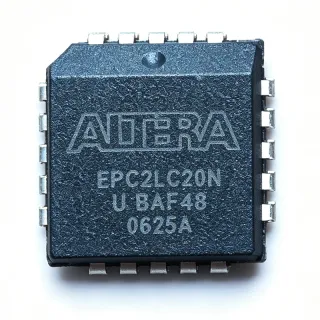
Key features include 440,800 bits of storage (enough for the largest ACEX 1K and APEX 20K bitstreams), a simple serial interface, and 3.3 V single-supply operation. Unlike modern SPI flash devices, the EPC1441 uses Altera's proprietary 4-pin serial configuration protocol, so it cannot be replaced by a generic SPI flash without reworking the FPGA firmware. The PLCC-20 package is a J-lead ceramic/plastic surface-mount style, 9x9 mm with 1.27 mm pin pitch, rated to MSL-3.
Typical applications include legacy industrial controllers, factory-automation retrofits, military/aerospace systems with long lifecycle support requirements, and any design using ACEX, APEX 20K, FLEX 10KE, FLEX 10KA, or Mercury FPGAs that still relies on a dedicated configuration PROM. Designers often keep the EPC1441 on the BOM for designs that were originally prototyped in the late 1990s or early 2000s, when changing the boot memory would invalidate the FPGA pinout and timing closure.
Design considerations: the EPC1441 outputs one bit per DCLK rising edge; the host FPGA drives DCLK and reads DATA on the following edge. The nSTATUS open-drain pin signals configuration errors and must be pulled high with a 4.7-10 kohm resistor. Because the part is OTP (programmed once via Altera programming hardware), design changes require a new PROM and rework. For new designs targeting modern Intel/Altera FPGAs (Cyclone, Arria, Stratix), engineers should evaluate EPCQ-A or EPCQ-L serial configuration flash instead.
This page consolidates distributor pricing, drop-in alternative MPNs, and practical PCB layout notes that go beyond the manufacturer datasheet to support sourcing and second-source decisions.
Drop-in alternatives for EPC1441LI20 — same package, pin-to-pin compatible. Different-package parts requiring PCB rework are excluded.
Variants in this series
Same-series models that are drop-in compatible with EPC1441LI20 (same form factor and footprint) — differing in Memory Type, Memory Size, Package, Mounting Type, Operating Temperature.
Quick Comparison Tool — Select alternative parts for side-by-side comparison:
EPC1441LC20N
✅ Drop-In✓ In Stock
$7.95 / Unit
View Datasheet →EPC1441LC20
✅ Drop-In✓ In Stock
Contact for price
View Datasheet →EPC1064VLC20
✅ Drop-In✓ In Stock
$1.51 / Unit
View Datasheet →EPC1064LC20
✅ Drop-In✓ In Stock
$9.85 / Unit
View Datasheet →EPC1441LI20 Maximum Ratings & Electrical Characteristics
| Memory Type | OTP Configuration PROM (PROM) |
| Density | 441 kbits (440,800 bits) |
| Number of Words | 440,800 |
| Bits per Word | 1 bit |
| Configuration Interface | Altera 4-pin serial (DATA, DCLK, nCONFIG, nSTATUS) |
| Supported FPGA Families | ACEX, APEX 20K / 20KC / 20KE, FLEX 10KE, FLEX 10KA, Mercury |
| Supply Voltage | 3.3 V |
| Operating Temperature | -40 C to +85 C (industrial) |
| Package | 20-pin PLCC (J-lead, 9x9 mm) |
| Pin Pitch | 1.27 mm |
| Programming Method | One-Time-Programmable via Altera programming hardware |
| Configuration Time | Depends on FPGA bitstream length and DCLK frequency |
EPC1441LI20 Pin Configuration
| Pin 1 | NC — Not connected (per datasheet) |
| Pin 2 | DATA — Serial data output to FPGA |
| Pin 3 | DCLK — Configuration clock input from FPGA |
| Pin 4 | NC — Not connected (per datasheet) |
| Pin 5 | NC — Not connected (per datasheet) |
| Pin 6 | NC — Not connected (per datasheet) |
| Pin 7 | NC — Not connected (per datasheet) |
| Pin 8 | nCONFIG — Configuration initiate, active-low input from FPGA |
| Pin 9 | nSTATUS — Configuration status, open-drain output to FPGA |
| Pin 10 | GND — Ground |
| Pin 11 | NC — Not connected (per datasheet) |
| Pin 12 | NC — Not connected (per datasheet) |
| Pin 13 | NC — Not connected (per datasheet) |
| Pin 14 | NC — Not connected (per datasheet) |
| Pin 15 | NC — Not connected (per datasheet) |
| Pin 16 | NC — Not connected (per datasheet) |
| Pin 17 | NC — Not connected (per datasheet) |
| Pin 18 | NC — Not connected (per datasheet) |
| Pin 19 | NC — Not connected (per datasheet) |
| Pin 20 | VCC — 3.3 V supply voltage |
Typical Applications
EPC1441LI20 is suitable for 7 applications: Legacy Industrial PLC Controllers, Factory Automation Retrofit Systems, Military and Aerospace Long-Lifecycle Systems, Medical Imaging Equipment Service Spares, Telecommunications Backplane Controllers, Test and Measurement Instrumentation, Automotive Diagnostic and Service Equipment.
Legacy Industrial PLC Controllers
The EPC1441LI20 stores the bitstream for ACEX 1K or FLEX 10KA FPGAs used in legacy PLC and industrial process controllers. Its 440,800-bit density accommodates the largest APEX 20K bitstreams, and the 3.3 V single supply simplifies integration with 1990s-vintage 3.3 V logic. The -40 C to +85 C industrial temperature range supports factory-floor environments. Designers should keep the EPC1441 on the BOM for retrofit programs where PCB redesign is not economically viable - the part drops into the existing PLCC-20 footprint without firmware changes to the FPGA.
Recommended
Factory Automation Retrofit Systems
Retrofit programs for 1990s and 2000s vintage factory-automation equipment rely on EPC1441LI20 PROMs because the host FPGAs (APEX 20K, FLEX 10KE) still in service require the original 4-pin Altera serial configuration protocol. The OTP nature of the part prevents unauthorized firmware updates in the field - a security plus for industrial IP. The PLCC-20 package allows socketed installation, simplifying field replacement. For new automation designs, EPCQ-A SPI flash with Cyclone IV/V is the modern path, but for retrofit, the EPC1441 remains the lowest-risk drop-in.
Recommended
Military and Aerospace Long-Lifecycle Systems
Long-lifecycle defense and aerospace programs (20+ years field life) often pin to the EPC1441LI20 because the host FPGA design was qualified under a specific configuration PROM part number. The industrial temperature range and known reliability profile simplify continued airworthiness certification. Obsolescence management often requires lifetime-buys and second-source qualification - the EPC1441LC20N (RoHS) or EPC1441LC20 (SnPb) provide dual-sourcing within the same PLCC-20 footprint, enabling PCB-level drop-in replacement without requalification.
Recommended
Medical Imaging Equipment Service Spares
Medical imaging systems (MRI gradient controllers, CT scanner data acquisition) built on ACEX or APEX 20K FPGAs use EPC1441LI20 PROMs for configuration storage. Service organizations must stock the part for board-level repairs, even though the host equipment is end-of-life for new sales. The OTP nature provides a fixed, qualified bitstream that cannot be corrupted by partial writes. Source from authorized distributors when possible; independent distributors (Avaq, YIC, ICMASS) provide surplus sourcing for legacy spares.
Recommended
Telecommunications Backplane Controllers
Telecom backplane controller cards designed in the early 2000s use FLEX 10KE or Mercury FPGAs with EPC1441LI20 configuration PROMs. The 4-pin serial interface keeps the FPGA-to-PROM trace count to four signals, simplifying backplane routing. Industrial temperature range and 3.3 V operation match the backplane power budget. When upgrading these controllers for next-generation standards, the EPC1441LC20N (commercial temp, RoHS) is the recommended alternate to maintain the same PLCC-20 footprint while improving environmental compliance.
Recommended
Test and Measurement Instrumentation
Test and measurement instruments (logic analyzer probes, oscilloscope front-ends, signal generator DSP sections) built on APEX 20K or FLEX 10KA FPGAs use EPC1441LI20 to boot the configuration. The 440 kb density is more than adequate for these mid-density bitstreams, providing headroom for future firmware revisions. Industrial temperature grade supports lab and field environments. For new T&M designs, the EPCQ-A SPI flash is recommended, but existing instruments with EPC1441 PROMs can be serviced with this exact part or the LC20N lead-free alternate.
Recommended
Automotive Diagnostic and Service Equipment
Automotive diagnostic tools, scan tools, and ECU service equipment built on legacy ACEX or APEX 20K FPGAs use EPC1441LI20 configuration PROMs. The industrial temperature range handles underhood and workshop environments. The OTP nature ensures the diagnostic firmware cannot be inadvertently modified in the field. The part is now obsolete at Intel, but the EPC1441LC20N (commercial temp, lead-free) and EPC1441LC20 (SnPb) provide drop-in alternates on the same PLCC-20 footprint for PCB-level second sourcing.
Recommended
Recommended Products Summary
Engineering reference data for EPC1441LI20 — comparison, design guidance, and compliance information.
Selection Guide
Comparison with Alternatives
| Parameter | This Product | EPC1441LC20N | EPC1441LC20 | EPC1064VLC20 | EPC1064LC20 |
|---|---|---|---|---|---|
| Package | 20-pin PLCC (9x9 mm) | 20-pin PLCC - same | 20-pin PLCC - same | 20-pin PLCC - same | 20-pin PLCC - same |
| Brand | Intel (Altera) | Intel (Altera) | Intel (Altera) | Intel (Altera) | Intel (Altera) |
| Density | 440 kbit (440,800 bits) | 440 kbit (same) | 440 kbit (same) | 64 kbit (-85%) | 64 kbit (-85%) |
| Supply Voltage | 3.3 V | 3.3 V (same) | 3.3 V (same) | 3.3 V (same) | 3.3 V (same) |
| Operating Temperature | -40 C to +85 C (industrial) | 0 C to +70 C (commercial) | 0 C to +70 C (commercial) | -40 C to +85 C (industrial) | 0 C to +70 C (commercial) |
| Programming Type | OTP | OTP (same) | OTP (same) | OTP (same) | OTP (same) |
| Supported FPGA Families | ACEX, APEX 20K, FLEX 10KE/10KA, Mercury | Same families | Same families | Same families (smaller bitstreams) | Same families (smaller bitstreams) |
| Lifecycle Status | Obsolete | Obsolete (NRND) | Obsolete (NRND) | Obsolete | Obsolete |
Key Differentiators
- Industry-standard 4-pin Altera configuration protocol (vs EPCQ-A SPI flash)
- Industrial temperature grade (-40 C to +85 C) (vs EPC1441LC20N)
- 440 kbit density covers largest ACEX/APEX 20K bitstreams (vs EPC1064VLC20)
Design Notes
The EPC1441LI20 operates from a single 3.3 V supply. Place a 100 nF decoupling capacitor within 5 mm of the VCC pin (pin 20) and a bulk 10 uF tantalum or ceramic capacitor at the board-level 3.3 V rail. During configuration, the device draws up to 50 mA peak; verify the upstream regulator can supply this in-rush without sagging below 3.0 V.
Route DATA (pin 2), DCLK (pin 3), nCONFIG (pin 8), and nSTATUS (pin 9) as a matched-length bus to the FPGA, keeping each trace under 50 mm to avoid reflection issues. The PLCC-20 socket should be a low-profile through-hole or surface-mount type with a pin-1 orientation marker matching the silkscreen. Add a 4.7 kohm pull-up resistor on nSTATUS (open-drain) close to the EPC1441.
Do not attempt to substitute EPC1441LI20 with EPCQ-A SPI flash without also changing the FPGA configuration mode from FPP/PS (used by EPC PROMs) to Active Serial (AS). The two protocols are not interchangeable - mixing them causes configuration failures. When migrating, also update the FPGA MSEL pin strapping. Refer to the Altera Configuration Handbook for the migration procedure.
The EPC1441LI20 dissipates minimal power (under 200 mW typical) during configuration and standby, so no heatsink is required. However, in enclosed industrial enclosures above 70 C ambient, verify the part's thermal performance using the manufacturer datasheet's thermal resistance (theta_JA). For most applications, the PLCC-20 package's thermal resistance is adequate without forced airflow.
Compliance Information
Original EPC1441LI20 release (late 1990s) used SnPb plating; the EPC1441LC20N variant is lead-free per the 'N' suffix. RoHS and REACH compliance status not specified in the Verified Web Data - consult the manufacturer datasheet or contact Intel Product Compliance for confirmation. AEC-Q100 not applicable (industrial/embedded component, not automotive-grade).