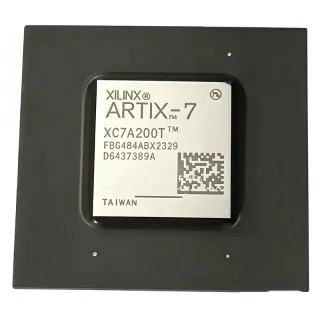
EPF10K100EBC356-3 - 100K Gates FLEX-10KE FPGA, 356-LBGA | Intel
MPN: EPF10K100EBC356-3 ✗ End of Life| Qty | Unit Price | Extended |
|---|---|---|
| 1 | $95 | $95.00 |
| 10 | $87.5 | $875.00 |
| 100 | $78 | $7,800.00 |
| 500 | $70 | $35,000.00 |
| 1,000 | $62.5 | $62,500.00 |
EPF10K100EBC356-3 Overview
An FPGA (Field-Programmable Gate Array) is a reconfigurable integrated circuit whose logic fabric, routing, and I/O cells can be programmed in the field via an SRAM-based configuration bitstream. FPGAs sit within the broader semiconductor hierarchy as programmable logic devices (PLDs), themselves a sub-category of digital logic ICs, and are commonly used for digital signal processing, glue logic, prototyping, and high-speed I/O expansion where ASIC NRE costs cannot be justified.
Key features of the EPF10K100EBC356-3 include its 624 LABs (Logic Array Blocks), embedded array blocks (EABs) for memory and DSP functions, CMOS SRAM-based configuration (volatile, requiring a configuration device), in-system programmability via JTAG, and a high I/O count (274) that supports parallel buses and many discrete interfaces. The device is fabricated on a 0.22 micron CMOS process.
Architecturally, the FLEX-10KE family pioneered embedded array blocks (EABs), allowing each block to be configured as RAM or ROM and to implement arithmetic logic. Combined with the interconnect-rich logic array, this hybrid structure prefigures modern heterogeneous FPGAs with hard DSP and memory blocks. The 356-LBGA package provides controlled-impedance signal paths and a generous ball grid for high pin density at 35 mm x 35 mm.
Typical applications include telecommunications line cards, industrial control and factory automation, data acquisition systems, and digital signal processing glue logic. The wide user I/O count and high gate density make it well-suited to bus-bridging, protocol conversion, and high-speed serial-to-parallel interfaces.
When designing, note that the FLEX-10KE core is 2.5 V; I/O banks can be configured for 2.5 V or 3.3 V interface levels, but 5 V tolerance is not guaranteed. A configuration EPROM or JTAG programmer (ByteBlaster-compatible) is required at board bring-up. Designers migrating from this part should evaluate Cyclone III/IV as next-generation equivalents, as FLEX-10KE is no longer in active production.
This page synthesizes distributor pricing, drop-in pin-compatible alternatives, and practical design notes not found in the manufacturer datasheet alone.
Drop-in alternatives for EPF10K100EBC356-3 — same package, pin-to-pin compatible. Different-package parts requiring PCB rework are excluded.
Variants in this series
Same-series models that are drop-in compatible with EPF10K100EBC356-3 (same form factor and footprint) — differing in Process Technology, Operating Temperature, Family, RoHS Status, Package.
Quick Comparison Tool — Select alternative parts for side-by-side comparison:
EPF10K100EBC356-1
✅ Drop-In✓ In Stock
$92 / Unit
View Datasheet →EPF10K100EBC356-2
✅ Drop-In✓ In Stock
$59.95 / Unit
View Datasheet →EPF10K100ABC356-2
✅ Drop-In✓ In Stock
$108 / Unit
View Datasheet →EPF10K100ABI356-3
✅ Drop-In✓ In Stock
$65.8 / Unit
View Datasheet →EPF10K100EBC356-3 Maximum Ratings & Electrical Characteristics
| Family | FLEX-10KE |
| Logic Elements / Cells | 4,992 |
| Total Gates | ~100,000 |
| Logic Array Blocks (LABs) | 624 |
| Embedded Memory (RAM bits) | 49,152 |
| User I/Os | 274 |
| Supply Voltage (Core) | 2.5 V (2.375 V to 2.625 V) |
| Speed Grade | -3 |
| Propagation Delay (typical) | 0.6 ns |
| Maximum Internal Frequency | 200 MHz |
| Process Technology | 0.22 micron CMOS |
| Configuration Technology | SRAM (volatile) |
| Operating Temperature | 0 C to 70 C (Commercial) |
| Package | 356-LBGA (35 x 35 mm) |
| Mounting Type | Surface Mount |
EPF10K100EBC356-3 356-lbga (35 x 35 mm) Pin Configuration Guide
Pin configuration for EPF10K100EBC356-3 (356-lbga (35 x 35 mm) package). This digital IC includes GPIO, communication interfaces (UART, SPI, I2C), and power pins. Refer to the manufacturer datasheet for alternate pin functions and configuration options. Essential for embedded system design and PCB layout.

No detailed pinout data available for EPF10K100EBC356-3.
Refer to the datasheet for full pin configuration.
Typical Applications
EPF10K100EBC356-3 is suitable for 6 applications: Telecommunications Line-Card Glue Logic, Industrial Control and Factory Automation, Data Acquisition and Instrumentation, Digital Signal Processing Glue Logic, Legacy ASIC Replacement / Prototyping, Storage and RAID Controller Hub.
Telecommunications Line-Card Glue Logic
The EPF10K100EBC356-3 is well suited to legacy telecom line-card designs where the FLEX-10KE architecture was a common glue-logic platform. Its 4,992 LEs and 624 LABs accommodate bus-bridging, UTOPIA/posphy interface conversion, and TDM crossbar switching. The 274 user I/Os support wide parallel buses for connection to network processors and ASICs without external muxing. Configured via JTAG during manufacturing test and SRAM-loaded via EPC16 at field power-up, the part integrates seamlessly with the typical line-card BOM. Compared to a hard ASIC, the EPF10K100EBC356-3 reduces NRE cost and allows late design changes. Engineers should plan for the 2.5 V core supply with 3.3 V-tolerant I/O bank configuration.
Recommended
Industrial Control and Factory Automation
In industrial PLC and motion-control backplanes, the EPF10K100EBC356-3 implements custom protocol stacks and high-speed encoder counters. Its 200 MHz internal frequency enables precise quadrature decoding and PID-loop computation in the fabric, while 49,152 embedded RAM bits provide FIFO buffers between the FPGA and a host CPU/DSP. The 356-LBGA package's 35 x 35 mm footprint is compatible with standard 4-layer industrial backplane layouts. Industrial-grade variants like the EPF10K100ABI356-3 extend operating range for harsh environments. For new industrial designs, engineers should weigh the EPF10K100EBC356-3 against active Cyclone IV E parts that offer AEC-Q100 options and lower power.
Recommended
Data Acquisition and Instrumentation
The EPF10K100EBC356-3 is a strong fit for high-channel-count data acquisition front-ends where it performs timing, triggering, and channel-multiplexing functions. Its 49,152 bits of embedded RAM serve as deep sample buffers, and 274 I/Os allow direct fan-out to multi-MHz ADC/DAC banks. The 0.6 ns propagation delay and 200 MHz fabric permit real-time DSP pre-processing such as digital filtering, peak detection, and FFT pre-staging. Because the part is SRAM-based, designers can reconfigure trigger logic in the field via JTAG when measurement requirements change. Thermal management for the 356-LBGA requires thermal vias under the center balls and at least a 4-layer PCB with continuous ground/power planes.
Recommended
Digital Signal Processing Glue Logic
For DSP coprocessor boards built around a host CPU plus TI C6x or Analog Devices SHARC DSPs, the EPF10K100EBC356-3 implements the host port interface, DMA engine, and ping-pong memory arbitration. The 624 LABs provide ample combinational logic for handshake generation, while the 49,152 RAM bits act as buffer descriptors. Because the FLEX-10KE EABs support synchronous RAM, designers can build dual-port FIFO bridges between processors at full fabric speed. The part's mature Quartus II toolchain (legacy) supports schematic, VHDL, and Verilog entry, making it a familiar ramp for engineers transitioning to newer Cyclone families.
Recommended
Legacy ASIC Replacement / Prototyping
The EPF10K100EBC356-3 was widely adopted as an ASIC prototyping and low-volume production platform where NRE cost dominated. The 100K-gate capacity matches small to mid-complexity ASIC designs in telecom, storage, and imaging, while the 356-LBGA package provides signal integrity comparable to a packaged ASIC. Designers can validate IP blocks, firmware/ASIC co-simulation, and timing closure in silicon before committing to a mask set. Quartus II synthesis accepts standard HDL, allowing straightforward migration from existing ASIC RTL. For new projects, however, active Cyclone IV or Cyclone 10 LP parts offer better price/performance and ongoing silicon availability.
Recommended
Storage and RAID Controller Hub
In storage controller designs, the EPF10K100EBC356-3 implements the host-bus interface, parity generation, and command queue management between SATA/SAS PHYs and a CPU. The 274 user I/Os accommodate multiple 8-bit/16-bit PHY-side buses plus LED and management I/O without external bus switches. The 4,992 LEs sustain RAID XOR engines for small RAID-5/6 sets at HDD-class throughput. The 200 MHz fabric ensures command latency stays well below disk service times. Designers should evaluate migrating to newer Cyclone families for active silicon, but for sustaining legacy RAID blades already in field deployment, the EPF10K100EBC356-3 remains a stable platform.
Recommended
Recommended Products Summary
Engineering reference data for EPF10K100EBC356-3 — comparison, design guidance, and compliance information.
Selection Guide
Comparison with Alternatives
| Parameter | This Product | EPF10K100EBC356-1 | EPF10K100EBC356-2 | EPF10K100ABC356-2 | EPF10K100ABI356-3 |
|---|---|---|---|---|---|
| Package | 356-LBGA (35x35 mm) | 356-LBGA (35x35 mm) - same | 356-LBGA (35x35 mm) - same | 356-LBGA (35x35 mm) - same | 356-LBGA (35x35 mm) - same |
| Brand | Intel | Intel | Intel | Intel | Intel |
| Logic Elements | 4,992 | 4,992 | 4,992 | 4,992 | 4,992 |
| Speed Grade | -3 (fastest) | -1 (slowest) | -2 (mid) | -2 (mid) | -3 (fastest) |
| Operating Temperature | 0 C to 70 C (Commercial) | 0 C to 70 C (Commercial) | 0 C to 70 C (Commercial) | 0 C to 70 C (Commercial) | -40 C to 85 C (Industrial) |
| Core Voltage | 2.375 V to 2.625 V (2.5 V nominal) | 2.375 V to 2.625 V | 2.375 V to 2.625 V | 2.375 V to 2.625 V | 2.375 V to 2.625 V |
| User I/Os | 274 | 274 | 274 | 274 | 274 |
| Lifecycle Status | Obsolete | Obsolete | Obsolete | Obsolete | Obsolete |
Key Differentiators
- Fastest speed grade in FLEX-10KE 100K-gate BGA-356 family (vs EPF10K100EBC356-1)
- Industrial-temperature sibling for harsh-environment designs (vs EPF10K100ABI356-3)
- Same architecture, mid-speed grade for cost-sensitive designs (vs EPF10K100EBC356-2)
Design Notes
The EPF10K100EBC356-3 requires a 2.5 V core supply with strict 2.375 V to 2.625 V regulation. I/O banks can be independently powered at 2.5 V or 3.3 V for level translation. Decoupling requires at least one 0.1 uF X7R ceramic per supply pin plus bulk 47 uF to 100 uF tantalum or polymer caps near the package. Estimated quiescent current is approximately 100 mA idle (per FLEX-10KE family datasheet); expect 500 mA to 1 A at full fabric utilization.
The 356-LBGA package dissipates significant heat under high utilization. Per the FLEX-10KE datasheet, theta_JA is approximately 16 C/W with a JEDEC-standard 4-layer test board. Estimated: at full fabric toggling (~2 W internal), junction-to-ambient rise is 32 C, so commercial 70 C ambient leaves roughly 80 C margin. For industrial use (-40 C to 85 C), strongly consider the EPF10K100ABI356-3 variant and provide thermal vias under the BGA center balls.
Use at least a 4-layer PCB with continuous power and ground planes under the 356-LBGA. Escape routing for the 1.0 mm pitch BGA requires microvias (laser-drilled) or dog-bone fanout on inner rows. Maintain 50 ohm controlled impedance on high-speed signals and use length matching within 150 mil for clock pairs. Place the EPC2/EPC16 configuration EPROM within 2 inches of the FPGA to keep DCLK rise times clean.
Do not assume 5 V tolerance on any I/O bank of the EPF10K100EBC356-3 - use level shifters (e.g., 74LVC245) when interfacing legacy 5 V logic. A common pitfall is configuring MSEL pins incorrectly, which leaves the device unconfigured after power-up. Always include JTAG (TCK/TMS/TDO/TDI) test access on the board boundary for in-system programming and post-production debug. Because the part is obsolete, label the configuration EPROM socket as a rework point during board bring-up.
Compliance Information
Compliance status not present in verified web data; legacy Altera FLEX-10KE parts were typically not RoHS-compliant at original release. Verify with manufacturer before placing into a design that must satisfy current RoHS/REACH directives.