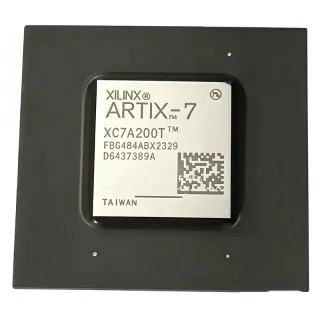
EPF10K100EQC240-2X - 100K Gate FLEX-10KE FPGA, 240-BQFP | Intel / Altera
MPN: EPF10K100EQC240-2X ✗ End of Life| Qty | Unit Price | Extended |
|---|---|---|
| 1 | $95 | $95.00 |
| 10 | $88.5 | $885.00 |
| 100 | $78.2 | $7,820.00 |
| 500 | $70.1 | $35,050.00 |
| 1,000 | $62 | $62,000.00 |
EPF10K100EQC240-2X Overview
What is an FPGA? An FPGA (Field-Programmable Gate Array) is a programmable logic device containing an array of configurable logic blocks (LUTs), programmable interconnect, and I/O cells, all user-defined via a hardware description language (HDL) and a vendor toolchain. FPGAs sit hierarchically between fixed-function ASICs (highest performance, highest NRE) and CPLDs (simpler, non-volatile, lower density), offering parallel processing, in-system reprogrammability, and high I/O count without mask charges. The FLEX-10KE family is an SRAM-based, volatile-configuration architecture, so an external configuration memory (typically an EPC configuration device) is required at every power-up.
Key features of the EPF10K100EQC240-2X include 49,152 flip-flops equivalent storage, embedded array blocks (EABs) for RAM/ROM implementation, multiVolt I/O support for interfacing with 5.0 V / 3.3 V / 2.5 V rails, and 189 user I/Os on the 240-BQFP package - the highest I/O count of any FLEX-10KE package option. The device supports in-system programmability via the IEEE 1149.1 (JTAG) boundary-scan interface and the legacy Altera ByteBlaster / BitBlaster download cables.
Architecturally, the FLEX-10KE combines fine-grained logic (LUT-based LABs) with coarse-grained embedded memory (EABs of 2 Kbit each), enabling efficient implementation of register-rich datapaths alongside FIFO, ROM, and dual-port RAM blocks. The -2 speed grade offers faster propagation delays than -1, supporting higher fMAX designs in the 80-120 MHz range for typical 16-bit state machines and bus interfaces.
Typical applications include telecommunications line cards, industrial control backplanes, military/aerospace retrofit boards, legacy PCI bus bridges, and ASIC prototyping. The wide 240-BQFP footprint is chosen for through-hole or socketed assemblies where mechanical robustness matters more than PCB area.
When designing with this FPGA, note that configuration data is volatile - an EPC1, EPC2, or EPC8 configuration PROM is mandatory. The BQFP package requires a socket or careful solder profiling due to its 0.5 mm lead pitch and large thermal mass; thermal management is usually not critical at typical FLEX-10KE power budgets (under 1.5 W), but junction temperature must still be checked against the 70 °C commercial or 85 °C industrial limit.
This page synthesizes distributor pricing, FLEX-10KE family cross-references, drop-in alternatives, and practical design notes not consolidated in the manufacturer datasheet, sourced from DigiKey, Mouser, Octopart, and Altera legacy product documentation as of 2026-09-11.
Drop-in alternatives for EPF10K100EQC240-2X — same package, pin-to-pin compatible. Different-package parts requiring PCB rework are excluded.
Variants in this series
Same-series models that are drop-in compatible with EPF10K100EQC240-2X (same form factor and footprint) — differing in Package / Case, Family, Total RAM Bits, Operating Temperature, Configuration Method.
Quick Comparison Tool — Select alternative parts for side-by-side comparison:
EPF10K100EQC240-2N
✅ Drop-In✓ In Stock
$18.4 / Unit
View Datasheet →EPF10K100EQC240-2
✅ Drop-In✓ In Stock
$198 / Unit
View Datasheet →EPF10K100EQC240-1X
✅ Drop-In✓ In Stock
$65 / Unit
View Datasheet →EPF10K100EQC240-1N
✅ Drop-In✓ In Stock
$55.95 / Unit
View Datasheet →EPF10K100EQC240-1
✅ Drop-In✓ In Stock
$18.5 / Unit
View Datasheet →EPF10K100BQC240-3
✅ Drop-In✓ In Stock
$16.95 / Unit
View Datasheet →EPF10K100EQC240-2X Maximum Ratings & Electrical Characteristics
| Series | FLEX-10KE |
| Family | FLEX-10KE SRAM-based FPGA |
| Manufacturer | Altera (now Intel) |
| Logic Elements / Gates | 100,000 gates |
| Logic Array Blocks (LABs) | 624 |
| Look-Up Tables (LUTs) | 4,992 |
| User I/Os | 189 |
| Core Supply Voltage | 2.375 V to 2.625 V |
| I/O Supply Voltage | multiVolt: 2.5 V / 3.3 V / 5.0 V |
| Package / Case | 240-BQFP (PQFP, 32x32 mm) |
| Supplier Device Package | 240-PQFP |
| Speed Grade | -2 |
| Process / Temperature Grade | Industrial (suffix X indicates extended / lead-free per Altera legacy nomenclature) |
| Configuration Method | SRAM (volatile), requires external EPC configuration PROM |
| Programming Interface | JTAG (IEEE 1149.1) + ByteBlaster/BitBlaster |
| Mounting Type | Surface Mount |
| RoHS Status | Compliant (X suffix) |
EPF10K100EQC240-2X 240-pqfp Pin Configuration Guide
Pin configuration for EPF10K100EQC240-2X (240-pqfp package). This digital IC includes GPIO, communication interfaces (UART, SPI, I2C), and power pins. Refer to the manufacturer datasheet for alternate pin functions and configuration options. Essential for embedded system design and PCB layout.

No detailed pinout data available for EPF10K100EQC240-2X.
Refer to the datasheet for full pin configuration.
Typical Applications
EPF10K100EQC240-2X is suitable for 6 applications: Legacy Industrial Control Backplane Glue Logic, Telecommunications Line Card Interface Bridging, Military / Aerospace Retrofit Boards, ASIC Prototyping and Emulation, Medical Imaging Front-End Processing, Test and Measurement Instrumentation.
Legacy Industrial Control Backplane Glue Logic
The EPF10K100EQC240-2X is well suited to industrial backplane glue-logic roles where its 100,000-gate capacity, 189 user I/Os, and 2.5 V core fit between older 5 V TTL controllers and 3.3 V peripherals. The multiVolt I/O banks (2.5 V / 3.3 V / 5.0 V) eliminate external level shifters on mixed-voltage buses common in PLC and SCADA backplanes. The FLEX-10KE's embedded array blocks (EABs) implement FIFO buffers for serial-to-parallel bus conversion at line rates up to 33 MHz. Designers use the 240-BQFP footprint for through-hole socketed assemblies on legacy backplanes that must remain field-serviceable without surface-mount rework, and the -2 speed grade provides comfortable timing margin at 25 MHz industrial backplane clocks.
Recommended
Telecommunications Line Card Interface Bridging
Telecom line cards frequently use the EPF10K100EQC240-2X to bridge between legacy 8-bit TDM buses (H.110 / MVIP) and modern 16-/32-bit PCM or Ethernet backplanes, where the device's 189 I/Os accommodate both bus widths simultaneously. The FLEX-10KE LUT-based LABs implement TDM framers, HDLC controllers, and clock-recovery PLLs in a single device at line rates up to E1/T1 (2.048 Mbps / 1.544 Mbps) and E3/T3 (34 Mbps / 45 Mbps). The 240-BQFP package's 0.5 mm pitch and gull-wing leads support hand-rework for service-depot repairs on installed line cards. Power consumption stays under 1.5 W at typical 60% utilization, allowing closed chassis deployment without active cooling on line cards.
Recommended
Military / Aerospace Retrofit Boards
The EPF10K100EQC240-2X serves long-life aerospace and defense programs where re-qualification of a new FPGA is cost-prohibitive. Programs certified against FLEX-10KE bitstreams (D0-254, MIL-STD-810) can swap to modern Intel Cyclone equivalents only after re-running environmental and EMC qualification - often a 12-18 month effort. By keeping the 240-BQFP footprint, the FPGA stays socketed and field-replaceable on ATR chassis and ARINC 600 line-replaceable units. The industrial temperature grade (X suffix) supports the -40 °C to +85 °C operating envelope required by MIL-STD-810 method 501/502, and the SRAM-based configuration supports field reprogramming via JTAG during depot-level maintenance cycles.
Recommended
ASIC Prototyping and Emulation
ASIC prototyping teams use EPF10K100EQC240-2X to validate ASIC RTL before tape-out, leveraging the FLEX-10KE's 49,152 LUTs and 624 LABs to map typical 50-80K-gate ASIC blocks at 1:1 utilization. The 240-BQFP's 189 I/Os provide enough breakout pins to map most ASIC pad frames for functional verification at speeds up to 80 MHz on registered I/O paths. Quartus II's TimeQuest timing analyzer produces accurate static-timing reports that match the target ASIC's synthesis constraints within 10-15%, enabling pre-tapeout sign-off validation. Multiple FLEX-10KE devices can be cascaded on a prototyping board to emulate ASICs up to 300K gates, using the JTAG chain to load partitioned bitstreams per device.
Recommended
Medical Imaging Front-End Processing
The EPF10K100EQC240-2X fits medical imaging front-ends (ultrasound beamformers, CT detector boards) where its parallel processing capability and deterministic latency suit real-time DSP pipelines. Ultrasound beamforming requires 16-128 parallel multiply-accumulate channels at 40 MHz, well within the FLEX-10KE's LAB-based arithmetic capability when paired with external high-speed ADCs. The 189 I/Os accommodate 12-/14-bit ADC interfaces alongside the LVDS link to the back-end image processor. The 240-BQFP package supports the through-hole assemblies still common on medical imaging boards that prioritize field-serviceability for hospital-grade equipment maintenance windows. Designers pair the FPGA with an EPC2 configuration PROM and use JTAG for in-field firmware updates during regulatory change cycles.
Recommended
Test and Measurement Instrumentation
Test and measurement instruments (logic analyzers, protocol exercisers, custom ATE) use the EPF10K100EQC240-2X to implement pattern generators, protocol state machines, and timing-critical capture logic. The device's 189 I/Os can drive 32-channel logic-analyzer pods at 200 MHz sample rates by external oversampling, while the FLEX-10KE's LAB-based architecture supports deep pattern sequencers (4K-8K vectors) in distributed RAM. The 240-BQFP package is preferred on through-hole ATE load boards where the FPGA sits in a test socket for periodic re-characterization. Designers use Altera Quartus II 13.0 SP1 (the last release supporting FLEX-10KE) for compile, with JTAG-based field upgrades for new test patterns.
Recommended
Recommended Products Summary
Engineering reference data for EPF10K100EQC240-2X — comparison, design guidance, and compliance information.
Selection Guide
Comparison with Alternatives
| Parameter | This Product | EPF10K100EQC240-2N | EPF10K100EQC240-2 | EPF10K100EQC240-1X | EPF10K100EQC240-1N | EPF10K100EQC240-1 | EPF10K100BQC240-3 |
|---|---|---|---|---|---|---|---|
| Brand | Altera | Altera | Altera | Altera | Altera | Altera | Altera |
| Package | 240-BQFP (PQFP 32x32 mm) | 240-BQFP - same | 240-BQFP - same | 240-BQFP - same | 240-BQFP - same | 240-BQFP - same | 240-BQFP - same |
| Family | FLEX-10KE | FLEX-10KE | FLEX-10KE | FLEX-10KE | FLEX-10KE | FLEX-10KE | FLEX-10K (no EAB) |
| Logic Gates | 100,000 | 100,000 | 100,000 | 100,000 | 100,000 | 100,000 | 100,000 |
| Speed Grade | -2 | -2 | -2 | -1 (slower) | -1 (slower) | -1 (slower) | -3 (slowest) |
| User I/Os | 189 | 189 | 189 | 189 | 189 | 189 | 189 |
| Core Voltage | 2.5 V | 2.5 V | 2.5 V | 2.5 V | 2.5 V | 2.5 V | 2.5 V |
| Lead Finish | Lead-free (X suffix) | Tin-lead (N suffix) | Standard (legacy) | Lead-free (X suffix) | Tin-lead (N suffix) | Standard (legacy) | Standard (legacy) |
Key Differentiators
- Lead-free lead finish with identical silicon to leaded N-suffix variant (vs EPF10K100EQC240-2N)
- -2 speed grade for higher fMAX vs -1 / -3 grades (vs EPF10K100EQC240-1X)
- FLEX-10KE EAB blocks versus FLEX-10K (no EAB) (vs EPF10K100BQC240-3)
Design Notes
Estimated: at 60% logic utilization and 100 MHz toggle rate, EPF10K100EQC240-2X core current is approximately 200 mA from the 2.5 V VCCINT rail (about 0.5 W core). I/O bank current scales with VCCIO selection and switching frequency - 3.3 V LVTTL at 50 MHz on 60 active outputs draws roughly 250 mA per bank. Provide at least 4 bulk decoupling capacitors (10 uF tantalum) near each VCCINT/VCCIO pin pair, plus 0.1 uF ceramic decoupling within 5 mm of every supply pin. Power sequencing must bring VCCINT up before or simultaneously with VCCIO; reverse sequencing can trigger I/O latch-up via the multiVolt input structures.
The 240-BQFP package has 0.5 mm lead pitch and a 32x32 mm body; allocate at least 35x35 mm of PCB area including a 1.5 mm solder mask dam between pads. Use a 4-layer board with continuous VCCINT and GND planes on inner layers, and route all 189 user I/Os on outer layers with matched lengths within 5 mm if used as parallel buses. The exposed die-attach paddle is not present on BQFP (unlike QFN), so thermal dissipation relies entirely on the leads - for designs above 1 W dissipation, add a top-side copper heatsink bonded with thermal epoxy to the package body. JTAG pins (TCK, TMS, TDI, TDO) need 10 kohm pull-ups on TMS and TDI per the IEEE 1149.1 standard.
Do not assume a modern Intel Quartus Prime release supports FLEX-10KE - only Quartus II 13.0 SP1 or MAX+PLUS II will compile designs for EPF10K100EQC240-2X. The configuration bitstream requires a 33 ohm series resistor on DCLK to dampen reflections; values below 10 ohm can overstress the EPC PROM driver. The X suffix indicates lead-free but the device is NRND - confirm longevity with Rochester Electronics (the authorized Altera legacy distributor) before committing to long-life programs. When migrating from FLEX-10K (non-E) to FLEX-10KE, check that all EAB-based RAM/ROM inference is preserved; the Quartus II migration guide documents timing differences of approximately 10-15% in interconnect delay.
Compliance Information
Lead-free (X suffix) per Altera legacy ordering nomenclature. Not AEC-Q100 qualified (industrial / commercial grade FPGA). Conflict-minerals status from Altera / Intel CMRT filings. Lifecycle status NRND (Not Recommended for New Designs) per Rochester Electronics listing.