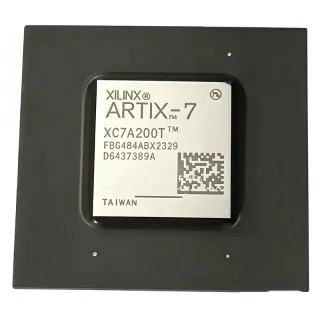
EPF10K30EQC208-1N - FLEX 10KE FPGA, 30K Gates, PQFP-208 | Intel
MPN: EPF10K30EQC208-1N ✗ End of Life| Qty | Unit Price | Extended |
|---|---|---|
| 1 | $78.5 | $78.50 |
| 10 | $65 | $650.00 |
| 100 | $48.2 | $4,820.00 |
| 500 | $36.75 | $18,375.00 |
| 1,000 | $28.4 | $28,400.00 |
EPF10K30EQC208-1N Overview
An FPGA (Field-Programmable Gate Array) is a type of programmable logic device (PLD) that combines configurable logic blocks, programmable interconnect, and I/O cells on a single silicon die. FPGAs sit within the broader taxonomy of digital semiconductors: PLD -> FPGA -> SRAM-based FPGA. The FLEX 10KE family specifically pioneered embedded array blocks (EABs) that integrate dedicated RAM, ROM, or multiplier functions alongside the general logic fabric, enabling System-on-a-Programmable-Chip (SOPC) integration of glue logic, state machines, register files, and small FIFOs in a single device.
Key features of the EPF10K30EQC208-1N include 147 user I/O pins, 216 logic array blocks / configurable logic blocks, an internal clock frequency up to 250 MHz, 0.22 µm CMOS process technology, 2.5V core VCCINT with 3.3V or 5V tolerant I/O via VCCIO banks, in-system programmability via SRAM configuration cells, and JTAG (IEEE 1149.1) boundary-scan support. The device retains its configuration in volatile SRAM and must be reconfigured at every power-up from an external PROM or flash, which is characteristic of the FLEX 10KE architecture.
Typical applications for the EPF10K30EQC208-1N include legacy industrial glue logic replacement, PCI bus interface bridging, telecommunications channel cards, prototyping of ASIC designs prior to tape-out, and educational / laboratory digital design platforms where the through-hole-friendly PQFP package simplifies socket-based programming and rework. Because this device is now mature and discontinued, surviving inventory is typically allocated to long-life-cycle industrial, military, and aerospace sustainment programs.
When designing with this FPGA, plan a 5V or 3.3V I/O supply on VCCIO pins and a tightly regulated 2.5V supply on VCCINT, with bulk decoupling near each supply pin. Allow adequate configuration time during power-up and consider JTAG-based ISP for field updates rather than relying solely on parallel EPC configuration. The PQFP-208 package is suitable for socketed development but is increasingly rare in new designs; for production, prefer a BGA-packaged FLEX 10KE variant such as the EPF10K30EBC356-1 or the equivalent.
This page synthesizes distributor stock levels, drop-in alternatives, and design considerations not found in the manufacturer datasheet alone.
Drop-in alternatives for EPF10K30EQC208-1N — same package, pin-to-pin compatible. Different-package parts requiring PCB rework are excluded.
Variants in this series
Same-series models that are drop-in compatible with EPF10K30EQC208-1N (same form factor and footprint) — differing in Package, Family, Process Technology, Operating Temperature, Propagation Delay.
Quick Comparison Tool — Select alternative parts for side-by-side comparison:
EPF10K30EQC208-1
✅ Drop-In✓ In Stock
$17.95 / Unit
View Datasheet →EPF10K30EQC208-1X
✅ Drop-In✓ In Stock
$18.4 / Unit
View Datasheet →EPF10K30EQC208-2
✅ Drop-In✓ In Stock
$17.85 / Unit
View Datasheet →EPF10K30AQC208-1N
✅ Drop-In✓ In Stock
$21.4 / Unit
View Datasheet →EPF10K50EQC208-1N
✅ Drop-In📋 Reference alternative (not in catalog)
EPF10K30EQC208-1N Maximum Ratings & Electrical Characteristics
| Family | FLEX 10KE |
| Logic Elements / Cells | 1,728 |
| Total RAM Bits | 24,576 |
| Typical Gate Count | 30,000 gates |
| Number of LABs / CLBs | 216 |
| Number of User I/O | 147 |
| Number of Gates | 119,000 |
| Internal Frequency (max) | 250 MHz |
| Propagation Delay | 0.6 ns |
| Core Voltage VCCINT | 2.375 V to 2.625 V (nominal 2.5 V) |
| Process Technology | 0.22 µm CMOS |
| Operating Temperature | 0 C to 70 C (commercial) |
| Mounting Type | Surface Mount |
| Package / Case | 208-BFQFP (PQFP-208, 28x28 mm) |
| Configuration Method | SRAM-based, ISP via JTAG |
| Part Status | Obsolete (last-time-buy may apply) |
EPF10K30EQC208-1N 208-bfqfp (pqfp-208, 28x28 mm) Pin Configuration Guide
Pin configuration for EPF10K30EQC208-1N (208-bfqfp (pqfp-208, 28x28 mm) package). This digital IC includes GPIO, communication interfaces (UART, SPI, I2C), and power pins. Refer to the manufacturer datasheet for alternate pin functions and configuration options. Essential for embedded system design and PCB layout.

No detailed pinout data available for EPF10K30EQC208-1N.
Refer to the datasheet for full pin configuration.
Typical Applications
EPF10K30EQC208-1N is suitable for 6 applications: Legacy Industrial Glue Logic Replacement, PCI Bus Interface Bridge, Telecommunications Channel Card, ASIC Prototyping Platform, Educational and Laboratory Digital Design, Long-Life Industrial and Aerospace Sustainment.
Legacy Industrial Glue Logic Replacement
The EPF10K30EQC208-1N is widely deployed as a programmable replacement for dozens of discrete TTL/CMOS glue-logic ICs on legacy industrial PCBs. With 1,728 logic elements, 216 LABs, and 147 user I/Os it can absorb address decoding, bus arbitration, timing generation, and interrupt control that would otherwise require 5-10 separate 74-series chips. The 2.5V core plus 3.3V/5V-tolerant I/O banks make it compatible with mixed-voltage backplanes found in PLCs and process controllers. Designers port their logic to Quartus II and benefit from a single reconfigurable part.
Recommended
PCI Bus Interface Bridge
The EPF10K30EQC208-1N implements a 32-bit/33 MHz PCI target or master bridge in legacy embedded systems where modern PCIe is not required. The 147 user I/Os provide enough headroom for the 32-bit PCI data bus (32 lines), address bus (32 lines), and C/BE, FRAME, IRDY, TRDY, DEVSEL, STOP, IDSEL, and PAR parity signals. The 250 MHz internal fabric and 0.6 ns propagation delay easily meet the 33 MHz PCI clock with timing margin to spare. PCI is pin-intensive so the PQFP-208 footprint is a natural fit for development boards and PCI add-in cards.
Recommended
Telecommunications Channel Card
Telecommunications channel cards (T1/E1, ISDN, early DSLAM line cards) used the EPF10K30EQC208-1N for framing, HDLC, scrambling, and TDM bus aggregation. The 24,576 bits of embedded RAM, distributed across multiple EABs, are ideal for small FIFO buffers and elastic stores in serial data streams. The 147 user I/Os accommodate parallel TDM buses (H.110 / MVIP), while the 2.5V core supports low-power 24/7 always-on operation. Surviving telecom deployments still require spare FPGAs for 20+ year field service.
Recommended
ASIC Prototyping Platform
ASIC prototyping remains a strong use case for the EPF10K30EQC208-1N. Engineers map gate-level netlists from synthesis tools onto the FLEX 10KE fabric to validate functionality before committing to NRE mask costs. Quartus II supports gate-level simulation back-annotation, and the PQFP-208 socket-friendly package simplifies bring-up on a logic-analyzer-equipped bench. While the 30K-gate capacity is modest by modern standards, it is sufficient for peripheral controllers, custom microsequencers, and DSP datapath prototyping.
Recommended
Educational and Laboratory Digital Design
University digital-design labs and engineering training programs use the EPF10K30EQC208-1N to teach HDL-based design flow, state-machine synthesis, and timing closure. The PQFP-208 package sits in a low-cost socket on a development board where students can hot-swap devices and inspect signals with an oscilloscope or logic analyzer. With 1,728 logic elements, projects scale from simple counters and UARTs to complete 8-bit microcontrollers. Quartus II Web Edition provides a free toolchain that supports the FLEX 10KE family.
Recommended
Long-Life Industrial and Aerospace Sustainment
Long-life-cycle systems in industrial automation, railway signaling, military radios, and aerospace sustainment programs require continuous availability of the EPF10K30EQC208-1N for spares and repair. The device is obsolete from the manufacturer but remains available through authorized distributors and aftermarket suppliers with full traceability (date code, lot, country of origin). Customers typically establish last-time-buy contracts, qualify independent distributors, and store devices in nitrogen-purged cabinets to extend shelf life for 10+ years.
Recommended
Recommended Products Summary
Engineering reference data for EPF10K30EQC208-1N — comparison, design guidance, and compliance information.
Selection Guide
Comparison with Alternatives
| Parameter | This Product | EPF10K30EQC208-1 | EPF10K30EQC208-1X | EPF10K30EQC208-2 | EPF10K30AQC208-1N | EPF10K50EQC208-1N |
|---|---|---|---|---|---|---|
| Package | 208-PQFP (PQFP-208, 28x28 mm) | 208-PQFP - same | 208-PQFP - same | 208-PQFP - same | 208-PQFP - same | 208-PQFP - same |
| Brand | Intel (Altera) | Intel (Altera) - same | Intel (Altera) - same | Intel (Altera) - same | Intel (Altera) - same | Intel (Altera) - same |
| Family | FLEX 10KE | FLEX 10KE - same | FLEX 10KE - same | FLEX 10KE - same | FLEX 10KA | FLEX 10KE - same |
| Core Voltage | 2.5 V | 2.5 V | 2.5 V | 2.5 V | 5 V | 2.5 V |
| Logic Elements | 1,728 | 1,728 | 1,728 | 1,728 | 1,728 | ~2,880 |
| User I/O | 147 | 147 | 147 | 147 | 147 | 147 |
| Speed Grade | -1 | -1 | -1 | -2 (faster) | -1 | -1 |
| Operating Temperature | 0 to 70 C (commercial) | 0 to 70 C | -40 to 85 C (industrial) | 0 to 70 C | 0 to 70 C | 0 to 70 C |
| Lead Finish | Lead-free (N suffix) | Tin-lead (SnPb) | Tin-lead (SnPb) | Lead-free | Lead-free (N suffix) | Lead-free (N suffix) |
Key Differentiators
- Lead-free RoHS-compliant finish on PQFP-208 footprint (vs EPF10K30EQC208-1)
- FLEX 10KE 2.5V core with embedded array blocks (EABs) (vs EPF10K30AQC208-1N)
- Industrial temperature variant available in same footprint (vs EPF10K30EQC208-1X)
Design Notes
The EPF10K30EQC208-1N requires a regulated 2.5 V supply on VCCINT pins (range 2.375 V to 2.625 V) and a separate 3.3 V or 5.0 V supply on VCCIO bank pins. Both supplies must ramp together within datasheet power-sequencing limits to avoid latch-up. Use a low-dropout regulator (LDO) such as the LT1085-2.5 or TI TPS7A4533 to derive VCCINT from the 3.3 V rail. Place 10 µF bulk + 0.1 µF ceramic decoupling capacitors near every VCCINT and VCCIO pin pair to suppress switching noise from the internal SRAM configuration logic.
PQFP-208 packages have relatively high theta_JA (approximately 35-45 C/W with still air, dropping to 20-25 C/W with 200 LFM airflow). The FLEX 10KE device dissipates typically 0.5-1.5 W depending on toggle rate and utilization; however, in worst-case designs with all 147 I/Os at 100 MHz the power can approach 2.5 W. For commercial 0-70 C operation, ensure maximum junction temperature stays below 85 C margin: at 1.5 W dissipation and 40 C/W theta_JA, junction rises 60 C above ambient, so ambient must stay below 25 C without airflow. Add a copper heatsink or forced airflow for hot enclosures.
PQFP-208 has 0.5 mm lead pitch, which is the upper limit for reliable hand-soldering but easy to assemble by standard SMT reflow. Route all VCCINT and VCCIO power pins to a single 2.5 V or 3.3 V plane with multiple vias near each pin to minimize inductance. Place configuration device (EPC2LC20 or EPC4) within 50 mm of the FPGA configuration pins (DCLK, DATA0, nSTATUS, CONFIG_DONE) to avoid signal-integrity issues on parallel configuration. The JTAG chain should include 10 kohm pull-ups on TCK, TMS, and TDI per IEEE 1149.1 to keep the chain idle-stable during power-up.
Three common pitfalls: (1) attempting to use a FLEX 10KA bitstream on a FLEX 10KE device - bitstream formats are incompatible even though both share the PQFP-208 package. The 'E' suffix means 2.5 V core, not the older 5 V FLEX 10KA. (2) Forgetting that the FLEX 10KE is SRAM-based and loses configuration at every power-down - it must be reconfigured from an external EPC2/EPC4 PROM or via JTAG each power-up. (3) Confusing the 'N' suffix with 'N' industrial temperature - 'N' here indicates lead-free finish, while industrial temperature is marked with 'I' (e.g., EPF10K30EQI208-1N) or 'X' suffix in some datasheets.
Compliance Information
RoHS compliance indicated by 'N' suffix per Intel/Altera ordering information. Not AEC-Q100 qualified (FPGAs are not typically AEC-Q100 qualified; industrial-grade -1X variant is suitable for harsh environments but not automotive).