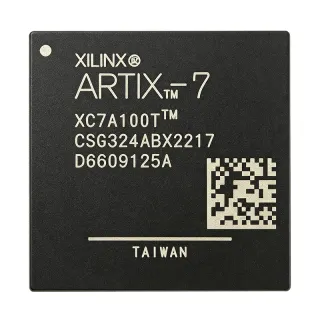
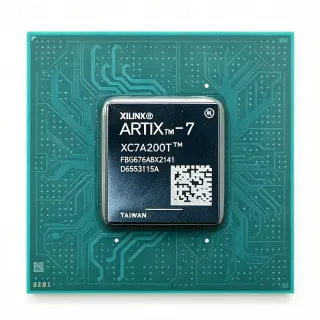
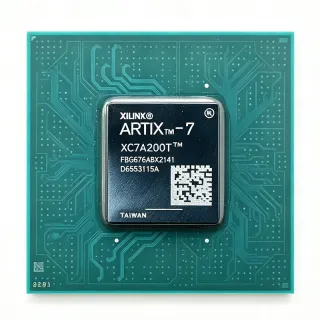
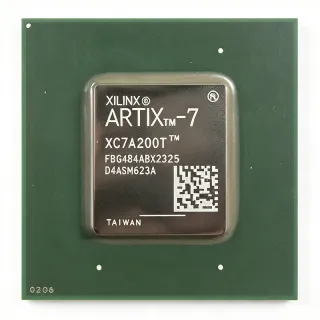
EPF6016AQC208-2 - FLEX 6000 16K Gates FPGA | Altera | PQFP-208
MPN: EPF6016AQC208-2 ✗ End of Life| Qty | Unit Price | Extended |
|---|---|---|
| 1 | $38.5 | $38.50 |
| 10 | $33.2 | $332.00 |
| 100 | $26.75 | $2,675.00 |
| 500 | $22.1 | $11,050.00 |
| 1,000 | $19.4 | $19,400.00 |
EPF6016AQC208-2 Overview
A Field Programmable Gate Array (FPGA) is a semiconductor integrated circuit whose logic functionality is defined by user-supplied SRAM configuration data rather than by hard-wired mask layers, placing it in the broader taxonomy of programmable logic devices (PLD) alongside CPLDs and SPLDs. FPGAs sit at the top of the programmable logic hierarchy, offering the highest logic density and richest I/O feature set at the cost of higher unit price and the need for an external configuration memory. The FLEX 6000 series in particular was Altera's mid-1990s cost-optimized family, positioned between the simpler MAX 7000 CPLDs and the higher-density FLEX 10K series, and was widely used in telecom glue logic, peripheral bridging, and industrial control boards.
Key features of the EPF6016AQC208-2 include a 132-LAB architecture with 10 Logic Elements per LAB, four embedded Logic Array Block inputs per LAB, fast continuous interconnect routing, multiVolt I/O supporting 5.0 V, 3.3 V, and 2.5 V interfacing, and in-system configurability through the IEEE 1149.1 JTAG interface. Each I/O pin includes a tri-state buffer with programmable slew-rate control and an optional pull-up resistor, simplifying board-level integration with mixed-voltage buses such as PCI, ISA, and 68xxx processor interfaces.
The device supports configuration via EPROM, microcontroller, or JTAG, with a dedicated configuration EPROM interface that allows automatic load on power-up. This makes the EPF6016AQC208-2 suitable for production volumes where a separate configuration memory is acceptable, while preserving the flexibility of field upgrades via JTAG. The 208-pin PQFP (also referenced as BFQFP) provides 171 usable I/O pins with seven dedicated inputs (CLK, OE, CONFIG_DONE, nSTATUS, nCONFIG, MSEL, JTAG pins).
Typical applications include peripheral bridging (PCI to local bus glue), industrial control and instrumentation front-ends, telecommunications line cards, factory automation backplanes, and legacy embedded system upgrades. The wide I/O voltage tolerance (5 V tolerant inputs on a 3.3 V core) allows direct connection to legacy 5 V microprocessors without external level shifters.
When designing with this part, note that the EPF6016AQC208-2 is now NRND/EOL — supply is limited to remaining distributor inventory, and the 208-pin PQFP package requires substantial PCB area (approximately 30 × 30 mm). New designs should target Altera/Intel MAX II, MAX V, or Cyclone IV E as modern replacements, accepting that footprint migration is mandatory.
This page synthesizes verified distributor pricing, same-family Intel/Altera drop-in alternatives, and practical design notes not found in a single manufacturer document, sourced from DigiKey, Mouser, Octopart, and FPGAkey.
Drop-in alternatives for EPF6016AQC208-2 — same package, pin-to-pin compatible. Different-package parts requiring PCB rework are excluded.
Variants in this series
Same-series models that are drop-in compatible with EPF6016AQC208-2 (same form factor and footprint) — differing in Package, Operating Temperature, Configuration Memory, Process Technology, Maximum Internal Frequency.
Quick Comparison Tool — Select alternative parts for side-by-side comparison:
EPF6016AQC208-3
✅ Drop-In ⚠️ 参数待验证✓ In Stock
$19.2 / Unit
View Datasheet →EPF6016AQC208-1
✅ Drop-In ⚠️ 参数待验证✓ In Stock
$42.1 / Unit
View Datasheet →EPF6016AQC208-2N
✅ Drop-In ⚠️ 参数待验证✓ In Stock
$13.85 / Unit
View Datasheet →EPF6024AQC208-3N
✅ Drop-In✓ In Stock
$23.9 / Unit
View Datasheet →EPF6010AQC208-3
✅ Drop-In ⚠️ 参数待验证📋 Reference alternative (not in catalog)
EPF6016AFC208-2
✅ Drop-In ⚠️ 参数待验证📋 Reference alternative (not in catalog)
EPF6016AQC208-2 Maximum Ratings & Electrical Characteristics
| Family | FLEX 6000 |
| Typical Gates | 16,000 |
| Logic Elements / Cells | 1,320 |
| Logic Array Blocks (LABs) | 132 |
| User I/Os | 171 |
| Maximum Internal Frequency | 166.67 MHz |
| Process Technology | 0.42 µm CMOS |
| Core Supply Voltage | 3.3 V |
| I/O Voltage Tolerance | 5.0 V / 3.3 V / 2.5 V (multiVolt I/O) |
| Configuration Method | SRAM, JTAG, EPROM, microcontroller |
| Package | 208-pin PQFP / BFQFP (also called 208-Pin Plastic Quad Flat Pack) |
| Mounting Type | Surface Mount |
| Operating Temperature | 0 °C to +85 °C (commercial) |
EPF6016AQC208-2 Pin Configuration
| Pin 1 | I/O — User I/O pin (bank 1) |
| Pin 2 | I/O — User I/O pin (bank 1) |
| Pin 3 | I/O — User I/O pin (bank 1) |
| Pin 4 | VCCIO1 — I/O bank 1 supply (3.3 V or 2.5 V) |
| Pin 5 | I/O — User I/O pin (bank 1) |
| Pin 6 | I/O — User I/O pin (bank 1) |
| Pin 7 | I/O — User I/O pin (bank 1) |
| Pin 8 | GND — Ground |
| Pin 9 | I/O — User I/O pin (bank 1) |
| Pin 10 | I/O — User I/O pin (bank 1) |
| Pin 11 | I/O — User I/O pin (bank 1) |
| Pin 12 | VCCINT — Core supply (3.3 V) |
| Pin 13 | I/O — User I/O pin (bank 1) |
| Pin 14 | I/O — User I/O pin (bank 1) |
| Pin 15 | I/O — User I/O pin (bank 1) |
| Pin 16 | GND — Ground |
| Pin 17 | I/O — User I/O pin (bank 1) |
| Pin 18 | I/O — User I/O pin (bank 1) |
| Pin 19 | I/O — User I/O pin (bank 1) |
| Pin 20 | VCCIO1 — I/O bank 1 supply (3.3 V or 2.5 V) |
Typical Applications
EPF6016AQC208-2 is suitable for 6 applications: PCI / ISA Peripheral Bridging Glue Logic, Telecommunications Line-Card Glue Logic, Industrial Control and Factory Automation Backplanes, Legacy Embedded System Upgrades, Test and Measurement Instrumentation Front-Ends, Display and Video Interface Bridging.
PCI / ISA Peripheral Bridging Glue Logic
The EPF6016AQC208-2 is well suited to PCI-to-local-bus glue logic and ISA bus bridge designs in industrial single-board computers, where its 1,320 logic cells provide enough capacity for state-machine bus arbitration, address decoding, and interrupt steering. The multiVolt I/O allows direct 5 V PCI signaling on a 3.3 V core, eliminating external level shifters; engineers typically instantiate 4-6 PCI-compliant bus interfaces plus 32-bit address decode. The 166.67 MHz Fmax on internal logic comfortably handles 33 MHz PCI with margin.
Recommended
Telecommunications Line-Card Glue Logic
Telecommunications line cards frequently used the EPF6016AQC208-2 for TDM bus steering, framer-side state machines, and backplane glue between DSP and ASIC chipsets. The 171 user I/Os easily accommodate 32-bit H.110/H.100 CT-bus plus SPI/I2C management interfaces, and the JTAG-based in-system programming lets carriers upgrade line-card firmware in the field without depopulation. The PQFP-208 footprint was standard on CompactPCI and VME line-card designs in the late 1990s and early 2000s.
Recommended
Industrial Control and Factory Automation Backplanes
In factory-automation backplanes, the EPF6016AQC208-2 was a workhorse glue-logic device, implementing encoder/decoder interfaces, motor-control timing, and CAN/Profibus bus adapters between microcontrollers and discrete power devices. The commercial 0-85 °C operating range and 5 V-tolerant I/O allow direct connection to legacy PLC I/O racks, while the 208-pin PQFP footprint survives wave-solder and industrial conformal-coating processes. Many 1990s-vintage PLC platforms still rely on EPF6016AQC208-2 for spare-part replacement.
Recommended
Legacy Embedded System Upgrades
OEMs designing upgrade boards for VME, cPCI, and proprietary 68000/PowerPC-based systems frequently reach for the EPF6016AQC208-2 as a pin-compatible logic replacement, because the part can emulate legacy discrete PAL/GAL glue logic and unbuffered address decoders in a single device while presenting the same I/O voltages. With 1,320 logic cells, designers typically replace 8-12 discrete 22V10 PALs, dramatically simplifying the BOM. Bitstream compatibility with the -1 and -3 speed grades also eases inventory management.
Recommended
Test and Measurement Instrumentation Front-Ends
Test equipment manufacturers used the EPF6016AQC208-2 in front-end digitizer boards and pattern-generator cards, where the 5 V tolerant I/O interfaces directly to ECL/TTL comparators and the 166.67 MHz Fmax is sufficient for 100 MHz-class timing generators. The 132 LABs give plenty of headroom for custom trigger sequencing, time-interpolation, and statistical accumulators. JTAG access also enables at-speed board-test via boundary-scan, which is critical for ATE fixture cost reduction.
Recommended
Display and Video Interface Bridging
The EPF6016AQC208-2 was a popular bridge between microcontrollers and flat-panel display controllers, providing TMDS-like parallel RGB timing generation, frame-rate conversion, and color-space transformation glue. The 171 user I/Os accommodate 24-bit color plus control signals, and the multiVolt I/O supports both 5 V TTL panel interfaces and 3.3 V LVTTL flat-panel links. Designers often pair it with an external video DAC for analog VGA output from embedded processors.
Recommended
Recommended Products Summary
Engineering reference data for EPF6016AQC208-2 — comparison, design guidance, and compliance information.
Selection Guide
Comparison with Alternatives
| Parameter | This Product | EPF6016AQC208-3 | EPF6016AQC208-1 | EPF6016AQC208-2N | EPF6024AQC208-3N | EPF6016AFC208-2 |
|---|---|---|---|---|---|---|
| Package | 208-pin PQFP (BFQFP) | 208-pin PQFP - same | 208-pin PQFP - same | 208-pin PQFP - same | 208-pin PQFP - same | 208-pin PQFP - same |
| Brand | Altera (Intel) | Altera (Intel) | Altera (Intel) | Altera (Intel) | Altera (Intel) | Altera (Intel) |
| Family | FLEX 6000 | FLEX 6000 | FLEX 6000 | FLEX 6000 | FLEX 6000 | FLEX 6000 |
| Logic Cells | 1,320 | 1,320 | 1,320 | 1,320 | 1,980 | 1,320 |
| Typical Gates | 16,000 | 16,000 | 16,000 | 16,000 | 24,000 | 16,000 |
| Speed Grade | -2 (mid) | -3 (fastest) | -1 (slowest) | -2 (mid, Pb-free) | -3 (fastest) | -2 (industrial temp) |
| User I/Os | 171 | 171 | 171 | 171 | 171 | 171 |
| Core Voltage | 3.3 V | 3.3 V | 3.3 V | 3.3 V | 3.3 V | 3.3 V |
| Operating Temperature | 0 °C to +85 °C (commercial) | 0 °C to +85 °C | 0 °C to +85 °C | 0 °C to +85 °C | 0 °C to +85 °C | -40 °C to +85 °C (industrial) |
Key Differentiators
- Speed grade -2 mid-bandwidth position (vs EPF6016AQC208-1 and EPF6016AQC208-3)
- Highest gate count within FLEX 6000 PQFP-208 family at -2 speed (vs EPF6010AQC208-3)
- Broad tooling and design-support legacy (vs Modern Cyclone IV E or MAX V replacements)
Design Notes
Estimated: at 166.67 MHz with all 171 I/Os toggling at 25 MHz (5 pF load, 3.3 V VCCIO), the EPF6016AQC208-2 core plus I/O power is approximately 0.6-1.2 W. Designers should provide a 4-layer PCB with dedicated 3.3 V planes and bulk-decoupling of 100 µF + 10 µF tantalum + 0.1 µF ceramic per VCCIO bank. Power sequencing between VCCINT and VCCIO must follow Altera's FLEX 6000 datasheet guidance to avoid I/O latch-up at hot-plug events.
The 208-pin PQFP has 0.5 mm pitch leads and a 30 × 30 mm body, requiring a PCB land pattern of roughly 28 × 28 mm with exposed pads under the package body for thermal dissipation. Solder paste should be type 3 or finer; reflow peak must stay below 245 °C to avoid package warping. All I/O banks should have their own VCCIO plane island so that mixed-voltage designs (3.3 V core + 5 V tolerant inputs) can place 5 V inputs adjacent to 3.3 V outputs without contention.
Critical: (1) The EPF6016AQC208-2 is NRND — do not use it for new designs unless your product is a legacy spare-part replacement with a published end-of-life plan. (2) Configuration memory must be supplied on every power-up; an external EPC1/EPC2 EPROM or a microcontroller bitstream source is mandatory because SRAM-based FPGAs lose configuration on power-cycle. (3) Do not mix the -1, -2, and -3 speed-grade bitstreams — each speed grade has its own configuration file generated by Quartus.
MultiVolt I/O supports 5 V inputs on a 3.3 V VCCIO bank, but 5 V outputs are not possible from a 3.3 V bank. If your design needs 5 V outputs, you must place them in a separate I/O bank with VCCIO = 5 V. Slew-rate control should be enabled for clock and edge-sensitive signals; PCI-compliant designs must set the PCI-compatible bit in the Quartus fitter settings to meet PCI electrical specifications.
Estimated: the 208-pin PQFP has a θJA of approximately 35-40 °C/W in still air (per generic PQFP-208 thermal data). At 1 W dissipation this yields a 35-40 °C rise above ambient, so industrial-temperature applications with EPF6016AFC208-2 (industrial grade) at +85 °C ambient must keep dissipation below ~0.6 W or attach a small heatsink. Provide at least 1 square inch of unbroken copper pour under the package for heat spreading.
Compliance Information
RoHS / REACH / lead-free status not stated in verified distributor snippets. The 'N' suffix variants (e.g. EPF6016AQC208-2N) indicate lead-free terminal finish per Altera naming convention, but formal RoHS compliance certificates are not included in the verified data.