TPD3S714AQRVCRQ1 - Automotive USB 2.0 Protection IC | TI
MPN: TPD3S714AQRVCRQ1 ✓ Active| Qty | Unit Price | Extended |
|---|---|---|
| 1 | $0.89 | $0.89 |
| 10 | $0.85 | $8.50 |
| 100 | $0.8 | $80.00 |
| 500 | $0.76 | $380.00 |
| 1,000 | $0.71 | $710.00 |
TPD3S714AQRVCRQ1 Overview
An interface protection IC is a power-management and surge-suppression device that sits between a host controller and an external connector, guarding both the power rail and the high-speed data pins against fault conditions. Within the system hierarchy it belongs to the broader families of surge suppression ICs, circuit protection devices, and power management ICs. In automotive USB systems, connector pins are exposed to shorts to the 12-V battery rail, shorts to ground, load-dump transients, and electrostatic discharge, all of which can destroy unprotected transceivers.
The TPD3S714-Q1 family integrates a current-limited VBUS power switch with short-to-battery and short-to-ground fault response, together with integrated data-line switches that provide best-in-class bandwidth for minimal signal degradation during USB short-to-battery events. The high-bandwidth data switches isolate the USB 2.0 D+/D- lines at fault detection, protecting the downstream transceiver while preserving signal integrity during normal full-speed and high-speed operation.
According to the TI datasheet, the device is a single-chip solution for automotive USB hubs, head units, rear-seat entertainment, telematics, and media interface applications. Single-chip integration of the VBUS FET, data switches, and fault-control logic reduces BOM count versus discrete TVS, FET, and controller solutions, and the integrated solution reduces the protection response time relative to external discrete implementations.
Typical applications include automotive USB charging ports and hubs, infotainment head units, rear-seat charging modules, and telematics control units where USB connectors face harsh fault environments.
Design consideration: confirm the VBUS current-limit setting and fault flag behavior against the host controller power-sequencing requirements, and provide solid ground pours under the WQFN exposed pad for thermal and ESD performance.
This page adds distributor pricing, drop-in family alternatives, design notes, and comparison data beyond the manufacturer datasheet.
Drop-in alternatives for TPD3S714AQRVCRQ1 — same package, pin-to-pin compatible. Different-package parts requiring PCB rework are excluded.
Variants in this series
Same-series models that are drop-in compatible with TPD3S714AQRVCRQ1 (same form factor and footprint) — differing in Function, Package.
Quick Comparison Tool — Select alternative parts for side-by-side comparison:
TPD3S713AQRVCRQ1
✅ Drop-In ⚠️ 参数待验证✓ In Stock
Contact for price
View Datasheet →TPD3S714AQRVCRQ1 Specifications
| Function | USB 2.0 interface protection (short-to-battery, short-circuit, ESD) |
| Data Line Bandwidth | USB 2.0 high-speed (integrated data switches) |
| Output Voltage (VBUS switch) | 5.25 V |
| Output Current (VBUS switch) | 500 mA |
| Protection Features | Short-to-battery, short-to-ground, overcurrent, ESD |
| ESD Protection | Integrated on VBUS and D+/D- data lines |
| Automotive Qualification | AEC-Q100 qualified |
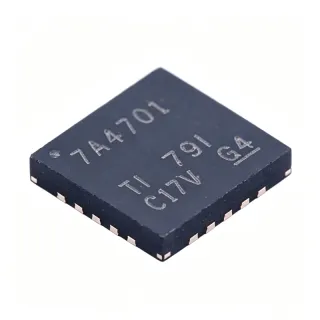
| Package | WQFN-16 (RVC) |
| Mounting Type | Surface Mount |
| RoHS Status | Compliant (per TI product page) |
| Applications | Automotive USB hubs, head units, rear-seat entertainment, telematics, media interface |
TPD3S714AQRVCRQ1 wqfn-16 (rvc) Pin Configuration Guide
Pin configuration for TPD3S714AQRVCRQ1 (wqfn-16 (rvc) package). Pin numbering, functions, and connection diagrams are defined in the manufacturer datasheet. Refer to it for the exact footprint and soldering guidelines.

No detailed pinout data available for TPD3S714AQRVCRQ1.
Refer to the datasheet for full pin configuration.
Typical Applications
TPD3S714AQRVCRQ1 is suitable for 6 applications: Automotive USB Hubs, Infotainment Head Units, Rear-Seat Entertainment Systems, Telematics Control Units, Media Interface Modules, Automotive USB Charging Ports.
Automotive USB Hubs
The TPD3S714AQRVCRQ1 is purpose-built for automotive USB hub applications, where multiple downstream USB ports face high fault exposure. Its single-chip integration of VBUS short-to-battery protection (5.25 V, 500 mA current limit), short-to-ground response, and ESD protection on D+/D- eliminates the need for discrete FET, TVS, and controller combinations, reducing both BOM count and total protection response time. The integrated high-bandwidth data switches isolate the host transceiver during short-to-battery events while preserving USB 2.0 high-speed signal integrity in normal operation. Placed between the hub controller and each connector, the device keeps fault energy confined to the connector side; the 16-pin WQFN (RVC) package suits dense multi-port hub PCBs. AEC-Q100 qualification covers the automotive ambient range required in cabin and dashboard environments.
Recommended
Infotainment Head Units
In automotive head units, the user-facing USB connectors are exposed to battery shorts, grounded accessories, and repeated ESD strikes from consumer devices. The TPD3S714AQRVCRQ1 protects the media interface by combining a 500 mA current-limited VBUS switch (5.25 V output) with integrated data-line switches of best-in-class bandwidth, ensuring USB 2.0 media playback and smartphone connectivity continue without signal degradation. Because data switches isolate the host SoC during short-to-battery events, the infotainment processor survives faults that would otherwise destroy unprotected PHY pins. The AEC-Q100 qualification and automotive 'A' grade address the reliability requirements of always-powered cabin electronics, while the compact WQFN-16 (RVC) footprint fits the crowded boards typical of head-unit designs. Fault flags support host-side diagnostics for service interfaces.
Recommended
Rear-Seat Entertainment Systems
Rear-seat USB ports are frequently abused by passengers: connectors get jammed with foreign objects, cables short against seat frames, and devices are plugged in while wet. The TPD3S714AQRVCRQ1 is explicitly listed by TI for rear-seat entertainment applications. Its short-to-battery and short-to-ground protection reacts faster than host software current monitoring, and the 500 mA VBUS current limit prevents connector overheating during sustained faults. The integrated data switches preserve USB 2.0 video and audio streaming bandwidth between rear-seat displays and the media source. Integration in one AEC-Q100 WQFN-16 (RVC) package reduces the per-port solution area, which matters when a vehicle carries four to six USB ports. Estimated benefit: a discrete FET-plus-TVS-plus-controller chain is replaced by one IC, cutting board area and assembly cost per port.
Recommended
Telematics Control Units
Telematics control units (TCUs) use USB interfaces for diagnostics, firmware updates, and connectivity modules, and they must survive workshop environments where probe shorts and battery-contact events are common. The TPD3S714AQRVCRQ1 provides the required single-chip short-to-battery, short-circuit, and ESD protection with AEC-Q100 qualification, keeping the TCU processor and USB PHY isolated during fault events on the diagnostic connector. The 5.25 V, 500 mA VBUS switch supports standard USB device powering for dongles and diagnostic adapters, and the high-bandwidth data switches maintain USB 2.0 timing margins for reliable firmware flashing sessions. The WQFN-16 (RVC) package and integrated fault-reporting behavior support the compact, serviceable architectures typical of telematics hardware deployed in vehicles for 10+ year lifetimes.
Recommended
Media Interface Modules
Automotive media interface modules concentrate USB, AUX, and charging connectors in armrests and center consoles, environments with high ESD incidence and mechanical abuse. The TPD3S714AQRVCRQ1 serves as the USB port guardian: its integrated VBUS switch limits output to 5.25 V and 500 mA, its data switches isolate the host during short-to-battery faults, and its ESD structures absorb connector transients. TI's datasheet specifically names media interface applications alongside hubs and head units. Because protection is fully integrated, response time is deterministic - a key advantage over discrete solutions where controller propagation plus external FET switching adds delay. The AEC-Q100 qualification covers the -40C to +85C cabin-adjacent ambient, and the 16-pin WQFN (RVC) package enables compact port-distribution boards placed close to the connector cluster for maximum protection effectiveness.
Recommended
Automotive USB Charging Ports
USB charging ports in vehicles require robust overcurrent and short-circuit protection because cables and connectors endure heavy mechanical stress. The TPD3S714AQRVCRQ1 provides a 500 mA current-limited 5.25 V VBUS switch with short-to-battery and short-to-ground fault response, satisfying the protection needs of standard USB 2.0-class charging ports. Its integrated ESD structures protect the data pins used by smart-charging handshakes. For standard-current ports the device operates as the complete port-protection stage; for higher-current BC1.2 profiles, pair it with the host controller's port-power policy or select a higher-current TI power switch, since the verified output current is 500 mA. The AEC-Q100 WQFN-16 (RVC) package and single-chip integration reduce per-port BOM cost and board area in multi-port charging modules installed across the vehicle cabin.
Recommended
Recommended Products Summary
Engineering reference data for TPD3S714AQRVCRQ1 — comparison, design guidance, and compliance information.
Selection Guide
Comparison with Alternatives
| Parameter | This Product | TPD3S713AQRVCRQ1 | TPD3S714QDBQRQ1 |
|---|---|---|---|
| Package | WQFN-16 (RVC) | WQFN-16 (RVC) - same footprint family | SSOP-16 (DBQ) - same function, different package |
| Brand | Texas Instruments | Texas Instruments | Texas Instruments |
| Automotive Qualification | AEC-Q100 (Q1) | AEC-Q100 (Q1) | AEC-Q100 (Q1) |
| Drop-in Compatible | - | Same footprint family - verify pinout | No - requires new PCB layout |
Key Differentiators
- Single-chip integration of VBUS and data-line protection (vs TPD3S713AQRVCRQ1)
- Automotive extended-grade WQFN package option (vs TPD3S714QDBQRQ1)
- Signal integrity preserved during faults (vs Discrete TVS + FET solutions)
Design Notes
Place the TPD3S714AQRVCRQ1 as close to the USB connector as possible so that short-to-battery and short-to-ground faults are interrupted before energy propagates to the host board. Solder the WQFN-16 (RVC) exposed pad to a solid ground pour with an array of thermal vias; this provides both heat dissipation for the VBUS FET during fault events and a low-impedance return path for ESD currents. Route D+/D- as a matched 90-ohm differential pair through the integrated data switches to preserve USB 2.0 high-speed eye margins.
The VBUS switch is rated for 5.25 V output at 500 mA per verified data. Ensure the upstream 5V rail (typically from a buck converter off the 12V battery) is regulated and transient-protected before the TPD3S714 input; automotive load-dump transients must be clamped upstream. Size input and output capacitors per the TI datasheet typical application to prevent nuisance tripping during inrush when capacitive loads (phones, dongles) connect.
Do not assume the TPD3S713AQRVCRQ1 is pin-identical without checking both datasheets: TI notes that some newer family versions have the same functionality with a different pin-out. Also do not substitute the SSOP-16 (DBQ) package variant TPD3S714QDBQRQ1 onto an RVC footprint - the packages are mechanically and electrically incompatible despite identical silicon function. Verify the 500 mA current limit matches the intended USB port power class before finalizing the design.
Compliance Information
AEC-Q100 qualification indicated by the -Q1 suffix per TI product page. RoHS compliance per TI product page. REACH, halogen-free, and conflict-minerals status should be confirmed via TI product documentation.