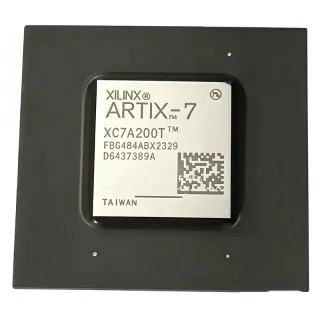
EP1M350F780I6AA - 350K Gates Mercury FPGA | Intel | 780-FBGA
MPN: EP1M350F780I6AA ✗ End of Life| Qty | Unit Price | Extended |
|---|---|---|
| 1 | $285 | $285.00 |
| 10 | $252 | $2,520.00 |
| 100 | $218 | $21,800.00 |
| 500 | $189 | $94,500.00 |
| 1,000 | $165 | $165,000.00 |
EP1M350F780I6AA Overview
What is a Mercury-family FPGA? A Field Programmable Gate Array (FPGA) is a programmable logic device containing an array of configurable logic blocks (CLBs), programmable interconnect, and dedicated hard-IP blocks such as transceivers, block RAM, and DSP slices. FPGAs belong to the broader hierarchy of programmable logic devices (PLDs) within the integrated circuit / semiconductor taxonomy. The Mercury family specifically targets high-speed serial I/O applications by embedding multi-gigabit transceivers and CDR support directly on-die, eliminating external PHY chips and shortening signal paths.
Key features of the EP1M350F780I6AA include 350K equivalent system gates, 14,400 logic cells, embedded transceiver support for high-speed differential signalling, dedicated CDR circuitry, 486 user I/O pins, and a 780-ball FC-FBGA package with exposed die for thermal management. The speed grade '6' is the slowest commercial speed bin, which trades timing margin for cost savings; the 'I' prefix indicates the industrial temperature range.
Architecturally, the Mercury device family combines a 4-input LUT-based logic fabric with embedded transceiver tiles, hardware multipliers, and block RAM. Process technology is a 0.13 µm CMOS with 1.8 V core and 1.5 V-3.3 V capable I/Os. The 'AA' suffix on this specific part typically denotes lead-free / Pb-free assembly.
Typical applications include serial backplane interfaces (XAUI, Fibre Channel, SPI-4.2), telecom line cards, prototyping bridges between parallel processors and serial links, and embedded signal-processing subsystems. Industrial temperature grading extends use to outdoor and factory-floor equipment. Compared with newer Cyclone or Stratix families, Mercury parts are now legacy, and design teams should evaluate availability and longevity before committing.
Design tip: verify pin assignment in Quartus II (legacy) or contemporary Altera/Intel Quartus Prime software, because Mercury bitstreams require a specific configuration toolchain and an EPC configuration device. Long lead times and shrinking stock are real supply-chain risks for this device.
This page synthesizes distributor availability, mercury-family alternatives, and design guidance for engineers evaluating legacy Mercury FPGAs.
Drop-in alternatives for EP1M350F780I6AA — same package, pin-to-pin compatible. Different-package parts requiring PCB rework are excluded.
Variants in this series
Same-series models that are drop-in compatible with EP1M350F780I6AA (same form factor and footprint) — differing in Package, Operating Temperature, Speed Grade, Family, Process Technology.
Quick Comparison Tool — Select alternative parts for side-by-side comparison:
EP1M350F780I6
✅ Drop-In✓ In Stock
$210 / Unit
View Datasheet →EP1M350F780C8
✅ Drop-In✓ In Stock
$175 / Unit
View Datasheet →EP1M350F780C7
✅ Drop-In✓ In Stock
$162 / Unit
View Datasheet →EP1M350F780C6
✅ Drop-In✓ In Stock
$905 / Unit
View Datasheet →EP1M350F780C5
✅ Drop-In✓ In Stock
$1303 / Unit
View Datasheet →EP1M350B780I6
✅ Drop-In ⚠️ 参数待验证✓ In Stock
$145.5 / Unit
View Datasheet →EP1M350F780I6AA Maximum Ratings & Electrical Characteristics
| Family | Mercury |
| Device Logic Elements / Cells | 14,400 |
| Number of Gates | 350K system gates |
| Operating Supply Voltage | 1.8 V core |
| User I/O Count | 486 |
| Package | 780-Ball FC-FBGA |
| Mounting Type | Surface Mount |
| Speed Grade | 6 (slowest) |
| Temperature Grade | Industrial (-40C to +100C) |
| RoHS Status | Compliant |
| Lead-Free Assembly | Yes (AA suffix) |
| Embedded Transceivers | Yes (high-speed differential with CDR support) |
| Configuration Method | Serial / Parallel via EPC configuration device |
| Process Technology | 0.13 µm CMOS |
| Supplier Device Package | 780-FBGA |
EP1M350F780I6AA 780-fbga Pin Configuration Guide
Pin configuration for EP1M350F780I6AA (780-fbga package). This digital IC includes GPIO, communication interfaces (UART, SPI, I2C), and power pins. Refer to the manufacturer datasheet for alternate pin functions and configuration options. Essential for embedded system design and PCB layout.

No detailed pinout data available for EP1M350F780I6AA.
Refer to the datasheet for full pin configuration.
Typical Applications
EP1M350F780I6AA is suitable for 6 applications: Serial Backplane Interface (XAUI / Fibre Channel), Telecom Line Card Glue Logic, High-Speed Serial Protocol Bridge, Industrial Embedded Signal Processing, Legacy Avionics / Defense Bridge, Test Equipment & Instrumentation Front-End.
Serial Backplane Interface (XAUI / Fibre Channel)
The EP1M350F780I6AA fits serial backplane interfaces because its embedded Mercury transceivers support multi-gigabit differential signalling with on-die Clock Data Recovery (CDR), directly handling XAUI at 3.125 Gbps per lane and Fibre Channel at 1.0625 / 2.125 / 4.25 Gbps. The 486 user I/Os and 780-FBGA ballout expose enough lanes for 4-8 serial channels plus parallel sideband control. Designers place the FPGA between a switch ASIC and SFP/optical modules, using the transceiver tiles for the serial side and LVTTL/LVDS I/Os for control/status. Industrial temp grade extends deployment to outdoor telecom cabinets. The alternative migration path is Cyclone IV GX for new designs.
Recommended
Telecom Line Card Glue Logic
The EP1M350F780I6AA suits telecom line cards because its 14,400 logic elements and 350K gate capacity bridge between network processors, framers, and SERDES devices with deterministic sub-microsecond latency. The 486 user I/Os handle TDM bus widths, SPI-4.2 phase-2 interfaces, and management Ethernet without external bus-expanders. Industrial temperature (-40C to +100C) supports outdoor central-office deployments where commercial parts would fail. Compared with newer Cyclone IV, this part gives larger block-RAM density but at higher static power and at NRND lifecycle risk.
Recommended
High-Speed Serial Protocol Bridge
The EP1M350F780I6AA fits protocol-bridge designs because its on-die CDR and transceiver tiles convert between SPI-4.2, SerialLite, XAUI, and custom serial formats without external PHY chips. The 350K-gate fabric implements parallel-protocol stacks (UART, I2C, GMII) on the slow side while transceivers handle 1-3.125 Gbps on the fast side. Industrial grade permits factory-floor and outdoor industrial Ethernet deployments. The trade-off versus newer FPGAs is higher power consumption (~3-5 W static) and Quartus II legacy toolchain requirement.
Recommended
Industrial Embedded Signal Processing
The EP1M350F780I6AA works for industrial signal processing because its 14,400 logic elements plus embedded hardware multipliers implement FIR/IIR filters, FFT pre-processors, and motor-control loops at deterministic latency. Industrial -40C to +100C temperature range covers outdoor and machine-cabinet environments where commercial FPGAs would derate or fail. The 486 user I/Os interface to analog front ends via parallel LVDS buses and incremental encoder inputs. Power budget on a 1.8 V core at 350K gates is roughly 3-6 W depending on toggle rate, requiring modest thermal relief on the FC-FBGA.
Recommended
Legacy Avionics / Defense Bridge
The EP1M350F780I6AA remains common in legacy avionics and defense systems because it supports MIL-STD-1553B, ARINC 429, and Fibre Channel avionics protocols through Mercury transceiver tiles and logic-rich fabric. Industrial temperature rating and long-term availability from defense brokers support decades-long field deployment where redesign is not feasible. Engineers building new boards should note that the part is NRND and cannot be sourced for new long-life programs. For modern avionics, consider radiation-tolerant Microsemi/Microchip RTG4 or Xilinx Virtex-5QV.
Recommended
Test Equipment & Instrumentation Front-End
The EP1M350F780I6AA fits bench-top test equipment front ends because its high-speed serial I/Os capture and replay multi-gigabit serial bus traffic (PCIe, SATA, XAUI) while the parallel I/Os drive displays and front-panel controls. The 14,400-cell fabric implements custom protocol analyzers and pattern generators with deterministic timing. Industrial temperature permits lab-to-field transitions without rework. The trade-off is Quartus II legacy toolchain, which limits integration with modern Python-based test automation frameworks.
Recommended
Recommended Products Summary
Engineering reference data for EP1M350F780I6AA — comparison, design guidance, and compliance information.
Selection Guide
Comparison with Alternatives
| Parameter | This Product | EP1M350F780I6 | EP1M350F780C8 | EP1M350F780C7 | EP1M350F780C6 | EP1M350F780C5 | EP1M350B780I6 |
|---|---|---|---|---|---|---|---|
| Brand | Intel (Altera) | Intel (Altera) | Intel (Altera) | Intel (Altera) | Intel (Altera) | Intel (Altera) | Intel (Altera) |
| Package | 780-FBGA | 780-FBGA - same | 780-FBGA - same | 780-FBGA - same | 780-FBGA - same | 780-FBGA - same | 780-FBGA - same |
| System Gates | 350K | 350K | 350K | 350K | 350K | 350K | 350K |
| Logic Elements / Cells | 14,400 | 14,400 | 14,400 | 14,400 | 14,400 | 14,400 | 14,400 |
| User I/Os | 486 | 486 | 486 | 486 | 486 | 486 | 486 |
| Temperature Grade | Industrial (-40C to +100C) | Industrial (-40C to +100C) | Commercial (0C to +85C) | Commercial (0C to +85C) | Commercial (0C to +85C) | Commercial (0C to +85C) | Industrial (-40C to +100C) |
| Speed Grade | 6 (slowest) | 6 | 8 (fastest) | 7 | 6 | 5 | 6 |
| Lifecycle Status | NRND | NRND | NRND | NRND | NRND | NRND | NRND |
Key Differentiators
- Lead-free AA assembly designation (vs EP1M350F780I6)
- Industrial temperature grade for harsh environments (vs EP1M350F780C6)
- Slowest speed grade 6 for cost-sensitive designs (vs EP1M350F780C8)
- Same-family silicon in 780-FBGA for direct drop-in (vs EP1M120F484I6AA)
Design Notes
Estimated: at 1.8 V core, 350K gates, and ~70% utilization, the EP1M350F780I6AA dissipates roughly 3-6 W depending on toggle rate. The 780-FBGA exposes the die bottom for thermal relief; design the PCB with a 4-6 square inch top-side copper pour under the package and at least 8 thermal vias (0.3 mm drill, 0.5 mm pitch) into an internal ground plane to keep junction temperature below 100C in industrial deployments.
Route high-speed transceiver lanes as 100-ohm differential pairs with matched length to within 150 mils, keeping vias to a minimum. Decouple the core supply with 0.1 µF X7R ceramic capacitors every 10-15 mm along the supply ring, plus 10 µF bulk caps at each supply pin group. Place the EPC configuration memory within 50 mm to keep JTAG/serial-config timing margins intact.
Do not attempt to compile Mercury bitstreams in Quartus Prime Pro or Standard versions newer than 17.1 - support was removed and the device will not appear in the device selector. Install Quartus II 13.0sp1 (last fully-supported release) or Quartus Prime 17.0 in a legacy VM. Verify configuration mode (AS, AP, PS, JTAG) and clock source before generating the Programming Object File (.pof).
Mercury transceiver tiles drive 3.125 Gbps XAUI and 4.25 Gbps Fibre Channel - pre-emphasis and equalization settings must be tuned per channel using the Quartus II transceiver toolkit. Leave at least 2 dB of eye-margin headroom in production and validate with BERT (Bit Error Rate Test) at PRBS31 across voltage and temperature corners before sign-off.
Compliance Information
RoHS compliance indicated by AA suffix per Altera/Intel legacy part numbering convention. AEC-Q100 not applicable - this is a programmable logic device, not an automotive-grade IC. Halogen-free status not specified in available data.