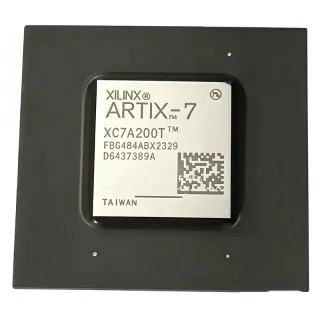
EP20K600EFC672-3 - APEX 20KE 600K Gate FPGA | Intel | 672-BGA
MPN: EP20K600EFC672-3 ⚠ Last Time Buy| Qty | Unit Price | Extended |
|---|---|---|
| 1 | $485 | $485.00 |
| 10 | $462 | $4,620.00 |
| 100 | $425 | $42,500.00 |
| 500 | $388 | $194,000.00 |
| 1,000 | $355 | $355,000.00 |
EP20K600EFC672-3 Overview
A Field-Programmable Gate Array (FPGA) is a type of programmable logic device (PLD) that combines configurable logic blocks, programmable interconnect, and embedded memory arrays on a single die, allowing engineers to implement custom digital circuits, glue logic, datapath pipelines, and bus interfaces without fabricating a custom ASIC. FPGAs sit hierarchically under the broader category of programmable logic, alongside CPLDs (Complex Programmable Logic Devices), and form a foundational tier of digital semiconductors used in networking, telecom, video processing, and embedded computing.
Key features of the EP20K600EFC672-3 include 488 maximum user I/Os (508 in the BGA-672 pinout variant), 311,296 embedded memory bits distributed across embedded array blocks (EABs), built-in LVDS and high-speed I/O support, in-system programmability via the IEEE 1149.1 JTAG interface, and per-pin series/parallel termination options. The device also integrates dedicated clock-management circuitry including phase-locked loops (PLLs) for skew control and frequency synthesis, which is essential for high-speed synchronous designs.
Architecturally the APEX 20KE family combines a fine-grained logic-element fabric with MegaLAB structures grouping multiple logic array blocks (LABs) and one EAB, allowing designers to trade logic density against embedded memory on a per-region basis. This hybrid architecture targets System-on-a-Programmable-Chip (SOPC) designs that mix wide datapaths with moderate-sized FIFO or ROM/RAM blocks.
Typical applications include high-speed telecommunications backplanes, network switches and routers, digital video broadcast equipment, image processing pipelines, and PCI/PCI-X bus bridge interfaces. Its 488 I/O count also suits parallel ASIC prototyping where many channels must be brought off-chip simultaneously. The commercial 0 °C to 85 °C operating range covers office and lab environments rather than industrial or automotive deployments.
When designing with the EP20K600EFC672-3, engineers should plan power distribution carefully because 488 I/Os switching simultaneously can demand multi-ampere core and I/O rails; a multi-layer PCB with dedicated ground planes and adequate bulk decoupling is mandatory. Designers should also evaluate migration to the Cyclone or Stratix families for new designs, since the APEX 20KE is no longer recommended for new projects.
This page synthesizes distributor pricing, drop-in pin-compatible alternatives within the APEX 20KE family, and practical design notes not consolidated on the manufacturer datasheet.
Drop-in alternatives for EP20K600EFC672-3 — same package, pin-to-pin compatible. Different-package parts requiring PCB rework are excluded.
Variants in this series
Same-series models that are drop-in compatible with EP20K600EFC672-3 (same form factor and footprint) — differing in Operating Temperature, RoHS Status, Package, Speed Grade, Process Technology.
Quick Comparison Tool — Select alternative parts for side-by-side comparison:
EP20K600EFC672-2N
✅ Drop-In✓ In Stock
$158 / Unit
View Datasheet →EP20K600EFC672-2X
✅ Drop-In✓ In Stock
$115 / Unit
View Datasheet →EP20K600EFC672-2N
✅ Drop-In✓ In Stock
$158 / Unit
View Datasheet →EP20K600EFC672-1X
✅ Drop-In✓ In Stock
$980 / Unit
View Datasheet →EP20K600EFC672-1XN
✅ Drop-In✓ In Stock
$285 / Unit
View Datasheet →EP20K600EFC672-3 Maximum Ratings & Electrical Characteristics
| Family | APEX 20KE |
| Device Type | FPGA - Field Programmable Gate Array |
| Maximum System Gates | 600,000 |
| Logic Elements | 24,320 |
| Embedded Memory Bits | 311,296 bits |
| Maximum User I/Os | 488 |
| Package | 672-pin FineLine BGA (FC-FBGA), 27 x 27 mm |
| Operating Temperature | 0 °C to +85 °C (commercial) |
| Core Supply Voltage | 1.71 V to 1.89 V |
| Process Technology | 0.15 µm all-layer copper CMOS |
| Maximum Operating Frequency | 182 MHz |
| Propagation Delay | 1.48 ns |
| Speed Grade | -3 |
| Programmable Interface | IEEE 1149.1 JTAG, in-system programmable |
| RoHS Status | Compliant (ROHS3 per distributor data) |
| Mounting Type | Surface Mount |
EP20K600EFC672-3 672-pin fineline bga (fc-fbga), 27 x 27 mm Pin Configuration Guide
Pin configuration for EP20K600EFC672-3 (672-pin fineline bga (fc-fbga), 27 x 27 mm package). This digital IC includes GPIO, communication interfaces (UART, SPI, I2C), and power pins. Refer to the manufacturer datasheet for alternate pin functions and configuration options. Essential for embedded system design and PCB layout.

No detailed pinout data available for EP20K600EFC672-3.
Refer to the datasheet for full pin configuration.
Typical Applications
EP20K600EFC672-3 is suitable for 6 applications: Telecommunications Backplane Bridging, Network Switch and Router Line Cards, Digital Video Broadcast Equipment, Image Processing Pipelines, ASIC Prototyping Platforms, PCI / PCI-X Bus Bridge Interfaces.
Telecommunications Backplane Bridging
The EP20K600EFC672-3 is well suited for telecom backplane bridging where 488 user I/Os support wide parallel datapaths across multiple line cards. Its 182 MHz Fmax and 24,320 logic elements can implement custom bus bridges, channelized framers, and link-layer state machines. The 311,296 embedded memory bits back FIFO buffers and lookup tables, while JTAG enables in-system field updates. Design tip: route matched-length differential pairs to LVDS-capable pins to keep skew within the 1.48 ns propagation-delay budget across hot-spot timing paths.
Recommended
Network Switch and Router Line Cards
Used as the co-processor fabric on line cards for early-2000s enterprise switches, the EP20K600EFC672-3 can implement packet-classification engines, queue managers, and TCAM replacement logic alongside a network processor. The 600K system gates absorb non-trivial protocol stacks while 488 I/Os handle multi-gigabit SERDES companion glue. The 1.8 V core supply simplifies power tree design when paired with 3.3 V I/O ring for legacy PHY interfaces. Estimated: total IO toggle at 125 MHz on a 100 I/O bus draws roughly 1.5 A dynamic I/O current, plan bulk decoupling accordingly.
Recommended
Digital Video Broadcast Equipment
The EP20K600EFC672-3 fits MPEG-2 / SD-SDI / HD-SDI video processing boards where its 311,296 embedded memory bits back line buffers, motion-estimation RAMs, and FIFO pipelines. Its 182 MHz Fmax supports real-time SDI de-/re-embedding at 270 Mbps and HD-SDI at 1.485 Gbps when paired with an external serializer. The 672-ball FineLine BGA offers ample package-level routing density for the parallel video bus. Design tip: assign dedicated clock pins to BGA rows closest to the PLL to minimize clock-tree skew across the 488 I/O ring.
Recommended
Image Processing Pipelines
Industrial image processing pipelines benefit from the EP20K600EFC672-3's high logic count, 488 user I/Os for camera data ingestion, and embedded memory for line buffers. Designers can implement Sobel, Laplacian, and FFT cores in parallel within the 24,320 logic elements. The JTAG port allows rapid bitstream iteration during algorithm development. Trade-off: APEX 20KE lacks hard DSP blocks, so convolution and filtering are logic-intensive; an external DSP may be preferable for very high tap counts.
Recommended
ASIC Prototyping Platforms
With 600K system gates and 488 I/Os, the EP20K600EFC672-3 acts as a multi-chip ASIC prototyping substrate for pre-silicon validation of large SoCs. Engineers partition the design across two or three APEX 20KE devices, leveraging their fine-grained logic to model ASIC standard cells. The 1.27 mm BGA pitch simplifies BGA-to-QFP adapter board layout. The commercial temperature grade suits lab bring-up; for chamber testing choose an industrial-marked EP20K600EFI variant.
Recommended
PCI / PCI-X Bus Bridge Interfaces
The EP20K600EFC672-3 is a common PCI-X bridge fabric because its 488 I/Os expose the wide 64-bit, 66 MHz PCI-X bus alongside local memory and CPU-side glue. The 311 Kbit embedded memory supports transaction buffering, while 24,320 logic elements implement target and master state machines. The 1.8 V core / 3.3 V I/O capability matches legacy PCI signaling levels without level shifters. Trade-off: APEX 20KE predates PCIe hard cores, so PCIe designs require external PHY plus soft IP.
Recommended
Recommended Products Summary
Engineering reference data for EP20K600EFC672-3 — comparison, design guidance, and compliance information.
Selection Guide
Comparison with Alternatives
| Parameter | This Product | EP20K600EFC672-2 | EP20K600EFC672-2X | EP20K600EFC672-2N | EP20K600EFC672-1X | EP20K600EFC672-1XN |
|---|---|---|---|---|---|---|
| Brand | Intel | Intel | Intel | Intel | Intel | Intel |
| Package | 672-BBGA (27x27) | 672-BBGA (27x27) - same | 672-BBGA (27x27) - same | 672-BBGA (27x27) - same | 672-BBGA (27x27) - same | 672-BBGA (27x27) - same |
| Speed Grade | -3 | -2 | -2X | -2N | -1X | -1XN |
| System Gates | 600,000 | 600,000 | 600,000 | 600,000 | 600,000 | 600,000 |
| Logic Elements | 24,320 | 24,320 | 24,320 | 24,320 | 24,320 | 24,320 |
| User I/Os | 488 | 488 | 488 | 488 | 488 | 488 |
| Embedded Memory (bits) | 311,296 | 311,296 | 311,296 | 311,296 | 311,296 | 311,296 |
| Operating Temperature | 0 °C to +85 °C (commercial) | 0 °C to +85 °C (commercial) | Extended screening | 0 °C to +85 °C (commercial) | 0 °C to +85 °C (commercial) | 0 °C to +85 °C (commercial) |
Key Differentiators
- Fastest speed grade in the 672-BGA EP20K600E family (vs EP20K600EFC672-2)
- Pin-compatible drop-in alternative for speed-grade migration (vs EP20K600EFC672-1X)
- Highest logic density in the APEX 20KE 672-BGA product family (vs EP20K400EFC672-3)
Design Notes
The 488 I/O ring can demand multi-ampere supply current at high toggle rates. Provide at least 4 bulk capacitors (470 µF to 1000 µF) on each of VCCINT (1.8 V core) and VCCIO (3.3 V or 2.5 V I/O), distributed around the package perimeter. Estimated: 488 I/Os toggling at 100 MHz draw roughly 1.5 A dynamic current - actual value depends on loading and edge rate, so validate with the APEX 20KE PowerPlay early-estimation spreadsheet before board layout.
Use a minimum 6-layer PCB for the 672-ball FineLine BGA at 1.27 mm pitch. Escape the inner rows with micro-via-in-pad or 8-mil laser-drilled vias on a 1-2-1 stack-up. Match differential-pair lengths on LVDS and clock nets to within 50 mils to keep channel skew below the 1.48 ns propagation-delay budget. Assign dedicated ground planes directly under the BGA footprint to provide a low-impedance return path for the simultaneous-switching I/Os.
The APEX 20KE configuration bitstream is not compatible with Cyclone, Stratix, or Arria devices - migrating to a newer family requires full firmware re-synthesis. Do not assume JTAG chain compatibility with newer Altera tool versions; use Quartus II version 13.1 or earlier with the legacy MAX+PLUS II flow for APEX support. The MSL (Moisture Sensitivity Level) handling is critical: the 672-FBGA is moisture-sensitive and requires pre-bake before reflow.
Place the configuration PROM (EPC16 or EPC8) within 5 cm of the EP20K600EFC672-3 DATA0..DATA7 and DCLK pins. Use source-synchronous routing with matched length (±100 mils) on the configuration bus to avoid CRC errors during bitstream load. If using JTAG for in-system programming, place the JTAG header on the same board edge with ESD protection diodes on TCK, TMS, TDI, and TDO to prevent programming failures.
For SDR/DDR memory interfaces, use SSTL-2 Class-I signaling on byte lanes assigned to the EP20K600EFC672-3's matched-impedance I/O banks. Enable on-die termination (OCT) where available and place series resistors (22-33 ohm) within 200 mils of the FPGA pin to dampen reflections on the address/control bus. Apply length-matching rules separately to byte-lane groups to avoid setup/hold violations at 133 MHz DDR.
Compliance Information
ROHS3 compliant per Microchip USA distributor listing. REACH, halogen-free, and conflict-mineral status were not provided in verified web data - defaulting to 'unknown' per Data Authenticity Rule 14. Not AEC-Q100 qualified; the APEX 20KE family targets commercial telecom/datacom applications.